
June 2023 Paper 2 Q11
11 Two balls \(P\) and \(Q\) have masses \(0.6\,\mathrm{kg}\) and \(0.4\,\mathrm{kg}\) respectively. The balls are attached to the ends of a string. The string passes over a pulley which is fixed at the edge of a rough horizontal surface. Ball \(P\) is held at rest on the surface \(2\,\mathrm{m}\) from the pulley. Ball \(Q\) hangs vertically below the pulley. Ball \(Q\) is attached to a third ball \(R\) of mass \(m\,\mathrm{kg}\) by another string and \(R\) hangs vertically below \(Q\) (see diagram).
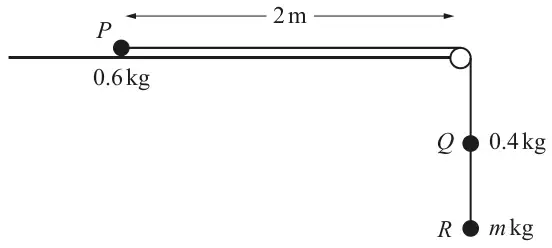
The system is released from rest with the strings taut. Ball \(P\) moves towards the pulley with acceleration \(3.5\,\mathrm{m\,s^{-2}}\) and a constant frictional force of magnitude \(4.5\,\mathrm{N}\) opposes the motion of \(P\).
The balls are modelled as particles, the pulley is modelled as being small and smooth, and the strings are modelled as being light and inextensible.
When the balls have been in motion for 0.4 seconds the string connecting \(Q\) and \(R\) breaks.
It is given that in fact ball \(P\) does reach the pulley.
| Scheme | Marks | AO |
|---|---|---|
| \(T_1 - 4.5 = 0.6(3.5)\) | M1 | 3.3 |
| \(T_1 = 6.6\ (\mathrm{N})\) | A1 | 1.1 |
| [2] |
Notes
M1: N2L for \(P\) – correct number of terms and dimensionally consistent – allow sign confusion
| Scheme | Marks | AO |
|---|---|---|
| For \(Q\): \(T_2 + 0.4g - T_1 = 0.4(3.5)\) For \(R\): \(mg - T_2 = m(3.5)\) | M1 M1 A1 | 3.3 3.3 1.1 |
| \(m = 0.648\) | A1 | 1.1 |
| [4] |
Notes
M1 for N2L for \(Q\) and M1 for N2L for \(R\) – correct number of terms and dimensionally consistent – allow sign confusion
Must be using \(a = 3.5\)
A1 for both correct (allow with their tension from (a))
Or (by considering \(Q\) and \(R\) together) \((0.4 + m)g - T_1 = (0.4 + m) \times 3.5\) scores M2 A1
A1: 3sf required (0.6476190…) \(\left(m = \tfrac{68}{105}\right)\)
| Scheme | Marks | AO |
|---|---|---|
| Before string breaks \(P\) moves \(0.5(3.5)(0.4)^2\ (= 0.28)\) | B1 | 3.4 |
| When string breaks the speed of \(P\) is \(3.5(0.4)\ (= 1.4)\) | B1 | 3.4 |
| For \(P\): \(T - 4.5 = 0.6a\) For \(Q\): \(0.4g - T = 0.4a\) | M1* A1 | 3.3 1.1 |
| When string breaks \(P\) travels a distance \(s\) where \(0 = 1.4^2 + 2(-0.58)s\) | M1dep* | 3.1b |
| Total distance is \(0.28 + 1.689\ldots = 1.9696\ldots \lt 2\) or Total distance is \(0.28 + 1.689\ldots = 1.9696\ldots\) so \(P\) does not reach the pulley | A1 | 2.2a |
| [6] |
Notes
B1: Correct (unsimplified) expression
B1: Correct (unsimplified) expression
M1*: M1 for attempt at N2L for both P and Q after string breaks – correct number of terms and dimensionally consistent- but allow sign confusion
For reference if solved correctly then \(a\) is \(-0.58\)
M1dep*: Use of \(v^2 = u^2 + 2as\) with \(v = 0\) and their values for \(u\) and \(a\)
M0 if \(a = 3.5\) used
For reference \(s = \tfrac{49}{29} = 1.689655\ldots\)
A1: AG
| Scheme | Marks | AO |
|---|---|---|
| Both \(P\) and the pulley are modelled as having negligible size rather than as objects with dimensions and therefore this could account for why \(P\) does reach the pulley See Appendix for some allowable responses Identifying a relevant factor is sufficient | B1 | 3.5a |
| [1] |
Notes
B1: An answer that refers to the dimensions of \(P\) and/or the pulley
If more than one factor given then B1 if all are acceptable, B0 if not.
Appendix
Exemplar responses for Q11(d)
| Response | Mark |
|---|---|
| Frictional force may not be constant | B1 |
| String not light | B1 |
| String not inextensible | B1 |
| String may be elastic | B1 |
| Elasticity | B1 |
| String may be extensible | B1 |
| Friction is constant | B1 |
| Friction (as a one word answer) | B1 |
| Surface being smooth | B0 |
| Air resistance | B0 |
| Particle may be smooth | B0 |
| Frictional force on pulley | B0 |