
June 2024 Unit 2 Q9
9. The diagram below shows an object \(A\), of mass \(2m\text{ kg}\), lying on a horizontal table. It is connected to another object \(B\), of mass \(m\text{ kg}\), by a light inextensible string, which passes over a smooth pulley \(P\), fixed at the edge of the table. Initially, object \(A\) is held at rest so that object \(B\) hangs freely with the string taut.
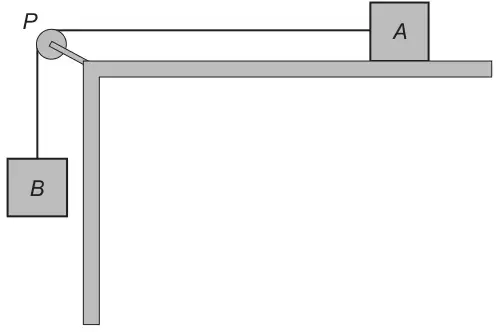
Object \(A\) is then released.
(a) When object \(B\) has moved downwards a vertical distance of \(0{\cdot}4\text{ m}\), its speed is \(1{\cdot}2\text{ ms}^{-1}\). Use a formula for motion in a straight line with constant acceleration to show that the magnitude of the acceleration of \(B\) is \(1{\cdot}8\text{ ms}^{-2}\). [2]
(b) During the motion, object \(A\) experiences a constant resistive force of \(22\text{ N}\). Find the value of \(m\) and hence determine the tension in the string. [6]
(c) What assumption did the word ‘inextensible’ in the description of the string enable you to make in your solution? [1]
| Scheme | Marks | Comments |
|---|---|---|
| \(v^2=u^2+2as\), with \(s=0{\cdot}4,\ u=0,\ v=1{\cdot}2\) \((1{\cdot}2)^2=(0)^2+2a(0{\cdot}4)\) \((1{\cdot}44=0{\cdot}8a)\) | M1 | Used, oe \(a=\frac{v^2-u^2}{2s}=\frac{(1\cdot2)^2-(0)^2}{2(0\cdot4)}\) |
| \(a=1{\cdot}8\) \((\text{ms}^{-2})\) | A1 | Convincing |
| [2] |
| Scheme | Marks | Comments |
|---|---|---|
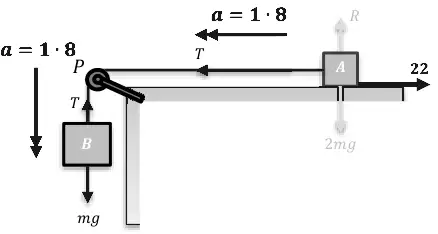
| Apply N2L to both \(A\) and \(B\) separately | M1 | At least one dimensionally correct equation \(T\) and \(mg/22\) opposing |
| \(A\colon\ \ T-22=2ma\) OR \(T-22=3{\cdot}6m\) | B1 | 1st correct equation |
| \(B\colon\ \ mg-T=ma\) OR \(9{\cdot}8m-T=1{\cdot}8m\) \(T=8m\) | A1 | 2nd correct equation |
| Eliminating \(T\) \(mg-22=3ma\) OR \(9{\cdot}8m-22=5{\cdot}4m\) | m1 | Attempted |
| \(m=5\) | A1 | cao |
| \(T=40\) (N) | A1 | cao |
| [6] |
| Scheme | Marks | Comments |
|---|---|---|
| Inextensible string enables me to assume that (the magnitude of) the acceleration of objects \(A\) and \(B\) is equal. | E1 | |
| [1] | ||
| Total for Question | 9 |