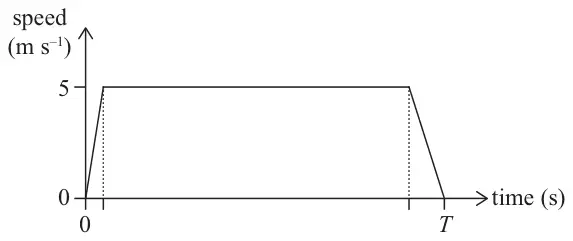
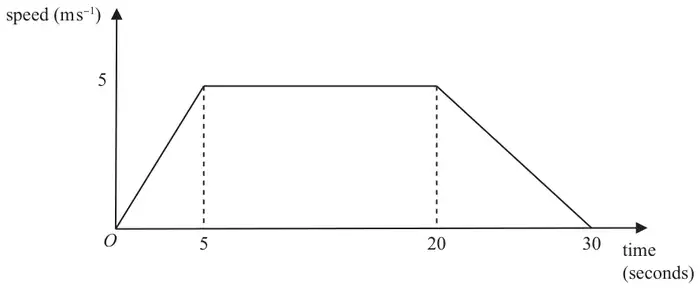
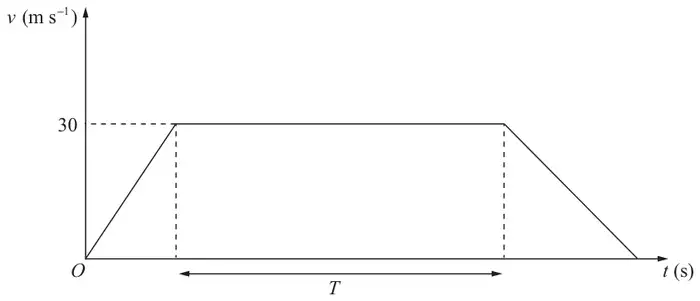
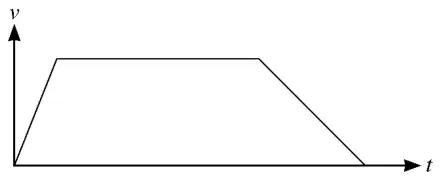
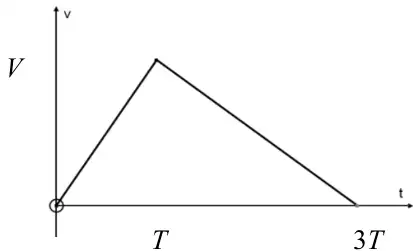
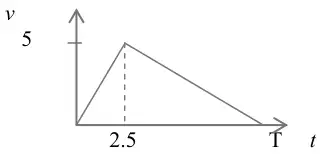
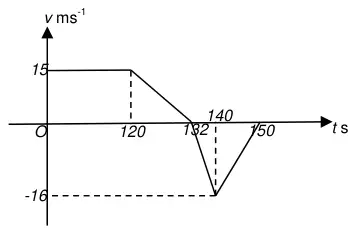
Figure 1 shows a sketch of the speed-time graph for a model of the motion of a runner travelling along a straight horizontal road from a point \(A\) to a point \(B\).
The distance from \(A\) to \(B\) is 400 metres.
In the model of the motion, the runner
starts from rest at \(A\) at time \(t = 0\)
then moves with constant acceleration for 5 seconds, reaching a maximum speed of \(5\ \mathrm{m\,s^{-1}}\)
then travels at a constant speed of \(5\ \mathrm{m\,s^{-1}}\)
then moves with constant deceleration for 15 seconds, until coming to rest at \(B\)
travels from \(A\) to \(B\) in \(T\) seconds
(a) Find the value of \(T\). (3)
(b) State one reason why the actual time taken to travel from \(A\) to \(B\) might not be \(T\) seconds. (1)
Mark scheme (a)
Scheme
Marks
AO
Use total distance \(= 400\) to set up an equation in \(T\) only (oe e.g. \(400 - 12.5 - 37.5 = 350,\ 350 \div 5 = 70,\ 70 + 20 = 90\)) by using area under graph and/or using suvat on each section. Must be a complete method, including use of \((T - 20)\)
M1: Must cover the total distance. If using areas, must be using a correct formula for a triangle and/or a trapezium e.g. if \(\frac{1}{2}\) is missing then M0.
A1: Correct unsimplified equation in \(T\) (allow \(T\) replaced by e.g. \(t\) throughout)
A1: Cao, allow \(t = 90\)
Mark scheme (b)
Scheme
Marks
AO
e.g. The change from constant acceleration to constant speed (zero acceleration) will not be instantaneous. The change from constant speed to constant deceleration will not be instantaneous. The runner is unlikely to maintain constant speed. The runner is unlikely to maintain constant acceleration or deceleration The timing(s) may not be exact. Air or wind resistance on the runner. The runner is unlikely to run in a straight line (obstacles in the road) Any physical limitation of the runner or the terrain e.g. smoothness of the road i.e. bumps in the road. The runner may run more than 400 m. Traffic on the road.
B1
3.5b
(1)
(4 marks)
Notes
B1: Any appropriate limitation of the model. B0 if incorrect extra answer(s) are included: e.g. the road not being straight, friction from the road, the road not being horizontal, the road not being flat
M1 Complete method to find the total area under the graph, with the correct structure triangle + rectangle + triangle or trapezium or triangle + trapezium or trapezium + triangle or rectangle – triangle – triangle N.B. They may use suvat on one or more of the sections.
A1 Correct unsimplified expression for the distance \(AB\)
A1 Accept 110 or better
Mark scheme (b)
Scheme
Marks
AO
B1 B1 B1
1.1b 1.1b 1.1b
(3)
(6 marks)
Notes
SC: If there is a single straight line with a positive gradient, allow B1B0B0, unless it’s absolutely clear that it is for the first section only. If there are just two straight lines, both with positive gradient, allow B1B0B0.
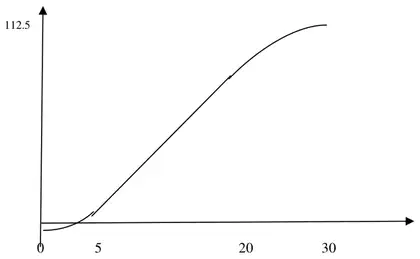
B1 One section correct. Straight section should be straight with positive gradient..Curves should look like curves with first one having increasing gradient and second one decreasing gradient but staying non-negative.
B1 Two sections correct. Straight section should be straight with positive gradient Curves should look like curves with first one having increasing gradient and second one decreasing gradient but staying non-negative. Continuous graph but condone incorrect transition between sections.
B1 All three sections correct and 5, 20, 30 and their 112.5 shown. Straight section should be straight with positive gradient. Curves should look like curves with first one having increasing gradient and second one decreasing gradient but staying non-negative. Continuous graph but condone incorrect transition between sections.
N.B. Subtract 1 mark from any earned if there is a continuous vertical line at the end. Ignore any figs when awarding the first two B marks except for the SC mentioned above.
If they use \(g = 9.81\) or 10 in this question, penalise once for whole question. Penalise explicit use of \(g = 9.81\) or 10 once for the whole question the first time it occurs.
M1 Complete method, using \(s = ut + \tfrac{1}{2}at^2\) or possibly \(s = vt - \tfrac{1}{2}at^2\) with the motion reversed, or an ‘up and down’ method i.e an appropriate equation for the motion from \(O\) to the top AND an appropriate equation from the top down to the ground AND combining to give the total distance
A1 Correct expression (s) N.B. If using an ‘up and down method’, this mark is for all the intermediate values: Distance up = 78.4, Time up = 4, time down = 6, distance down = 176.4 AND combining correctly i.e. (176.4 – 78.4) or (78.4 –176.4) These are the values for \(g = 9.8\)
A1 cao
Mark scheme (b)
Scheme
Marks
AO
Complete method to find either half the time or the full time
M1
3.1b
Correct equation e.g. \(0 = 24.5 - gt\) OR \(-24.5 = 24.5 - gt\)
A1
1.1b
5 (s)
A1
1.1b
(3)
Notes
If they use \(g = 9.81\) or 10 in this question, penalise once for whole question. Penalise explicit use of \(g = 9.81\) or 10 once for the whole question the first time it occurs.
M1 Complete method to find half the time or the full time. Allow inequalities. e.g. for half the time, they may find \(t = 4\) and \(t = 1.5\) and subtract e.g. for the full time, they may find \(t = 6.5\) and \(t = 1.5\) and subtract
A1 Correct equation or equations if they are using more than one.
A1 cao
Mark scheme (c)
Scheme
Marks
AO
e.g. (include) air resistance
B1
3.5c
(1)
(7 marks)
Notes
B1 e.g. (use) a more accurate value of \(g\), (include) spin of the stone, (include )shape of the stone, (include) size of the stone, (include) wind effects , rotation B0 if any incorrect extras are included e.g. the mass or weight of the stone DO NOT ALLOW NEGATIVES OF THESE e.g there is no air resistance
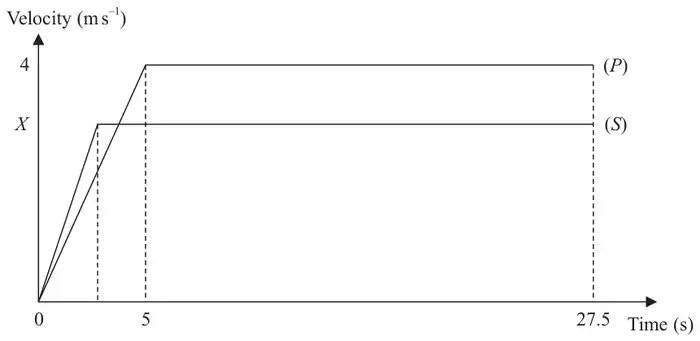
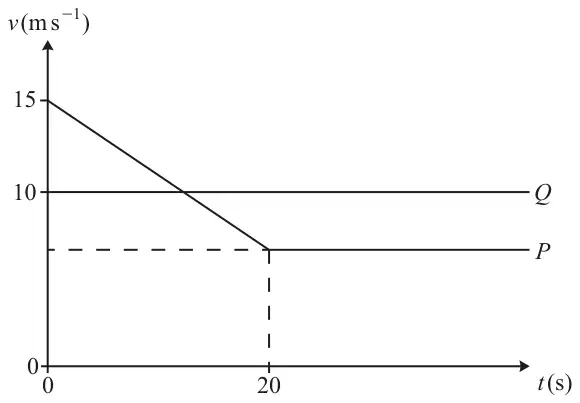
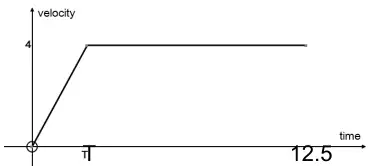
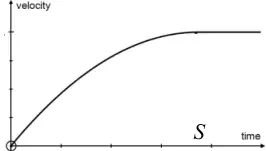
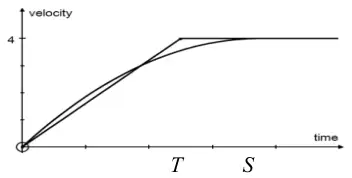
Two children, Pat (\(P\)) and Sam (\(S\)), run a race along a straight horizontal track.
Both children start from rest at the same time and cross the finish line at the same time.
In a model of the motion:
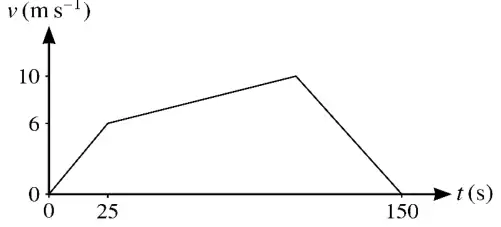
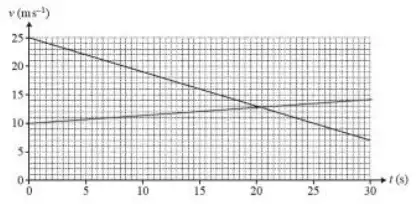
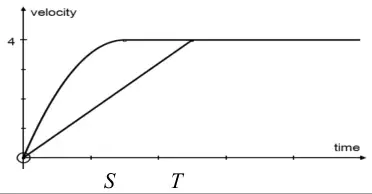
Pat accelerates at a constant rate from rest for 5 s until reaching a speed of \(4\ \mathrm{m\,s^{-1}}\) and then maintains a constant speed of \(4\ \mathrm{m\,s^{-1}}\) until crossing the finish line.
Sam accelerates at a constant rate of \(1\ \mathrm{m\,s^{-2}}\) from rest until reaching a speed of \(X\ \mathrm{m\,s^{-1}}\) and then maintains a constant speed of \(X\ \mathrm{m\,s^{-1}}\) until crossing the finish line.
Both children take 27.5 s to complete the race.
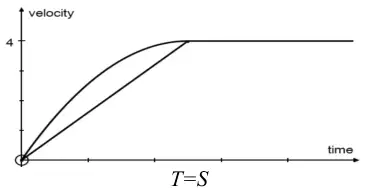
The velocity-time graphs shown in Figure 1 describe the model of the motion of each child from the instant they start to the instant they cross the finish line together.
Using the model,
(a) explain why the areas under the two graphs are equal, (1)
(b) find the acceleration of Pat during the first 5 seconds, (1)
(c) find, in metres, the length of the race, (2)
(d) find the value of \(X\), giving your answer to 3 significant figures. (4)
Mark scheme (a)
Scheme
Marks
AO
Because the distances travelled or displacements are equal oe. If they mention the times are the same as well, ignore it.
B1
2.4
(1)
Notes
B1 Must mention distances being equal specifically.
M1 Clear attempt to find the total area under the \(P\) graph, with the correct structure i.e. (triangle + rectangle) OR trapezium OR (rectangle – triangle); must see use of ½ where appropriate. OR they may use suvat to find the distance covered by \(P\) in one or more of the sections. N.B. M0 for use of a single suvat formula for the whole motion
A1 cao
Mark scheme (d)
Scheme
Marks
AO
Total area under graph = their answer for part (c)
M1
3.1b
\(\tfrac{1}{2}X \times X + X(27.5 - X) = 100\) OR \(\tfrac{1}{2}(27.5 + 27.5 - X) \times X = 100\) OR \(27.5X - \tfrac{1}{2}X^2 = 100\)
A1ft A1ft
1.1b 1.1b
\(X = 3.92\) to 3sf
A1
1.1b
(4)
(8 marks)
Notes
M1 Clear attempt to equate the total area under the \(S\) graph, with the correct structure, i.e. (triangle + rectangle) OR trapezium OR (rectangle – triangle), must see use of ½ where appropriate, to their answer for (c) to give a quadratic equation in \(X\) only N.B. they may use suvat to find the distance covered by \(S\) in one or more of the sections. N.B. M0 for use of a single suvat formula for the whole motion
A1ft Correct unsimplified quadratic equation in \(X\) only with at most one error, follow their answer for (c)
A1ft Correct unsimplified quadratic equation in \(X\) only, follow their answer for (c)
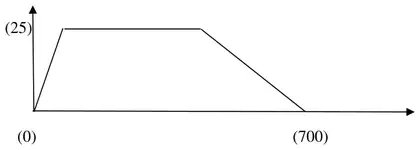
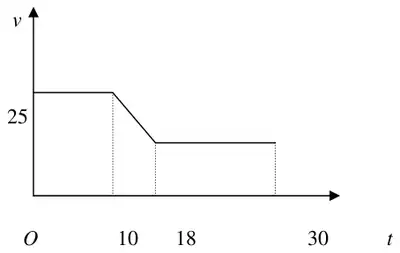
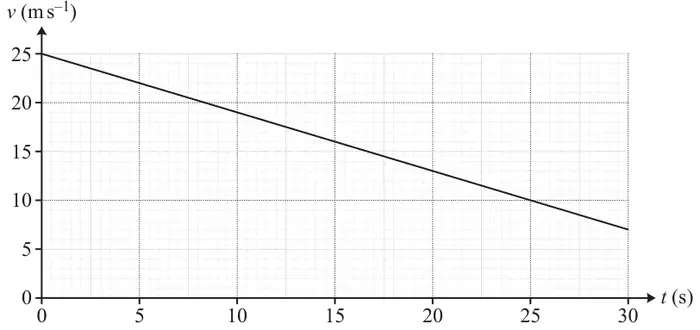
2. A train travels along a straight horizontal track from station \(P\) to station \(Q\).
In a model of the motion of the train, at time \(t = 0\) the train starts from rest at \(P\), and moves with constant acceleration until it reaches its maximum speed of 25 m s−1
The train then travels at this constant speed of 25 m s−1 before finally moving with constant deceleration until it comes to rest at \(Q\).
The time spent decelerating is four times the time spent accelerating.
The journey from \(P\) to \(Q\) takes 700 s.
Using the model,
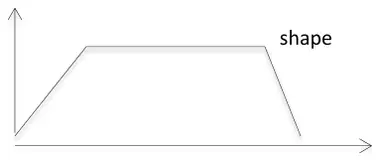
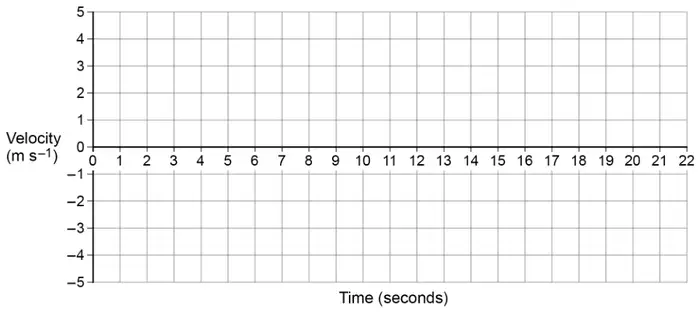
(a) sketch a speed-time graph for the motion of the train between the two stations \(P\) and \(Q\). (1)
The distance between the two stations is 15 km.
Using the model,
(b) show that the time spent accelerating by the train is 40 s, (3)
(c) find the acceleration, in m s−2, of the train, (1)
(d) find the speed of the train 572 s after leaving \(P\). (2)
(e) State one limitation of the model which could affect your answers to parts (b) and (c). (1)
Mark scheme (a)
Scheme
Marks
AO
shape
B1
1.1b
(1)
Notes
B1 Overall shape of graph, starting at the origin, with deceleration phase longer than the acceleration phase if nothing on the \(t\)-axis but ignore the relative lengths and allow if \(t\) (or 40) and \(4t\) (or 160) are clearly and correctly marked. Ignore incorrect figs on the axes. This mark can be earned if the graph appears anywhere in qu 2.
Mark scheme (b)
Scheme
Marks
AO
Using total area = 15000 to set up an equation in one unknown Or they may use suvat on one or more sections (but must still be considering all sections)
Allow an attempt at a clear explicit verification using \(t = 40\) e.g. the following would score M1A1A1*: \(4 \times 40 = 160\) then \(700 - 40 - 160 = 500\) \(\dfrac{(700 + 500)}{2} \times 25 = 15000 = 15\) km Withhold A1* if they don’t include = 15 km
N.B. M0 if a single suvat formula is used for the whole journey.
M1
3.4
\(\dfrac{1}{2}(700 + 700 - t - 4t) \times 25 = 15000\) OR \(\dfrac{1}{2} \times 25 \times t + 25(700 - t - 4t) + \dfrac{1}{2} \times 25 \times 4t = 15000\)
A1
1.1b
\(t = 40\) (s)*
A1*
1.1b
(3)
Notes
M1 Need all sections to be included, with correct structure for each section, with \(\frac{1}{2}\)’s where appropriate. Allow = 15 or 150 or 1500 etc instead of 15000
A1 A correct equation in their \(t\) only, seen or implied (or with \(t = 40\) for verification)
A1* cso. At least one line of working with brackets removed and \(t\)’s collected, or equivalent
Mark scheme (c)
Scheme
Marks
AO
0.63 or 0.625 or \(\dfrac{5}{8}\) oe (m s−2) isw
B1
1.1b/ (2.2a)
(1)
Notes
B1 cao
Mark scheme (d)
Scheme
Marks
AO
Complete method to find the speed or velocity at \(t = 572\) e.g \(\pm\left(25 - \left(32 \times \dfrac{5}{32}\right)\right)\) or \(\pm\left(128 \times \dfrac{5}{32}\right)\) oe
M1
3.1b
20 (m s−1)
A1
1.1b
(2)
Notes
M1 Any complete method, must have correct figs, but condone sign errors
A1 cao. Must be positive and exact i.e must not come from rounding.
Mark scheme (e)
Scheme
Marks
AO
e.g. (the train) cannot instantaneously change acceleration, (the train) won’t move with constant acceleration, (the train) won’t move with constant speed Allow negatives of these: e.g. (The train) moving at constant speed, or just ‘constant speed’ or ‘constant acceleration’ (is a limitation of the model) Must be a limitation of the model, so friction or air resistance or size of train is B0. N.B. Ignore incorrect reasons following a correct answer.
B1
3.5b
(1)
(8 marks)
Notes
B1 Any appropriate limitation of the model. B0 if any incorrect extra answers.
1. The point \(A\) is 1.8 m vertically above horizontal ground.
At time \(t = 0\), a small stone is projected vertically upwards with speed \(U\) m s−1 from the point \(A\).
At time \(t = T\) seconds, the stone hits the ground.
The speed of the stone as it hits the ground is 10 m s−1
In an initial model of the motion of the stone as it moves from \(A\) to where it hits the ground
the stone is modelled as a particle moving freely under gravity
the acceleration due to gravity is modelled as having magnitude 10 m s−2
Using the model,
(a) find the value of \(U\), (3)
(b) find the value of \(T\). (2)
(c) Suggest one refinement, apart from including air resistance, that would make the model more realistic. (1)
In reality the stone will not move freely under gravity and will be subject to air resistance.
(d) Explain how this would affect your answer to part (a). (1)
Mark scheme (a)
Scheme
Marks
AO
Complete method to produce an equation in \(U\) only
M1
3.4
e.g. \(10^2 = U^2 + 2 \times g \times 1.8\) oe
A1
1.1b
OR a complete method where they find \(T\) first and use it to find an equation in \(U\) only (M1) A correct equation in \(U\) only. (A1)
\(U = 8\) (only this answer)
A1
1.1b
(3)
Notes
M1 Use the model to obtain an equation in \(U\) only, condone sign errors, but M0 if using an incorrect formula.
A1 A correct equation in \(U\) only, \(g\) does not need to be substituted (so allow \(g = 9.8\) or 9.81)
A1 cao (A0 if \(g = 10\) has not been used)
Mark scheme (b)
Scheme
Marks
AO
Complete method to find an equation in \(T\) only: \(10 = -8 + gT\) or \(1.8 = 10T - \dfrac{1}{2}gT^2\) or \(1.8 = \dfrac{(-8 + 10)}{2}T\) or \(1.8 = -8T + \dfrac{1}{2}gT^2\) OR a complete method if they split the time. In both cases, the M1 is only earned on the final line when they try to add the two times to give an equation in \(T\).
ALT 1: time up + time down e.g. \(0 = 8 - gt_{\mathrm{UP}}\ (\Rightarrow t_{\mathrm{UP}} = 0.8)\) \(h_{\mathrm{UP}} = \dfrac{(8 + 0)}{2} \times 0.8\ (= 3.2)\) \((h_{\mathrm{UP}} + 1.8) = \dfrac{(0 + 10)}{2} \times t_{\mathrm{DOWN}}\ (\Rightarrow t_{\mathrm{DOWN}} = 1)\) \(T = t_{\mathrm{UP}} + t_{\mathrm{DOWN}}\)
ALT 2: time to \(A\) + time from \(A\) to ground e.g. \(8 = -8 + gt_A\ (\Rightarrow t_A = 1.6)\) \(1.8 = \dfrac{(8 + 10)}{2} \times t_{AG}\ (\Rightarrow t_{AG} = 0.2)\) \(T = t_A + t_{AG}\)
M1
3.4
\(T = 1.8\) oe e.g. 9/5
A1
1.1b
(2)
Notes
M1 Use the model to obtain an equation in \(T\) only, \(g\) does not need to be substituted (so allow \(g = 9.8\) or 9.81) condone sign errors, but M0 if using an incorrect formula. Follow through on their \(U\) where necessary
A1 cao (A0 if \(g = 10\) has not been used) A0 if they give two answers.
Mark scheme (c)
Scheme
Marks
AO
e.g. Use a more accurate (less rounded) value for \(g\) (or gravity), use \(g = 9.8\) or \(g = 9.81\), allow for wind effects, allow for the spin of the stone, include dimensions of stone (not a particle), shape and/or size of stone, allow for variable acceleration. If air resistance is mentioned as an extra, ignore it.
B1
3.5c
(1)
Notes
B1 Any appropriate refinement. B0 if an incorrect extra is given e.g. the mass or weight is mentioned
Mark scheme (d)
Scheme
Marks
AO
\(U\) would be greater. Allow without \(U\), e.g it would be greater, or just ‘greater’ oe ISW
1. At time \(t = 0\), a small ball is projected vertically upwards with speed \(U\ \mathrm{m\,s^{-1}}\) from a point \(A\) that is 16.8 m above horizontal ground.
The speed of the ball at the instant immediately before it hits the ground for the first time is \(19\ \mathrm{m\,s^{-1}}\)
The ball hits the ground for the first time at time \(t = T\) seconds.
The motion of the ball, from the instant it is projected until the instant just before it hits the ground for the first time, is modelled as that of a particle moving freely under gravity.
The acceleration due to gravity is modelled as having magnitude \(10\ \mathrm{m\,s^{-2}}\)
Using the model,
(a) show that \(U = 5\) (2)
(b) find the value of \(T\), (2)
(c) find the time from the instant the ball is projected until the instant when the ball is 1.2 m below \(A\). (4)
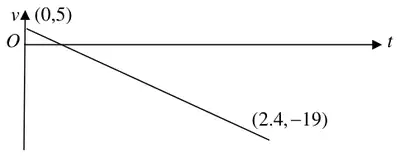
(d) Sketch a velocity-time graph for the motion of the ball for \(0 \leqslant t \leqslant T\), stating the coordinates of the start point and the end point of your graph. (2)
In a refinement of the model of the motion of the ball, the effect of air resistance on the ball is included and this refined model is now used to find the value of \(U\).
(e) State, with a reason, how this new value of \(U\) would compare with the value found in part (a), using the initial unrefined model. (1)
(f) Suggest one further refinement that could be made to the model, apart from including air resistance, that would make the model more realistic. (1)
Mark scheme (a)
Scheme
Marks
AO
\(19^2 = (-U)^2 + 2 \times 10 \times 16.8\) (Allow use of \(g = 9.8\) for this M mark)
M1
2.1
\(U = 5\) *
A1*
1.1b
(2)
Notes
For consistent use of \(g = 9.8\) in parts (b), (c) and (d), treat as a MR. i.e. max (b) M1A0 (c)M1A0M(A)0A1ft (d)B1B1ft
M1 Complete method to find \(U\), condone sign errors and use of \(g = 9.8\)
A1* \(U = 5\) cao correctly obtained – allow \(U^2\) instead of \((-U)^2\). Allow verification.
Mark scheme (b)
Scheme
Marks
AO
\(19 = -5 + 10T\) OR \(16.8 = \dfrac{(-5 + 19)}{2}T\) OR \(16.8 = -5T + \dfrac{1}{2} \times 10T^2\) OR \(16.8 = 19T - \dfrac{1}{2} \times 10T^2\)
M1
2.1
\(T = 2.4\)
A1
1.1b
(2)
Notes
M1 Complete method to find \(T\), condone sign errors
A1 \(T = 2.4\)
Mark scheme (c)
Scheme
Marks
AO
\(1.2 = -5t + \dfrac{1}{2} \times 10 \times t^2\)
M1
2.1
\(5t^2 - 5t - 1.2 = 0\)
A1 M(A)1
1.1b 1.1b
\(t = 1.2\) (s)
A1
1.1b
(4)
Notes
M1 Complete method to find \(t\), condone sign errors
A1 Correct equation with at most one error
(A)1 Correct equation
A1 \(t = 1.2\) (s)
Mark scheme (d)
Scheme
Marks
AO
B1 shape
1.1b
\((0, 5)\) and \((2.4, -19)\) Allow these to be marked on the axes.
B1ft
1.1b
(2)
Notes
B1 Graph could be reflected in the \(t\)-axis.
B1ft Follow through on their \(T\) value. If graph is reflected, \((0, -5)\) and \((2.4, 19)\)
Mark scheme (e)
Scheme
Marks
AO
Greater since air resistance would slow the ball down.
B1
3.5a
(1)
Notes
B1 Any similar appropriate comment
Mark scheme (f)
Scheme
Marks
AO
Take into account: spin, wind effects, use a more accurate value of \(g\), not model the ball as a particle
B1
3.5c
(1)
(12 marks)
Notes
B1 B0 if any incorrect extras e.g. weight/mass included
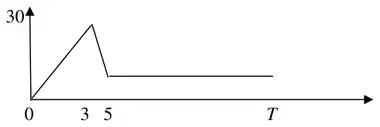
1. At time \(t = 0\), a parachutist falls vertically from rest from a helicopter which is hovering at a height of 550 m above horizontal ground.
The parachutist, who is modelled as a particle, falls for 3 seconds before her parachute opens.
While she is falling, and before her parachute opens, she is modelled as falling freely under gravity.
The acceleration due to gravity is modelled as being \(10\ \mathrm{m\,s^{-2}}\).
(a) Using this model, find the speed of the parachutist at the instant her parachute opens. (1)
When her parachute is open, the parachutist continues to fall vertically.
Immediately after her parachute opens, she decelerates at \(12\ \mathrm{m\,s^{-2}}\) for 2 seconds before reaching a constant speed and she reaches the ground with this speed.
The total time taken by the parachutist to fall the 550 m from the helicopter to the ground is \(T\) seconds.
(b) Sketch a speed-time graph for the motion of the parachutist for \(0 \leqslant t \leqslant T\). (2)
(c) Find, to the nearest whole number, the value of \(T\). (5)
In a refinement of the model of the motion of the parachutist, the effect of air resistance is included before her parachute opens and this refined model is now used to find a new value of \(T\).
(d) How would this new value of \(T\) compare with the value found, using the initial model, in part (c)? (1)
(e) Suggest one further refinement to the model, apart from air resistance, to make the model more realistic. (1)
Mark scheme (a)
Scheme
Marks
AO
\(V = 30\ (\mathrm{m\,s^{-1}})\)
B1
3.4
(1)
Notes
B1 cao
Mark scheme (b)
Scheme
Marks
AO
shape
B1
1.1b
figs
B1ft
1.1b
(2)
Notes
B1 Overall shape of the graph, starting at the origin. Dotted vertical line at end is OK but solid vertical line is B0
B1ft 3, 5 and \(T\) marked on the \(t\)-axis, and ft on their 30 marked on the speed axis. 3 must be where graph reaches a peak. Allow delineators: 3, 2 and \(T - 5\) or a mixture
Mark scheme (c)
Scheme
Marks
AO
Using total area = 550 to set up an equation in one unknown, Or they may use suvat on one or more of the sections (but must still be considering all sections) M0 if they use one suvat equation for the whole motion
M1 Need all sections to be included, with correct structure for each section. e.g. triangle + trapezium + rectangle oe = 550 to give an equation in one unknown (may not be T)
A2ftft on their answer to (a). -1 each error. N.B. If ‘6’ is incorrect, treat as one error, unless it is correct ft from their 30.
M1Attempt to solve for \(T\) provided they have tried to find the area using at least 3 sections. (M0 if they only solve for their unknown and never try to find \(T\))
A1 83 is the only answer
Mark scheme (d)
Scheme
Marks
AO
New value of \(T\) would be bigger (ignore their reasons whether correct or not)
B1
3.5a
(1)
Notes
B1 Clear statement about the value of \(T\) Allow ‘it would increase, get larger etc’ B0 for ‘Takes longer’ or ‘the value of \(T\) would be longer’
Mark scheme (e)
Scheme
Marks
AO
e.g. effect of wind; allow for dimensions of parachutist; use a more accurate value for \(g\); parachutist does not fall vertically after chute opens; smooth changes in \(v\); time for parachute to open; deceleration not constant (but B0 if they say acceleration not constant); smooth changes in \(a\); B0 for: moves horizontally; mass/weight of parachutist; upthrust; air pressure;air resistance; terminal velocity
B1
3.5c
(1)
(10 marks)
Notes
B1 Any appropriate refinement of the model. B0 if incorrect (or irrelevant) extras
7. A train travels along a straight horizontal track between two stations, \(A\) and \(B\).
In a model of the motion, the train starts from rest at \(A\) and moves with constant acceleration 0.3 m s−2 for 80 s. The train then moves at constant velocity before it moves with a constant deceleration of 0.5 m s−2, coming to rest at \(B\).
(a) For this model of the motion of the train between \(A\) and \(B\),
(i) state the value of the constant velocity of the train,
(ii) state the time for which the train is decelerating,
(iii) sketch a velocity-time graph. (3)
The total distance between the two stations is 4800 m.
(b) Using the model, find the total time taken by the train to travel from \(A\) to \(B\). (3)
(c) Suggest one improvement that could be made to the model of the motion of the train from \(A\) to \(B\) in order to make the model more realistic. (1)
Mark scheme (a)
Scheme
Marks
AO
(i) 24 (m s−1)
B1
1.1b
(ii) 48 (s)
B1
1.1b
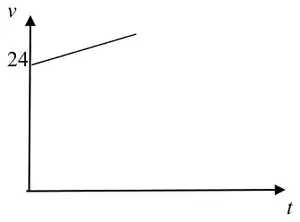
(iii)
B1
1.1b
(3)
Notes
(i) B1: 24 (m s−1) Must be stated i.e. not just inserted on the graph
(ii) B1: 48 (s) (Allow −48 changed to 48) Must be stated i.e. not just inserted on the graph
(iii) B1: A trapezium starting at the origin and ending on the \(t\)-axis.
Mark scheme (b)
Scheme
Marks
AO
Equating area under graph to 4800 to give equation in one unknown
M1: Complete method to find area of trapezium using trapezium rule with correct structure or using two triangles and a rectangle and equate to 4800 to give equation in one unknown N.B. \(\dfrac{1}{2}(T + 80 + 48) \times 24 = 4800\) is M0 (equivalent to using three triangles) OR they may use suvat on one or more sections (must have \(a = 0\) for middle section) and equate total distance travelled to 4800 to give equation in one unknown
A1ft: For a correct equation in their unknown ft on their 24 and 48 (but must be positive times)
A1: For 264 (s)
Mark scheme (c)
Scheme
Marks
AO
Accept Either: a smooth change from acceleration to constant velocity or from constant velocity to deceleration. Or have train accelerating and/or decelerating at a variable rate
Do not accept e.g. Comments on air resistance or resistive forces, straightness of track, horizontal track, friction, length of train, mass of train, not having train moving with constant velocity. B0 if either an incorrect extra is included or an incorrect reason for a valid improvement is included. N.B. Variable acceleration due to air resistance is B0 BUT Variable acceleration due to variable air resistance is B1
B1
3.5c
(1)
(7 marks)
Notes
B1:Either: Include time to change from constant accln to constant velocity and/or time to change from constant velocity to constant deceleration oe Or: Have train accelerating and/or decelerating at a variable rate
6. A man throws a tennis ball into the air so that, at the instant when the ball leaves his hand, the ball is 2 m above the ground and is moving vertically upwards with speed 9 m s−1
The motion of the ball is modelled as that of a particle moving freely under gravity and the acceleration due to gravity is modelled as being of constant magnitude 10 m s−2
The ball hits the ground \(T\) seconds after leaving the man’s hand.
Using the model, find the value of \(T\). (4)
Mark scheme
Scheme
Marks
AO
Equation in \(t\) only
M1
2.1
\(-2 = 9t - \tfrac{1}{2} \times 10t^2\)
A1
1.1b
\(5t^2 - 9t - 2 = 0 = (5t + 1)(t - 2)\)
DM1
1.1b
\(T = 2\) (only)
A1
1.1b
(4)
(4 marks)
Notes
M1: Complete method to give equation in \(t\) only. This mark is for a complete method for the TOTAL time i.e. for finding sufficient equations, with usual rules, correct no. of terms in each equation but condone sign errors and \(g\) does not need to be substituted
A1: A correct equation or correct equations (e.g. if they find the speed, 11 m s−1, when the ball strikes the ground and then use that to find the total time or if they split the time (e.g. 0.9 s up and 1.1 s down or 0.9 s + 0.9 s + 0.2 s)) N.B. \(g = 10\) must be substituted in all equations used.
DM1: Dependent on first M1, for solving a 3 term quadratic to find \(T\) or for solving their equations to find \(T\) or for solving their equations and adding their split times to find \(T\)
A1: \(T = 2\) only (i.e. A0 if they give two times)
N.B. If solving a correct quadratic, the DM1 can be implied by a correct answer i.e. the method does not need to be shown, but if there is no method shown and the answer is wrong then award DM0 A0.
4. A ball of mass 0.2 kg is projected vertically downwards with speed \(U\) m s\(^{-1}\) from a point \(A\) which is 2.5 m above horizontal ground. The ball hits the ground. Immediately after hitting the ground, the ball rebounds vertically with a speed of 10 m s\(^{-1}\). The ball receives an impulse of magnitude 7 N s in its impact with the ground. By modelling the ball as a particle and ignoring air resistance, find
(a) the value of \(U\). (6)
After hitting the ground, the ball moves vertically upwards and passes through a point \(B\) which is 1 m above the ground.
(b) Find the time between the instant when the ball hits the ground and the instant when the ball first passes through \(B\). (4)
(c) Sketch a velocity-time graph for the motion of the ball from when it was projected from \(A\) to when it first passes through \(B\). (You need not make any further calculations to draw this sketch.) (3)
Mark scheme (a)
Scheme
Marks
\(V^2 = U^2 + 2g \times 2.5\)
M1A1
Eliminate \(V\) and solve for \(U\)
A1 (DM1)
\(7 = 0.2(10 - -V)\)
M1A1
\(U = 24\)
A1
(6)
Notes
First M1 for complete method, using suvat, to find equation in \(U\) and \(V\) only
First A1 for a correct equation
Second A1 – treat as third DM1, dependent on the other two M’s, for eliminating \(V\) and solving for \(U\)
Second M1 for using Impulse = Change in Momentum of ball (must have 0.2 in both terms and be using 10 as one of the velocities) (M0 if clearly adding momenta or if \(g\) is included) but condone sign errors.
Third A1 for a correct equation, 7 and 10 must have the same sign but equation may have \(V\) instead of \(-V\)
Fourth A1 for \(U = 24\) (must appear here)
N.B. If they use \(U\) instead of \(V\) in the impulse-momentum equation, can score max M1A0/6 for part (a).
N.B. If they go from \(V^2 = U^2 + 49\) to \(V = U + 7\), can score max 5/6
Mark scheme (b)
Scheme
Marks
\(1 = 10t - 4.9t^2\) OR e.g. \(v^2 = 10^2 - 2 \times 9.8 \times 1\) and \(v = 10 - 9.8t\)
\(1 = 10t - 4.9t^2\) to give \(\sqrt{80.4} = 10 - 9.8t\)
\(t = 0.040\) (s) or 0.0403 (s) or 0.04 (s) (must only be ONE answer)
A1
First M1 for complete method, using one or more suvat formulae, to produce an equation in \(t\) only using \(s = 1\) or \(-1\)
First A1 for a correct equation in \(t\) only
Second DM1, dependent on first M1, for solving their equation (this mark can be implied by a correct answer)
Second A1 \(t = 0.040\) (s) or 0.0403 (s)
Mark scheme (c)
Scheme
Marks
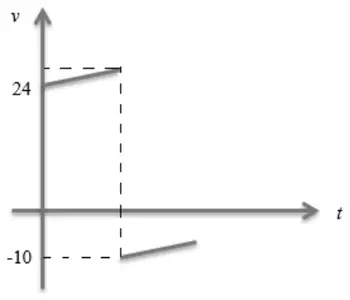
B1ft 1st line
B1 2nd line
B1 ,-10
(3)
(13 marks)
Notes
First B1ft for a straight line, with positive gradient, starting at their \(U\) value (or just at \(U\)) on the positive \(v\)-axis.
Second B1 for a parallel (approx.) line placed correctly (B0 if a continuous vertical line is included)
i.e. starting at a point where the \(t\) coordinate is equal to the \(t\) coordinate of the point where the first line stopped, and the \(v\) coordinate is negative.
Third B1 for second line, placed correctly, starting on \(v = -10\)
N.B. Whole graph could be reflected in the \(t\)-axis
SC: If second line is placed correctly but extends up to the \(t\)-axis, or beyond, lose second B1 but can score the third B1.
ALTERNATIVE
ALTERNATIVE : again “when it first passes through \(B\)” is taken to be when the ball is on the way down from \(A\).
B2 line B1ft 24
B2 for a straight line, with positive gradient, starting on the positive \(v\)-axis.
B1ft starting at their \(U\) value (or just at \(U\))
6. A cyclist is moving along a straight horizontal road and passes a point \(A\). Five seconds later, at the instant when she is moving with speed 10 m s\(^{-1}\), she passes the point \(B\). She moves with constant acceleration from \(A\) to \(B\).
Given that \(AB = 40\) m, find
(a) the acceleration of the cyclist as she moves from \(A\) to \(B\), (4)
(b) the time it takes her to travel from \(A\) to the midpoint of \(AB\). (5)
Mark scheme (a)
Scheme
Marks
\(s = vt - \tfrac{1}{2}at^2\)
\(40 = 10 \times 5 - \tfrac{1}{2}a5^2\)
M1 A2
\(a = 0.8\)
A1
(4)
Notes
First M1 for a complete method to produce a value for \(a\). They may use two (or more equations) and solve for \(a\).(see possible equations)
A2 if all correct, A1A0 for one error
Third A1 for 0.8 (m s\(^{-2}\))
Possible equations:
\(40 = 5u + \tfrac{1}{2}a.5^2\)
\(10^2 = u^2 + 2a.40\)
\(10 = u + 5a\)
\(40 = \dfrac{(u + 10)}{2}.5\)
Mark scheme (b)
Scheme
Marks
Finding \(u\) (\(= 6\))
M1
\(s = ut + \tfrac{1}{2}at^2\) (\(A\) to \(M\))
\(20 = 6t + \tfrac{1}{2}0.8t^2\)
M1 A1
\(t = \dfrac{-15 \pm \sqrt{225 + 200}}{2}\)
DM1
\(= 2.8\) or 2.81 or better
A1
(5)
(9 marks)
Notes
First M1 for attempt to find a value for \(u\) (This may have been done in part (a) but MUST be used in (b) )
Second M1 for a complete method (may involve 2 or more suvat equations) for finding an equation in \(t\) only
First A1 for a correct equation
Third M1, dependent on previous M, for solving their equation for \(t\)
Second A1 for 2.8 (s) or better or \(\dfrac{5(2\sqrt{17} - 6)}{4}\); \(\dfrac{40}{6 + 2\sqrt{17}}\)
Alternative
Finding \(v\) (\(= \sqrt{68}\))
M1
\(s = vt - \tfrac{1}{2}at^2\) (\(A\) to \(M\))
\(20 = \sqrt{68}t - \tfrac{1}{2}0.8t^2\)
M1 A1
\(t = \dfrac{\sqrt{68} \pm \sqrt{68 - 32}}{0.8}\)
DM1
\(= 2.8\) or 2.81 or better
A1
Alternative
\(s = vt_1 - \tfrac{1}{2}at_1^2\) (\(M\) to \(B\))
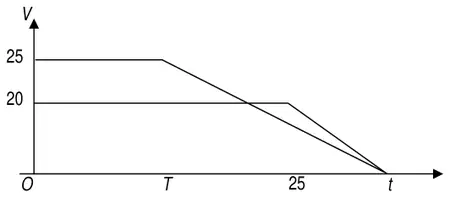
4. Two trains \(M\) and \(N\) are moving in the same direction along parallel straight horizontal tracks. At time \(t = 0\), \(M\) overtakes \(N\) whilst they are travelling with speeds 40 m s\(^{-1}\) and 30 m s\(^{-1}\) respectively. Train \(M\) overtakes train \(N\) as they pass a point \(X\) at the side of the tracks.
After overtaking \(N\), train \(M\) maintains its speed of 40 m s\(^{-1}\) for \(T\) seconds and then decelerates uniformly, coming to rest next to a point \(Y\) at the side of the tracks.
After being overtaken, train \(N\) maintains its speed of 30 m s\(^{-1}\) for 25 s and then decelerates uniformly, also coming to rest next to the point \(Y\).
The times taken by the trains to travel between \(X\) and \(Y\) are the same.
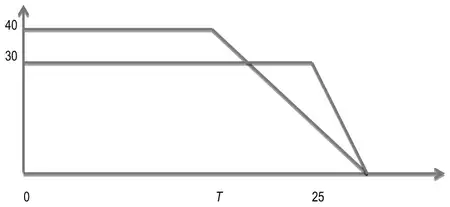
(a) Sketch, on the same diagram, the speed-time graphs for the motions of the two trains between \(X\) and \(Y\). (4)
Given that \(XY = 975\) m,
(b) find the value of \(T\). (8)
Mark scheme (a)
Scheme
Marks
B1 shape (\(M\))
B1 figs (40,\(T\))
B1 shape (\(N\))
B1 figs (30,25)
(4)
Notes
First B1 (\(M\)) for correct shape – must start and finish on the axes.
Second B1 for 40 and \(T\) marked clearly (if delineators omitted B0) and correctly
Third B1 (\(N\)) for correct shape – must start and finish on the axes.
Fourth B1 for 30 and 25 (if delineators omitted B0) marked clearly and correctly
N.B. If graphs do not cross and/or do not finish at the same point, max score is B1B1B0B1.
N.B. If graphs done on separate diagrams, mark each and award the higher mark i.e. can score max 2/4 for part (a).
Mark scheme (b)
Scheme
Marks
For N: \(\tfrac{1}{2}(25 + 25 + t).30 = 975\) OR \(\tfrac{1}{2}(25 + t_1).30 = 975\)
M1 A1
\(t = 15\) \(t_1 = 40\)
DM1 A1
For M: \(\tfrac{1}{2}(25 + t + T).40 = 975\) OR \(\tfrac{1}{2}(t_1 + T).40 = 975\)
M1 A1
\(T = 8.75\) (\(8\tfrac{3}{4}\) or \(\dfrac{35}{4}\) oe)
DM1 A1
(8)
(12 marks)
Notes
N.B. When attempting to find the area of a triangle, must see ½ x …. to be able to award an M mark i.e. M0 if ½ is missing
N.B. When attempting to find the area of a trapezium, must see something of the form : ½ x \((a + b)h\) to be able to award an M mark i.e. M0 if ½ is missing and bracket is not a sum
First M1 for attempt at using 975m distance travelled by \(N\) to obtain an equation in one unknown time (usually extra time \(t\) after 25 s, but could, for example, be whole time \(t_1\)). They may use the area under their graph or use suvat (N.B. Any single suvat equn using \(s = 975\) is M0).
First A1 for a correct equation in their unknown time
e.g. \((30 \times 25) + \tfrac{1}{2}30t = 975\) OR \((30 \times 25) + \tfrac{1}{2}30(t_1 - 25) = 975\)
Second M1, dependent on first M, for solving their equation
Second A1 for a correct value for their unknown.
Third M1 for attempt at using 975m distance travelled by \(M\) to obtain an equation in \(T\) and possibly one other unknown time (usually extra time \(t\) after 25 s, but could, for example, be whole time \(t_1\)). They may use the area under their graph or use suvat (N.B. Any suvat equn using \(s = 975\) is M0)
Third A1 for a correct equation in \(T\) and possibly their unknown.
This A1 can be earned if they just have a letter for their unknown :-
e.g. \(40T + \tfrac{1}{2}40.(25 + t - T) = 975\) OR \(40T + \tfrac{1}{2}40.(t_1 - T) = 975\)
or for an incorrect numerical value in place of \(t\) or \(t_1\).
Fourth M1, dependent on first, second and third M’s, for solving for \(T\).
Fourth A1 for 8.75 or 35/4 or any other equivalent
ALTERNATIVE
They may find \(t\) or \(t_1\), in terms of \(T\), from their (\(M\)) equation, and substitute for \(t\) or \(t_1\) in their (\(N\)) equation, and then solve for \(T\):
For M: \(\tfrac{1}{2}(25 + t + T).40 = 975\) OR \(\tfrac{1}{2}(t_1 + T).40 = 975\)
7. A train travels along a straight horizontal track between two stations, \(A\) and \(B\). The train starts from rest at \(A\) and moves with constant acceleration 0.5 m s\(^{-2}\) until it reaches a speed of \(V\) m s\(^{-1}\), \((V < 50)\). The train then travels at this constant speed before it moves with constant deceleration 0.25 m s\(^{-2}\) until it comes to rest at \(B\).
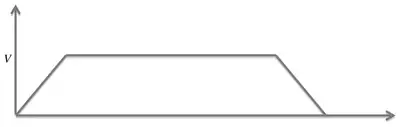
(a) Sketch in the space below a speed-time graph for the motion of the train between the two stations \(A\) and \(B\). (2)
The total time for the journey from \(A\) to \(B\) is 5 minutes.
(b) Find, in terms of \(V\), the length of time, in seconds, for which the train is
(i) accelerating,
(ii) decelerating,
(iii) moving with constant speed. (5)
Given that the distance between the two stations \(A\) and \(B\) is 6.3 km,
(c) find the value of \(V\). (6)
Mark scheme (a)
Scheme
Marks
B1 (shape)
B1 (\(V\))
(2)
Notes
B1 for a trapezium with line starting and finishing on the \(t\)-axis
B1 for \(V\) correctly marked
Mark scheme (b)
Scheme
Marks
(i) (ii) \(\dfrac{V}{t_1} = \dfrac{1}{2} \Rightarrow t_1 = 2V\) s; \(\ t_2 = 4V\) s
M1 A1; A1
(iii) \(t_3 = 300 - 2V - 4V = 300 - 6V\) s
M1 A1
(5)
Notes
First M1 for a correct method
First A1 for \(V/0.5\) oe
Second A1 for \(V/0.25\) oe
Second M1 for (300 – sum of previous answers) Allow 5 instead of 300.
First M1 for using the area under the curve (distance travelled) to form an equation in \(V\) only. (Allow use of 6.3 but must see ½ used at least once in their expression.)
First A1 ft on their answers in (b) for a correct equation so must have used 6300 not 6.3
Second A1 for correct equation in form \(aV^2 + bV + c = 0\)
Second M1 for solving a 3 term quadratic. (Can be implied by correct answers)
Second A1 for either 30 or 70
Third A1 for 30 as final answer.
N.B. If answer(s) are wrong or have come from an incorrect quadratic, and the quadratic formula is used, M1 can only be awarded if there is clear evidence that the correct formula has been used. i.e. we need to see numbers substituted into a stated correct formula.
2. A small stone is projected vertically upwards from a point \(O\) with a speed of 19.6 m s\(^{-1}\). Modelling the stone as a particle moving freely under gravity,
(a) find the greatest height above \(O\) reached by the stone, (2)
(b) find the length of time for which the stone is more than 14.7 m above \(O\). (5)
Mark scheme (a)
Scheme
Marks
\(0^2 = 19.6^2 - 2 \times gH\)
M1
\(H = 19.6\) m (20)
A1
(2)
Notes
M1 is for a complete method (which could involve use of two suvat equations) for finding \(H\) i.e. for an equation in \(H\) only, condone sign errors
A1 for 19.6 or 20 correctly obtained (\(2g\) is A0)
Mark scheme (b)
Scheme
Marks
\(14.7 = 19.6t - \tfrac{1}{2}gt^2\)
M1 A1
\(t^2 - 4t + 3 = 0\)
\((t - 1)(t - 3) = 0\)
DM1
\(t = 1\) or 3; Answer 2 s
A1; A1
(5)
(7 marks)
Notes
First M1 is for a quadratic equation in \(t\) only (where \(t\) is time at 14.7 above \(O\))
First A1 for a correct equation
Second DM1, dependent on first M1, for solving for \(t\)
Second A1 for both values of \(t\), 1 and 3.
N.B. If answer(s) are wrong or have come from an incorrect quadratic, and the quadratic formula has been used, M1 can only be awarded if there is clear evidence that the correct formula has been used. If their expression is not correct for their quadratic, allow a slip but only if we see an attempt to substitute into a stated correct formula.
Third A1 for 2 s
N.B. Obtaining \(t = 1\) at \(s = 14.7\) (above \(O\)) only, can score max M1 A1
2(b) ALT 1
(their \(h\) − 14.7) \(= \frac{1}{2}gt^2\), \(\ t = 1\) OR \(v^2 = 19.6^2 - 2g \times 14.7 \Rightarrow v = (\pm)\,9.8\) and \(0 = 9.8 - 9.8t \Rightarrow t = 1\)
M1 A1 A1
Total \(= 2 \times\) their 1 \(= 2\) s
DM 1 A1
(Corrected from the printed mark scheme: the “=” is missing from \(0 = 9.8 - 9.8t\).)
2(b) ALT 2/3
\(v^2 = 19.6^2 - 2g \times 14.7\)
M1
\(v = \pm 9.8\)
A1
EITHER: \(-9.8 = 9.8 - gT\), \(\ T = 2\)
DM1 A1 A1
OR: \(0 = 9.8t - \frac{1}{2}gt^2\), \(\ t = (0)\) or 2
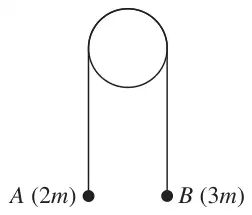
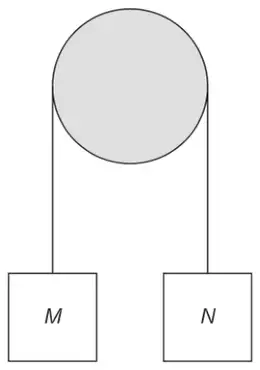
Two particles \(A\) and \(B\) have masses \(2m\) and \(3m\) respectively. The particles are connected by a light inextensible string which passes over a smooth light fixed pulley. The system is held at rest with the string taut. The hanging parts of the string are vertical and \(A\) and \(B\) are above a horizontal plane, as shown in Figure 2. The system is released from rest.
(a) Show that the tension in the string immediately after the particles are released is \(\dfrac{12}{5}mg\). (6)
After descending 1.5 m, \(B\) strikes the plane and is immediately brought to rest. In the subsequent motion, \(A\) does not reach the pulley.
(b) Find the distance travelled by \(A\) between the instant when \(B\) strikes the plane and the instant when the string next becomes taut. (6)
Given that \(m = 0.5\) kg,
(c) find the magnitude of the impulse on \(B\) due to the impact with the plane. (2)
Mark scheme (a)
Scheme
Marks
\(3mg - T = 3ma\)
M1A1
\(T - 2mg = 2ma\)
M1A1
\(T = 2mg + 2\left(mg - \dfrac{T}{3}\right)\)
DM1
\(T = \dfrac{12}{5}mg\) *Given Answer*
A1
(6)
Notes
First M1 for resolving vertically (up or down) for \(B\), with correct no. of terms etc (allow if they omit \(m\) but have the 3)
First A1 for a correct equation.
Second M1 for resolving vertically (up or down) for \(A\), with correct no. of terms etc (allow if they omit \(m\) but have the 2)
Second A1 for a correct equation
Third M1, dependent on the first two M marks, for eliminating \(a\)
Third A1 for \(T = 12mg/5\) given answer
N.B. Either equation above can be replaced by the whole system equation
M1A1 for \(3mg - 2mg = 5ma\); any error loses both marks.
N.B. If \(m\) has been omitted in (a), which has led to a dimensionally incorrect value of \(a\), can score max B0M1A0M1M1A0 in (b) and M1A0 in (c).
Mark scheme (b)
Scheme
Marks
\(a = \dfrac{g}{5}\)
B1
At time of impact \(v^2 = u^2 + 2as = 2 \times \dfrac{g}{5} \times 1.5 = 0.6g\)
M1A1
Vertical motion under gravity \(0 = 0.6g - 2gs\)
M1
\(s = 0.3\) (m)
Total distance \(2 \times 0.3 = 0.6\) (m)
DM1A1
(6)
Notes
B1 for \(a = g/5\) found (possibly in part (a)) and used here.
First M1 for using suvat with their \(a\) from part (a), to find the speed \(v\) (or \(v^2\)) of \(B\) at impact
First A1 for \(\sqrt{0.6g}\) oe, 2.4 or better (may be implied) found correctly.
Second M1 for using suvat with \(a = \pm g\), to obtain an equation in \(s\) only, using their \(v\) (or \(v^2\)) with final velocity \(= 0\)
Third M1, dependent on second M1, for doubling their \(s\) value
Second A1 for 0.6 (m)
Mark scheme (c)
Scheme
Marks
Impulse \(= 3m(v - u) = -3mu\)
M1
Magnitude \(= 3m\sqrt{0.6g} = 3.6\) (Ns) (3.64)
A1
(2)
(14 marks)
Notes
M1 for \(\pm 3m \times\) (their \(v\)) or \(\pm 1.5 \times\) (their \(v\)) or \(\pm m \times\) (their \(v\)) or \(\pm 0.5 \times\) (their \(v\))
4. At time \(t = 0\), a particle is projected vertically upwards with speed \(u\) from a point \(A\). The particle moves freely under gravity. At time \(T\) the particle is at its maximum height \(H\) above \(A\).
(a) Find \(T\) in terms of \(u\) and \(g\). (2)
(b) Show that \(H = \dfrac{u^2}{2g}\) (2)
The point \(A\) is at a height \(3H\) above the ground.
(c) Find, in terms of \(T\), the total time from the instant of projection to the instant when the particle hits the ground. (4)
Mark scheme (a)
Scheme
Marks
Max ht \(v = 0\). \(\ v = u - gt \Rightarrow T = \dfrac{u}{g}\)
M1A1
(2)
Notes
In this question, condone sign errors in a suvat equation for the M mark, but a missing term is M0 or an incorrect term is M0. An incorrect suvat formula is M0
Allow use of symmetry of motion.
e.g. in (a), using \(v = u + at\), either \(0 = u - gT\) or \(u = 0 + gT\)
M1 for use of suvat to obtain an equation in \(T\), \(u\) and \(g\) only.
A1 for \(T = u/g\) correctly obtained.
Mark scheme (b)
Scheme
Marks
Max ht \(H = ut + \dfrac{1}{2}at^2 = \dfrac{u^2}{g} - \dfrac{u^2}{2g} = \dfrac{u^2}{2g}\) * Given answer*
M1A1
Or use of \(v^2 = u^2 + 2as\)
(2)
Notes
In this question, condone sign errors in a suvat equation for the M mark, but a missing term is M0 or an incorrect term is M0. An incorrect suvat formula is M0
Allow use of symmetry of motion.
M1 for use of suvat to obtain an equation in \(H\), \(u\) and \(g\) only.
A1 for \(H = u^2/2g\) correctly obtained (given answer)
Mark scheme (c)
Scheme
Marks
\(-3 \times \dfrac{u^2}{2g} = ut - \dfrac{1}{2}gt^2\)
In this question, condone sign errors in a suvat equation for the M mark, but a missing term is M0 or an incorrect term is M0. An incorrect suvat formula is M0
Allow use of symmetry of motion.
Question 4(c)Watch out for t / T confusion (N.B. if only \(T\)’s used, M0DM0)
First M1 for a complete method to find the total time in terms of \(u\), \(g\), \(H\) or \(T\):-
either: \(3H = -ut + \frac{1}{2}gt^2\)
or: \(4H = \frac{1}{2}gt^2\) and \(t + T\)
or: \(v^2 = u^2 + 6gH\) and \(v = -u + gt\), with \(v\) eliminated
Second M1, dependent on first M1, for producing an expression, in terms of \(u\), \(g\), \(H\) or \(T\), for the total time, by solving a quadratic
First A1 for any correct expression for the total time in terms of \(u\), \(g\), \(H\) or \(T\).
Second A1 for \(3T\) cso
(c) alt
\(-4H = -\dfrac{1}{2}gt^2\)
M1
Total time \(= T + \sqrt{\dfrac{8H}{g}} = T + \sqrt{\dfrac{8u^2}{2g^2}}\)
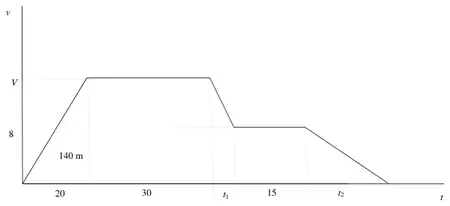
3. A car starts from rest and moves with constant acceleration along a straight horizontal road. The car reaches a speed of \(V\) m s\(^{-1}\) in 20 seconds. It moves at constant speed \(V\) m s\(^{-1}\) for the next 30 seconds, then moves with constant deceleration \(\dfrac{1}{2}\) m s\(^{-2}\) until it has speed 8 m s\(^{-1}\). It moves at speed 8 m s\(^{-1}\) for the next 15 seconds and then moves with constant deceleration \(\dfrac{1}{3}\) m s\(^{-2}\) until it comes to rest.
(a) Sketch, in the space below, a speed-time graph for this journey. (3)
In the first 20 seconds of this journey the car travels 140 m.
Find
(b) the value of \(V\), (2)
(c) the total time for this journey, (4)
(d) the total distance travelled by the car. (4)
Mark scheme (a)
Scheme
Marks
\(0 < t < 50\)
B1
\(50 < t\)
B1
(\(V\),8,15,20,30)
B1
(3)
Notes
First B1 for shape of graph for \(0 \leqslant t \leqslant 50\)
Second B1 for shape of graph for \(t > 50\)
Third B1 for \(V\), 8, 15, 20, 30 appropriately used
Mark scheme (b)
Scheme
Marks
Use area under graph or suvat to form an equation in \(V\) only.
\(140 = \dfrac{1}{2} \times 20 \times V\)
M1
\(V = 14\)
A1
(2)
Notes
M1 for use of area under graph (must have ‘1/2’) or suvat to obtain an equation in \(V\) only.
First M1 for an expression for the total area (distance) including all parts of the motion. Where a triangle or trapezium is used, a ‘1/2’ must be seen.
Second A2 ft on their \(V\), \(t_1\) and \(t_2\), -1 each error.
3. A ball of mass 0.3 kg is released from rest at a point which is 2 m above horizontal ground. The ball moves freely under gravity. After striking the ground, the ball rebounds vertically and rises to a maximum height of 1.5 m above the ground, before falling to the ground again. The ball is modelled as a particle.
(a) Find the speed of the ball at the instant before it strikes the ground for the first time. (2)
(b) Find the speed of the ball at the instant after it rebounds from the ground for the first time. (2)
(c) Find the magnitude of the impulse on the ball in the first impact with the ground. (2)
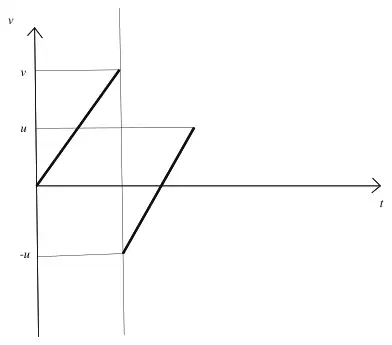
(d) Sketch, in the space provided, a velocity-time graph for the motion of the ball from the instant when it is released until the instant when it strikes the ground for the second time. (3)
(e) Find the time between the instant when the ball is released and the instant when it strikes the ground for the second time. (4)
Mark scheme (a)
Scheme
Marks
Using \(v^2 = u^2 + 2as\): \(v^2 = 4g\), \(v = \sqrt{4g}\) or 6.3 or 6.26 (m s\(^{-1}\))
M1,A1
(2)
Notes
N.B. Deduct only 1 mark in whole question for not giving an answer to either 2 sf or 3 sf, following use of g = 9.8 or use of g = 9.81
M1 is for a complete method for finding speed (usually \(v^2 = u^2 + 2as\))
A1 for \(v = 6.3\) (ms\(^{-1}\)) or 6.26 (ms\(^{-1}\)) or \(\sqrt{4g}\) (ms\(^{-1}\)) (must be positive)
Allow \(0 = u^2 - 4g\) or \(v^2 = 4g\) but not \(0 = u^2 + 4g\) or \(v^2 = -4g\)
Mark scheme (b)
Scheme
Marks
Rebounds to 1.5 m, \(0 = u^2 - 3g\), \(u = \sqrt{3g}\), 5.4 or 5.42 (m s\(^{-1}\))
M1A1
(2)
Notes
M1 is for a complete method for finding speed
Allow \(0 = u^2 - 3g\) or \(v^2 = 3g\) but not \(0 = u^2 + 3g\) or \(v^2 = -3g\)
A1 for 5.4 (ms\(^{-1}\)) or 5.42 (ms\(^{-1}\)) or \(\sqrt{3g}\) (ms\(^{-1}\)) (must be positive)
Mark scheme (c)
Scheme
Marks
Impulse \(= 0.3(6.3 + 5.4) = 3.5\) (Ns)
M1A1
(2)
Notes
M1 is for \(\pm 0.3\)(their (b) \(\pm\) their (a)) (unless they are definitely adding the momenta i.e. using \(I = m(v + u)\) which is M0). N.B. Extra g is M0
A1 for 3.5 (Ns) or 3.50 (Ns) (must be positive)
Mark scheme (d)
Scheme
Marks
If speed downwards is taken to be positive:
First line B1 Second line B1 \(-u, u\), B1
(3)
Notes
First B1 for a straight line from origin to their \(v\) which must be marked on the axis.
Second B1 for a parallel straight line correctly positioned (if continuous vertical lines are clearly included as part of the graph then B0)
Third B1 for their \(-u\) and \(u\) correctly marked, provided their second line is correctly positioned
N.B. A reflection of the graph in the \(t\)-axis (upwards +ve) is also acceptable
Mark scheme (e)
Scheme
Marks
Use of suvat to find \(t_1\) or \(t_2\), \(\sqrt{4g} = gt_1\) \(t_1 = \sqrt{\dfrac{4}{g}} = 0.64\) s \(\sqrt{3g} = gt_2\) \(t_2 = \sqrt{\dfrac{3}{g}} = 0.55\) s
M1A1 (\(t_1\) or \(t_2\))
Total time \(= t_1 + 2t_2 = 1.7\) s or 1.75 s
DM1A1
(4)
(13 marks)
Notes
First M1 for use of suvat or area under their \(v\)-\(t\) graph to find either \(t_1\) or \(t_2\) or \(2t_2\)
First A1 for correct value for either \(t_1\) or \(t_2\) (can be in terms of g at this stage or surds or unsimplified e.g.6.3/9.8)
Second M1 dependent on the first M1 for their \(t_1 + 2t_2\)
4. At time \(t = 0\), two balls \(A\) and \(B\) are projected vertically upwards. The ball \(A\) is projected vertically upwards with speed 2 m s\(^{-1}\) from a point 50 m above the horizontal ground. The ball \(B\) is projected vertically upwards from the ground with speed 20 m s\(^{-1}\). At time \(t = T\) seconds, the two balls are at the same vertical height, \(h\) metres, above the ground. The balls are modelled as particles moving freely under gravity. Find
\(T = \dfrac{50}{18} = 2.777\ldots = 2.8\) or better
A1
(5)
Notes
First M1 for use of \(s = ut + 1/2at^2\) (or use of 2 suvat formulae AND eliminating \(v\), to give an equation in \(s\) and \(t\)). N.B. M0 if they use \(s = 50\) or \(u = 0\) or \(v = 0\))
First A1 with \(u = 2\) and \(a = -g\) or \(-9.8\) to obtain a distance, possibly with 50 added or subtracted. (2 and 4.9 must have opposite signs)
Second A1 with \(u = 20\) and \(a = -g\) or \(-9.8\) to obtain a distance, possibly with 50 added or subtracted. (2 and 4.9 must have opposite signs)
Second M1 dependent on first M1 for a correct equation obtained correctly in \(T\) only.
Third A1 for 25/9 oe, 2.8 or better
Mark scheme (b)
Scheme
Marks
\(h = 20 \times T - 4.9 \times T^2 = 17.74\ldots \approx 17.7\) (18 to 2 s.f.) (use of 2.8 gives 17.584)
M1A1
(2)
(7 marks)
Notes
First M1 for substituting their \(T\) value (allow –ve changed to +ve but A mark is then unavailable) into an appropriate equation
First A1 for 17.7 or 18 (m). (A0 if they then add 50)
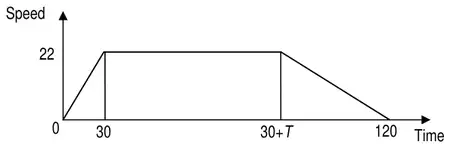
5. A car is travelling along a straight horizontal road. The car takes 120 s to travel between two sets of traffic lights which are 2145 m apart. The car starts from rest at the first set of traffic lights and moves with constant acceleration for 30 s until its speed is 22 m s\(^{-1}\). The car maintains this speed for \(T\) seconds. The car then moves with constant deceleration, coming to rest at the second set of traffic lights.
(a) Sketch, in the space below, a speed-time graph for the motion of the car between the two sets of traffic lights. (2)
(b) Find the value of \(T\). (3)
A motorcycle leaves the first set of traffic lights 10 s after the car has left the first set of traffic lights. The motorcycle moves from rest with constant acceleration, \(a\) m s\(^{-2}\), and passes the car at the point \(A\) which is 990 m from the first set of traffic lights. When the motorcycle passes the car, the car is moving with speed 22 m s\(^{-1}\).
(c) Find the time it takes for the motorcycle to move from the first set of traffic lights to the point \(A\). (4)
(d) Find the value of \(a\). (2)
Mark scheme (a)
Scheme
Marks
Shape B1 Figures B1
(2)
Notes
First B1 for a trapezium starting at the origin and ending on the \(t\)-axis.
Second B1 for the figures marked (allow missing 0 and a delineator oe for \(T\)) (allow if they have used \(T = 75\) correctly on their graph)
Mark scheme (b)
Scheme
Marks
\(\dfrac{(120 + T)22}{2} = 2145\)
M1 A1
\(T = 75\)
A1
(3)
Notes
First M1 for producing an equation in their \(T\) only by equating the area of the trapezium to 2145, with the correct no. of terms. If using a single trapezium, we need to see evidence of using ½ the sum of the two parallel sides or if using triangle(s), need to see ½ base x height.
Second A1 cao for a correct equation in \(T\) (This is not f.t. on their \(T\))
Third A1 for \(T = 75\).
N.B. Use of a single suvat equation for the whole motion of the car e.g. \(s = t(u + v)/2\) is M0
Mark scheme (c)
Scheme
Marks
\(\dfrac{(t + t - 30)22}{2} = 990\)
M1 A1
\(t = 60\)
A1
\(\mathit{Answer} = 60 - 10 = 50\)
A1
(4)
Notes
First M1 for producing an equation in \(t\) only (they may use \((t - 30)\) oe as their variable) by equating the area of the trapezium to 990, with the correct no. of terms. If using a trapezium, we need to see evidence of using ½ the sum of the two parallel sides or if using triangle(s), need to see ½ base x height.
First A1 for a correct equation.
Second A1 for \(t = 60\) (Allow 30 + 30).
Third A1 for answer of 50.
N.B. Use of a single suvat equation for the whole motion of the car e.g. \(s = t(u + v)/2\) is M0.
Use of the motion of the motorcycle is M0 (insufficient information).
4. A lorry is moving along a straight horizontal road with constant acceleration. The lorry passes a point \(A\) with speed \(u\) m s\(^{-1}\), \((u \lt 34)\), and 10 seconds later passes a point \(B\) with speed 34 m s\(^{-1}\). Given that \(AB = 240\) m, find
(a) the value of \(u\), (3)
(b) the time taken for the lorry to move from \(A\) to the mid-point of \(AB\). (6)
Mark scheme (a)
Scheme
Marks
\(240 = \tfrac{1}{2}(u + 34)10\)
M1 A1
\(u = 14\)
A1
(3)
Notes
First M1 for a complete method to produce an equation in \(u\) only.
First A1 for a correct equation. (\(u^2 - 48u + 476 = 0\) oe is possible).
First M1 for an equation in \(a\) only. (M0 if \(v = 34\) when \(s = 120\) is used)
First A1 for \(a = 2\). (This may have been found in part (a))
Second M1 for a 3-term quadratic equation in \(t\) only, allow sign errors (must have found a value of \(a\). (M0 if \(v = 34\) when \(s = 120\) is used)
Second A1 for a correct equation.
Third M1 dependent on previous M1 for solving for \(t\).
Third A1 for \(t = 6\)
OR
First M1 for an equation in \(a\) only.
First A1 for \(a = 2\). (This may have been found in part (a))
Second M1 for a complete method to obtain an equation in \(t\) only, allow sign errors. (must have found a value of \(a\))
Second A1 for a correct equation.
Third M1 dependent on previous M1 for solving for \(t\).
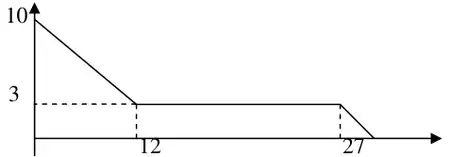
The velocity-time graph in Figure 4 represents the journey of a train \(P\) travelling along a straight horizontal track between two stations which are 1.5 km apart. The train \(P\) leaves the first station, accelerating uniformly from rest for 300 m until it reaches a speed of 30 m s\(^{-1}\). The train then maintains this speed for \(T\) seconds before decelerating uniformly at 1.25 m s\(^{-2}\), coming to rest at the next station.
(a) Find the acceleration of \(P\) during the first 300 m of its journey. (2)
(b) Find the value of \(T\). (5)
A second train \(Q\) completes the same journey in the same total time. The train leaves the first station, accelerating uniformly from rest until it reaches a speed of \(V\) m s\(^{-1}\) and then immediately decelerates uniformly until it comes to rest at the next station.
(c) Sketch on the diagram above, a velocity-time graph which represents the journey of train \(Q\). (2)
5. A particle \(P\) is projected vertically upwards from a point \(A\) with speed \(u\) m s\(^{-1}\). The point \(A\) is 17.5 m above horizontal ground. The particle \(P\) moves freely under gravity until it reaches the ground with speed 28 m s\(^{-1}\).
(a) Show that \(u = 21\) (3)
At time \(t\) seconds after projection, \(P\) is 19 m above \(A\).
(b) Find the possible values of \(t\). (5)
The ground is soft and, after \(P\) reaches the ground, \(P\) sinks vertically downwards into the ground before coming to rest. The mass of \(P\) is 4 kg and the ground is assumed to exert a constant resistive force of magnitude 5000 N on \(P\).
(c) Find the vertical distance that \(P\) sinks into the ground before coming to rest. (4)
First M1 for a complete method for finding at least one \(t\) value i.e. for producing an equation in \(t\) only. (condone sign errors but not missing terms)
First A1 for a correct quadratic equation in \(t\) only or TWO correct linear equations in \(t\) only.
Second DM1, dependent on first M1, for attempt to solve the quadratic or one of the linear equations.
Second A1 for 3.0 or 3 or 2.99
Third A1 for 1.3 or 1.30
Mark scheme (c)
Scheme
Marks
N2L \(4g - 5000 = 4a\) \((a = -1240.2)\)
M1 A1
\(v^2 = u^2 + 2as\ \Rightarrow\ 0^2 = 28^2 - 2 \times 1240.2 \times s\) Leading to \(s = 0.316\) (m) or 0.32
M1 A1
(4)
(12 marks)
Notes
First M1 for resolving vertically with usual rules.
First A1 for a correct equation
Second M1 for use of \(v^2 = u^2 + 2as\), with \(v = 0\), \(u = 28\) or \(u = 0\) and \(v = 28\) and their \(a\), (or any other complete method which produces an equation in \(s\), which could be negative)
M0 if they haven’t calculated a value of \(a\).
Second A1 for 0.32 or 0.316. (must be positive since it’s a distance)
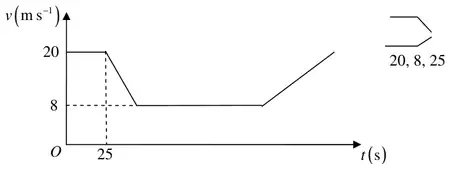
4. A car is moving on a straight horizontal road. At time \(t = 0\), the car is moving with speed 20 m s\(^{-1}\) and is at the point \(A\). The car maintains the speed of 20 m s\(^{-1}\) for 25 s. The car then moves with constant deceleration 0.4 m s\(^{-2}\), reducing its speed from 20 m s\(^{-1}\) to 8 m s\(^{-1}\). The car then moves with constant speed 8 m s\(^{-1}\) for 60 s. The car then moves with constant acceleration until it is moving with speed 20 m s\(^{-1}\) at the point \(B\).
(a) Sketch a speed-time graph to represent the motion of the car from \(A\) to \(B\). (3)
(b) Find the time for which the car is decelerating. (2)
Given that the distance from \(A\) to \(B\) is 1960 m,
(c) find the time taken for the car to move from \(A\) to \(B\). (8)
Mark scheme (a)
Scheme
Marks
B1 B1 B1
(3)
Notes
First B1 for 1st section of graph
Second B1 for 2nd section
Third B1 for the figures 20, 8 and 25
Mark scheme (b)
Scheme
Marks
\(v = u + at\ \Rightarrow\ 8 = 20 - 0.4t\)
M1
\(t = 30\) (s)
A1
(2)
Notes
M1 for a complete method to produce an equation in \(t\) only; allow \((20 - 8)/0.4\)
A1 for 30 N.B.
Give A0 for \(t = -30\), even if changed to 30, but then allow use of 30 in part (c), where full marks could then be scored.
First M1 (generous) for clear attempt to find whole area under their graph (must include at least one “1/2”), in terms of a single unknown time (\(t\) say), and equate it to 1960.
First A3, ft on their (b), for a correct equation.
Deduct 1 mark for each numerical error, or omission, in each of the 4 sections of the area corresponding to each stage of the motion. (they may ‘slice’ it, horizontally into 3 sections, or a combination of the two)
Second DM1, dependent on first M1, for simplifying to produce an equation with all their \(t\) terms collected.
Fourth A1 for a correct equation for \(t\) or \(T\)
Third DM1, dependent on second M1. for solving for \(T\)
Fifth A1 155
Please note that any incorrect answer to (b) will lead to an answer of 155 in (c) and can score max 6/8;
Solutions with the correct answer of 155 will need to be checked carefully.
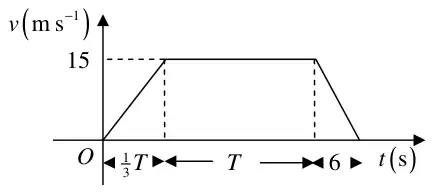
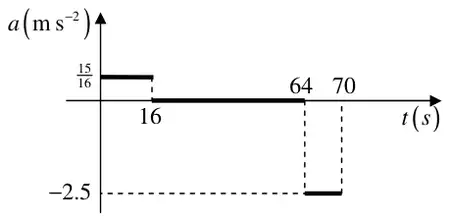
6. A car moves along a straight horizontal road from a point \(A\) to a point \(B\), where \(AB = 885\) m. The car accelerates from rest at \(A\) to a speed of 15 m s\(^{-1}\) at a constant rate \(a\) m s\(^{-2}\). The time for which the car accelerates is \(\tfrac{1}{3}T\) seconds. The car maintains the speed of 15 m s\(^{-1}\) for \(T\) seconds. The car then decelerates at a constant rate of 2.5 m s\(^{-2}\) stopping at \(B\).
(a) Find the time for which the car decelerates. (2)
(b) Sketch a speed-time graph for the motion of the car. (2)
(c) Find the value of \(T\). (4)
(d) Find the value of \(a\). (2)
(e) Sketch an acceleration-time graph for the motion of the car. (3)
Mark scheme (a)
Scheme
Marks
\(v = u + at \ \Rightarrow\ 0 = 15 - 2.5t\)
M1
\(t = 6\ \ (\text{s})\)
A1
(2)
Mark scheme (b)
Scheme
Marks
Shape
B1
15, \(T\)
B1
(2)
Mark scheme (c)
Scheme
Marks
\(\dfrac{1}{2}15\left(\dfrac{4}{3}T + 6 + T\right) = 885\) ft their 6
5. A stone is projected vertically upwards from a point \(A\) with speed \(u\) m s\(^{-1}\). After projection the stone moves freely under gravity until it returns to \(A\). The time between the instant that the stone is projected and the instant that it returns to \(A\) is \(3\tfrac{4}{7}\) seconds.
Modelling the stone as a particle,
(a) show that \(u = 17\tfrac{1}{2}\), (3)
(b) find the greatest height above \(A\) reached by the stone, (2)
(c) find the length of time for which the stone is at least \(6\tfrac{3}{5}\) m above \(A\). (6)
Mark scheme (a)
Scheme
Marks
\(v = u + at\,(\uparrow) \Rightarrow 0 = u - g\left(\dfrac{25}{14}\right)\)
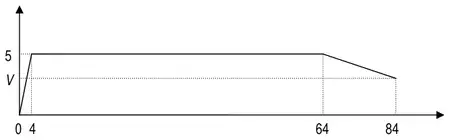
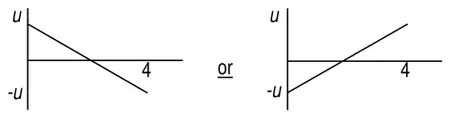
4. A girl runs a 400 m race in a time of 84 s. In a model of this race, it is assumed that, starting from rest, she moves with constant acceleration for 4 s, reaching a speed of 5 m s\(^{-1}\). She maintains this speed for 60 s and then moves with constant deceleration for 20 s, crossing the finishing line with a speed of \(V\) m s\(^{-1}\).
(a) Sketch, in the space below, a speed-time graph for the motion of the girl during the whole race. (2)
(b) Find the distance run by the girl in the first 64 s of the race. (3)
(c) Find the value of \(V\). (5)
(d) Find the deceleration of the girl in the final 20 s of her race. (2)
1. At time \(t = 0\) a ball is projected vertically upwards from a point \(O\) and rises to a maximum height of 40 m above \(O\). The ball is modelled as a particle moving freely under gravity.
(a) Show that the speed of projection is 28 m s\(^{-1}\). (3)
(b) Find the times, in seconds, when the ball is 33.6 m above \(O\). (5)
2. A ball is thrown vertically upwards with speed \(u\) m s\(^{-1}\) from a point \(P\) at height \(h\) metres above the ground. The ball hits the ground 0.75 s later. The speed of the ball immediately before it hits the ground is 6.45 m s\(^{-1}\). The ball is modelled as a particle.
(a) Show that \(u = 0.9\) (3)
(b) Find the height above \(P\) to which the ball rises before it starts to fall towards the ground again. (2)
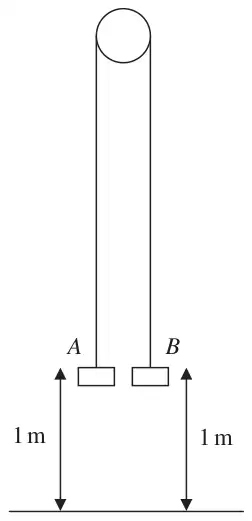
Two particles \(A\) and \(B\) have mass 0.4 kg and 0.3 kg respectively. The particles are attached to the ends of a light inextensible string. The string passes over a small smooth pulley which is fixed above a horizontal floor. Both particles are held, with the string taut, at a height of 1 m above the floor, as shown in Figure 3. The particles are released from rest and in the subsequent motion \(B\) does not reach the pulley.
(a) Find the tension in the string immediately after the particles are released. (6)
(b) Find the acceleration of \(A\) immediately after the particles are released. (2)
When the particles have been moving for 0.5 s, the string breaks.
(c) Find the further time that elapses until \(B\) hits the floor. (9)
6. A ball is projected vertically upwards with a speed of 14.7 m s\(^{-1}\) from a point which is 49 m above horizontal ground. Modelling the ball as a particle moving freely under gravity, find
(a) the greatest height, above the ground, reached by the ball, (4)
(b) the speed with which the ball first strikes the ground, (3)
(c) the total time from when the ball is projected to when it first strikes the ground. (3)
Mark scheme (a)
Scheme
Marks
\((\uparrow)\ \ v^2 = u^2 + 2as\)
\(0 = 14.7^2 - 2 \times 9.8 \times s\)
M1A1
\(s = 11.025\) (or 11 or 11.0 or 11.03) m
A1
Height is 60 m or 60.0 m ft
A1ft
(4)
Mark scheme (b)
Scheme
Marks
\((\downarrow)\ \ v^2 = u^2 + 2as\)
\(v^2 = (-14.7)^2 + 2 \times 9.8 \times 49\)
M1 A1
\(v = 34.3\) or 34 m s\(^{-1}\)
A1
(3)
Mark scheme (c)
Scheme
Marks
\((\downarrow)\ \ v = u + at\) OR \((\downarrow)\ \ s = ut + \tfrac{1}{2}at^2\)
5. Two cars \(P\) and \(Q\) are moving in the same direction along the same straight horizontal road. Car \(P\) is moving with constant speed 25 m s\(^{-1}\). At time \(t = 0\), \(P\) overtakes \(Q\) which is moving with constant speed 20 m s\(^{-1}\). From \(t = T\) seconds, \(P\) decelerates uniformly, coming to rest at a point \(X\) which is 800 m from the point where \(P\) overtook \(Q\). From \(t = 25\) s, \(Q\) decelerates uniformly, coming to rest at the same point \(X\) at the same instant as \(P\).
(a) Sketch, on the same axes, the speed-time graphs of the two cars for the period from \(t = 0\) to the time when they both come to rest at the point \(X\). (4)
(b) Find the value of \(T\). (8)
Mark scheme (a)
Scheme
Marks
Shape (both)
B1
Cross
B1
Meet on \(t\)-axis
B1
Figures 25, 20, \(T\), 25
B1
(4)
Mark scheme (b)
Scheme
Marks
For \(Q\): \(20\left(\dfrac{t + 25}{2}\right) = 800\)
M1 A1
\(t = 55\)
DM1 A1
For \(P\): \(25\left(\dfrac{T + 55}{2}\right) = 800\)
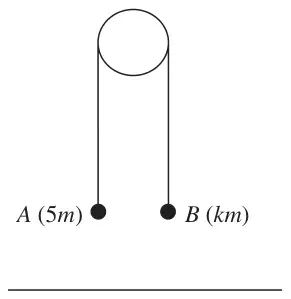
Two particles \(A\) and \(B\) have masses \(5m\) and \(km\) respectively, where \(k \lt 5\). The particles are connected by a light inextensible string which passes over a smooth light fixed pulley. The system is held at rest with the string taut, the hanging parts of the string vertical and with \(A\) and \(B\) at the same height above a horizontal plane, as shown in Figure 4. The system is released from rest. After release, \(A\) descends with acceleration \(\dfrac{1}{4}g\).
(a) Show that the tension in the string as \(A\) descends is \(\dfrac{15}{4}mg\). (3)
(b) Find the value of \(k\). (3)
(c) State how you have used the information that the pulley is smooth. (1)
After descending for 1.2 s, the particle \(A\) reaches the plane. It is immediately brought to rest by the impact with the plane. The initial distance between \(B\) and the pulley is such that, in the subsequent motion, \(B\) does not reach the pulley.
(d) Find the greatest height reached by \(B\) above the plane. (7)
Mark scheme (a)
Scheme
Marks
N2L \(A\): \(5mg - T = 5m \times \dfrac{1}{4}g\)
M1 A1
\(T = \dfrac{15}{4}mg\) * cso
A1
(3)
Mark scheme (b)
Scheme
Marks
N2L \(B\): \(T - kmg = km \times \dfrac{1}{4}g\)
M1 A1
\(k = 3\)
A1
(3)
Mark scheme (c)
Scheme
Marks
The tensions in the two parts of the string are the same
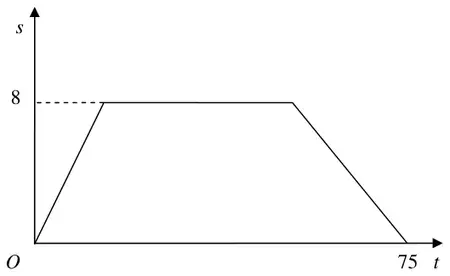
2. An athlete runs along a straight road. She starts from rest and moves with constant acceleration for 5 seconds, reaching a speed of 8 m s\(^{-1}\). This speed is then maintained for \(T\) seconds. She then decelerates at a constant rate until she stops. She has run a total of 500 m in 75 s.
(a) In the space below, sketch a speed-time graph to illustrate the motion of the athlete. (3)
1. Three posts \(P\), \(Q\) and \(R\), are fixed in that order at the side of a straight horizontal road. The distance from \(P\) to \(Q\) is 45 m and the distance from \(Q\) to \(R\) is 120 m. A car is moving along the road with constant acceleration \(a\) m s\(^{-2}\). The speed of the car, as it passes \(P\), is \(u\) m s\(^{-1}\). The car passes \(Q\) two seconds after passing \(P\), and the car passes \(R\) four seconds after passing \(Q\). Find
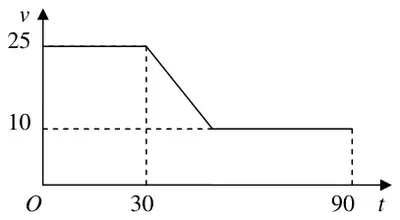
4. A car is moving along a straight horizontal road. The speed of the car as it passes the point \(A\) is 25 m s\(^{-1}\) and the car maintains this speed for 30 s. The car then decelerates uniformly to a speed of 10 m s\(^{-1}\). The speed of 10 m s\(^{-1}\) is then maintained until the car passes the point \(B\). The time taken to travel from \(A\) to \(B\) is 90 s and \(AB = 1410\) m.
(a) Sketch, in the space below, a speed-time graph to show the motion of the car from \(A\) to \(B\). (2)
(b) Calculate the deceleration of the car as it decelerates from 25 m s\(^{-1}\) to 10 m s\(^{-1}\). (7)
2. At time \(t = 0\), a particle is projected vertically upwards with speed \(u\) m s\(^{-1}\) from a point 10 m above the ground. At time \(T\) seconds, the particle hits the ground with speed 17.5 m s\(^{-1}\). Find
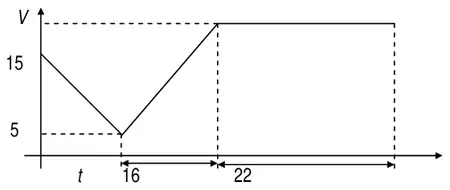
3. A car moves along a horizontal straight road, passing two points \(A\) and \(B\). At \(A\) the speed of the car is 15 m s\(^{-1}\). When the driver passes \(A\), he sees a warning sign \(W\) ahead of him, 120 m away. He immediately applies the brakes and the car decelerates with uniform deceleration, reaching \(W\) with speed 5 m s\(^{-1}\). At \(W\), the driver sees that the road is clear. He then immediately accelerates the car with uniform acceleration for 16 s to reach a speed of \(V\) m s\(^{-1}\) \((V \gt 15)\). He then maintains the car at a constant speed of \(V\) m s\(^{-1}\). Moving at this constant speed, the car passes \(B\) after a further 22 s.
(a) Sketch, in the space below, a speed-time graph to illustrate the motion of the car as it moves from \(A\) to \(B\). (3)
(b) Find the time taken for the car to move from \(A\) to \(B\). (3)
The distance from \(A\) to \(B\) is 1 km.
(c) Find the value of \(V\). (5)
Mark scheme (a)
Scheme
Marks
Shape ‘V’
B1
Shape for last 22s (with \(V \gt 15\))
B1
Figures
B1
(3)
Mark scheme (b)
Scheme
Marks
\(\tfrac{1}{2}(15 + 5) \times t = 120\)
M1
\(\Rightarrow\ \ t = 12\ \ \rightarrow\ \ T = 12 + 16 + 22 = 50\) s
2. A firework rocket starts from rest at ground level and moves vertically. In the first 3 s of its motion, the rocket rises 27 m. The rocket is modelled as a particle moving with constant acceleration \(a\) m s\(^{-2}\). Find
(a) the value of \(a\), (2)
(b) the speed of the rocket 3 s after it has left the ground. (2)
After 3 s, the rocket burns out. The motion of the rocket is now modelled as that of a particle moving freely under gravity.
(c) Find the height of the rocket above the ground 5 s after it has left the ground. (4)
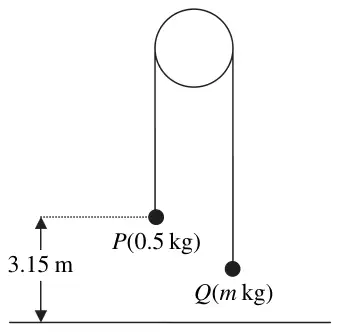
Two particles \(P\) and \(Q\) have mass 0.5 kg and \(m\) kg respectively, where \(m \lt 0.5\). The particles are connected by a light inextensible string which passes over a smooth, fixed pulley. Initially \(P\) is 3.15 m above horizontal ground. The particles are released from rest with the string taut and the hanging parts of the string vertical, as shown in Figure 4. After \(P\) has been descending for 1.5 s, it strikes the ground. Particle \(P\) reaches the ground before \(Q\) has reached the pulley.
(a) Show that the acceleration of \(P\) as it descends is 2.8 m s\(^{-2}\). (3)
(b) Find the tension in the string as \(P\) descends. (3)
(c) Show that \(m = \dfrac{5}{18}\). (4)
(d) State how you have used the information that the string is inextensible. (1)
When \(P\) strikes the ground, \(P\) does not rebound and the string becomes slack. Particle \(Q\) then moves freely under gravity, without reaching the pulley, until the string becomes taut again.
(e) Find the time between the instant when \(P\) strikes the ground and the instant when the string becomes taut again. (6)
4. A car is moving along a straight horizontal road. At time \(t = 0\), the car passes a point \(A\) with speed 25 m s\(^{-1}\). The car moves with constant speed 25 m s\(^{-1}\) until \(t = 10\) s. The car then decelerates uniformly for 8 s. At time \(t = 18\) s, the speed of the car is \(V\) m s\(^{-1}\) and this speed is maintained until the car reaches the point \(B\) at time \(t = 30\) s.
(a) Sketch, in the space provided, a speed–time graph to show the motion of the car from \(A\) to \(B\). (3)
Given that \(AB = 526\) m, find
(b) the value of \(V\), (5)
(c) the deceleration of the car between \(t = 10\) s and \(t = 18\) s. (3)
5. A ball is projected vertically upwards with speed 21 m s\(^{-1}\) from a point \(A\), which is 1.5 m above the ground. After projection, the ball moves freely under gravity until it reaches the ground. Modelling the ball as a particle, find
(a) the greatest height above \(A\) reached by the ball, (3)
(b) the speed of the ball as it reaches the ground, (3)
(c) the time between the instant when the ball is projected from \(A\) and the instant when the ball reaches the ground. (4)
3. A train moves along a straight track with constant acceleration. Three telegraph poles are set at equal intervals beside the track at points \(A\), \(B\) and \(C\), where \(AB = 50\) m and \(BC = 50\) m. The front of the train passes \(A\) with speed 22.5 m s\(^{-1}\), and 2 s later it passes \(B\). Find
(a) the acceleration of the train, (3)
(b) the speed of the front of the train when it passes \(C\), (3)
(c) the time that elapses from the instant the front of the train passes \(B\) to the instant it passes \(C\). (4)
Mark scheme (a)
Scheme
Marks
\(AB\): \(50 = 2 \times 22.5 + \tfrac{1}{2}a.4\)
M1 A1
\(\Rightarrow a = 2.5\) m s\(^{-2}\)
A1
(3)
Notes
NB note slight changes to scheme: dependency now in (c) and new rule on accuracy of answers.
Mark scheme (b)
Scheme
Marks
\(v^2 = 22.5^2 + 2 \times 2.5 \times 100\)
M1 A1ft
\(\Rightarrow v \approx 31.7(2)\) m s\(^{-1}\)
A1
(3)
Notes
(b) M1 for valid use of data (e.g. finding speed at \(B\) by spurious means and using this to get \(v\) at \(C\) is M0.
Accept answer as AWRT 31.7
In (b) and (c), f.t. A marks are for f.t. on wrong \(a\) and/or answer from (b).
1. A stone is thrown vertically upwards with speed 16 m s\(^{-1}\) from a point \(h\) metres above the ground. The stone hits the ground 4 s later. Find
(a) the value of \(h\), (3)
(b) the speed of the stone as it hits the ground. (3)
Mark scheme (a)
Scheme
Marks
Distance after 4 s \(= 16 \times 4 - \tfrac{1}{2} \times 9.8 \times 4^2\)
M1 A1
\(= -14.4 \;\Rightarrow\; h = (+)\ 14.4\) m
A1
(3)
Mark scheme (b)
Scheme
Marks
\(v = 16 - 9.8 \times 4\)
M1 A1
\(= -23.2 \;\Rightarrow\;\) speed \(= (+)\ 23.2\) m s\(^{-1}\)
5. A train is travelling at 10 m s\(^{-1}\) on a straight horizontal track. The driver sees a red signal 135 m ahead and immediately applies the brakes. The train immediately decelerates with constant deceleration for 12 s, reducing its speed to 3 m s\(^{-1}\). The driver then releases the brakes and allows the train to travel at a constant speed of 3 m s\(^{-1}\) for a further 15 s. He then applies the brakes again and the train slows down with constant deceleration, coming to rest as it reaches the signal.
(a) Sketch a speed-time graph to show the motion of the train, (3)
(b) Find the distance travelled by the train from the moment when the brakes are first applied to the moment when its speed first reaches 3 m s\(^{-1}\). (2)
(c) Find the total time from the moment when the brakes are first applied to the moment when the train comes to rest. (5)
Mark scheme (a)
Scheme
Marks
Shape \(0 \lt t \lt 12\)
B1
Shape \(t \gt 12\)
B1
Figures
B1
(3)
Mark scheme (b)
Scheme
Marks
Distance in 1st 12 s \(= \tfrac{1}{2} \times (10 + 3) \times 12\) or \((3 \times 12) + \tfrac{1}{2} \times 3 \times 7\)
M1
\(= 78\) m
A1
(2)
Mark scheme (c)
Scheme
Marks
either distance from \(t = 12\) to \(t = 27 = 15 \times 3 = 45\) \(\therefore\) distance in last section \(= 135 - 45 = 12\) m
B1ft
\(\tfrac{1}{2} \times 3 \times t = 12\),
M1 A1ft
\(\Rightarrow t = 8\) s
A1
hence total time \(= 27 + 8 = 35\) s
A1
(5)
(10 marks)
Notes
or
Scheme
Marks
Distance remaining after 12 s \(= 135 - 78 = 57\) m
1. In taking off, an aircraft moves on a straight runway \(AB\) of length 1.2 km. The aircraft moves from \(A\) with initial speed 2 m s\(^{-1}\). It moves with constant acceleration and 20 s later it leaves the runway at \(C\) with speed 74 m s\(^{-1}\). Find
(a) the acceleration of the aircraft, (2)
(b) the distance \(BC\). (4)
Mark scheme (a)
Scheme
Marks
‘\(v = u + at\)’: \(74 = 2 + a \times 20 \;\Rightarrow\; a = 3.6\) m s\(^{-2}\)
(a) Show that the distance from \(A\) to \(B\) is 10 metres. [3 marks]
(b) A constant resultant force, of magnitude \(R\) newtons, acts on a particle so that it moves in a straight line passing through the same two points \(A\) and \(B\)
At \(A\), the speed of the particle is 3 m s−1 in the direction from \(A\) to \(B\)
The particle takes 2 seconds to travel from \(A\) to \(B\)
The mass of the particle is 150 grams.
Find the value of \(R\) [3 marks]
Mark scheme (a)
Scheme
Marks
AO
Subtracts given vectors with at least one component correct for \(\overrightarrow{AB}\) or \(\overrightarrow{BA}\) or Finds difference between \(\underline{\mathbf{i}}\) and \(\underline{\mathbf{j}}\) components with at least one correct, may be seen on a diagram
M1
1.1a
Uses Pythagoras for their \(\underline{\mathbf{i}}\) and \(\underline{\mathbf{j}}\) component differences
M1
1.1a
Shows distance between A and B is 10 metres AG Condone missing units
16 Jermaine and his friend Meena are walking in the same direction along a straight path.
Meena is walking at a constant speed of \(u\) m s−1
Jermaine is walking 0.2 m s−1 more slowly than Meena.
When Jermaine is \(d\) metres behind Meena he starts to run with a constant acceleration of 2 m s−2, for a time of \(t\) seconds, until he reaches her.
(a) Show that\[d = t^2 - 0.2t\] [4 marks]
(b) When Jermaine’s speed is 7.8 m s−1, he reaches Meena.
Given that \(u = 1.4\) find the value of \(d\). [2 marks]
Mark scheme (a)
Scheme
Marks
AO
Uses appropriate constant acceleration equation to find expression for displacement of Jermaine \(t\) seconds after acceleration begins, with at least one term correct.
M1
3.1b
Obtains fully correct equation for Jermaine’s displacement PI\[s = (u - 0.2)t + 0.5 \times 2t^2\]Or\[s = (u - 0.2)t + 0.5 \times 2t^2 - d\]
A1
1.1b
Forms a correct expression for Meena’s displacement.
\(s = ut\) or \(s = ut + d\)
Do not accept \(ut - d\)
B1
3.1b
Completes reasoned argument to obtain given result. AG
R1
2.1
(4)
Typical solution
Jermaine’s displacement
\[s = (u - 0.2)t + 0.5 \times 2t^2\]
Reaches Meena when \(s = ut + d\)
\[ut + d = (u - 0.2)t + t^2\]\[ut + d = ut - 0.2t + t^2\]\[d = t^2 - 0.2t\]
Mark scheme (b)
Scheme
Marks
AO
Uses appropriate constant acceleration equation to find value for \(t\)
M1
3.1b
Uses given equation to find correct value of \(d\) Accept 10.2 or 10.23
14 A ball is released from rest from a height \(h\) metres above horizontal ground and falls freely downwards.
When the ball reaches the ground, its speed is \(v\) m s−1, where \(v \leqslant 10\)
Show that\[h \leqslant \frac{50}{g}\] [3 marks]
Mark scheme
Scheme
Marks
AO
Identifies consistent values for \(u\), \(a\) and \(s\) Do not condone numerical value of \(g\) unless recovered later. PI
B1
3.4
Selects appropriate constant acceleration equation and substitutes their values of \(u\), \(a\) and \(s\), allow numerical value of \(g\) here (accept equality or inequality at this stage). Condone \(v^2\) not substituted for.
M1
1.1a
Completes reasoned argument to justify the given inequality. AG
15 A tractor and its driver have a combined mass of \(m\) kilograms.
The tractor is towing a trailer of mass \(4m\) kilograms in a straight line along a horizontal road.
The tractor and trailer are connected by a horizontal tow bar, modelled as a light rigid rod.
A driving force of 11 080 N and a total resistance force of 160 N act on the tractor.
A total resistance force of 600 N acts on the trailer.
The tractor and the trailer have an acceleration of 0.8 m s−2
(a) Find \(m\). [3 marks]
(b) Find the tension in the tow bar. [2 marks]
(c) At the instant the speed of the tractor reaches 18 km h−1 the tow bar breaks.
The total resistance force acting on the trailer remains constant.
Starting from the instant the tow bar breaks, calculate the time taken until the speed of the trailer reduces to 9 km h−1[4 marks]
Mark scheme (a)
Scheme
Marks
AO
Models overall system as a single particle using Newton’s second law, one side of equation correct. If two separate equations used, must eliminate \(T\) to obtain a single equation
15 A cyclist, Laura, is travelling in a straight line on a horizontal road at a constant speed of 25 km h−1
A second cyclist, Jason, is riding closely and directly behind Laura. He is also moving with a constant speed of 25 km h−1
(a) The driving force applied by Jason is likely to be less than the driving force applied by Laura.
Explain why. [1 mark]
(b)
Jason has a problem and stops, but Laura continues at the same constant speed.
Laura sees an accident 40 m ahead, so she stops pedalling and applies the brakes.
She experiences a total resistance force of 40 N
Laura and her cycle have a combined mass of 64 kg
(i) Determine whether Laura stops before reaching the accident.
Fully justify your answer. [4 marks]
(ii) State one assumption you have made that could affect your answer to part (b)(i). [1 mark]
Mark scheme (a)
Scheme
Marks
AO
States that the resistance is less for the second rider so the force required for equilibrium is also less, or mention of slipstreaming OE
E1
2.4
(1)
Typical solution
Jason experiences less air resistance than Laura.
Mark scheme (b)
Scheme
Marks
AO
(i) Models situation by using given mass and total resistance force to form equation of motion PI
M1
3.3
Uses appropriate suvat formula. May include \(u = 25\).
M1
3.4
States correct value for \(s\) (AWFW 38.5 to 38.6) Or maximum \(u = 7.07\) m s−1 or 25.5 km/h (AWRT) Or \(a\) needs to be \(\lt -0.603\) (AWRT) Or Resistance needs to be \(\gt 38.5\) N (AWFW 38.4 to 38.6) Or \(v^2\) is \(-1.8\) (AWRT) when \(s = 40\)
A1
1.1b
Makes appropriate comparison to conclude that Laura stops in time. Not necessary to see \(38.6 \lt 40\), but comparison for other variables must be clear.
E1
3.2a
(ii) States an assumption that, if incorrect, would contradict the conclusion in (i). (eg reaction time, diminishing resistive force as speed drops OE)
13 A vehicle, which begins at rest at point \(P\), is travelling in a straight line.
For the first 4 seconds the vehicle moves with a constant acceleration of 0.75 m s−2
For the next 5 seconds the vehicle moves with a constant acceleration of \(-1.2\) m s−2
The vehicle then immediately stops accelerating, and travels a further 33 m at constant speed.
(a) Draw a velocity–time graph for this journey on the grid below. [3 marks]
(b) Find the distance of the car from \(P\) after 20 seconds. [3 marks]
Mark scheme (a)
Scheme
Marks
AO
Draws first stage of graph correctly.
B1
3.3
Draws second stage correctly Line moving down by 6 m s−1 in 5 s
B1F
3.3
Deduces final stage correctly Horizontal line of length \(33/v\) where \(v\) is the speed of the vehicle at the end of the second stage.
B1F
2.2a
(3)
Typical solution
Line connecting \((0, 0)\) to \((4, 3)\).
Line connecting \((4, 3)\) to \((9, -3)\).
Line connecting \((9, -3)\) to \((20, -3)\).
Mark scheme (b)
Scheme
Marks
AO
Finds at least one non-rectangular area. As typical solution Or \(t\) between 0 & 6.5: Area of triangle \(= 3 \times 6.5 \div 2 = 9.75\) m (forward) \(t\) between 6.5 & 20: Area of trapezium \(= 0.5(13.5 + 11) \times (-3) = -36.75\) m (backwards)
M1
1.1a
Subtracts their areas below axis from areas above axis. OE
M1
1.1a
Calculates distance from \(P\) correctly. CAO. Units not required
A1
3.2a
(3)
(6 marks)
Typical solution
\(t\) between 0 & 4: Area of triangle \(= 3 \times 4 \div 2 = 6\) m (forward)
\(t\) between 4 & 6.5: Area of triangle \(= 3 \times 2.5 \div 2 = 3.75\) m (forward)
\(t\) between 6.5 & 9: Area of triangle \(= 2.5 \times -3 \div 2 = -3.75\) m (backwards)
\(t\) between 9 and 20: Area of rect. \(= -3 \times 11 = -33\) m (backwards)
Displacement from \(P\) is \(9.75 - 36.75 = -27\) m
Distance is 27 m
Notes
(corrected from the printed mark scheme: “Displacement from O” is printed; the displacement is measured from \(P\))
The velocity-time graph represents the motion of two cyclists \(P\) and \(Q\) who are travelling along a straight, horizontal road. At time \(t = 0\), the cyclists pass the same point on the road with \(P\) cycling at \(15\,\mathrm{m\,s^{-1}}\) and \(Q\) cycling at \(10\,\mathrm{m\,s^{-1}}\).
From time \(t = 0\), \(P\) cycles with constant deceleration \(0.4\,\mathrm{m\,s^{-2}}\) for 20 seconds and \(Q\) cycles at a constant velocity of \(10\,\mathrm{m\,s^{-1}}\). From \(t = 20\) onwards, \(P\)’s velocity remains constant.
(a) Find the value of \(t\) when \(P\) and \(Q\) have the same velocity. [2]
(b) Determine the value of \(t\) when \(Q\) overtakes \(P\). [4]
Mark scheme (a)
Scheme
Marks
AO
\((v_P =)\ 15 - 0.4t\)
M1
3.4
\(15 - 0.4t = 10 \Rightarrow t = 12.5\)
A1
1.1
[2]
Notes
M1: Attempt to find a linear expression for the velocity of \(P\) for \(t \lt 20\) soi Condone \(a = 0.4\) May see \(y = 15 - 0.4x\)
A1: Condone \(x = 12.5\)
Mark scheme (b)
Scheme
Marks
AO
Speed of \(P\) at \(t = 20\) is given by \(15 + (-0.4)(20)\)
M1: Attempt to find speed of \(P\) at \(t = 20\) May be seen on the diagram but needs to be seen or used in (b) If correct speed is 7
B1: Possibly seen in subsequent working oe Condone \(10x\)
A1FT: Correct equation with their speed of \(P\) at \(t = 20\) Condone any inequality rather than equation here Condone \(x\) Where \(T\) is the time from 20s until \(Q\) overtakes \(P\) Condone \(t\)
A1: Allow 26.7 or better (26.6666…) Condone exact value \(\tfrac{80}{3}\) or \(26\tfrac{2}{3}\)
9 A cyclist travels along a straight horizontal road between house \(A\) and house \(B\).
The cyclist starts from rest at \(A\) and moves with constant acceleration for 20 seconds, reaching a velocity of \(15\,\mathrm{m\,s^{-1}}\). The cyclist then moves at this constant velocity before decelerating at \(0.3\,\mathrm{m\,s^{-2}}\), coming to rest at \(B\).
(a) Find the time, in seconds, for which the cyclist is decelerating. [1]
(b) Sketch a velocity-time graph for the motion of the cyclist between \(A\) and \(B\). [Your sketch need not be drawn to scale; numerical values need not be shown.] [1]
The total distance between \(A\) and \(B\) is \(1950\,\mathrm{m}\).
(c) Find the time, in seconds, for which the cyclist is moving at constant velocity. [2]
Mark scheme (a)
Scheme
Marks
AO
50 (s)
B1
3.4
[1]
Mark scheme (b)
Scheme
Marks
AO
B1
1.1
[1]
Notes
B1: Correct \((t, v)\) graph – no values on axes required
Mark scheme (c)
Scheme
Marks
AO
\(\tfrac{1}{2}(15)(20) + 15T + \tfrac{1}{2}(15)(\text{‘}50\text{’}) = 1950\) or \(\tfrac{1}{2}\left(20 + T + \text{‘}50\text{’} + T\right) \times 15 = 1950\) o.e.
M1
3.4
95 (s)
A1
1.1
[2]
Notes
M1: “Correct” equation for finding required time \(T\) using their (a) May not be earned until e.g. \(\dfrac{\text{“}1425\text{”}}{15}\) seen
10 A small ball \(B\) is projected vertically upwards from a point \(2\,\mathrm{m}\) above horizontal ground. \(B\) is projected with initial speed \(3.5\,\mathrm{m\,s^{-1}}\), and takes \(t\) seconds to reach the ground.
M1: M1 for use of \(s = ut + \frac{1}{2}at^2\) with \(s = \pm 2, u = \pm 3.5\) and \(a = \pm g\) and \(t\) is the total time for the motion
A1: Correct equation – need not be simplified
Possible to consider for eg motion up and motion down. In this case: M1 for complete method to find relevant times. A1 All equations correct – need not be simplified
10 A cyclist starts from rest and moves with constant acceleration along a straight horizontal road. The cyclist reaches a speed of \(6\,\mathrm{m\,s^{-1}}\) in 25 seconds. The cyclist then moves with constant acceleration \(0.05\,\mathrm{m\,s^{-2}}\) until the speed is \(10\,\mathrm{m\,s^{-1}}\). The cyclist then moves with constant deceleration until coming to rest. The total time for the cyclist’s journey is 150 seconds.
(a) Sketch a velocity-time graph to represent the cyclist’s motion. [2]
(b) Find the acceleration during the first 25 seconds of the cyclist’s motion. [1]
The cyclist takes \(T\) seconds to decelerate from \(10\,\mathrm{m\,s^{-1}}\) until coming to rest.
(c) Determine the value of \(T\). [2]
(d) Determine the average speed for the cyclist’s journey. [3]
Mark scheme (a)
Scheme
Marks
AO
B1 B1
1.1 1.1
[2]
Notes
B1: Correct shape
B1: Correct labels on axes \(v, t\) (or velocity, time), 6, 10, 25 and 150 need to be seen Must be correct shape
11 A car starts from rest at a set of traffic lights and moves along a straight road with constant acceleration \(4\ \text{m s}^{-2}\). A motorcycle, travelling parallel to the car with constant speed \(16\ \text{m s}^{-1}\), passes the same traffic lights exactly 1.5 seconds after the car starts to move. The time after the car starts to move is denoted by \(t\) seconds.
(a) Determine the two values of \(t\) at which the car and motorcycle are the same distance from the traffic lights. [6]
These two values of \(t\) are denoted by \(t_1\) and \(t_2\), where \(t_1 \lt t_2\).
(b) Describe the relative positions of the car and the motorcycle when \(t_1 \lt t \lt t_2\). [1]
(c) Determine the maximum distance between the car and the motorcycle when \(t_1 \lt t \lt t_2\). [3]
Mark scheme (a)
Scheme
Marks
AO
M1*
3.3
Car: \(s = 2t^2\)
A1
1.1
Motorcycle: \(s = 16(t - 1.5)\)
A1
1.1
\(2t^2 = 16(t - 1.5)\)
M1dep*
3.1a
\(t^2 - 8t + 12 = 0 \Rightarrow t = \ldots\)
M1
1.1
\(t_1 = 2\) and \(t_2 = 6\)
A1
1.1
[6]
Notes
M1*: Attempts motion for the motorcycle in terms of \(t\) with \(a = 0\) – allow \(s = 16t\) for this mark or attempts motion of the car with \(u = 0\)
M1dep*: Equates their expressions for \(s\) to obtain a three-term quadratic in \(t\)
M1: Attempts to solve their three-term quadratic in \(t\) Dependent on all previous M marks Must obtain two positive values for \(t\)
Mark scheme (b)
Scheme
Marks
AO
The motorcycle is ahead of the car
B1
3.2a
[1]
Mark scheme (c)
Scheme
Marks
AO
Maximum distance is at \(t = 4\)
B1ft
3.1b
\(\mathrm{f}(4) = 16(4) - 24 - 2(4)^2\)
M1
3.4
\(= 8\) m
A1
1.1
[3]
Notes
B1ft: Follow through their positive values of \(t\) Or from differentiating \(\mathrm{f}(t) = 16t - 24 - 2t^2\)
M1: Method for finding maximum distance between the car and motorcycle
A particle \(P\) is moving along a straight line with constant acceleration. Initially the particle is at \(O\). After \(9\,\text{s}\), \(P\) is at a point \(A\), where \(OA = 18\,\text{m}\) (see diagram) and the velocity of \(P\) at \(A\) is \(8\,\text{m}\,\text{s}^{-1}\) in the direction \(\overrightarrow{OA}\).
(i)
(a) Show that the initial speed of \(P\) is \(4\,\text{m}\,\text{s}^{-1}\). [2]
(b) Find the acceleration of \(P\). [2]
\(B\) is a point on the line such that \(OB = 10\,\text{m}\), as shown in the diagram.
(ii) Show that \(P\) is never at point \(B\). [4]
A second particle \(Q\) moves along the same straight line, but has variable acceleration. Initially \(Q\) is at \(O\), and the displacement of \(Q\) from \(O\) at time \(t\) seconds is given by
\[x = at^3 + bt^2 + ct,\]
where \(a\), \(b\) and \(c\) are constants.
It is given that
the velocity and acceleration of \(Q\) at the point \(O\) are the same as those of \(P\) at \(O\),
\(Q\) reaches the point \(A\) when \(t = 6\).
(iii) Find the velocity of \(Q\) at \(A\). [5]
Mark scheme (i)(a)
Scheme
Marks
AO
\(18 = \left(\dfrac{8 + u}{2}\right)(9)\)
M1
3.4
\(u = -4\) therefore the speed of \(P\) is 4 \((\text{m}\,\text{s}^{-1})\)
M1: Use of \(v = u + at\) with their \(u\) or \(s = vt - \frac{1}{2}at^2\) or \(v^2 = u^2 + 2as\) with their \(u\) or \(s = ut + \frac{1}{2}at^2\) with their \(u\)
M1: Attempt to differentiate once. Two terms differentiated correctly
M1: Attempt to differentiate again and substitute \(t = 0\) into both equations and substitute their acceleration in their second derivative and their \(u\) in their first derivative. Two terms differentiated correctly following through from their first derivative
A1ft: \(b = 0.5 \times\) their accel. and \(c = \pm 4\). Allow \(b = 0.665\) from accel. \(= 1.33\)
A1ft: Allow \(a = -\dfrac{5}{36}, -\dfrac{7}{108}, \dfrac{1}{108}\) which come from \(u = 4\)
8 On the planet Mars, acceleration due to gravity is \(3.71\ \text{m s}^{-2}\).
(a) Calculate the time it would take an object to fall to the planet’s surface from rest from a point 2 m above the surface. There are no resistances to the motion of the object. [2]
(b) The mass of the object is 2.5 kg.
Calculate the magnitude of the normal contact force when the object is at rest on the planet’s surface. [1]
Mark scheme (a)
Scheme
Marks
AO
\(s = 2, u = 0, a = 3.71\) \(s = ut + \frac{1}{2}at^2\) gives \(2 = \frac{1}{2} \times 3.71t^2\)
M1
3.4
So \(t = 1.04\) s
A1
1.1
[2]
Notes
M1: Uses suvat equation(s) leading to a value of \(t\) with \(a = \pm 3.71\) Soi
A1: Www. Accept 1.0 but not 1
Mark scheme (b)
Scheme
Marks
AO
Normal reaction = weight = \(2.5 \times 3.71 = 9.275\) N (9.28 to 3 s.f.)
9 Two trains are travelling in the same direction on parallel straight tracks and train A overtakes train B. At time \(t\) seconds after the front of train A overtakes the front of train B the velocities of trains A and B are \(v_\text{A}\) \(\text{m s}^{-1}\) and \(v_\text{B}\) \(\text{m s}^{-1}\) respectively.
The velocity of train A is modelled by \(v_\text{A} = 25 - 0.6t\). The velocity-time graph of train A is shown below.
(a) A student argues that the speed of train A changes by \(18\ \text{m s}^{-1}\) in 30 seconds so its acceleration is \(0.6\ \text{m s}^{-2}\). Comment on the validity of the student’s argument. [1]
(b) When the front of train A overtakes the front of train B, train B has a velocity of \(10\ \text{m s}^{-1}\). The acceleration of train B is constant and is modelled as \(0.15\ \text{m s}^{-2}\). Write down the equation for \(v_\text{B}\) in terms of \(t\) that models the velocity of train B. [1]
(c) Draw the velocity-time graph of train B on the copy of the diagram in the Printed Answer Booklet. [1]
(d) Determine the distance between the fronts of the trains at the time when the trains are travelling at the same velocity. [3]
(e) Explain why the model for train A would not be valid for large values of \(t\). [1]
Mark scheme (a)
Scheme
Marks
AO
The student has found the magnitude of the acceleration and not the actual acceleration which is negative. The argument is not valid.
B1
2.3
[1]
Notes
Must comment of the validity of the argument.
Allow for a comment that student is wrong which includes statement that the acceleration should be negative or similar.
Mark scheme (b)
Scheme
Marks
AO
\(v_\text{B} = 10 + 0.15t\)
B1
3.3
[1]
Notes
Award if \(v = 10 + 0.15t\) seen
Mark scheme (c)
Scheme
Marks
AO
B1
1.1
[1]
Notes
Line through coordinates (0,10) and (20,13)
FT their linear (b)
Mark scheme (d)
Scheme
Marks
AO
Same speed when \(25 - 0.6t = 10 + 0.15t\), giving \(t = 20\)
B1
3.4
Displacement of train A is 380 m Displacement of train B is 230 m
M1
3.4
So distance between them is 150 m
A1
1.1
[3]
Notes
B1: Soi FT their (b)
M1: Attempt to use area or suvat equation(s) to find the displacement of at least one train at their value for \(t\)
A1: cao
Alternative for last 2 marks
Scheme
Marks
AO
Area of the triangle between graphs is \(\frac{1}{2} \times (25 - 10) \times 20\)
M1
So distance between them is 150 m
A1
M1: Soi FT their (b)
A1: cao
Mark scheme (e)
Scheme
Marks
AO
[Velocity is zero at 41.7 s.] For large values of \(t\), the model predicts that the velocity will be negative but the train will not go backwards as the trains are travelling in the same direction
B1
3.5b
[1]
Notes
Must compare what happens in the model with what happens to the train. (See the exemplars below)
Appendix: exemplar responses for Q9(e)
Response
Mark
“The velocity might be 0 and it doesn’t stop”
B0
“The velocity would be negative” on its own
B0
“The velocity would be negative which is impossible”
B0
“The velocity would be negative and velocity can’t be negative”
B0
“Because the model would represent the train going backwards”
B1
“The velocity would be negative which means going backwards”
B1
“The velocity would be negative which means going backwards which it can’t do”
B1
“The velocity would be negative which means going backwards which it says it doesn’t do in this question”
B1
“It would give an ever increasing negative velocity”
B0
“The model predicts travelling infinitely fast which is not possible”
B1
“The model predicts travelling infinitely fast in the opposite direction which is not possible”
12 Points A, B and C lie in a straight line in that order on horizontal ground. A box of mass 5 kg is pushed from A to C by a horizontal force of magnitude 8 N. The box is at rest at A and takes 3 seconds to reach B. The ground is smooth between A and B. Between B and C the ground is rough and the resistance to motion is 28 N. The box comes to rest at C.
Determine the distance AC. [8]
Mark scheme
Scheme
Marks
AO
For AB, Newton’s second law \(8 = 5a\) acceleration is 1.6 \(\text{m s}^{-2}\)
B1
3.1b
for AB \(u = 0,\ a = 1.6,\ t = 3\) \(s = \dfrac{1}{2}at^2 = \dfrac{1}{2} \times 1.6 \times 3^2 = 7.2\) m
M1
1.1a
velocity at B \(v = at = 1.6 \times 3 = 4.8\) \(\text{m s}^{-1}\)
M1
3.1b
for BC Newton’s second law \(8 - 28 = 5a\)
M1
3.1b
acceleration is \(-4\) \(\text{m s}^{-2}\)
A1
1.1b
for BC \(u = 4.8,\ v = 0,\ a = -4\) \(0^2 = 4.8^2 - 2 \times 4s\)
M1
1.1a
\(s = 2.88\) m
A1
1.1b
distance AC is \(7.2 + 2.88 = 10.08\) m
A1
1.1b
[8]
Notes
B1: Uses Newton’s second law to calculate acceleration
M1: Uses suvat equation(s) and their \(a\) leading to a value for \(s\)
M1: Uses suvat equation(s) and their \(a\) leading to a value for velocity at B
M1: Uses Newton’s second law to calculate acceleration. Condone missing 8N force. Allow sign errors.
A1: soi
M1: Uses suvat equation(s) and their \(a\) leading to a value for \(s\).
A1: FT their negative \(a\) and their positive velocity at B
11 A sports car accelerates along a straight road from rest. After 5 s its velocity is 9 \(\text{m s}^{-1}\).
In model A, the acceleration is assumed to be constant.
(a) Calculate the distance travelled by the car in the first 5 seconds according to model A. [2]
In model B, the velocity \(v\) in \(\text{m s}^{-1}\) is given by \(v = 0.05t^3 + kt\), where \(t\) is the time in seconds after the start and \(k\) is a constant.
(b) Find the value of \(k\) which gives the correct value of \(v\) when \(t = 5\). [2]
(c) Using this value of \(k\) in model B, calculate the acceleration of the car when \(t = 5\). [2]
The car travels 16 m in the first 5 seconds.
(d) Show that model B, with the value of \(k\) found in part (b), better fits this information than model A does. [3]
Mark scheme (a)
Scheme
Marks
AO
Using \(s = \frac{1}{2}(u + v)t\) with \(u = 0,\ v = 9,\ t = 5\)
M1
3.4
\(s = \frac{1}{2}(0 + 9)5 = 22.5\) m
A1*
1.1b
[2]
Notes
M1: Allow for any sequence of suvat equations leading to a value for \(s\) (\(a = 1.8\) may be seen)
Mark scheme (b)
Scheme
Marks
AO
Substituting \(t = 5,\ v = 9\) into \(v = 0.05t^3 + kt\) \(9 = 0.05 \times 5^3 + 5k\)
M1
3.3
\(k = 0.55\)
A1
1.1b
[2]
Notes
M1: Uses \(t = 5,\ v = 9\) to form an equation for \(k\)
Model B distance 14.7 is closer to 16 m than model A (22.5 m) so B models this better
E1 (dep)
3.5a
[3]
Notes
M1: Definite integral oe. Do not allow for \(s = 0.05\dfrac{t^4}{4} + 0.55\dfrac{t^2}{2} + c\) unless limits used, or there is an attempt to evaluate \(c\)
A1*: FT their \(k\). BC acceptable
E1 (dep): Comment which quotes at least two values. Dependent on both A marks indicated *
10 An astronaut on the surface of the moon drops a ball from a point 2 m above the surface.
(a) Without any calculations, explain why a standard model using \(g = 9.8\) \(\text{m s}^{-2}\) will not be appropriate to model the fall of the ball. [1]
The ball takes 1.6 s to hit the surface.
(b) Find the acceleration of the ball which best models its motion. Give your answer correct to 2 significant figures. [2]
(c) Use this value to predict the maximum height of the ball above the point of projection when thrown vertically upwards with an initial velocity of 15 \(\text{m s}^{-1}\). [2]
Mark scheme (a)
Scheme
Marks
AO
Acceleration due to gravity is not a constant but depends on location in the universe.
B1
3.5b
[1]
Notes
B1: Allow any sensible comment that \(g\) might be different on the moon
Mark scheme (b)
Scheme
Marks
AO
Using \(s = 2,\ u = 0,\ t = 1.6\) and \(s = ut + \frac{1}{2}at^2\) Downwards as the positive direction \(2 = \dfrac{1}{2} \times 1.6^2 a\) giving \([a = 1.5625]\)
M1
3.3
which 1.6 \(\text{m s}^{-2}\) to 2 sf
A1
1.1
[2]
Notes
M1: Allow any sign convention
A1: Allow −1.6 \(\text{m s}^{-2}\) if upwards is clearly indicated as positive. Must be 2 significant figures.
Mark scheme (c)
Scheme
Marks
AO
Using \(u = 15,\ v = 0,\ a = -1.6\) and \(v^2 = u^2 + 2as\) Upwards as the positive direction \(0 = 15^2 - 2 \times 1.6s\)
M1
3.4
\(s = 70.3\) m
A1
1.1
[2]
Notes
M1: Use of suvat equation(s) leading to a value for \(s\). Allow sign errors
A1: Must follow from correct working and if negative, explained.
9 A car travelling in a straight line accelerates uniformly from rest to \(V\) \(\text{m s}^{-1}\) in \(T\) s. It then slows down uniformly, coming to rest after a further \(2T\) s.
(a) Sketch a velocity-time graph for the car. [2]
The acceleration in the first stage of the motion is 2.5 \(\text{m s}^{-2}\) and the total distance travelled is 240 m.
(b) Calculate the values of \(V\) and \(T\). [4]
Mark scheme (a)
Scheme
Marks
AO
B1
B1
1.1a
1.1a
[2]
Notes
B1: Two line segments starting and ending on the \(x\)-axis
B1: \(T\) and \(3T\) seen on \(t\)-axis
Instead of \(3T\), allow for \(2T\) shown on the horizontal axis for the second phase
Mark scheme (b)
Scheme
Marks
AO
Acceleration phase \(\dfrac{V}{T} = 2.5\)
B1
3.4
Area under graph \(\dfrac{1}{2} \times V \times 3T = 240\)
9In this question you must show detailed reasoning.
A car accelerates from rest along a straight level road. The velocity of the car after 8 s is 25.6 \(\text{m s}^{-1}\).
In one model for the motion, the velocity \(v\) \(\text{m s}^{-1}\) at time \(t\) seconds is given by \(v = 1.2t^2 - kt^3\), where \(k\) is a constant and \(0 \leqslant t \leqslant 8\).
(a) The model gives the correct velocity of 25.6 \(\text{m s}^{-1}\) at time 8 s. Show that \(k = 0.1\). [2]
A second model for the motion uses constant acceleration.
(b) Find the value of the acceleration which gives the correct velocity of 25.6 \(\text{m s}^{-1}\) at time 8 s. [2]
(c) Show that these two models give the same value for the displacement in the first 8 s. [5]
Mark scheme (a)
Scheme
Marks
AO
DR
Using given values in \(v = 1.2t^2 - kt^3\): \(25.6 = 1.2 \times 8^2 - k \times 8^3\)
M1
3.3
\(k = \dfrac{25.6 - 76.8}{-8^3} = 0.1\)
A1
2.1
[2]
Notes
M1: method must be clear
A1: AG
Allow M1 for substitution of \(t = 8,\ k = 0.1\) to obtain \(v = 25.6\); A1 for comment made that \(k = 0.1\) is correct value.
Mark scheme (b)
Scheme
Marks
AO
DR
Uses \(v = u + at\quad u = 0,\ v = 25.6,\ t = 8\) \(\Rightarrow 25.6 = 0 + 8a\)
M1
3.3
\(a = 3.2\) \(\text{m s}^{-2}\)
A1
1.1
[2]
Notes
A1: Cao
Mark scheme (c)
Scheme
Marks
AO
DR
First model \(s = \displaystyle\int_0^8 (1.2t^2 - 0.1t^3)\,\mathrm{d}t = \Big[0.4t^3 - 0.025t^4\Big]_0^8\)
Second model: use suvat equation(s) with 3 from \(u = 0,\ v = 25.6,\ t = 8,\ a =\) their value, giving e.g. \(s = 0 \times 8 + \frac{1}{2} \times 3.2 \times 8^2\) or \(s = \dfrac{1}{2}(0 + 25.6)8\)
M1
3.4
\(= 102.4\) m, [which is the same value as for 1st model]
A1
1.1
[5]
Notes
M1: Attempt to integrate – expression for indefinite integral must be seen
Allow SC1 for \(\displaystyle\int_0^8 (1.2t^2 - 0.1t^3)\,\mathrm{d}t = 102.4\)
M1: Both limits seen or establishes that \(c = 0\) if indefinite integral used.
10 Rory runs a distance of 45 m in 12.5 s. He starts from rest and accelerates to a speed of 4 \(\text{m s}^{-1}\). He runs the remaining distance at 4 \(\text{m s}^{-1}\).
Rory proposes a model in which the acceleration is constant until time \(T\) seconds.
(i) Sketch the velocity-time graph for Rory’s run using this model. [2]
(ii) Calculate \(T\). [2]
(iii) Find an expression for Rory’s displacement at time \(t\) s for \(0 \leqslant t \leqslant T\). [2]
(iv) Use this model to find the time taken for Rory to run the first 4 m. [1]
Rory proposes a refined model in which the velocity during the acceleration phase is a quadratic function of \(t\). The graph of Rory’s quadratic goes through \((0, 0)\) and has its maximum point at \((S, 4)\). In this model the acceleration phase lasts until time \(S\) seconds, after which the velocity is constant.
(v) Sketch a velocity-time graph that represents Rory’s run using this refined model. [1]
(vi) State with a reason whether \(S\) is greater than \(T\) or less than \(T\). (You are not required to calculate the value of \(S\).) [1]
Mark scheme (i)
Scheme
Marks
AO
B1
B1
1.1a
1.1a
[2]
Notes
B1: Two line segments with one horizontal
B1: \((T, 4)\) and \((12.5, 4)\) labelled or indicated on scales. Allow their 2.5 marked instead of \(T\). On axes labelled \(v\) and \(t\) oe
7 A toy boat of mass 1.5 kg is pushed across a pond, starting from rest, for 2.5 seconds. During this time, the boat has an acceleration of 2 \(\text{m s}^{-2}\). Subsequently, when the only horizontal force acting on the boat is a constant resistance to motion, the boat travels 10 m before coming to rest. Calculate the magnitude of the resistance to motion. [6]
using the distance to find the time it takes to stop using areas (second triangle): \(\dfrac{1}{2}(T - 2.5) \times 5 = 10\) \(T = 6.5\) so time to stop is 4 s. So \(0 = 5 + 4a\) Giving \(a = -1.25\ \text{m s}^{-2}\)
M1 A1
\([-R] = 1.5 \times (-1.25) = -1.875\) Magnitude of \(R\) = 1.875 N (1.88 to 3sf)
M1 A1
[6]
M1: Use of suvat equation(s) to find velocity. Do not allow if \(s = 10\) used
M1: Use of area and suvat equation(s) to find acceleration
A1: Must be correct sign
M1: Use of Newton’s second law.
A1: FT their \(a\), \(a \neq 2\). Must be positive
10. A car, starting from rest at a point \(A\), travels along a straight horizontal road towards a point \(B\). The distance between points \(A\) and \(B\) is \(1{\cdot}9\text{ km}\). Initially, the car accelerates uniformly for 12 seconds until it reaches a speed of \(26\text{ ms}^{-1}\). The car continues at \(26\text{ ms}^{-1}\) for 1 minute, before decelerating at a constant rate of \(0{\cdot}75\text{ ms}^{-2}\) until it passes the point \(B\).
(a) Show that the car travels \(156\text{ m}\) while it is accelerating. [2]
(b)
(i) Work out the distance travelled by the car while travelling at a constant speed. [1]
(ii) Hence calculate the length of time for which the car is decelerating until it passes the point \(B\). [5]
(c) Sketch a displacement-time graph for the motion of the car between \(A\) and \(B\). [3]
Mark scheme (a)
Scheme
Marks
Comments
Distance travelled during acceleration \(s=\frac{1}{2}(u+v)t,\ \ u=0,\ v=26,\ t=12\)
M1
Used
\(s=156\) (m)
A1
Convincing
[2]
Mark scheme (b)
Scheme
Marks
Comments
(i) Distance covered at constant speed \(60\times 26=1560\ (\text{m})\)
B1
(ii) Distance travelled whilst decelerating \(1900-1560-156=184\) (m)
B1
FT answer to (i)
Time for deceleration \(s=ut+\frac{1}{2}at^2,\ s=184,\ u=26,\ a=(\pm)0{\cdot}75\)
Solving the quadratic \(\left(t=8 \quad\text{or}\quad t=\frac{184}{3}=61{\cdot}33\ldots\right)\)
m1
\(t=8\) (s)
A1
cao \(t=\frac{184}{3}\) clearly discounted.
[6]
Mark scheme (c)
Scheme
Marks
Comments
Sketch
B1 B1
B1 for any 1 below B2 for any 2 below
Concave up from \((0,0)\) to \((12,156)\) OR Straight line from \((12,156)\) to \((72,156+1560)\) (FT ‘1560’) OR Concave down to \((\mathbf{72}+\mathbf{8},1900)\) (FT ‘72’ and ‘8’)
9. The diagram below shows an object \(A\), of mass \(2m\text{ kg}\), lying on a horizontal table. It is connected to another object \(B\), of mass \(m\text{ kg}\), by a light inextensible string, which passes over a smooth pulley \(P\), fixed at the edge of the table. Initially, object \(A\) is held at rest so that object \(B\) hangs freely with the string taut.
Object \(A\) is then released.
(a) When object \(B\) has moved downwards a vertical distance of \(0{\cdot}4\text{ m}\), its speed is \(1{\cdot}2\text{ ms}^{-1}\). Use a formula for motion in a straight line with constant acceleration to show that the magnitude of the acceleration of \(B\) is \(1{\cdot}8\text{ ms}^{-2}\). [2]
(b) During the motion, object \(A\) experiences a constant resistive force of \(22\text{ N}\). Find the value of \(m\) and hence determine the tension in the string. [6]
(c) What assumption did the word ‘inextensible’ in the description of the string enable you to make in your solution? [1]
Mark scheme (a)
Scheme
Marks
Comments
\(v^2=u^2+2as\), with \(s=0{\cdot}4,\ u=0,\ v=1{\cdot}2\) \((1{\cdot}2)^2=(0)^2+2a(0{\cdot}4)\) \((1{\cdot}44=0{\cdot}8a)\)
8. An aircraft moves along a straight horizontal runway with a constant acceleration of \(1{\cdot}5\text{ ms}^{-2}\). Points \(A\) and \(B\) lie on the runway. The aircraft passes \(A\) with speed \(4\text{ ms}^{-1}\) and its speed at \(B\) must be at least \(78\text{ ms}^{-1}\) if it is to take off successfully.
(a) Find the speed of the aircraft 8 seconds after it passes \(A\). [2]
(b) Determine the minimum value of the distance \(AB\) for the aircraft to take off successfully. [3]
8. Lowri kicks a football vertically upwards with a speed of \(u\) ms–1 from a point which is 0·9 m above horizontal ground. The ball reaches a greatest height of 10·9 m above the ground. You may assume that there is no air resistance acting on the ball during its motion.
(a) Show that \(u=14\). [3]
(b) Determine the time between the ball being kicked and the ball hitting the ground. Give your answer correct to one decimal place. [4]
(c) In addition to the assumption given in the question, write down one further assumption that you have made in your solution. [1]
(d) Lowri now goes into a sports hall where the height of the ceiling is 11·5 m. She believes that if she kicks a lighter ball vertically upwards from the same height of 0·9 m above the floor, with the same initial speed of 14 ms–1, then the ball would hit the ceiling. Explain why this may not be the case according to this model. [1]
11. A vehicle moves along a straight horizontal road. Points \(A\) and \(B\) lie on the road. As the vehicle passes point \(A\), it is moving with constant speed 15 ms–1. It travels with this constant speed for 2 minutes before a constant deceleration is applied for 12 seconds so that it comes to rest at point \(B\).
(a) Find the distance \(AB\). [3]
The vehicle then reverses with a constant acceleration of 2 ms–2 for 8 seconds, followed by a constant deceleration of 1·6 ms–2, coming to rest at the point \(C\), which is between \(A\) and \(B\).
(b) Calculate the time it takes for the vehicle to reverse from \(B\) to \(C\). [4]
(c) Sketch a velocity-time graph for the motion of the vehicle. [3]
(d) Determine the distance \(AC\). [2]
Mark scheme (a)
Scheme
Marks
Comments
Distance moved during constant speed \(=15\times120=1800\)
B1
Distance moved during deceleration \(=0.5(u+v)\times t,\quad u=15, v=0, t=12\)
M1
oe
\(=0.5(15+0)\times12=90\) \(AB=1890\) (m)
A1
cao
Mark scheme (b)
Scheme
Marks
Comments
During acceleration Use \(v=u+at\) with \(u=0\), \(a=(\pm)2\), \(t=8\)
M1
\(v=(\pm)16\)
A1
During deceleration Use \(v=u+at\) with \(u=16\), \(v=0\), \(a=(\pm)1.6\)
M1
\(0=16-1.6t,\qquad t=10\) Time from \(B\) to \(C\) = 18 s
A1
Mark scheme (c)
Scheme
Marks
Comments
B1
\(v\)-\(t\) graph +ve portion with 15, 120, 132 Labelled
B1
negative portion
B1
all correct, units, labels
Mark scheme (d)
Scheme
Marks
Comments
Distance \(AB\) = 1890 Distance = area under graph
We'd like to use Google Analytics cookies to count visits and see which pages help most. They're optional, and the site works exactly the same either way. Privacy policy