
M1 June 2014 Q3
3. A ball of mass 0.3 kg is released from rest at a point which is 2 m above horizontal ground. The ball moves freely under gravity. After striking the ground, the ball rebounds vertically and rises to a maximum height of 1.5 m above the ground, before falling to the ground again. The ball is modelled as a particle.
| Scheme | Marks |
|---|---|
| Using \(v^2 = u^2 + 2as\): \(v^2 = 4g\), \(v = \sqrt{4g}\) or 6.3 or 6.26 (m s\(^{-1}\)) | M1,A1 |
| (2) |
Notes
N.B. Deduct only 1 mark in whole question for not giving an answer to either 2 sf or 3 sf, following use of g = 9.8 or use of g = 9.81
M1 is for a complete method for finding speed (usually \(v^2 = u^2 + 2as\))
A1 for \(v = 6.3\) (ms\(^{-1}\)) or 6.26 (ms\(^{-1}\)) or \(\sqrt{4g}\) (ms\(^{-1}\)) (must be positive)
Allow \(0 = u^2 - 4g\) or \(v^2 = 4g\) but not \(0 = u^2 + 4g\) or \(v^2 = -4g\)
| Scheme | Marks |
|---|---|
| Rebounds to 1.5 m, \(0 = u^2 - 3g\), \(u = \sqrt{3g}\), 5.4 or 5.42 (m s\(^{-1}\)) | M1A1 |
| (2) |
Notes
M1 is for a complete method for finding speed
Allow \(0 = u^2 - 3g\) or \(v^2 = 3g\) but not \(0 = u^2 + 3g\) or \(v^2 = -3g\)
A1 for 5.4 (ms\(^{-1}\)) or 5.42 (ms\(^{-1}\)) or \(\sqrt{3g}\) (ms\(^{-1}\)) (must be positive)
| Scheme | Marks |
|---|---|
| Impulse \(= 0.3(6.3 + 5.4) = 3.5\) (Ns) | M1A1 |
| (2) |
Notes
M1 is for \(\pm 0.3\)(their (b) \(\pm\) their (a)) (unless they are definitely adding the momenta i.e. using \(I = m(v + u)\) which is M0). N.B. Extra g is M0
A1 for 3.5 (Ns) or 3.50 (Ns) (must be positive)
| Scheme | Marks |
|---|---|
If speed downwards is taken to be positive: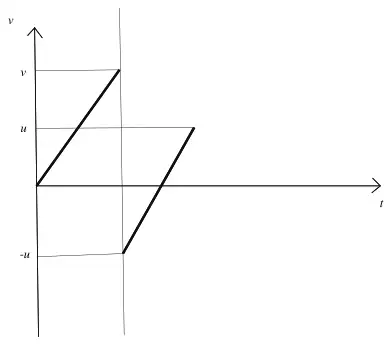 | First line B1 Second line B1 \(-u, u\), B1 |
| (3) |
Notes
First B1 for a straight line from origin to their \(v\) which must be marked on the axis.
Second B1 for a parallel straight line correctly positioned (if continuous vertical lines are clearly included as part of the graph then B0)
Third B1 for their \(-u\) and \(u\) correctly marked, provided their second line is correctly positioned
N.B. A reflection of the graph in the \(t\)-axis (upwards +ve) is also acceptable
| Scheme | Marks |
|---|---|
| Use of suvat to find \(t_1\) or \(t_2\), \(\sqrt{4g} = gt_1\) \(t_1 = \sqrt{\dfrac{4}{g}} = 0.64\) s \(\sqrt{3g} = gt_2\) \(t_2 = \sqrt{\dfrac{3}{g}} = 0.55\) s | M1A1 (\(t_1\) or \(t_2\)) |
| Total time \(= t_1 + 2t_2 = 1.7\) s or 1.75 s | DM1A1 |
| (4) | |
| (13 marks) |
Notes
First M1 for use of suvat or area under their \(v\)-\(t\) graph to find either \(t_1\) or \(t_2\) or \(2t_2\)
First A1 for correct value for either \(t_1\) or \(t_2\) (can be in terms of g at this stage or surds or unsimplified e.g.6.3/9.8)
Second M1 dependent on the first M1 for their \(t_1 + 2t_2\)
Second A1 for 1.7 (s) or 1.75 (s).