
October 2020 Paper 1 Q9
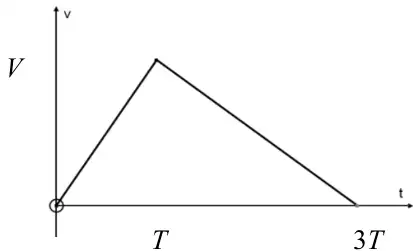
9 A car travelling in a straight line accelerates uniformly from rest to \(V\) \(\text{m s}^{-1}\) in \(T\) s. It then slows down uniformly, coming to rest after a further \(2T\) s.
The acceleration in the first stage of the motion is 2.5 \(\text{m s}^{-2}\) and the total distance travelled is 240 m.
| Scheme | Marks | AO |
|---|---|---|
 | B1 B1 | 1.1a 1.1a |
| [2] |
Notes
B1: Two line segments starting and ending on the \(x\)-axis
B1: \(T\) and \(3T\) seen on \(t\)-axis
Instead of \(3T\), allow for \(2T\) shown on the horizontal axis for the second phase
| Scheme | Marks | AO |
|---|---|---|
| Acceleration phase \(\dfrac{V}{T} = 2.5\) | B1 | 3.4 |
| Area under graph \(\dfrac{1}{2} \times V \times 3T = 240\) | B1 | 3.4 |
| Solving simultaneously \(\dfrac{3}{2}(2.5T)T = 240 \Rightarrow T^2 = 64\) | M1 | 1.1a |
| So \(T = 8\) and \(V = 20\) | A1 | 1.1 |
| [4] |
Notes
B1: soi
B1: May be sum of two areas soi: \(\dfrac{1}{2}VT + VT = 240\)
M1: Attempt to eliminate one variable
A1: correct pair of answers
Alternative solution
| Scheme | Marks | AO |
|---|---|---|
| Acceleration phase using \(v = u + at\) \(V = 2.5 \times T\) | B1 | |
| First phase has distance \(240 \div 3 = 80\) m | M1 | |
| Using \(s = 80,\ u = 0,\ a = 2.5\) \(80 = \dfrac{1}{2} \times 2.5T^2\) | B1 | |
| giving \(T = 8\) and \(V = 20\) | A1 |
B1: May be final step using \(T = 8\)
M1: award if seen
B1: Using suvat equation(s) leading to a value for \(t\) with \(s = 80\)
A1: correct pair of answers