
June 2022 Mechanics Q2
2. A train travels along a straight horizontal track from station \(P\) to station \(Q\).
In a model of the motion of the train, at time \(t = 0\) the train starts from rest at \(P\), and moves with constant acceleration until it reaches its maximum speed of 25 m s−1
The train then travels at this constant speed of 25 m s−1 before finally moving with constant deceleration until it comes to rest at \(Q\).
The time spent decelerating is four times the time spent accelerating.
The journey from \(P\) to \(Q\) takes 700 s.
Using the model,
The distance between the two stations is 15 km.
Using the model,
| Scheme | Marks | AO |
|---|---|---|
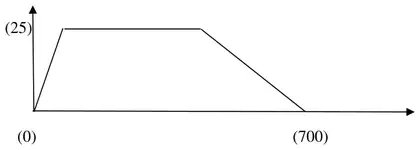 shape | B1 | 1.1b |
| (1) |
Notes
B1 Overall shape of graph, starting at the origin, with deceleration phase longer than the acceleration phase if nothing on the \(t\)-axis but ignore the relative lengths and allow if \(t\) (or 40) and \(4t\) (or 160) are clearly and correctly marked.
Ignore incorrect figs on the axes.
This mark can be earned if the graph appears anywhere in qu 2.
| Scheme | Marks | AO |
|---|---|---|
| Using total area = 15000 to set up an equation in one unknown Or they may use suvat on one or more sections (but must still be considering all sections) Allow an attempt at a clear explicit verification using \(t = 40\) e.g. the following would score M1A1A1*: \(4 \times 40 = 160\) then \(700 - 40 - 160 = 500\) \(\dfrac{(700 + 500)}{2} \times 25 = 15000 = 15\) km Withhold A1* if they don’t include = 15 km N.B. M0 if a single suvat formula is used for the whole journey. | M1 | 3.4 |
| \(\dfrac{1}{2}(700 + 700 - t - 4t) \times 25 = 15000\) OR \(\dfrac{1}{2} \times 25 \times t + 25(700 - t - 4t) + \dfrac{1}{2} \times 25 \times 4t = 15000\) | A1 | 1.1b |
| \(t = 40\) (s)* | A1* | 1.1b |
| (3) |
Notes
M1 Need all sections to be included, with correct structure for each section, with \(\frac{1}{2}\)’s where appropriate.
Allow = 15 or 150 or 1500 etc instead of 15000
A1 A correct equation in their \(t\) only, seen or implied (or with \(t = 40\) for verification)
A1* cso. At least one line of working with brackets removed and \(t\)’s collected, or equivalent
| Scheme | Marks | AO |
|---|---|---|
| 0.63 or 0.625 or \(\dfrac{5}{8}\) oe (m s−2) isw | B1 | 1.1b/ (2.2a) |
| (1) |
Notes
B1 cao
| Scheme | Marks | AO |
|---|---|---|
| Complete method to find the speed or velocity at \(t = 572\) e.g \(\pm\left(25 - \left(32 \times \dfrac{5}{32}\right)\right)\) or \(\pm\left(128 \times \dfrac{5}{32}\right)\) oe | M1 | 3.1b |
| 20 (m s−1) | A1 | 1.1b |
| (2) |
Notes
M1 Any complete method, must have correct figs, but condone sign errors
A1 cao. Must be positive and exact i.e must not come from rounding.
| Scheme | Marks | AO |
|---|---|---|
| e.g. (the train) cannot instantaneously change acceleration, (the train) won’t move with constant acceleration, (the train) won’t move with constant speed Allow negatives of these: e.g. (The train) moving at constant speed, or just ‘constant speed’ or ‘constant acceleration’ (is a limitation of the model) Must be a limitation of the model, so friction or air resistance or size of train is B0. N.B. Ignore incorrect reasons following a correct answer. | B1 | 3.5b |
| (1) | ||
| (8 marks) |
Notes
B1 Any appropriate limitation of the model. B0 if any incorrect extra answers.