
June 2019 Mechanics Q1
1. At time \(t = 0\), a parachutist falls vertically from rest from a helicopter which is hovering at a height of 550 m above horizontal ground.
The parachutist, who is modelled as a particle, falls for 3 seconds before her parachute opens.
While she is falling, and before her parachute opens, she is modelled as falling freely under gravity.
The acceleration due to gravity is modelled as being \(10\ \mathrm{m\,s^{-2}}\).
When her parachute is open, the parachutist continues to fall vertically.
Immediately after her parachute opens, she decelerates at \(12\ \mathrm{m\,s^{-2}}\) for 2 seconds before reaching a constant speed and she reaches the ground with this speed.
The total time taken by the parachutist to fall the 550 m from the helicopter to the ground is \(T\) seconds.
In a refinement of the model of the motion of the parachutist, the effect of air resistance is included before her parachute opens and this refined model is now used to find a new value of \(T\).
| Scheme | Marks | AO |
|---|---|---|
| \(V = 30\ (\mathrm{m\,s^{-1}})\) | B1 | 3.4 |
| (1) |
Notes
B1 cao
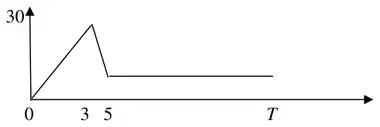
| Scheme | Marks | AO |
|---|---|---|
| shape | B1 | 1.1b |
| figs | B1ft | 1.1b |
| (2) |
Notes
B1 Overall shape of the graph, starting at the origin.
Dotted vertical line at end is OK but solid vertical line is B0
B1ft 3, 5 and \(T\) marked on the \(t\)-axis, and ft on their 30 marked on the speed axis.
3 must be where graph reaches a peak.
Allow delineators: 3, 2 and \(T - 5\) or a mixture
| Scheme | Marks | AO |
|---|---|---|
| Using total area = 550 to set up an equation in one unknown, Or they may use suvat on one or more of the sections (but must still be considering all sections) M0 if they use one suvat equation for the whole motion | M1 | 2.1 |
| \(\dfrac{1}{2} \times 3 \times 30 + \dfrac{(30 + 6)}{2} \times 2 + 6(T - 5) = 550\) OR: \(\dfrac{1}{2} \times 3 \times 30 + \dfrac{1}{2} \times 2 \times 24 + 6(T - 3) = 550\) OR: \(\dfrac{1}{2} \times 3 \times 30 + \dfrac{1}{2} \times 2 \times 24 + (2 \times 6) + 6(T - 5) = 550\) | A2 ft | 1.1b |
| Solve for \(T\) | M1 | 1.1b |
| \(T = 83\) (nearest whole number) | A1 | 1.1b |
| (5) |
Notes
M1 Need all sections to be included, with correct structure for each section.
e.g. triangle + trapezium + rectangle oe = 550 to give an equation in one unknown (may not be T)
A2ft ft on their answer to (a).
-1 each error.
N.B. If ‘6’ is incorrect, treat as one error, unless it is correct ft from their 30.
M1 Attempt to solve for \(T\) provided they have tried to find the area using at least 3 sections.
(M0 if they only solve for their unknown and never try to find \(T\))
A1 83 is the only answer
| Scheme | Marks | AO |
|---|---|---|
| New value of \(T\) would be bigger (ignore their reasons whether correct or not) | B1 | 3.5a |
| (1) |
Notes
B1 Clear statement about the value of \(T\)
Allow ‘it would increase, get larger etc’
B0 for ‘Takes longer’ or ‘the value of \(T\) would be longer’
| Scheme | Marks | AO |
|---|---|---|
| e.g. effect of wind; allow for dimensions of parachutist; use a more accurate value for \(g\); parachutist does not fall vertically after chute opens; smooth changes in \(v\); time for parachute to open; deceleration not constant (but B0 if they say acceleration not constant); smooth changes in \(a\); B0 for: moves horizontally; mass/weight of parachutist; upthrust; air pressure;air resistance; terminal velocity | B1 | 3.5c |
| (1) | ||
| (10 marks) |
Notes
B1 Any appropriate refinement of the model.
B0 if incorrect (or irrelevant) extras