
M1 June 2016 Q4
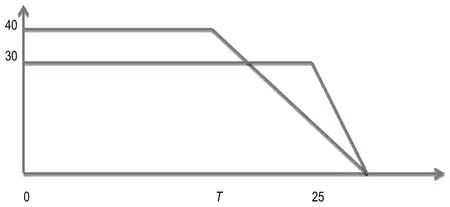
4. Two trains \(M\) and \(N\) are moving in the same direction along parallel straight horizontal tracks. At time \(t = 0\), \(M\) overtakes \(N\) whilst they are travelling with speeds 40 m s\(^{-1}\) and 30 m s\(^{-1}\) respectively. Train \(M\) overtakes train \(N\) as they pass a point \(X\) at the side of the tracks.
After overtaking \(N\), train \(M\) maintains its speed of 40 m s\(^{-1}\) for \(T\) seconds and then decelerates uniformly, coming to rest next to a point \(Y\) at the side of the tracks.
After being overtaken, train \(N\) maintains its speed of 30 m s\(^{-1}\) for 25 s and then decelerates uniformly, also coming to rest next to the point \(Y\).
The times taken by the trains to travel between \(X\) and \(Y\) are the same.
Given that \(XY = 975\) m,
| Scheme | Marks |
|---|---|
| B1 shape (\(M\)) | |
| B1 figs (40,\(T\)) | |
| B1 shape (\(N\)) | |
| B1 figs (30,25) | |
| (4) |
Notes
First B1 (\(M\)) for correct shape – must start and finish on the axes.
Second B1 for 40 and \(T\) marked clearly (if delineators omitted B0) and correctly
Third B1 (\(N\)) for correct shape – must start and finish on the axes.
Fourth B1 for 30 and 25 (if delineators omitted B0) marked clearly and correctly
N.B. If graphs do not cross and/or do not finish at the same point, max score is B1B1B0B1.
N.B. If graphs done on separate diagrams, mark each and award the higher mark i.e. can score max 2/4 for part (a).
| Scheme | Marks |
|---|---|
| For N: \(\tfrac{1}{2}(25 + 25 + t).30 = 975\) OR \(\tfrac{1}{2}(25 + t_1).30 = 975\) | M1 A1 |
| \(t = 15\) \(t_1 = 40\) | DM1 A1 |
| For M: \(\tfrac{1}{2}(25 + t + T).40 = 975\) OR \(\tfrac{1}{2}(t_1 + T).40 = 975\) | M1 A1 |
| \(T = 8.75\) (\(8\tfrac{3}{4}\) or \(\dfrac{35}{4}\) oe) | DM1 A1 |
| (8) | |
| (12 marks) |
Notes
N.B. When attempting to find the area of a triangle, must see ½ x …. to be able to award an M mark i.e. M0 if ½ is missing
N.B. When attempting to find the area of a trapezium, must see something of the form : ½ x \((a + b)h\) to be able to award an M mark i.e. M0 if ½ is missing and bracket is not a sum
First M1 for attempt at using 975m distance travelled by \(N\) to obtain an equation in one unknown time (usually extra time \(t\) after 25 s, but could, for example, be whole time \(t_1\)). They may use the area under their graph or use suvat (N.B. Any single suvat equn using \(s = 975\) is M0).
First A1 for a correct equation in their unknown time
e.g. \((30 \times 25) + \tfrac{1}{2}30t = 975\) OR \((30 \times 25) + \tfrac{1}{2}30(t_1 - 25) = 975\)
Second M1, dependent on first M, for solving their equation
Second A1 for a correct value for their unknown.
Third M1 for attempt at using 975m distance travelled by \(M\) to obtain an equation in \(T\) and possibly one other unknown time (usually extra time \(t\) after 25 s, but could, for example, be whole time \(t_1\)). They may use the area under their graph or use suvat (N.B. Any suvat equn using \(s = 975\) is M0)
Third A1 for a correct equation in \(T\) and possibly their unknown.
This A1 can be earned if they just have a letter for their unknown :-
e.g. \(40T + \tfrac{1}{2}40.(25 + t - T) = 975\) OR \(40T + \tfrac{1}{2}40.(t_1 - T) = 975\)
or for an incorrect numerical value in place of \(t\) or \(t_1\).
Fourth M1, dependent on first, second and third M’s, for solving for \(T\).
Fourth A1 for 8.75 or 35/4 or any other equivalent
ALTERNATIVE
| They may find \(t\) or \(t_1\), in terms of \(T\), from their (\(M\)) equation, and substitute for \(t\) or \(t_1\) in their (\(N\)) equation, and then solve for \(T\): | |
| For M: \(\tfrac{1}{2}(25 + t + T).40 = 975\) OR \(\tfrac{1}{2}(t_1 + T).40 = 975\) | M1 A1 |
| \(t = \left(\tfrac{1950}{40} - 25 - T\right)\) \(t_1 = \left(\tfrac{1950}{40} - T\right)\) | DM1 A1 |
| For N: \(\tfrac{1}{2}(25 + 25 + t).30 = 975\) OR \(\tfrac{1}{2}(25 + t_1).30 = 975\) | M1 A1 |
| sub for \(t\) or sub for \(t_1\) | |
| \(T = 8.75\) (\(8\tfrac{3}{4}\) or \(\dfrac{35}{4}\) oe) | DM1 A1 |