B1 Seen or implied, with \(\mathbf{i}\)’s and \(\mathbf{j}\)’s collected
M1 Using Pythagoras, with or without the root, on their resultant force N.B. This mark is available even if they’ve subtracted the two forces.
M1 Use of \(F = ma\) to obtain an equation in \(c\) only.
OR
M1 Using \(\mathbf{F} = m\mathbf{a}\) with their resultant force to obtain \(\mathbf{a}\) with \(\mathbf{i}\)’s and \(\mathbf{j}\)’s collected N.B. This mark is available even if they’ve subtracted the two forces.
M1 Using Pythagoras, with or without the root, on their \(\mathbf{a}\) to obtain an equation in \(c\) only
\(\dfrac{(4 + p)}{(q - 6)} = \dfrac{2}{1}\) or \(-\dfrac{2}{1}\) (or \(\dfrac{1}{2}\) or \(-\dfrac{1}{2}\))
DM1 A1
\(2q - 12 = 4 + p\)
\(p - 2q = -16\) GIVEN ANSWER
DM1 A1
(5)
Notes
Allow column vectors throughout
First M1 for adding the two forces, with i’s and j’s collected, seen or implied
Second DM1, dependent on first M1, for an equation in \(p\) and \(q\) only. Allow \(\dfrac{1}{2}\) or \(-\dfrac{1}{2}\) or \(-\dfrac{2}{1}\) instead of \(\dfrac{2}{1}\)
First A1 for a correct equation in any form
Third DM1, dependent on the second M1, for (at least)one correct intermediate line of working
Second A1 for correct given answer
Mark scheme (b)
Scheme
Marks
\(q = 3 \Rightarrow p = -10\)
B1
EITHER \(\ 0.5\mathbf{a} = -6\mathbf{i} - 3\mathbf{j}\) OR \(\ |\mathbf{R}| = \sqrt{(-6)^2 + (-3)^2}\)
M1 for use of a relevant trig ratio from their \(\mathbf{a}\) or their \(\mathbf{R}\) (may not be the sum of the two forces) or \(-2\mathbf{i} - \mathbf{j}\)
First A1 for any relevant correct angle coming from a correct \(\mathbf{a}\) or \(\mathbf{R}\) or from \(-2\mathbf{i} - \mathbf{j}\)
1. Three forces, \((15\mathbf{i} + \mathbf{j})\) N, \((5q\mathbf{i} - p\mathbf{j})\) N and \((-3p\mathbf{i} - q\mathbf{j})\) N, where \(p\) and \(q\) are constants, act on a particle. Given that the particle is in equilibrium, find the value of \(p\) and the value of \(q\). (6)
First M1 for equating the sum of the three forces to zero (can be implied by subsequent working)
Second M1 for equating the sum of the \(\mathbf{i}\) components to zero AND the sum of the \(\mathbf{j}\) components to zero oe to produce TWO equations, each one being in \(p\) and \(q\) ONLY.
First A1 for TWO correct equations (in any form)
N.B. It is possible to obtain TWO equations by using \(\lambda(3p - 5q - 15) = \mu(p + q - 1)\) with TWO different pairs of values for \(\lambda\) and \(\mu\), with one pair not a multiple of the other e.g \(\lambda = 1\), \(\mu = 1\) AND \(\lambda = 1\), \(\mu = 2\).
Third M1(independent) for attempt (either by substitution or elimination) to produce an equation in either \(p\) ONLY or \(q\) ONLY.
Second A1 for \(p = 2.5\) (any equivalent form, fractions do not need to be in lowest terms)
Third A1 for \(q = -1.5\) (any equivalent form, fractions do not need to be in lowest terms)
2. A particle is acted upon by two forces \(\mathbf{F}_1\) and \(\mathbf{F}_2\), given by
\[\mathbf{F}_1 = (\mathbf{i} - 3\mathbf{j})\text{ N},\]\[\mathbf{F}_2 = (p\mathbf{i} + 2p\mathbf{j})\text{ N, where } p \text{ is a positive constant.}\]
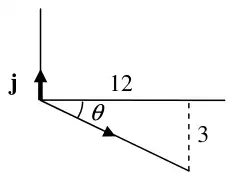
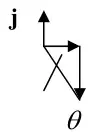
(a) Find the angle between \(\mathbf{F}_2\) and \(\mathbf{j}\). (2)
The resultant of \(\mathbf{F}_1\) and \(\mathbf{F}_2\) is \(\mathbf{R}\). Given that \(\mathbf{R}\) is parallel to \(\mathbf{i}\),
6. Two forces, \((4\mathbf{i} - 5\mathbf{j})\) N and \((p\mathbf{i} + q\mathbf{j})\) N, act on a particle \(P\) of mass \(m\) kg. The resultant of the two forces is \(\mathbf{R}\). Given that \(\mathbf{R}\) acts in a direction which is parallel to the vector \((\mathbf{i} - 2\mathbf{j})\),
(a) find the angle between \(\mathbf{R}\) and the vector \(\mathbf{j}\), (3)
(b) show that \(2p + q + 3 = 0\). (4)
Given also that \(q = 1\) and that \(P\) moves with an acceleration of magnitude \(8\sqrt{5}\) m s\(^{-2}\),
19 A force \(\mathbf{F}\) is \(\begin{bmatrix} p \\ -0.5 \end{bmatrix}\) newtons, where \(p\) is a constant.
Given that the magnitude of \(\mathbf{F}\) is 1.3 newtons, find the possible values of \(p\) [3 marks]
Mark scheme
Scheme
Marks
AO
Obtains \(p^2 + (-0.5)^2\) or \(p^2 + 0.5^2\) ACF Condone any variable for \(p\)
B1
1.1b
Equates their expression for the magnitude of the given vector to 1.3 or the square of the magnitude of the given vector to 1.32 to obtain at least one value for \(p\)
(a) Show that the distance from \(A\) to \(B\) is 10 metres. [3 marks]
(b) A constant resultant force, of magnitude \(R\) newtons, acts on a particle so that it moves in a straight line passing through the same two points \(A\) and \(B\)
At \(A\), the speed of the particle is 3 m s−1 in the direction from \(A\) to \(B\)
The particle takes 2 seconds to travel from \(A\) to \(B\)
The mass of the particle is 150 grams.
Find the value of \(R\) [3 marks]
Mark scheme (a)
Scheme
Marks
AO
Subtracts given vectors with at least one component correct for \(\overrightarrow{AB}\) or \(\overrightarrow{BA}\) or Finds difference between \(\underline{\mathbf{i}}\) and \(\underline{\mathbf{j}}\) components with at least one correct, may be seen on a diagram
M1
1.1a
Uses Pythagoras for their \(\underline{\mathbf{i}}\) and \(\underline{\mathbf{j}}\) component differences
M1
1.1a
Shows distance between A and B is 10 metres AG Condone missing units
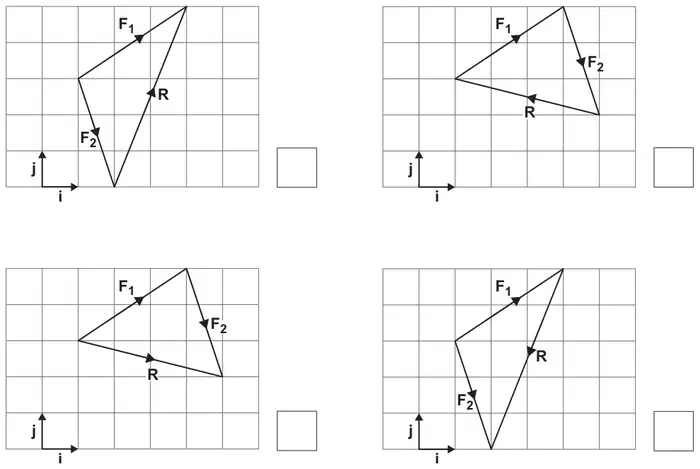
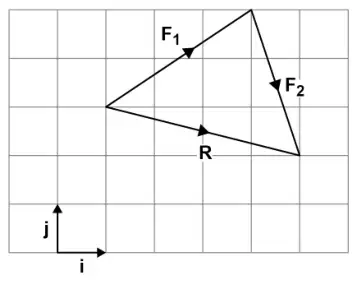
14 Two forces, \(\mathbf{F}_1 = 3\mathbf{i} + 2\mathbf{j}\) newtons and \(\mathbf{F}_2 = \mathbf{i} - 3\mathbf{j}\) newtons, are added together to find a resultant force, \(\mathbf{R}\) newtons.
This vector addition can be represented using a diagram.
Identify the diagram below which correctly represents this vector addition.
17 A particle, \(P\), is initially at rest on a smooth horizontal surface.
A resultant force of \(\begin{bmatrix} 12 \\ 9 \end{bmatrix}\) N is then applied to \(P\), so that it moves in a straight line.
(a) Find the magnitude of the resultant force. [1 mark]
(b) Two fixed points \(A\) and \(B\) have position vectors\[\overrightarrow{OA} = \begin{bmatrix} 3 \\ 7 \end{bmatrix}\text{ metres} \qquad \text{and} \qquad \overrightarrow{OB} = \begin{bmatrix} k \\ k - 1 \end{bmatrix}\text{ metres}\]
with respect to a fixed origin, \(O\)
\(P\) moves in a straight line parallel to \(\overrightarrow{AB}\)
(i) Find \(\overrightarrow{AB}\) in terms of \(k\) [1 mark]
(ii) Find the value of \(k\) [2 marks]
Mark scheme (a)
Scheme
Marks
AO
Finds correct magnitude of force.
Condone omission of units
B1
1.1b
(1)
Typical solution
\[\sqrt{12^2 + 9^2} = 15\text{ N}\]
Mark scheme (b)
Scheme
Marks
AO
(i) Forms correct expression for \(\overrightarrow{AB}\)
Condone omission of units
B1
1.1b
(1)
(ii) Deduces \(\overrightarrow{AB}\) is a scalar multiple of \(\begin{bmatrix} 12 \\ 9 \end{bmatrix}\)
M1
2.2a
Deduces \(k = 23\)
FT their answer to part (b)(i)
A1F
2.2a
(2)
(4 marks)
Typical solution
(i)
\[\overrightarrow{AB} = \begin{bmatrix} k - 3 \\ k - 8 \end{bmatrix}\text{ metres}\]
(ii)
Since direction of movement is in direction of force then \(\overrightarrow{AB}\) is a scalar multiple of \(\begin{bmatrix} 12 \\ 9 \end{bmatrix}\)
12 One of the following is an expression for the distance between the points represented by position vectors \(5\mathbf{i} - 3\mathbf{j}\) and \(18\mathbf{i} + 7\mathbf{j}\)
14 Two particles, \(A\) and \(B\), lie at rest on a smooth horizontal plane.
\(A\) has position vector \(\mathbf{r}_A = (13\mathbf{i} - 22\mathbf{j})\) metres \(B\) has position vector \(\mathbf{r}_B = (3\mathbf{i} + 2\mathbf{j})\) metres
(a) Calculate the distance between \(A\) and \(B\). [2 marks]
(b) Three forces, \(\mathbf{F}_1\), \(\mathbf{F}_2\) and \(\mathbf{F}_3\) are applied to particle \(A\), where\[\mathbf{F}_1 = (-2\mathbf{i} + 4\mathbf{j})\text{ newtons}\]\[\mathbf{F}_2 = (6\mathbf{i} - 10\mathbf{j})\text{ newtons}\]Given that \(A\) remains at rest, explain why \(\mathbf{F}_3 = (-4\mathbf{i} + 6\mathbf{j})\) newtons [1 mark]
(c) A force of \((5\mathbf{i} - 12\mathbf{j})\) newtons, is applied to \(B\), so that \(B\) moves, from rest, in a straight line towards \(A\).
\(B\) has a mass of 0.8 kg
(i) Show that the acceleration of \(B\) towards \(A\) is 16.25 m s−2[2 marks]
(ii) Hence, find the time taken for \(B\) to reach \(A\).
Give your answer to two significant figures. [2 marks]
Mark scheme (a)
Scheme
Marks
AO
Condone omission of units throughout this question
Calculates the magnitude of \(AB\) Ignore one sign error.
Explains that \(A\) remains at rest implies resultant force = 0 and shows \(\mathbf{F}_1 + \mathbf{F}_2 + \mathbf{F}_3 = \mathbf{0}\) or shows addition of \(\mathbf{F}_1\) and \(\mathbf{F}_2\) and states that \(\mathbf{F}_3\) is the opposite
9 A particle \(P\) of mass \(2.5\,\mathrm{kg}\) is in equilibrium under the action of three horizontal forces \(\mathbf{F}_1 = \begin{pmatrix} 3 \\ -7 \end{pmatrix}\mathrm{N}\), \(\mathbf{F}_2 = \begin{pmatrix} -5 \\ 10 \end{pmatrix}\mathrm{N}\) and \(\mathbf{F}_3\).
(a) Find the force \(\mathbf{F}_3\). [2]
The force \(\mathbf{F}_3\) is changed to \(\begin{pmatrix} 8 \\ 1 \end{pmatrix}\mathrm{N}\).
(b) Find the acceleration of \(P\), giving your answer in column vector form. [2]
M1: Use \(\mathbf{F}_1 + \mathbf{F}_2 + \mathbf{F}_3 = \mathbf{0}\) Correct answer implies this mark Allow sign errors. One correct component for \(\mathbf{F}_3\) can imply this mark
A1: cao – isw if magnitude of the force is found after correct vector seen oe e.g. \(-\begin{pmatrix} -2 \\ 3 \end{pmatrix}\), \(2\mathbf{i} - 3\mathbf{j}\)
M1: Use of \(\mathbf{F} = m\mathbf{a}\) with \(m = 2.5\) and at least one correct component for \(\mathbf{F} = \begin{pmatrix} 6 \\ 4 \end{pmatrix}\) (either stated or implied by working)
A1: cao – isw if magnitude of the acceleration is found after correct vector seen
9 Three forces \(\begin{pmatrix} 7 \\ -6 \end{pmatrix}\,\text{N}\), \(\begin{pmatrix} 2 \\ 5 \end{pmatrix}\,\text{N}\) and \(\mathbf{F}\,\text{N}\) act on a particle.
Given that the particle is in equilibrium under the action of these three forces, calculate \(\mathbf{F}\). [2]
9 In this question the horizontal unit vectors \(\mathbf{i}\) and \(\mathbf{j}\) are in the directions east and north respectively.
A model ship of mass \(2\,\text{kg}\) is moving so that its acceleration vector \(\mathbf{a}\,\text{m}\,\text{s}^{-2}\) at time \(t\) seconds is given by \(\mathbf{a} = 3(2t - 5)\mathbf{i} + 4\mathbf{j}\). When \(t = T\), the magnitude of the horizontal force acting on the ship is \(10\,\text{N}\).
Find the possible values of \(T\). [4]
Mark scheme
Scheme
Marks
AO
\(F = \sqrt{36(2T - 5)^2 + 64}\)
M1*
3.3
\(36(2T - 5)^2 = 36\)
A1
1.1
\(2T - 5 = \pm 1 \Rightarrow T = \ldots\)
Dep*M1
1.1
\(T = 2\) and \(T = 3\)
A1
2.2a
[4]
Notes
M1*: Correct use of \(\mathbf{F} = m\mathbf{a}\) and Pythagoras
A1: Correct equation(s) for both values of \(T\) e.g. \(10 = 2\sqrt{9(2T - 5)^2 + 16}\) Allow \(t\) throughout
Dep*M1: Attempt to solve a quadratic leading to at least one value for \(T\)
In the \(\mathbf{j}\) direction \(-3g + k - 5 = 0\) [so \(k = 34.4\)]
M1
3.1b
\(\mathbf{i}\) direction \(h + k = 0\) so \(h = -34.4\)
A1
1.1
[3]
Notes
B1: Accept \(-29.4\mathbf{j}\). May be implied by the use of weight (with correct sign) in their vertical equation and not their horizontal equation. May be implied by \(k = 34.4\) seen with no equation
Vector equation need not be seen explicitly
M1: Uses the \(\mathbf{j}\)-direction to find a value for \(k\). Allow only sign errors. Need not be simplified. May be implied by \(k = 34.4\) seen
A1: Cao
Mark scheme (c)
Scheme
Marks
AO
\(h\mathbf{i} - 3g\mathbf{j} = 3\mathbf{a}\)
B1FT
2.5
[1]
Notes
B1FT: Must be vector equation FT their \(h\) from (b) and accept numerical equivalents (e.g. note \(-34.4\mathbf{i} - 29.4\mathbf{j} = 3\mathbf{a}\) is fully correct) ISW if \(\mathbf{a}\) is evaluated
2 Two forces \(\mathbf{F}_1\) N and \(\mathbf{F}_2\) N are given by \(\mathbf{F}_1 = -6\mathbf{i} + 2\mathbf{j}\) and \(\mathbf{F}_2 = -8\mathbf{i} + \mathbf{j}\).
Show that the magnitude of the resultant of these two forces is \(\sqrt{205}\) N. [2]
7 In this question the unit vectors \(\mathbf{i}\) and \(\mathbf{j}\) are directed east and north respectively.
A canal narrowboat of mass 9 tonnes is pulled by two ropes. The tensions in the ropes are \((450\mathbf{i} + 20\mathbf{j})\) N and \((420\mathbf{i} - 20\mathbf{j})\) N. The boat experiences a resistance to motion \(\mathbf{R}\) of magnitude 300 N.
(a) Explain what it means to model the boat as a particle. [1]
The boat is travelling in a straight line due east.
(b) Find the equation of motion of the boat. [2]
(c) Find the acceleration of the boat giving your answer as a vector. [1]
Mark scheme (a)
Scheme
Marks
AO
When the boat is modelled as a particle, the size and shape of the boat are not taken into account in the model Any rotation of the boat is neglected
B1
3.3
[1]
Notes
B1: A sensible comment
Mark scheme (b)
Scheme
Marks
AO
Resistance is \(-300\mathbf{i}\) N Newton’s second law \(\big((450\mathbf{i} + 20\mathbf{j}) + (420\mathbf{i} - 20\mathbf{j})\big) - 300\mathbf{i} = 9000\mathbf{a}\)
M1
A1
1.1a
1.1b
\([570\mathbf{i} = 9000\mathbf{a}]\)
[2]
Notes
M1: Sum of at least two forces seen in a N2L equation. Also allow for scalar equation in the \(\mathbf{i}\) direction only. Allow missing or incorrect resistance
A1: Accept equivalent scalar equation and statement that there is no [resultant] force or no acceleration in the \(\mathbf{j}\) direction)
3 Forces \(\mathbf{F}_1 = (2\mathbf{i} + 9\mathbf{j})\) N and \(\mathbf{F}_2 = (-\mathbf{i} + \mathbf{j})\) N act on a particle. A third force \(\mathbf{F}_3\) acts so that the particle is in equilibrium under the action of the three forces.
4 In this question, the \(x\) and \(y\) directions are horizontal and vertically upwards respectively.
A particle of mass 1.5 kg is in equilibrium under the action of its weight and forces \(\mathbf{F}_1 = \begin{pmatrix} 4 \\ -2 \end{pmatrix}\) N and \(\mathbf{F}_2\).
(a) Find the force \(\mathbf{F}_2\). [3]
The force \(\mathbf{F}_2\) is changed to \(\begin{pmatrix} 2 \\ 20 \end{pmatrix}\) N.
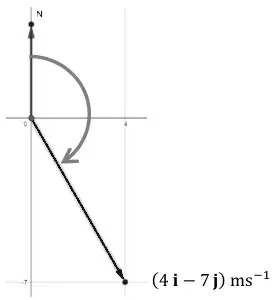
6. A ship \(S\) is moving with constant velocity \((4\mathbf{i}-7\mathbf{j})\text{ ms}^{-1}\), where \(\mathbf{i}\) and \(\mathbf{j}\) are unit vectors due east and due north respectively.
Find the speed and direction of \(S\), giving the direction as a three-figure bearing, correct to the nearest degree. [4]
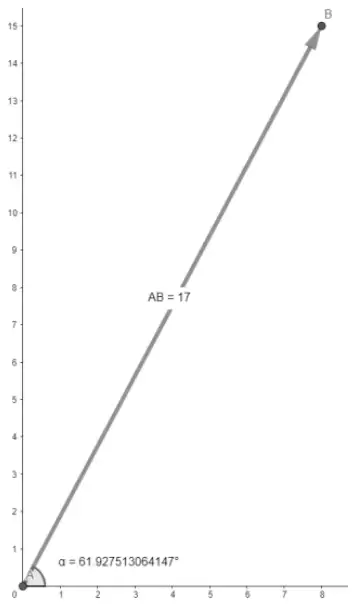
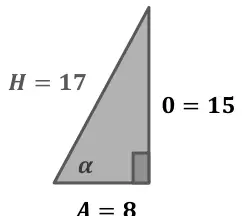
Let \(\alpha\) be angle that \(\mathbf{R}\) makes with the \(\mathbf{i}\) vector Accept any of the following ratios \(\sin\alpha=\frac{15}{17}\ \ \left(=\frac{8}{17}\right)\) \(\cos\alpha=\frac{8}{17}\ \ \left(=\frac{15}{17}\right)\) \(\tan\alpha=\frac{15}{8}\ \ \left(=\frac{8}{15}\right)\)
M1
FT their derived value of \(k\) \(\sin\alpha=\frac{k-5}{17}\ \ \left(=\frac{8}{17}\right)\) \(\cos\alpha=\frac{8}{17}\ \ \left(=\frac{k-5}{17}\right)\) \(\tan\alpha=\frac{k-5}{8}\ \ \left(=\frac{8}{k-5}\right)\)
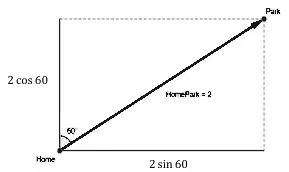
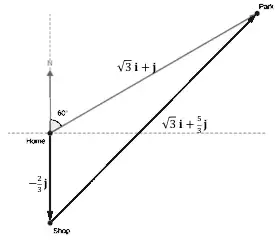
10. In this question, \(\mathbf{i}\) and \(\mathbf{j}\) represent unit vectors due east and due north respectively.
Sarah is going for a walk. She leaves her house and walks directly to the shop. She then walks directly from the shop to the park. Relative to her house:
the shop has position vector \(\left(-\frac{2}{3}\mathbf{j}\right)\) km,
the park is 2 km away on a bearing of 060°.
(a) Show that the position vector of the park relative to the house is \(\left(\sqrt{3}\mathbf{i}+\mathbf{j}\right)\) km. [2]
(b) Determine the total distance walked by Sarah from her house to the park. [3]
(c) By considering a modelling assumption you have made, explain why the answer you found in part (b) may not be the actual distance that Sarah walked. [1]
(a) Given that the acceleration of the body is \((7\mathbf{i}-3\mathbf{j})\) ms–2, find the values of the constants \(a\), \(b\). [4]
(b) A fourth force, \(\mathbf{F}_4\), is then applied to the body causing it to move with constant velocity. Find \(\mathbf{F}_4\), giving your answer in vector form. [2]
9. Three forces \(\mathbf{L}\), \(\mathbf{M}\) and \(\mathbf{N}\) are given by \[\begin{aligned}\mathbf{L}&=2\mathbf{i}+5\mathbf{j},\\ \mathbf{M}&=3\mathbf{i}-22\mathbf{j},\\ \mathbf{N}&=4\mathbf{i}-23\mathbf{j}.\end{aligned}\]
Find the magnitude and direction of the resultant of the three forces. [6]
We'd like to use Google Analytics cookies to count visits and see which pages help most. They're optional, and the site works exactly the same either way. Privacy policy