
M1 January 2009 Q6
6. Two forces, \((4\mathbf{i} - 5\mathbf{j})\) N and \((p\mathbf{i} + q\mathbf{j})\) N, act on a particle \(P\) of mass \(m\) kg. The resultant of the two forces is \(\mathbf{R}\). Given that \(\mathbf{R}\) acts in a direction which is parallel to the vector \((\mathbf{i} - 2\mathbf{j})\),
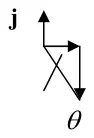
(a) find the angle between \(\mathbf{R}\) and the vector \(\mathbf{j}\), (3)
(b) show that \(2p + q + 3 = 0\). (4)
Given also that \(q = 1\) and that \(P\) moves with an acceleration of magnitude \(8\sqrt{5}\) m s\(^{-2}\),
(c) find the value of \(m\). (7)
| Scheme | Marks |
|---|---|
| \(\tan\theta = \dfrac{2}{1}\ \Rightarrow\ \theta = 63.4^\circ\) | M1 A1 |
| angle is \(153.4^\circ\) | A1 |
| (3) |
| Scheme | Marks |
|---|---|
| \((4 + p)\mathbf{i} + (q - 5)\mathbf{j}\) | B1 |
| \((q - 5) = -2(4 + p)\) | M1 A1 |
| \(2p + q + 3 = 0\) \(\ast\) | A1 |
| (4) |
| Scheme | Marks |
|---|---|
| \(q = 1\ \Rightarrow\ p = -2\) | B1 |
| \(\Rightarrow\ \ \mathbf{R} = 2\mathbf{i} - 4\mathbf{j}\) | M1 |
| \(\Rightarrow |\mathbf{R}| = \sqrt{2^2 + (-4)^2} = \sqrt{20}\) | M1 A1 f.t. |
| \(\sqrt{20} = m8\sqrt{5}\) | M1 A1 f.t. |
| \(\Rightarrow m = \dfrac{1}{4}\) | A1 cao |
| (7) | |
| (14 marks) |