
M1 January 2012 Q3
3. Three forces \(\mathbf{F}_1\), \(\mathbf{F}_2\) and \(\mathbf{F}_3\) acting on a particle \(P\) are given by
\[\begin{aligned}\mathbf{F}_1 &= (7\mathbf{i} - 9\mathbf{j})\text{ N}\\ \mathbf{F}_2 &= (5\mathbf{i} + 6\mathbf{j})\text{ N}\\ \mathbf{F}_3 &= (p\mathbf{i} + q\mathbf{j})\text{ N}\end{aligned}\]where \(p\) and \(q\) are constants.
Given that \(P\) is in equilibrium,
(a) find the value of \(p\) and the value of \(q\). (3)
The force \(\mathbf{F}_3\) is now removed. The resultant of \(\mathbf{F}_1\) and \(\mathbf{F}_2\) is \(\mathbf{R}\).
Find
(b) the magnitude of \(\mathbf{R}\), (2)
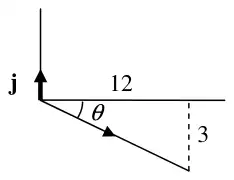
(c) the angle, to the nearest degree, that the direction of \(\mathbf{R}\) makes with \(\mathbf{j}\). (3)
| Scheme | Marks |
|---|---|
| \(7 + 5 + p = 0\) or \(-9 + 6 + q = 0\) | M1 |
| \(p = -12\) | A1 |
| \(q = 3\) | A1 |
| (3) |
| Scheme | Marks |
|---|---|
| \(\mathbf{R} = 12\mathbf{i} - 3\mathbf{j}\) | |
| \(|\mathbf{R}| = \sqrt{\left(12^2 + (-3)^2\right)} = \sqrt{153}\) or \(3\sqrt{17}\) or 12.4 or better (N) | M1 A1 |
| (2) |
| Scheme | Marks |
|---|---|
| \(\tan\theta = \dfrac{3}{12}\) | M1 |
| \(\theta = 14.03^\circ\ldots\) | A1 |
| Angle with \(\mathbf{j}\) is 104\(^\circ\), to the nearest degree cao | A1 |
| (3) | |
| (8 marks) |