
June 2019 Mechanics Q2
2.
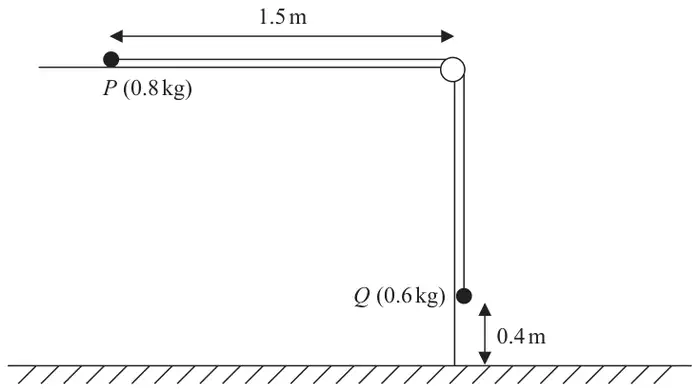
A small ball, \(P\), of mass 0.8 kg, is held at rest on a smooth horizontal table and is attached to one end of a thin rope.
The rope passes over a pulley that is fixed at the edge of the table.
The other end of the rope is attached to another small ball, \(Q\), of mass 0.6 kg, that hangs freely below the pulley.
Ball \(P\) is released from rest, with the rope taut, with \(P\) at a distance of 1.5 m from the pulley and with \(Q\) at a height of 0.4 m above the horizontal floor, as shown in Figure 1.
Ball \(Q\) descends, hits the floor and does not rebound.
The balls are modelled as particles, the rope as a light and inextensible string and the pulley as small and smooth.
Using this model,
| Scheme | Marks | AO |
|---|---|---|
| Equation of motion for \(Q\) | M1 | 3.3 |
| \(0.6g - T = 0.6a\) | A1 | 1.1b |
| Equation of motion for \(P\) | M1 | 3.3 |
| \(T = 0.8a\) | A1 | 1.1b |
| \(a = 4.2\ (\mathrm{m\,s^{-2}})\) * | A1* | 2.2a |
| (5) |
Notes
N.B. Omission or extra \(g\) in a resolution is an accuracy error not a method error
In 2(a), use the mass which appears in the ‘ma’ term of an equation of motion, to identify which particle that equation of motion applies to.
M1 Equation of motion for \(Q\) with correct no. of terms, condone sign errors.
A1 A correct equation
M1 Equation of motion for \(P\) with correct no. of terms, condone sign errors.
(corrected from the printed mark scheme: the note for this mark says “Equation of motion for \(Q\)”; it is the equation of motion for \(P\))
A1 A correct equation
A1* Given acceleration obtained correctly.
You must see an equation in \(a\) only before reaching \(a = 4.2\)
N.B. if they just use the whole system equation: \(0.6g = 1.4a\), can only score max M1A1M0A0A0
N.B. Use of \(g = 9.81\) or 10 loses final A mark only.
N.B. Complete verification, using both equations, can score full marks.
| Scheme | Marks | AO |
|---|---|---|
| \(0.4 = \dfrac{1}{2} \times 4.2 \times t_1^{\,2}\) or e.g. they may find \(v\) first and then use \(v = 4.2t_1\) | M1 | 2.1 |
| \(t_1 = 0.436(4357\ldots)\) Allow 0.43, 0.44, 0.436, or better, or any surd form e.g. \(\dfrac{2}{\sqrt{21}}\) | A1 | 1.1b |
| \(v = 4.2 \times t_1\) or \(v = \sqrt{2 \times 4.2 \times 0.4}\) or \(0.4 = \dfrac{(0 + v)}{2} \times t_1\) \((v = 1.8330\ldots)\) | M1 | 3.4 |
| \(t_2 = \dfrac{1.5 - 0.4}{v}\) | M1 | 1.1b |
| Complete strategy to solve the problem by finding the sum of the two times \(t_1 + t_2\) | DM1 | 3.1b |
| 1.0 (s) or 1.04 (s) | A1 | 1.1b |
| (6) |
Notes
M1 Complete method (they may use more than one suvat equation) to find time for \(Q\) to hit the floor
(M0 if 0.4 not used as distance moved and/or if 4.2 is not used as acceleration and this applies to finding \(v\) as well if they use \(v\) to find \(t_1\))
A1 See alternatives
M1 Complete method to find speed of \(Q\) as it hits the floor
(M0 if 0.4 not used as distance moved and/or if 4.2 is not used as acceleration and this applies to finding \(t_1\) as well if they use \(t_1\) to find \(v\))
M1 Uses distance/speed to find time for \(P\) to hit the pulley after \(Q\) has hit the floor.
N.B. This is independent of previous M mark.
DM1 Complete method to solve the problem by finding and adding the two required times, dependent on previous three M marks
| Scheme | Marks | AO |
|---|---|---|
| e.g. rope being light; rope being inextensible; pulley being smooth; pulley being small; balls being particles | B1 | 3.5b |
| (1) | ||
| (12 marks) |
Notes
B1 Clear statement. Allow negatives of these i.e. the rope may not be light, the rope may not be inextensible etc
Must be a limitation of the model stated in the question
Penalise incorrect or irrelevant extras
B0 for: Air resistance, table being smooth