
June 2025 Unit 2 Q10
10. A lift is pulled upwards by means of a single cable, as shown in the diagram on the right. A person of mass \(80\text{ kg}\) is standing in the lift. The mass of the lift is \(420\text{ kg}\).
The diagram on the left shows a sketch of the velocity-time graph for the journey of the lift for a period of \(t\) seconds.
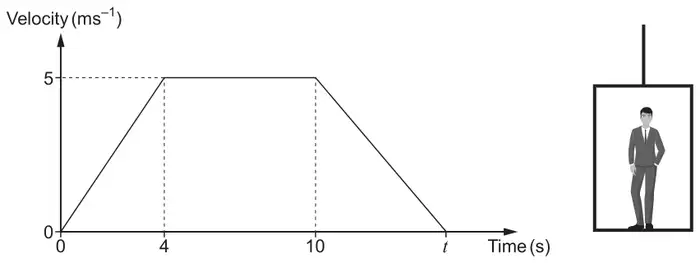
(a) Find the tension in the cable while the lift is accelerating. [4]
(b) While the lift is decelerating, the magnitude of the reaction of the floor of the lift on the person is \(704\text{ N}\). Determine the deceleration of the lift and hence show that \(t=15\). [5]
(c) Calculate the distance travelled by the lift during the entire 15 s journey. [2]
| Scheme | Marks | Comments |
|---|---|---|
| Accelerating from \(t=0\) to \(t=4\), acceleration = gradient \(=\frac{5}{4}\) or \(1{\cdot}25\) \((\text{ms}^{-2})\) | B1 | cao, any form |
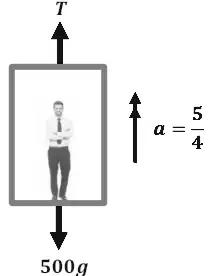 | \((420+80)g=500g\) \(=4900\) No extra forces | |
| N2L applied to lift, upwards positive \(T-500g=500a\) \((T-4900=500a)\) | M1 A1 | Dimensionally correct equation \(T\) and \(500g\) opposing Correct equation |
| \(T-500g=500\left(\frac{5}{4}\right)\) \((T-4900=625)\) \(T=5\,525\) (N) | A1 | cao |
| [4] |
Further Notes
Alternative Solution for B1
| Scheme | Marks | Comments |
|---|---|---|
| \(v=u+at,\ u=0,\ v=5,\ t=4\) \(5=0+a(4)\) \(a=\frac{5}{4}\) or \(1{\cdot}25\) \((\text{ms}^{-2})\) | B1 [1] | cao |
| Scheme | Marks | Comments |
|---|---|---|
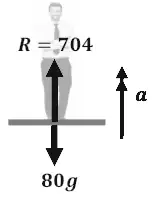 | \(80g=784\) No extra forces | |
| N2L on person only \(R-80g=\pm 80a\) \((R-784=80a)\) \(704-80g=\pm 80a\) \((704-784=80a)\) | M1 A1 | Dimensionally correct equation with \(R\) and \(80g\) opposing |
| \(a=\mp 1\) \((\text{ms}^{-2})\) Deceleration \(=1\) \((\text{ms}^{-2})\) | A1 | cao |
| For \(10<\text{time}<t\), acceleration = gradient \(=-1\) \((1=)\ \dfrac{5-0}{t-10}\) | M1 | oe, gradient calculation |
| \(t=15\) | A1 | Convincing |
| [5] |
Note
Award SC1 if \(a=1\) is derived from assuming that \(t=15\)
Further Notes
Alternative Solution to show that \(t=15\)
| Scheme | Marks | Comments |
|---|---|---|
| Starting from \(t=10\) \(v=u+at,\ u=5,\ v=0,\ a=-1\) \(0=5+(-1)t\) \(t=5\) | M1 | Used |
| \(t=10+5=15\) | A1 [2] | Convincing |
Corrected by Westie's Workshop
- The board's mark scheme printed “\(T=10+5=15\)”. Changed to “\(t=10+5=15\)” because the quantity being found is the time \(t\) (there is no tension \(T\) in this question).
Original: see the board's mark scheme PDF (link above).
| Scheme | Marks | Comments |
|---|---|---|
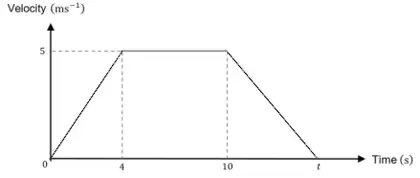
| Distance = area \(=\begin{cases}\frac{1}{2}\big((10-4)+15\big)(5)\\[4pt] \frac{1}{2}(4)(5)+(10-4)(5)+\frac{1}{2}(15-10)(5)\end{cases}\) | M1 | Attempt to find relevant area Trapezium OR Composite parts All 3 attempted \((=10+30+12{\cdot}5)\) |
| \(=\frac{105}{2}\) or \(52{\cdot}5\) (m) | A1 | cao, any form |
| [2] | ||
| Total for Question | 11 |