
October 2021 Paper 1 Q6
6 The displacement of a particle is modelled by the equation \(s = 7 + 4t - t^2\), where \(s\) metres is the displacement from the origin at time \(t\) seconds. The diagram shows part of the displacement-time graph for the particle. The point (2, 11) is the maximum point on the graph.
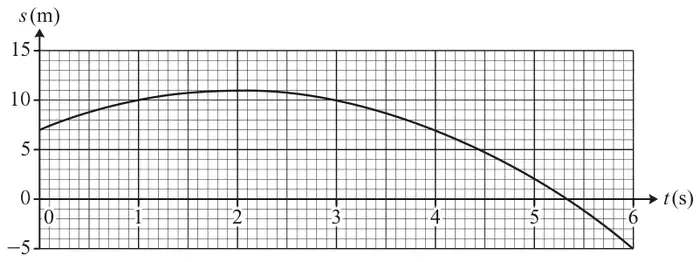
Comment on the validity of Kai’s argument. [1]
| Scheme | Marks | AO |
|---|---|---|
| (2, 11) on the graph tells Kai that the displacement from the origin at that time is 11 m and not the distance travelled. [The particle starts 7 m from the origin, so actual distance travelled is 11 – 7 = 4 m] | E1 | 2.3 |
| [1] |
Notes
E1: Draws a clear distinction between displacement from the origin at \(t = 2\) and the distance travelled
Allow for a statement that the displacement during the first 2 s is 4 m
| Scheme | Marks | AO |
|---|---|---|
| When \(t = 10,\ s = -53\) | M1 | 1.1 |
| Distance travelled is 53 + 11 + 4 | M1 | 1.1 |
| = 68 m | A1 | 1.1 |
| [3] |
Notes
M1: Evaluating displacement or distance from the origin at \(t = 10\) soi
May be implied by substitution seen or by −53 seen or by [distance of] 53 m
M1: Adds at least one distance to their 53m
| Scheme | Marks | AO |
|---|---|---|
| \(v = \dfrac{\mathrm{d}s}{\mathrm{d}t} = 4 - 2t\) | M1 A1 | 1.1a 1.1 |
| [2] |
Notes
M1: Attempt to differentiate
| Scheme | Marks | AO |
|---|---|---|
| When \(t = 10\) \(v = 4 - 2 \times 10\) [ −16 ] therefore the speed is 16 \(\text{m s}^{-1}\) | M1 A1 | 3.4 3.2a |
| [2] |
Notes
M1: Substitution of \(t = 10\) soi
A1: Allow for speed = 16 \(\text{m s}^{-1}\) seen www
Allow M1A0 for speed \(-16\) \(\text{m s}^{-1}\) seen or for \(4 - 2 \times 10 = 16\)