
June 2025 Paper 1 Q13
13 Particles A and B are moving along the same straight line. The graph below is the velocity–time graph for particle A with velocity \(v_{\text{A}}\ \text{m s}^{-1}\) at time \(t\) s. Particle A travels with constant acceleration. It has an initial velocity of \(-3\ \text{m s}^{-1}\) and is instantaneously at rest when \(t = 4\).
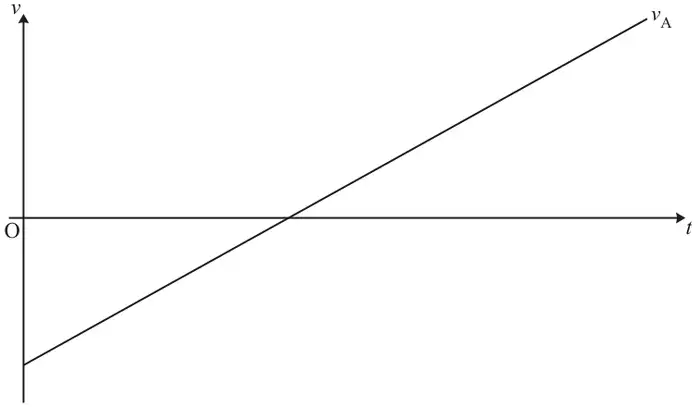
The velocity for particle B at time \(t\) s is given by \(v_{\text{B}} = 1.5 + 0.03t^2\ \text{m s}^{-1}\). The particles are first travelling at the same velocity at time \(t = T\) s. You are given that A and B do not collide.
| Scheme | Marks | AO |
|---|---|---|
| Acceleration of A is 0.75 Velocity of A is \([v_A =]\ {-3} + 0.75t\) | B1 | 3.1b |
| Same velocity when \(t = T\) \(-3 + 0.75T = 1.5 + 0.03T^2\) | M1 | 3.1a |
| \(T = 10\) or \(\sout{T = 15}\) So \(T = 10\) | A1 | 2.1 |
| [3] |
Notes
B1: Correct expression for velocity from graph
M1: Equated velocities and attempts to solve.
A1: AG Must see exclusion of \(T = 15\)
If M0A0 awarded, SC1 can be awarded if \(T = 10\) substituted into both velocity equations and are shown to be equal. Can be awarded if \(v_A = 4.5\) calculated at \(t = 10\) and used to calculate the time for \(v_B = 4.5\) or vice versa. (Beware circular argument) “First time” equal is not established by these methods
| Scheme | Marks | AO |
|---|---|---|
| At \(T = 10\) A has travelled a distance \(\left|\dfrac{1}{2}(-3 \times 4)\right| + \dfrac{1}{2}(10 - 4) \times 4.5\) | M1 A1 | 3.4 1.1 |
| \(= 6 + 13.5 = 19.5\) m | A1 | 1.1 |
| At \(T = 10\) B has travelled \(\displaystyle\int_0^{10} (1.5 + 0.03t^2)\,\mathrm{d}t = 25\) | M1 A1 | 3.1a 1.1 |
| So B has travelled 5.5 m further than A | A1FT | 1.1 |
| [6] |
Notes
M1: Attempting to find at least one area under the velocity-time graph
A1: At least one part correct allowing sign errors
A1: soi
M1: Attempts definite integral to calculate distance
A1: Cao
A1FT: FT their distances (dep on both method marks)
Alternative method for finding the distance for A
| Scheme | Marks | AO |
|---|---|---|
| \(u = -3, a = 0.75, t = 4\) so \(s = -6\) \(u = 0, a = 0.75, t = 10 - 4\) so \(s = 13.5\) | M1 A1 | |
| So total distance is 19.5 m | A1 |
M1: Uses suvat equations for \(0 \lt t \lt 4\) or \(4 \lt t \lt 10\) or \(0 \lt t \lt 10\) using \(u = -3\), and their \(a = 0.75\),
A1: Correct displacement or distance for either part
A1: soi
Alternative method for finding the distance for A
| Scheme | Marks | AO |
|---|---|---|
| \(\int_0^4 (-3 + 0.75t)\,\mathrm{d}t = -6\) \(\int_4^{10} (-3 + 0.75t)\,\mathrm{d}t = 13.5\) | M1 A1 | |
| So total distance is 19.5 m | A1 |
M1: Attempt to find definite integral \(0 \lt t \lt 4\) or \(4 \lt t \lt 10\) or \(0 \lt t \lt 10\). FT their \(v_A\)
A1: Correct displacement or distance for either part
A1: soi
BC may give total area so allow \(\int_0^{10} \left|-3 + 0.75t\right|\,\mathrm{d}t = 19.5\) (corrected from the printed mark scheme, which omits the modulus signs: \(\int_0^{10} (-3 + 0.75t)\,\mathrm{d}t\) is 7.5, not 19.5)