
June 2018 Paper 1 Q8
8 In this question you must show detailed reasoning.
Fig. 8 shows the graph of a quadratic function. The graph crosses the axes at the points \((-1, 0)\), \((0, -4)\) and \((2, 0)\).
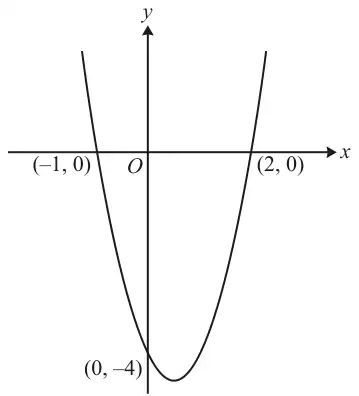
Find the area of the finite region bounded by the curve and the \(x\)-axis. [8]
| Scheme | Marks | AO |
|---|---|---|
| DR | ||
| EITHER Equation of the form \(y = k(x + 1)(x - 2)\) | M1 | 1.1a |
| \((0, -4)\) on curve so \(k = 2\) | M1 A1 | 3.1a 1.1b |
| OR Equation of the form \(y = ax^2 + bx + c\) \((0, -4)\) on curve \(c = -4\) | (M1) | |
| \((-1, 0)\) on the curve \(0 = a - b - 4\) \((2, 0)\) on the curve \(0 = 4a - 2b - 4\) | (M1) | |
| Solving simultaneous equations \(a = 2,\ b = -2\) | (A1) | |
| BOTH Area \(= \displaystyle\int_{-1}^{2} \left(2x^2 - 2x - 4\right) \mathrm{d}x\) \(\left[\dfrac{2x^3}{3} - x^2 - 4x\right]_{-1}^{2}\) | M1 A1 | 1.1a 1.1b |
| \(\left(\dfrac{2 \times 2^3}{3} - 2^2 - 4 \times 2\right) - \left(\dfrac{2 \times (-1)^3}{3} - (-1)^2 - 4 \times (-1)\right)\) | M1 | 1.1a |
| \(= -\dfrac{20}{3} - \dfrac{7}{3} = -9\) | A1 | 2.1 |
| Area is 9 below the \(x\)-axis. | E1 | 2.4 |
| [8] |
Notes
M1: Allow with \(k = 1\) and without \(y =\)
M1: Attempt to find \(k \neq 1\)
A1: All correct
Ignore = 0 if seen
(M1): Uses one point to form an equation
(M1): Uses both other points and attempts to solve simultaneous equations
(A1): All correct
Allow for \(c = -4\) seen
M1: Integration – allow without limits – condone one error
A1: FT their quadratic
M1: Substitution of limits clearly seen. Complete argument leading to exact answer.
A1: Allow for 9 if there is an argument to explain the change of sign even if \(-9\) not seen.
E1: Must give modulus and explain the change of sign. FT if their definite integral is negative.
“Area must be positive” is not sufficient explanation.