
C2 January 2007 Q7
7.
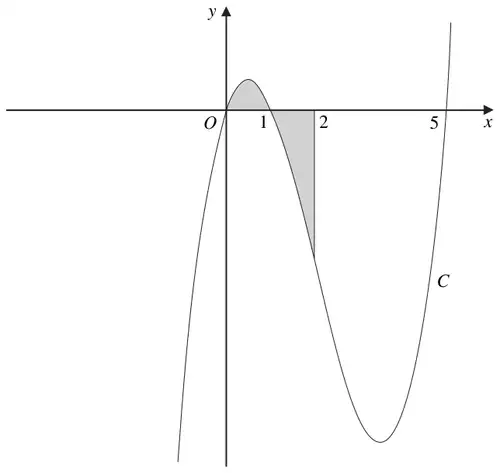
Figure 1 shows a sketch of part of the curve \(C\) with equation\[y = x(x - 1)(x - 5).\]Use calculus to find the total area of the finite region, shown shaded in Figure 1, that is between \(x = 0\) and \(x = 2\) and is bounded by \(C\), the \(x\)-axis and the line \(x = 2\). (9)
| Scheme | Marks |
|---|---|
| \(y = x(x^2 - 6x + 5)\) \(\phantom{y} = x^3 - 6x^2 + 5x\) | M1, A1 |
| \(\displaystyle\int (x^3 - 6x^2 + 5x)\,\mathrm{d}x = \frac{x^4}{4} - \frac{6x^3}{3} + \frac{5x^2}{2}\) | M1, A1ft |
| \(\left[\dfrac{x^4}{4} - 2x^3 + \dfrac{5x^2}{2}\right]_0^1 = \left(\dfrac{1}{4} - 2 + \dfrac{5}{2}\right) - 0 = \dfrac{3}{4}\) | M1 |
| \(\left[\dfrac{x^4}{4} - 2x^3 + \dfrac{5x^2}{2}\right]_1^2 = (4 - 16 + 10) - \dfrac{3}{4} = -\dfrac{11}{4}\) | M1, A1(both) |
| \(\therefore\) total area \(= \dfrac{3}{4} + \dfrac{11}{4}\) | M1 |
| \(= \dfrac{7}{2}\) o.e. | A1cso |
| (9) |
Notes
M1: Attempt to multiply out, must be a cubic.
A1: Award A mark for their final version of expansion (but final version does not need to have like terms collected).
M1: Attempt to integrate; \(x^n \to x^{n+1}\). Generous mark for some use of integration, so e.g. \(\displaystyle\int x(x - 1)(x - 5)\,\mathrm{d}x = \frac{x^2}{2}\left(\frac{x^2}{2} - x\right)\left(\frac{x^2}{2} - 5x\right)\) would gain method mark.
A1ft: Ft on their final version of expansion provided it is in the form \(ax^p + bx^q + \ldots\).
Integrand must have at least two terms and all terms must be integrated correctly.
If they integrate twice (e.g. \(\int_0^1\) and \(\int_1^2\)) and get different answers, take the better of the two.
M1: Substitutes and subtracts (either way round) for one integral. Integral must be a ‘changed’ function. Either 1 and 0, 2 and 1 or 2 and 0.
For \(\left[\ \right]_0^1\): \(-\,0\) for bottom limit can be implied (provided that it is 0).
M1: Substitutes and subtracts (either way round) for two integrals. Integral must be a ‘changed’ function. Must have 1 and 0 and 2 and 1 (or 1 and 2).
The two integrals do not need to be the same, but they must have come from attempts to integrate the same function.
A1: \(\dfrac{3}{4}\) and \(-\dfrac{11}{4}\) o.e. (if using \(\displaystyle\int_1^2 \mathrm{f}(x)\)) or \(\dfrac{3}{4}\) and \(\dfrac{11}{4}\) o.e. (if using \(\displaystyle\int_2^1 \mathrm{f}(x)\) or \(-\displaystyle\int_1^2 \mathrm{f}(x)\) or \(\displaystyle\int_1^2 -\mathrm{f}(x)\)) where \(\mathrm{f}(x) = \dfrac{x^4}{4} - 2x^3 + \dfrac{5x^2}{2}\).
The answer must be consistent with the integral they are using (so \(\displaystyle\int_1^2 \mathrm{f}(x) = \frac{11}{4}\) loses this A and the final A).
\(-\dfrac{11}{4}\) may not be seen explicitly. Can be implied by a subsequent line of working.
5th M1: \(\left|\text{their value for } \left[\ \right]_0^1\right| + \left|\text{their value for } \left[\ \right]_1^2\right|\)
Dependent on at least one of the values coming from integration (other may come from e.g. trapezium rules).
This can be awarded even if both values already positive.
A1 cso: \(\dfrac{7}{2}\) o.e. N.B. c.s.o.