
June 2023 Paper 1 Q5
5.
In this question you must show all stages of your working.
Solutions relying on calculator technology are not acceptable.
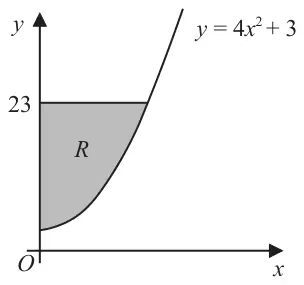
The finite region \(R\), shown shaded in Figure 2, is bounded by the curve with equation \(y = 4x^2 + 3\), the \(y\)-axis and the line with equation \(y = 23\)
Show that the exact area of \(R\) is \(k\sqrt{5}\) where \(k\) is a rational constant to be found. (5)
| Scheme | Marks | AO |
|---|---|---|
| States or uses the upper limit is \(\sqrt{5}\) | B1 | 1.1b |
| \(\displaystyle\int 4x^2 + 3\,\mathrm{d}x = \frac{4}{3}x^3 + 3x\) | M1 A1 | 1.1b 1.1b |
| Full method of finding the area of \(R\) e.g. \(23\sqrt{5} - \left[\dfrac{4}{3}x^3 + 3x\right]_0^{\sqrt{5}} = \ldots\) e.g. \(\left[20x - \dfrac{4}{3}x^3\right]_0^{\sqrt{5}} = \ldots\) | M1 | 2.1 |
| \(\Rightarrow \text{Area } R = \dfrac{40}{3}\sqrt{5}\) | A1 | 1.1b |
| (5) | ||
| (5 marks) |
Notes
B1: States or uses the upper limit \(\sqrt{5}\) Score when seen as the solution \(x = \sqrt{5}\)
M1: Attempts to integrate \(4x^2 + 3\) or \(\pm\left(23 - \left(4x^2 + 3\right)\right)\) which may be simplified.
Look for one term from \(4x^2 + 3\) with \(x^n \to x^{n+1}\) It is not sufficient just to integrate 23.
A1: Correct integration. Ignore any \(+c\) or spurious integral signs. Indices must be processed.
Look for \(\displaystyle\int 4x^2 + 3\,\{\mathrm{d}x\} = \frac{4}{3}x^3 + 3x\) or \(\displaystyle\pm\int 20 - 4x^2\,\{\mathrm{d}x\} = \pm\left(20x - \frac{4}{3}x^3\right)\) if (line – curve) or (curve – line) used.
M1: Full and complete method to find the area of \(R\) including the substitution of their upper limit.
The upper limit must come from an attempt to solve \(4x^2 + 3 = 23\)
The lower limit might not be seen but if seen it should be 0.
See scheme for two possible ways. Condone a sign slip if (line – curve) or (curve – line) used.
A1: \(\dfrac{40}{3}\sqrt{5}\) following correct algebraic integration.
If using (curve – line) then allow recovery but they must make the \(-\dfrac{40}{3}\sqrt{5}\) positive.
Alternative using \(\displaystyle\int x\,\mathrm{d}y\)
B1: States or uses limits 3 and 23. It must be for a clear attempt to integrate with respect to \(y\)
M1: Attempts to rearrange to \(x =\) and integrate \(\sqrt{\dfrac{y - 3}{4}}\) condoning slips on the rearrangement.
Look for \(\ldots(y \pm 3)^{\frac{1}{2}} \to \ldots(y \pm 3)^{\frac{3}{2}}\)
A1: Correct integration \(\displaystyle\int \frac{(y - 3)^{\frac{1}{2}}}{2}\,\{\mathrm{d}y\} = \frac{1}{3}(y - 3)^{\frac{3}{2}}\) Ignore any \(+c\) or spurious integral signs.
M1: Full and complete method to find the area of \(R\) including the substitution of their limits.
In this case it would be for substituting 23 and 3 and subtracting either way round into their changed expression in terms of \(y\)
A1: \(\dfrac{40}{3}\sqrt{5}\) following correct algebraic integration.