
C2 June 2011 Q9
9.
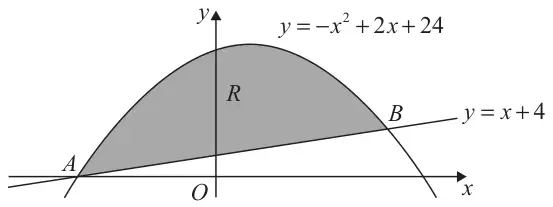
The straight line with equation \(y = x + 4\) cuts the curve with equation \(y = -x^2 + 2x + 24\) at the points \(A\) and \(B\), as shown in Figure 3.
The finite region \(R\) is bounded by the straight line and the curve and is shown shaded in Figure 3.
| Scheme | Marks |
|---|---|
| Curve: \(y = -x^2 + 2x + 24\), Line: \(y = x + 4\) | |
| \(\{\text{Curve} = \text{Line}\} \Rightarrow -x^2 + 2x + 24 = x + 4\) Eliminating \(y\) correctly. | B1 |
| \(x^2 - x - 20\ \{= 0\} \Rightarrow (x - 5)(x + 4)\ \{= 0\} \Rightarrow x = \ldots\) Attempt to solve a resulting quadratic to give \(x =\) their values. | M1 |
| So, \(x = 5, -4\) Both \(x = 5\) and \(x = -4\). | A1 |
| So corresponding \(y\)-values are \(y = 9\) and \(y = 0\). See notes below. | B1ft |
| [4] |
Notes
1st B1: For correctly eliminating either \(x\) or \(y\). Candidates will usually write \(-x^2 + 2x + 24 = x + 4\). This mark can be implied by the resulting quadratic.
M1: For solving their quadratic (which must be different to \(-x^2 + 2x + 24\)) to give \(x = \ldots\) See introduction for Method mark for solving a 3TQ. It must result from some attempt to eliminate one of the variables. A1: For both \(x = 5\) and \(x = -4\).
2nd B1ft: For correctly substituting their values of \(x\) in equation of line or parabola to give both correct ft \(y\)-values. (You may have to get your calculators out if they substitute their \(x\) into \(y = -x^2 + 2x + 24\)).
Note: For \(x = 5, -4 \Rightarrow y = 9\) and \(y = 0 \Rightarrow\) eg. \((-4, 9)\) and \((5, 0)\), award B1 isw.
If the candidate gives additional answers to \((-4, 0)\) and \((5, 9)\), then withhold the final B1 mark.
Special Case: Award SC: B0M0A0B1 for \(\{A\}(-4, 0)\). You may see this point marked on the diagram.
Note: SC: B0M0A0B1 for solving \(0 = -x^2 + 2x + 24\) to give \(\{A\}(-4, 0)\) and/or \((6, 10)\).
Alternative (a) Way 2
| Scheme | Marks |
|---|---|
| Curve: \(y = -x^2 + 2x + 24\), Line: \(y = x + 4\) | |
| \(\{\text{Curve} = \text{Line}\} \Rightarrow y = -(y - 4)^2 + 2(y - 4) + 24\) Eliminating \(x\) correctly. | B1 |
| \(y^2 - 9y\ \{= 0\} \Rightarrow y(y - 9)\ \{= 0\} \Rightarrow y = \ldots\) Attempt to solve a resulting quadratic to give \(y =\) their values. | M1 |
| So, \(y = 0, 9\) Both \(y = 0\) and \(y = 9\). | A1 |
| So corresponding \(y\)-values are \(x = -4\) and \(x = 5\). See notes below. | B1ft |
| [4] |
2nd B1ft: For correctly substituting their values of \(y\) in equation of line or parabola to give both correct ft \(x\)-values.
| Scheme | Marks |
|---|---|
| \(\left\{\displaystyle\int (-x^2 + 2x + 24)\,\mathrm{d}x\right\} = \underline{-\dfrac{x^3}{3} + \dfrac{2x^2}{2} + 24x}\ \{+ c\}\) M1: \(x^n \to x^{n + 1}\) for any one term. 1st A1 at least two out of three terms. 2nd A1 for correct answer. | M1A1A1 |
| \(\left[-\dfrac{x^3}{3} + \dfrac{2x^2}{2} + 24x\right]_{-4}^{5} = (\ldots\ldots) - (\ldots\ldots)\) Substitutes 5 and \(-4\) (or their limits from part(a)) into an “integrated function” and subtracts, either way round. | dM1 |
| \(\left\{\left(-\dfrac{125}{3} + 25 + 120\right) - \left(\dfrac{64}{3} + 16 - 96\right) = \left(103\dfrac{1}{3}\right) - \left(-58\dfrac{2}{3}\right) = 162\right\}\) | |
| Area of \(\Delta = \tfrac{1}{2}(9)(9) = 40.5\) Uses correct method for finding area of triangle. | M1 |
| So area of \(R\) is \(162 - 40.5 = 121.5\) Area under curve – Area of triangle. | M1 |
| 121.5 | A1 oe cao |
| [7] | |
| 11 |
Notes
Note: Do not give marks for working in part (b) which would be creditable in part (a).
1st M1 for an attempt to integrate meaning that \(x^n \to x^{n + 1}\) for at least one of the terms. Note that \(24 \to 24x\) is sufficient for M1.
1st A1 at least two out of three terms correctly integrated.
2nd A1 for correct integration only and no follow through. Ignore the use of a \(\text{‘}+ c\text{’}\).
2nd M1: Note that this method mark is dependent upon the award of the first M1 mark in part (b). Substitutes 5 and \(-4\) (and not 4 if the candidate has stated \(x = -4\) in part (a).) (or the limits the candidate has found from part(a)) into an “integrated function” and subtracts, either way round. Allow one slip!
3rd M1: Area of triangle \(= \dfrac{1}{2}(\text{their } x_2 - \text{their } x_1)(\text{their } y_2)\) or Area of triangle \(= \displaystyle\int_{x_1}^{x_2} x + 4\ \{\mathrm{d}x\}\).
Where \(x_1 =\) their \(-4\), \(x_2 =\) their 5 and \(y_2 =\) their \(y\) usually found in part (a).
4th M1: Area under curve – Area under triangle, where both Area under curve \(\gt 0\) and Area under triangle \(\gt 0\) and Area under curve \(\gt\) Area under triangle.
3rd A1: 121.5 or \(\tfrac{243}{2}\) oe cao.
Alternative (b) Way 2
| Scheme | Marks |
|---|---|
| Curve: \(y = -x^2 + 2x + 24\), Line: \(y = x + 4\) | |
| Area of \(R = \displaystyle\int_{-4}^{5} (-x^2 + 2x + 24) - (x + 4)\,\mathrm{d}x\) 3rd M1: Uses integral of \((x + 4)\) with correct ft limits. 4th M1: Uses “curve” – “line” function with correct ft limits. | |
| \(= -\dfrac{x^3}{3} + \dfrac{x^2}{2} + 20x\ \{+ c\}\) M: \(x^n \to x^{n + 1}\) for any one term. A1 at least two out of three terms. Correct answer (Ignore \(+ c\)). | M1 A1ft A1 |
| \(\left[-\dfrac{x^3}{3} + \dfrac{x^2}{2} + 20x\right]_{-4}^{5} = (\ldots\ldots) - (\ldots\ldots)\) Substitutes 5 and \(-4\) (or their limits from part(a)) into an “integrated function” and subtracts, either way round. | dM1 |
| \(\left\{\left(-\dfrac{125}{3} + \dfrac{25}{2} + 100\right) - \left(\dfrac{64}{3} + 8 - 80\right) = \left(70\dfrac{5}{6}\right) - \left(-50\dfrac{2}{3}\right)\right\}\) | |
| See above working to decide to award 3rd M1 mark here: | M1 |
| See above working to decide to award 4th M1 mark here: | M1 |
| So area of \(R\) is \(= 121.5\) 121.5 | A1 oe cao |
| [7] |
1st M1 for an attempt to integrate meaning that \(x^n \to x^{n + 1}\) for at least one of the terms. Note that \(20 \to 20x\) is sufficient for M1.
1st A1 at least two out of three terms correctly ft. Note this accuracy mark is ft in Way 2.
2nd A1 for correct integration only and no follow through. Ignore the use of a \(\text{‘}+ c\text{’}\).
Allow 2nd A1 also for \(-\dfrac{x^3}{3} + \dfrac{2x^2}{2} + 24x - \left(\dfrac{x^2}{2} + 4x\right)\). Note that \(\dfrac{2x^2}{2} - \dfrac{x^2}{2}\) or \(24x - 4x\) only counts as one integrated term for the 1st A1 mark. Do not allow any extra terms for the 2nd A1 mark.
2nd M1: Note that this method mark is dependent upon the award of the first M1 mark in part (b). Substitutes 5 and \(-4\) (and not 4 if the candidate has stated \(x = -4\) in part (a).) (or the limits the candidate has found from part(a)) into an “integrated function” and subtracts, either way round. Allow one slip!
3rd M1: Uses the integral of \((x + 4)\) with correct ft limits of their \(x_1\) and their \(x_2\) (usually found in part (a)) {where \((x_1, y_1) = (-4, 0)\) and \((x_2, y_2) = (5, 9)\).} This mark is usually found in the first line of the candidate’s working in part (b).
4th M1: Uses “curve” – “line” function with correct ft (usually found in part (a)) limits. Subtraction must be correct way round. This mark is usually found in the first line of the candidate’s working in part (b). Allow \(\displaystyle\int_{-4}^{5} (-x^2 + 2x + 24) - x + 4\ \{\mathrm{d}x\}\) for this method mark.
3rd A1: 121.5 oe cao.
Note: SPECIAL CASE for this alternative method
Area of \(R = \displaystyle\int_{-4}^{5} (x^2 - x - 20)\,\mathrm{d}x = \left[\frac{x^3}{3} - \frac{x^2}{2} - 20x\right]_{-4}^{5} = \left(\frac{125}{3} - \frac{25}{2} - 100\right) - \left(-\frac{64}{3} - 8 + 80\right)\)
The working so far would score SPECIAL CASE M1A1A1M1M1M0A0.
The candidate may then go on to state that \(= \left(-70\dfrac{5}{6}\right) - \left(50\dfrac{2}{3}\right) = -\dfrac{243}{2}\)
If the candidate then multiplies their answer by \(-1\) then they would gain the 4th M1 and 121.5 would gain the final A1 mark.
Alternative Methods for obtaining the M1 mark for use of limits
There are two alternative methods can candidates can apply for finding “162”.
Alternative 1:
\(\displaystyle\int_{-4}^{0} (-x^2 + 2x + 24)\,\mathrm{d}x + \int_{0}^{5} (-x^2 + 2x + 24)\,\mathrm{d}x\)
\(= \left[-\dfrac{x^3}{3} + \dfrac{2x^2}{2} + 24x\right]_{-4}^{0} + \left[-\dfrac{x^3}{3} + \dfrac{2x^2}{2} + 24x\right]_{0}^{5}\)
\(= (0) - \left(\dfrac{64}{3} + 16 - 96\right) + \left(-\dfrac{125}{3} + 25 + 120\right) - (0)\)
\(= \left(103\dfrac{1}{3}\right) - \left(-58\dfrac{2}{3}\right) = 162\)
Alternative 2:
\(\displaystyle\int_{-4}^{6} (-x^2 + 2x + 24)\,\mathrm{d}x - \int_{5}^{6} (-x^2 + 2x + 24)\,\mathrm{d}x\)
\(= \left[-\dfrac{x^3}{3} + \dfrac{2x^2}{2} + 24x\right]_{-4}^{6} - \left[-\dfrac{x^3}{3} + \dfrac{2x^2}{2} + 24x\right]_{5}^{6}\)
\(= \left\{\left(-\dfrac{216}{3} + 36 + 144\right) - \left(\dfrac{64}{3} + 16 - 96\right)\right\} - \left\{\left(-\dfrac{216}{3} + 36 + 144\right) - \left(-\dfrac{125}{3} + 25 + 120\right)\right\}\)
\(= \left\{(108) - \left(-58\dfrac{2}{3}\right)\right\} - \left\{(108) - \left(103\dfrac{1}{3}\right)\right\}\)
\(= \left(166\dfrac{2}{3}\right) - \left(4\dfrac{2}{3}\right) = 162\)