
C1 January 2014 (IAL) Q9
9. A curve with equation \(y = \mathrm{f}(x)\) passes through the point \((3, 6)\). Given that\[\mathrm{f}^{\prime}(x) = (x - 2)(3x + 4)\]
| Scheme | Marks |
|---|---|
| \(\mathrm{f}^{\prime}(x) = (x - 2)(3x + 4)\) \(= 3x^2 - 2x - 8\) | B1 |
| \(y = \displaystyle\int 3x^2 - 2x - 8\,\mathrm{d}x = 3\times\frac{x^3}{3} - 2\times\frac{x^2}{2} - 8x + c\) | M1A1 |
| \(x = 3, y = 6 \Rightarrow 6 = 27 - 9 - 24 + c\) \(c = ..\) | M1 |
| \(\mathrm{f}(x) = x^3 - x^2 - 8x + 12\) cso | A1 |
| (5) |
Notes
B1: Writes \((x - 2)(3x + 4)\) as \(3x^2 - 2x - 8\)
M1: \(x^n \to x^{n+1}\) in any one term.
For this M to be scored there must have been an attempt to expand the brackets and obtain a quadratic expression
A1: Correct (unsimplified) expression for \(\mathrm{f}(x)\), no need for +c. Accept \(3\dfrac{x^3}{3} - 2\dfrac{x^2}{2} - 8x\)
M1: Substitutes \(x\)=3 and \(y\)=6 into their f(\(x\)) containing a constant ‘\(c\)’ and proceed to find its value.
A1: Cso \(\mathrm{f}(x) = x^3 - x^2 - 8x + 12\). Allow \(y = ..\)
Do not accept an answer produced from part (b)
| Scheme | Marks |
|---|---|
| \(\mathrm{f}(x) = (x - 2)^2(x + p)\quad p = 3\) | B1 |
| \(\mathrm{f}(x) = (x^2 - 4x + 4)(x + 3)\) \(\mathrm{f}(x) = x^3 - 4x^2 + 3x^2 + 4x - 12x + 12\) \(\mathrm{f}(x) = x^3 - x^2 - 8x + 12\) cso | M1A1 |
| (3) |
Notes
B1: States \(p = 3\)
This may be obtained from subbing (3,6) into \(\mathrm{f}(x) = (x - 2)^2(x + p)\)
M1: Multiplies out a pair of brackets first, usually \((x - 2)^2\) and then attempts to multiply by the third. The minimum criteria should be the first multiplication is a 3T quadratic with correct first and last terms and the second is a 4T cubic with correct first and last terms.
Accept an expression involving \(p\) for M1
\((x - 2)^2(x + p) = (x^2 + ..x + 4)(x + p) = x^3 + ..x^2 + ..x + 4p\)
A1: cso \(\mathrm{f}(x) = x^3 - x^2 - 8x + 12\), which must be the same as their answer for part (a)
Candidates who have experienced Core 2 could take their answer to (a) and factorise.
The mark scheme can be applied with M1 for division by \((x - 2)\) and further factorisation of the quotient
\[\begin{array}{r} x^2\phantom{+\ldots\ldots\ldots} \\ x - 2\,\big)\overline{\,x^3 + \ldots\ldots\ldots} \end{array}\]
Alternatively the candidate could divide by \((x^2 - 4x + 4)\) to obtain \((x + ..)\)
\[\begin{array}{r} x + ..\phantom{\ldots\ldots\ldots} \\ x^2 - 4x + 4\,\big)\overline{\,x^3 + \ldots\ldots\ldots} \end{array}\]
The A1 is scored for \(\mathrm{f}(x) = (x - 2)^2(x + 3)\)
The B1 is awarded for a statement of \(p = 3\) and not just \((x - 2)^2(x + 3)\)
| Scheme | Marks |
|---|---|
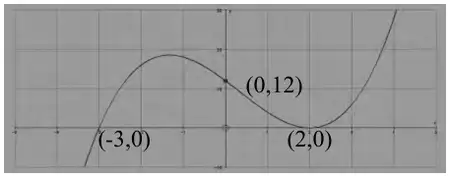
| Shape | B1 |
| Min at \((2, 0)\) | B1 |
| Crosses \(x\)- axis at \((-3, 0)\) | B1ft |
| Crosses \(y\)- axis at \((0, 12)\) | B1 |
| (4) | |
| (12 marks) |
Notes
B1: Shape \(+x^3\) graph with one maximum and one minimum. Its position is not important for this mark.
It must appear to tend to + infinity at the rhs and – infinity at the lhs.
The curve must extend beyond its ‘maximum’ point and minimum points.
Eg. These are NOT acceptable.

B1: There is a turning point at \((2, 0)\). Accept 2 marked as a maximum or minimum on the \(x\)- axis.
B1ft: Graph crosses the \(x\)- axis at \((-3, 0)\).
Accept −3 marked at the point where the curve crosses the \(x\)-axis.
You may follow through on their values of ‘\(-p\)’ as long as \(p < 2\)
B1: Graph crosses the \(y\)-axis at \((0, 12)\). Accept 12 marked on the \(y\)- axis.