
C2 January 2009 Q2
2.
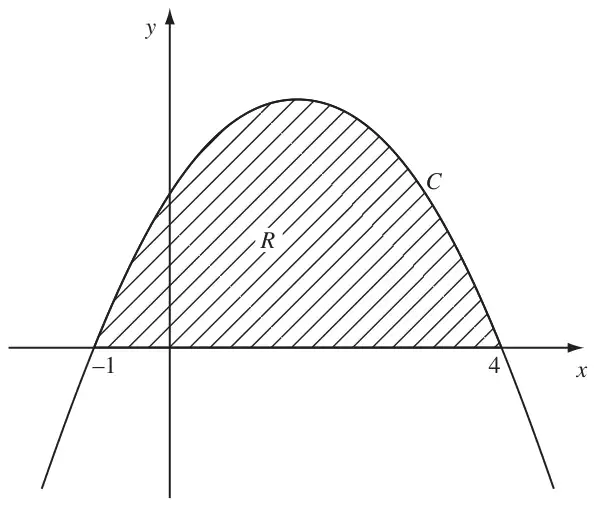
Figure 1 shows part of the curve \(C\) with equation \(y = (1 + x)(4 - x)\).
The curve intersects the \(x\)-axis at \(x = -1\) and \(x = 4\). The region \(R\), shown shaded in Figure 1, is bounded by \(C\) and the \(x\)-axis.
Use calculus to find the exact area of \(R\). (5)
| Scheme | Marks |
|---|---|
| \(y = (1 + x)(4 - x) = 4 + 3x - x^2\) M: Expand, giving 3 (or 4) terms | M1 |
| \(\displaystyle\int\left(4 + 3x - x^2\right)\mathrm{d}x = 4x + \frac{3x^2}{2} - \frac{x^3}{3}\) M: Attempt to integrate | M1 A1 |
| \(= \left[\ldots\ldots\ldots\right]_{-1}^{4} = \left(16 + 24 - \dfrac{64}{3}\right) - \left(-4 + \dfrac{3}{2} + \dfrac{1}{3}\right) = \dfrac{125}{6}\qquad\left(= 20\dfrac{5}{6}\right)\) | M1 A1 |
| (5) | |
| [5] |
Notes
M1 needs expansion, there may be a slip involving a sign or simple arithmetical error e.g. \(1 \times 4 = 5\), but there needs to be a ‘constant’ an ‘\(x\) term’ and an ‘\(x^2\) term’. The \(x\) terms do not need to be collected. (Need not be seen if next line correct)
Attempt to integrate means that \(x^n \to x^{n+1}\) for at least one of the terms, then M1 is awarded ( even 4 becoming \(4x\) is sufficient) – one correct power sufficient.
A1 is for correct answer only, not follow through. But allow \(2x^2 - \tfrac{1}{2}x^2\) or any correct equivalent. Allow + c, and even allow an evaluated extra constant term.
M1: Substitute limit 4 and limit –1 into a changed function (must be –1) and indicate subtraction (either way round).
A1 must be exact, not 20.83 or similar. If recurring indicated can have the mark. Negative area, even if subsequently positive loses the A mark.
Special cases
(i) Uses calculator method: M1 for expansion (if seen) M1 for limits if answer correct, so 0 , 1 or 2 marks out of 5 is possible (Most likely M0 M0 A0 M1 A0 )
(ii) Uses trapezium rule : not exact, no calculus – 0/5 unless expansion mark M1 gained.
(iii) Using original method, but then change all signs after expansion is likely to lead to: M1 M1 A0, M1 A0 i.e. 3/5