
C2 January 2008 Q7
7.
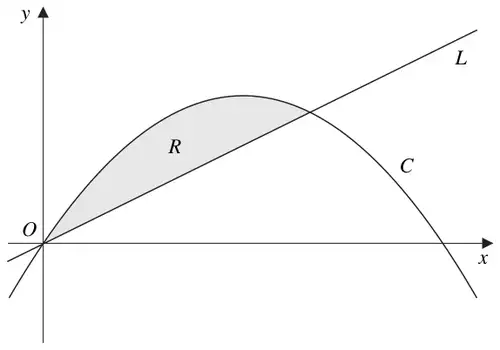
In Figure 2 the curve \(C\) has equation \(y = 6x - x^2\) and the line \(L\) has equation \(y = 2x\).
The region \(R\), bounded by the curve \(C\) and the line \(L\), is shown shaded in Figure 2.
| Scheme | Marks |
|---|---|
| Either solving \(0 = x(6 - x)\) and showing \(x = 6\) (and \(x = 0\)) or showing \((6, 0)\) (and \(x = 0\)) satisfies \(y = 6x - x^2\) [allow for showing \(x = 6\)] | B1 |
| (1) |
| Scheme | Marks |
|---|---|
| Solving \(2x = 6x - x^2\) \((x^2 = 4x)\) to \(x = ..\) | M1 |
| \(x = 4\) (and \(x = 0\)) | A1 |
| Conclusion: when \(x = 4,\ y = 8\) and when \(x = 0,\ y = 0\), | A1 |
| (3) |
Notes
In scheme first A1: need only give \(x = 4\)
If verifying approach used:
Verifying \((4, 8)\) satisfies both the line and the curve M1 (attempt at both),
Both shown successfully A1
For final A1, \((0, 0)\) needs to be mentioned ; accept “clear from diagram”
| Scheme | Marks |
|---|---|
| (Area =) \(\displaystyle\int_{(0)}^{(4)} (6x - x^2)\,\mathrm{d}x\) Limits not required | M1 |
| Correct integration \(3x^2 - \dfrac{x^3}{3}\ (+ c)\) | A1 |
| Correct use of correct limits on their result above (see notes on limits) \(\left[\text{“}3x^2 - \dfrac{x^3}{3}\text{”}\right]^4 - \left[\text{“}3x^2 - \dfrac{x^3}{3}\text{”}\right]_0\) with limits substituted \(\left[= 48 - 21\dfrac{1}{3} = 26\dfrac{2}{3}\right]\) | M1 |
| Area of triangle \(= 2\times 8 = 16\) (Can be awarded even if no M scored, i.e. B1) | A1 |
| Shaded area \(= \pm\)(area under curve − area of triangle) applied correctly | M1 |
| \(\left(= 26\dfrac{2}{3} - 16\right) = 10\dfrac{2}{3}\) (awrt 10.7) | A1 |
| (6) | |
| [10] |
Notes
Alternative Using Area \(= \pm\displaystyle\int_{(0)}^{(4)} \{(6x - x^2);\ -2x\}\,\mathrm{d}x\) approach
(i) If candidate integrates separately can be marked as main scheme
If combine to work with \(= \pm\displaystyle\int_{(0)}^{(4)} (4x - x^2)\,\mathrm{d}x\), first M mark and third M mark
\(= (\pm)\left[2x^2 - \dfrac{x^3}{3}\ (+ c)\right]\) A1,
Correct use of correct limits on their result second M1,
Totally correct, unsimplified \(\pm\) expression (may be implied by correct ans.) A1
\(10\tfrac{2}{3}\) A1 [Allow this if, having given \(-10\tfrac{2}{3}\), they correct it]
M1 for correct use of correct limits: Must substitute correct limits for their strategy into a changed expression and subtract, either way round, e.g \(\pm\left\{\left[\ \right]^4 - \left[\ \right]_0\right\}\)
If a long method is used, e,g, finding three areas, this mark only gained for correct strategy and all limits need to be correct for this strategy.
Use of trapezium rule: M0A0MA0, possible A1 for triangle
M1 (if correct application of trap. rule from \(x = 0\) to \(x = 4\)) A0