
C2 June 2012 Q5
5.
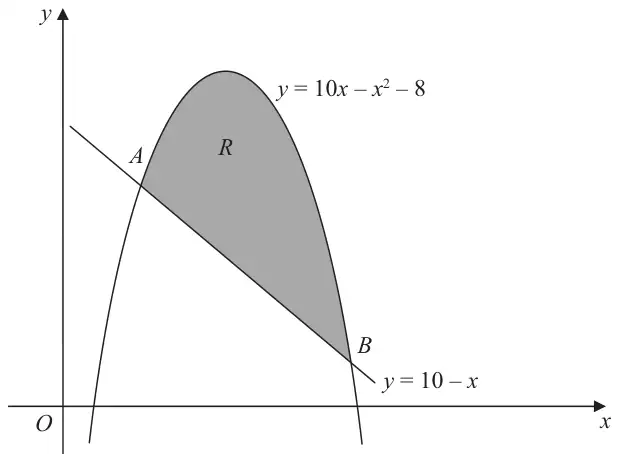
Figure 2 shows the line with equation \(y = 10 - x\) and the curve with equation \(y = 10x - x^2 - 8\)
The line and the curve intersect at the points \(A\) and \(B\), and \(O\) is the origin.
The shaded area \(R\) is bounded by the line and the curve, as shown in Figure 2.
| Scheme | Marks | |
|---|---|---|
| Method 1 | Or (eliminating x) | |
| Puts \(10 - x = 10x - x^2 - 8\) and rearranges to give three term quadratic | Or puts \(y = 10(10 - y) - (10 - y)^2 - 8\) and rearranges to give three term quadratic | M1 |
| Solves their “\(x^2 - 11x + 18 = 0\)” using acceptable method as in general principles to give \(x =\) | Solves their “\(y^2 - 9y + 8 = 0\)” using acceptable method as in general principles to give \(y =\) | M1 |
| Obtains \(x = 2\), \(x = 9\) (may be on diagram or in part (b) in limits) | Obtains \(y = 8\), \(y = 1\) (may be on diagram) | A1 |
| Substitutes their \(x\) into a given equation to give \(y =\) (may be on diagram) | Substitutes their \(y\) into a given equation to give \(x =\) (may be on diagram or in part (b)) | M1 |
| \(y = 8,\ y = 1\) | \(x = 2,\ x = 9\) | A1 |
| (5) | ||
Notes
First M1: See scheme Second M1: See notes relating to solving quadratics
Third M1: This may be awarded if one substitution is made
Two correct Answers following tables of values, or from Graphical calculator are 5/5
Just one pair of correct coordinates – no working or from table is M0M0A0M1A0
| Scheme | Marks |
|---|---|
| \(\displaystyle\int (10x - x^2 - 8)\,\mathrm{d}x = \frac{10x^2}{2} - \frac{x^3}{3} - 8x\ \{+ c\}\) | M1 A1 A1 |
| \(\left[\dfrac{10x^2}{2} - \dfrac{x^3}{3} - 8x\right]_2^9 = (\ldots\ldots) - (\ldots\ldots)\) | dM1 |
| \(= 90 - \dfrac{4}{3} = 88\tfrac{2}{3}\) or \(\tfrac{266}{3}\) | |
| Area of trapezium \(= \tfrac{1}{2}(8 + 1)(9 - 2) = 31.5\) | B1 |
| So area of \(R\) is \(88\tfrac{2}{3} - 31.5 = 57\tfrac{1}{6}\) or \(\tfrac{343}{6}\) | M1A1 cao |
| (7) | |
| 12 marks |
Notes
M1: \(x^n \to x^{n + 1}\) for any one term.
1st A1: at least two out of three terms correct 2nd A1: All three correct
dM1: Substitutes 9 and 2 (or limits from part(a)) into an “integrated function” and subtracts, either way round
(NB: If candidate changes all signs to get \(\displaystyle\int (-10x + x^2 + 8)\,\mathrm{d}x = -\frac{10x^2}{2} + \frac{x^3}{3} + 8x\ \{+ c\}\) This is M1 A1 A1
Then uses limits dM1 and trapezium is B1
Needs to change sign of value obtained from integration for final M1A1 so \(-88\tfrac{2}{3} - 31.5\) is M0A0 )
B1: Obtains 31.5 for area under line using any correct method (could be integration) or triangle minus triangle \(\tfrac{1}{2} \times 8 \times 8 - \tfrac{1}{2}\) or rectangle plus triangle [may be implied by correct 57 1/6 ]
M1: Their Area under curve – Their Area under line (if integrate both need same limits)
A1: Accept 57.16recurring but not 57.16
Method 2 for (b)
| Scheme | Marks |
|---|---|
| Area of \(R = \displaystyle\int_2^9 (10x - x^2 - 8) - (10 - x)\,\mathrm{d}x\) 3rd M1 (in (b) ): Uses difference between two functions in integral. | |
| \(\displaystyle\int_2^9 -x^2 + 11x - 18\,\mathrm{d}x = -\frac{x^3}{3} + \frac{11x^2}{2} - 18x\ \{+ c\}\) M: \(x^n \to x^{n + 1}\) for any one term. A1 at least two out of these three simplified terms. Correct integration. (Ignore \(+ c\)). | M1 A1 A1 |
| \(\left[-\dfrac{x^3}{3} + \dfrac{11x^2}{2} - 18x\right]_2^9 = (\ldots\ldots) - (\ldots\ldots)\) Substitutes 9 and 2 (or limits from part(a)) into an “integrated function” and subtracts, either way round. | dM1 |
| This mark is implied by final answer which rounds to 57.2 | B1 |
| See above working(allow bracketing errors) to decide to award 3rd M1 mark for (b) here: | M1 |
| \(40.5 - \left(-16\tfrac{2}{3}\right) = 57\tfrac{1}{6}\) cao | A1 |
| (7) |
Special case of above method
| Scheme | Marks |
|---|---|
| \(\displaystyle\int_2^9 x^2 - 11x + 18\,\mathrm{d}x = \frac{x^3}{3} - \frac{11x^2}{2} + 18x\ \{+ c\}\) | M1A1A1 |
| \(\left[\dfrac{x^3}{3} - \dfrac{11x^2}{2} + 18x\right]_2^9 = (\ldots\ldots) - (\ldots\ldots)\) | DM1 |
| This mark is implied by final answer which rounds to 57.2 (not -57.2) | B1 |
| Difference of functions implied (see above expression) | M1 |
| \(40.5 - \left(-16\tfrac{2}{3}\right) = 57\tfrac{1}{6}\) cao | A1 |
| (7) |
Special Case 2
Integrates expression in \(y\) e.g. “\(y^2 - 9y + 8 = 0\)”: This can have first M1 in part (b) and no other marks. (It is not a method for finding this area)
Notes
Take away trapezium again having used Method 2 loses last two marks
Common Error:
Integrates \(-x^2 + 9x - 18\) is likely to be M1A1A0dM1B0M1A0
Integrates \(2 - 11x - x^2\) is likely to e M1A0A0dM1B0M1A0
Writing \(\displaystyle\int_2^9 (10x - x^2 - 8) - (10 - x)\,\mathrm{d}x\) only earns final M mark