
June 2024 Unit 1 Q14
14. The diagram below shows a sketch of the curve C with equation \(y=2-3x-2x^2\) and the line L with equation \(y=x+2\). The curve and the line intersect the coordinate axes at the points A and B.
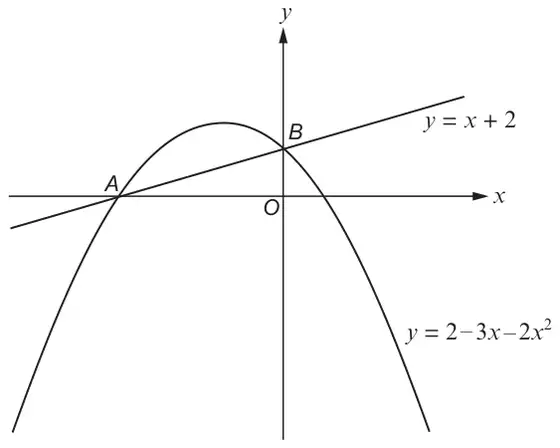
(a) Write down the coordinates of A and B. [2]
(b) Calculate the area enclosed by C and L. [6]
| Scheme | Marks | Comments |
|---|---|---|
| A is the point (–2, 0) | B1 | |
| B is the point (0, 2) | B1 |
| Scheme | Marks | Comments |
|---|---|---|
| \(\mathrm{I}=\int_{-2}^{0}(2-3x-2x^2)\,\mathrm{d}x\) | M1 | attempt to integrate \(y\) wrt \(x\) Limits not required. At least one power of \(x\) increased |
| \(=\left[2x-\frac{3}{2}x^2-\frac{2}{3}x^3\right]_{-2}^{0}\) | A1 | correct integration |
| \(=\left[0-\left(-4-6+\frac{16}{3}\right)\right]\) | m1 | correct use of candidate’s limits, |
| \(=\frac{14}{3}\) | A1 | cao, allow one decimal place correctly derived from \(\frac{14}{3}\). |
| Area of triangle \(\left(=\frac{1}{2}\times2\times2\right)=2\) | B1 | oe, ft (a) |
| Required area \(\left(=\frac{14}{3}-2\right)=\frac{8}{3}\) | A1 | cao, allow one decimal place correctly derived from \(\frac{8}{3}\). |
Note
Must be supported by workings.
If M0, award SC1 for sight of \(\frac{14}{3}\), OR SC2 for \(\frac{8}{3}\)
Alternative solution
| Scheme | Marks | Comments |
|---|---|---|
| \(\mathrm{I}=\int_{-2}^{0}(2-3x-2x^2-x-2)\,\mathrm{d}x\) | (M1) | attempt to integrate \(y\) wrt \(x\) Limits not required. At least one power of \(x\) increased |
| (A1) | attempt to subtract integrand | |
| \(=\int_{-2}^{0}(-4x-2x^2)\,\mathrm{d}x\) | ||
| \(=\left[-2x^2-\frac{2x^3}{3}\right]_{-2}^{0}\) | (A1) | correct integration |
| \(=\left[0-\left(-8+\frac{16}{3}\right)\right]\) | (m1) | correct use of candidate’s limits, |
| \(=\frac{8}{3}\) | (A2) | cao |
Note
Must be supported by workings.
If M0, SC2 for \(\frac{8}{3}\)