
C1 June 2017 Q9
9.
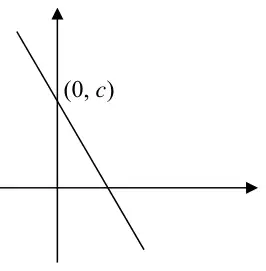
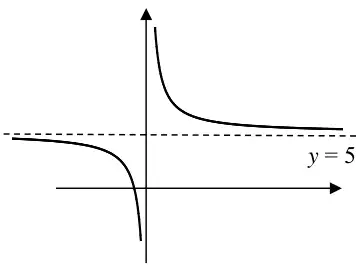
On each sketch show the coordinates of any point at which the graph crosses the \(y\)-axis and the equation of any horizontal asymptote.
(4)Given that \(y = -3x + c\), where \(c\) is a positive constant, meets the curve \(y = \dfrac{1}{x} + 5\) at two distinct points,
(a)(i)
| Scheme | Marks |
|---|---|
| Straight line with negative gradient anywhere even with no axes. | B1 |
| Straight line with an intercept at \((0, c)\) or just \(c\) marked on the positive \(y\)-axis provided the line passes through the positive \(y\)-axis. Allow \((c, 0)\) as long as it is marked in the correct place. Allow \((0, c)\) in the body of the script but in any ambiguity, the sketch has precedence. Ignore any intercepts with the \(x\)-axis. | B1 |
(a)(ii)
| Scheme | Marks |
|---|---|
| Either: For the shape of a \(y = \dfrac{1}{x}\) curve in any position. It must have two branches and be asymptotic horizontally and vertically with no obvious “overlap” with the asymptotes, but otherwise be generous. The curve may bend away from the asymptote a little at the end. Sufficient curve must be seen to suggest the asymptotic behaviour, both vertically and horizontally and the branches must approach the same asymptote Or the equation \(y = 5\) seen independently i.e. whether the sketch has an asymptote here or not. Do not allow \(y \neq 5\) or \(x = 5\). | B1 |
| Fully correct graph and with a horizontal asymptote on the positive \(y\)-axis. The asymptote does not have to be drawn but the equation \(y = 5\) must be seen. The shape needs to be reasonably accurate with the “ends” not bending away significantly from the asymptotes and the branches must approach the same asymptote. Ignore \(x = 0\) given as an asymptote. | B1 |
| Allow sketches to be on the same axes. | |
| (4) |
| Scheme | Marks |
|---|---|
| \(\dfrac{1}{x} + 5 = -3x + c \Rightarrow 1 + 5x = -3x^2 + cx\) \(\Rightarrow 3x^2 + 5x - cx + 1 = 0\) | M1 |
| \(b^2 - 4ac = (5 - c)^2 - 4\times 1\times 3\) | M1 |
| \((5 - c)^2 > 12\,*\) | A1* |
| (3) |
Notes
M1: Sets \(\dfrac{1}{x} + 5 = -3x + c\), attempts to multiply by \(x\) and collects terms (to one side). Allow e.g. “>” or “<” for “=”. At least 3 of the terms must be multiplied by \(x\), e.g. allow one slip. The ‘= 0’ may be implied by subsequent work and provided correct work follows, full marks are still possible in (b).
M1: Attempts to use \(b^2 - 4ac\) with their \(a\), \(b\) and \(c\) from their equation where \(a = \pm 3,\ b = \pm 5 \pm c\) and \(c = \pm 1\). This could be as part of the quadratic formula or as \(b^2 < 4ac\) or as \(b^2 > 4ac\) or as \(\sqrt{b^2 - 4ac}\) etc. If it is part of the quadratic formula only look for use of \(b^2 - 4ac\). There must be no \(x\)’s.
A1*: Completes proof with no errors or incorrect statements and with the “>” appearing correctly before the final answer, which could be from \(b^2 - 4ac > 0\). Note that the statement \(3x^2 + 5x - cx + 1 > 0\) or starting with e.g. \(\dfrac{1}{x} + 5 > -3x + c\) would be an error.
Note: A minimum for (b) could be,\(\dfrac{1}{x} + 5 = -3x + c \Rightarrow 3x^2 + 5x - cx + 1\left(= 0\right)\) (M1)
\(b^2 > 4ac \Rightarrow (5 - c)^2 > 12\) (M1A1)
If \(b^2 > 4ac\) is not seen then \(4\times 3\times 1\) needs to be seen explicitly.
| Scheme | Marks |
|---|---|
| \((5 - c)^2 = 12 \Rightarrow \left(c =\right)5 \pm \sqrt{12}\) or \((5 - c)^2 = 12 \Rightarrow c^2 - 10c + 13 = 0\) \(\Rightarrow \left(c =\right)\dfrac{-(-10) \pm \sqrt{\left(-10\right)^2 - 4\times 13}}{2}\) | M1A1 |
| \(c < \text{"}5 - \sqrt{12}\text{"},\ c > \text{"}5 + \sqrt{12}\text{"}\) | M1 |
| \(0 < c < 5 - \sqrt{12},\ c > 5 + \sqrt{12}\) | A1 |
| Allow the use of \(x\) rather than \(c\) in (c) but the final answer must be in terms of \(c\). | |
| (4) | |
| (11 marks) |
Notes
M1: Attempts to find at least one critical value using the result in (b) or by expanding and solving a 3TQ (See General Principles) (the “= 0” may be implied)
A1: Correct critical values in any form. Note that \(\sqrt{12}\) may be seen as \(2\sqrt{3}\).
M1: Chooses outside region. The ‘0 <’ can be ignored for this mark. So look for \(c <\) their \(5 - \sqrt{12}\), \(c >\) their \(5 + \sqrt{12}\). This could be scored from \(5 + \sqrt{12} < c < 5 - \sqrt{12}\) or \(5 - \sqrt{12} > c > 5 + \sqrt{12}\). Evidence is to be taken from their answers not from a diagram.
A1: Correct ranges including the ‘0 <’ e.g. answer as shown or each region written separately or e.g. \(\left(0, 5 - \sqrt{12}\right)\), \(\left(5 + \sqrt{12}, \infty\right)\). The critical values may be un-simplified but must be at least \(\dfrac{10 + \sqrt{48}}{2}, \dfrac{10 - \sqrt{48}}{2}\). Note that \(0 < c < 5 - \sqrt{12}\) and \(c > 5 + \sqrt{12}\) would score M1A0.