
C1 January 2007 Q10
10.
and indicate on your sketches the coordinates of all the points where the curves cross the \(x\)-axis.
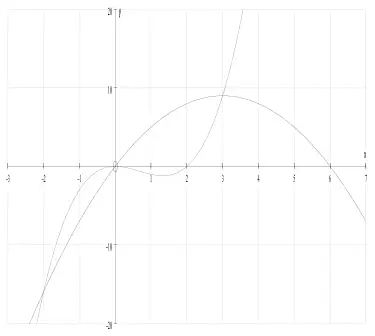
(i)
| Scheme | Marks |
|---|---|
Shape | B1 |
| Max. at (0, 0). | B1 |
| (2, 0), (or 2 shown on \(x\)-axis). | B1 |
| (3) |
(ii)
| Scheme | Marks |
|---|---|
Shape | B1 |
| (It need not go below \(x\)-axis) Through origin. | B1 |
| (6, 0), (or 6 shown on \(x\)-axis). | B1 |
| (3) |
Notes
(i) For the third ‘shape’ shown above, where a section of the graph coincides with the \(x\)-axis, the B1 for (2, 0) can still be awarded if the 2 is shown on the \(x\)-axis.
For the final B1 in (i), and similarly for (6, 0) in (ii):
There must be a sketch.
If, for example (2, 0) is written separately from the sketch, the sketch must not clearly contradict this.
If (0, 2) instead of (2, 0) is shown on the sketch, allow the mark.
Ignore extra intersections with the \(x\)-axis.
(ii) 2nd B is dependent on 1st B.
Separate sketches can score all marks.
| Scheme | Marks |
|---|---|
| \(x^2(x - 2) = x(6 - x)\) | M1 |
| \(x^3 - x^2 - 6x = 0\) Expand to form 3-term cubic (or 3-term quadratic if divided by \(x\)), with all terms on one side. The “= 0” may be implied. | M1 |
| \(x(x - 3)(x + 2) = 0 \qquad x = \ldots\) Factor \(x\) (or divide by \(x\)), and solve quadratic. | M1 |
| \(x = 3\) and \(x = -2\) | A1 |
| \(x = -2: \qquad y = -16\) Attempt \(y\) value for a non-zero \(x\) value by substituting back into \(x^2(x - 2)\) or \(x(6 - x)\). | M1 |
| \(x = 3: \qquad y = 9\) Both \(y\) values are needed for A1. \((-2, -16)\) and \((3, 9)\) | A1 |
| \((0, 0)\) This can just be written down. Ignore any ‘method’ shown. (But must be seen in part (b)). | B1 |
| (7) | |
| (13 marks) |
Notes
Note the dependence of the first three M marks.
A common wrong solution is \((-2, 0)\), \((3, 0)\), \((0, 0)\), which scores M0 A0 B1 as the last 3 marks.
A solution using no algebra (e.g. trial and error), can score up to 3 marks: M0 M0 M0 A0 M1 A1 B1. (The final A1 requires both \(y\) values).
Also, if the cubic is found but not solved algebraically, up to 5 marks: M1 M1 M0 A0 M1 A1 B1. (The final A1 requires both \(y\) values).