
June 2018 Paper 1 Q14
14. The circle \(C\) has equation
\[x^2 + y^2 - 6x + 10y + 9 = 0\]The line with equation \(y = kx\), where \(k\) is a constant, cuts \(C\) at two distinct points.
| Scheme | Marks | AO |
|---|---|---|
| Attempts to complete the square \((x \pm 3)^2 + (y \pm 5)^2 = \ldots\) | M1 | 1.1b |
| (i) Centre \((3, -5)\) | A1 | 1.1b |
| (ii) Radius 5 | A1 | 1.1b |
| (3) |
Notes
M1: Attempts \((x \pm 3)^2 + (y \pm 5)^2 = \ldots\)
This mark may be implied by candidates writing down a centre of \((\pm 3, \pm 5)\) or \(r^2 = 25\)
(i) A1: Centre \((3, -5)\)
(ii) A1: Radius 5. Do not accept \(\sqrt{25}\)
Answers only scores all three marks
| Scheme | Marks | AO |
|---|---|---|
| Uses a sketch or otherwise to deduce \(k = 0\) is a critical value | B1 | 2.2a |
| Substitute \(y = kx\) in \(x^2 + y^2 - 6x + 10y + 9 = 0\) | M1 | 3.1a |
| Collects terms to form correct 3TQ \(\left(1 + k^2\right)x^2 + (10k - 6)x + 9 = 0\) | A1 | 1.1b |
| Attempts \(b^2 - 4ac \ldots 0\) for their \(a\), \(b\) and \(c\) leading to values for \(k\) \(\text{``}(10k - 6)^2 - 36\left(1 + k^2\right) \ldots 0\text{''} \to k = \ldots, \ldots\) \(\left(0 \text{ and } \dfrac{15}{8}\right)\) | M1 | 1.1b |
| Uses \(b^2 - 4ac \gt 0\) and chooses the outside region (see note) for their critical values (Both \(a\) and \(b\) must have been expressions in \(k\)) | dM1 | 3.1a |
| Deduces \(k \lt 0, k \gt \dfrac{15}{8}\) oe | A1 | 2.2a |
| (6) | ||
| (9 marks) |
Notes
B1: Uses a sketch or their subsequent quadratic to deduce that \(k = 0\) is a critical value.
You may award for the correct \(k \lt 0\) but award if \(k \leqslant 0\) or even with greater than symbols
M1: Substitutes \(y = kx\) in \(x^2 + y^2 - 6x + 10y + 9 = 0\) or their \((x \pm 3)^2 + (y \pm 5)^2 = \ldots\) to form an equation in just \(x\) and \(k\). It is possible to substitute \(x = \dfrac{y}{k}\) into their circle equation to form an equation in just \(y\) and \(k\).
A1: Correct 3TQ \(\left(1 + k^2\right)x^2 + (10k - 6)x + 9 = 0\) with the terms in \(x\) collected. The "= 0" can be implied by subsequent work. This may be awarded from an equation such as \(x^2 + k^2x^2 + (10k - 6)x + 9 = 0\) so long as the correct values of \(a\), \(b\) and \(c\) are used in \(b^2 - 4ac \ldots 0\).
FYI The equation in \(y\) and \(k\) is \(\left(1 + k^2\right)y^2 + \left(10k^2 - 6k\right)y + 9k^2 = 0\) oe
M1: Attempts to find two critical values for \(k\) using \(b^2 - 4ac \ldots 0\) or \(b^2 \ldots 4ac\) where … could be "=" or any inequality.
dM1: Finds the outside region using their critical values. Allow the boundary to be included. It is dependent upon all previous M marks and both \(a\) and \(b\) must have been expressions in \(k\).
Note that it is possible that the correct region could be the inside region if the coefficient of \(k^2\) in \(4ac\) is larger than the coefficient of \(k^2\) in \(b^2\) Eg.
\(b^2 - 4ac = (k - 6)^2 - 4 \times \left(1 + k^2\right) \times 9 \gt 0 \Rightarrow -35k^2 - 12k \gt 0 \Rightarrow k(35k + 12) \lt 0\)
A1: Deduces \(k \lt 0, k \gt \dfrac{15}{8}\). This must be in terms of \(k\).
Allow exact equivalents such as \(k \lt 0 \cup k \gt 1.875\)
but not allow \(0 \gt k \gt \dfrac{15}{8}\) or the above with AND, & or \(\cap\) between the two inequalities
Alternative using a geometric approach with a triangle with vertices at \((0, 0)\), and \((3, -5)\)
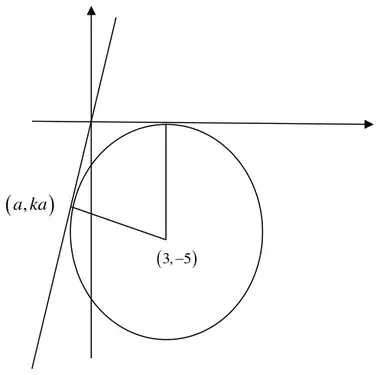
Alt (b)
| Scheme | Marks | AO |
|---|---|---|
| Uses a sketch or otherwise to deduce \(k = 0\) is a critical value | B1 | 2.2a |
| Distance from \((a, ka)\) to \((0, 0)\) is \(3 \Rightarrow a^2\left(1 + k^2\right) = 9\) | M1 | 3.1a |
| Tangent and radius are perpendicular \(\Rightarrow k \times \dfrac{ka + 5}{a - 3} = -1 \Rightarrow a\left(1 + k^2\right) = 3 - 5k\) | M1 | 3.1a |
| Solve simultaneously, (dependent upon both M's) | dM1 | 1.1b |
| \(k = \dfrac{15}{8}\) | A1 | 1.1b |
| Deduces \(k \lt 0, k \gt \dfrac{15}{8}\) | A1 | 2.2a |
| (6) |