
June 2024 Unit 1 Q16
16.
(a) Find the range of values of \(k\) for which the quadratic equation \(x^2-kx+4=0\) has no real roots. [4]
(b) Determine the coordinates of the points of intersection of the graphs of \(y=x^2-3x+4\) and \(y=x+16\). [4]
(c) Using the information obtained in parts (a) and (b), sketch the graphs of \(y=x^2-3x+4\) and \(y=x+16\) on the same set of axes. [2]
| Scheme | Marks | Comments |
|---|---|---|
| Discriminant \(=(-k)^2-4\times1\times4\) \(=k^2-16\) | B1 | si |
| If no real roots, discriminant < 0 \(k^2-16\lt0\) | M1 | condone \(\leq\), si by correct answer. |
| Critical values \(-4,\ 4\) | B1 | si |
| \(-4\lt k\lt4\) | A1 | cao, oe, e.g. \(k\gt-4\) and \(k\lt4\) Mark final answer |
| Scheme | Marks | Comments |
|---|---|---|
| \(x^2-3x+4=x+16\) | M1 | |
| \(x^2-4x-12=0\) | m1 | write as quadratic equation |
| \((x+2)(x-6)=0\) \(x=-2,\ x=6\) | A1 | cao one correct pair |
| \(y=14,\ y=22\) Points of intersection are (−2, 14) and (6, 22). | A1 | cao all correct |
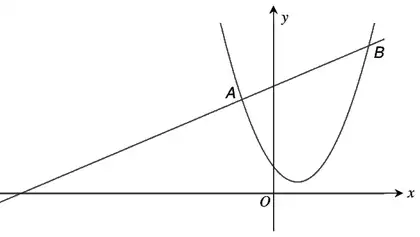
| Scheme | Marks | Comments |
|---|---|---|
| G1 | +ve quadratic, above \(x\)-axis | |
| G1 | straight line, +ve gradient 1 point of intersection in 1st quadrant, 1 point of intersection in 2nd quadrant |