
C1 January 2013 Q6
6.
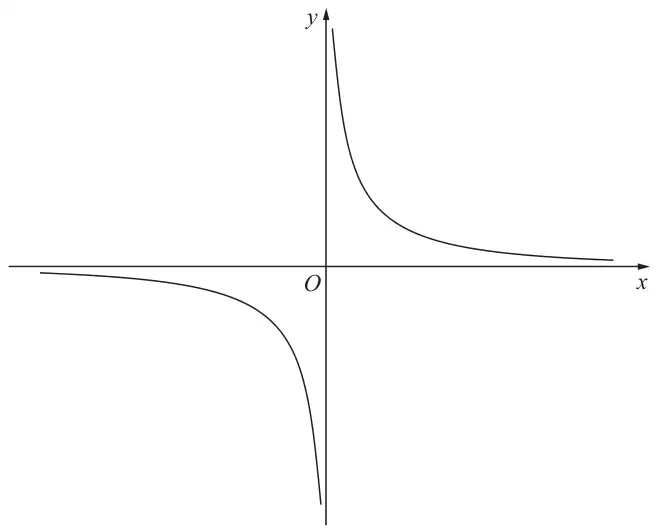
Figure 1 shows a sketch of the curve with equation \(y = \dfrac{2}{x},\ x \neq 0\)
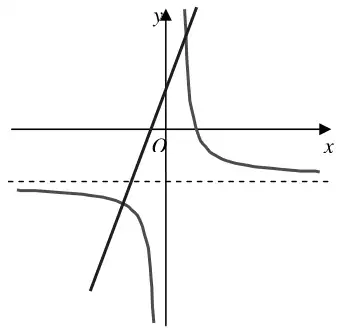
The curve \(C\) has equation \(y = \dfrac{2}{x} - 5,\ x \neq 0\), and the line \(l\) has equation \(y = 4x + 2\)
On your diagram, show clearly the coordinates of the points where \(C\) and \(l\) cross the coordinate axes. (5)
| Scheme | Marks |
|---|---|
| \(y = \dfrac{2}{x}\) is translated up or down. | M1 |
| \(y = \dfrac{2}{x} - 5\) is in the correct position. | A1 |
| Intersection with \(x\)-axis at \(\left(\tfrac{2}{5}, \{0\}\right)\) only Independent mark. | B1 |
| \(y = 4x + 2\) : attempt at straight line, with positive gradient with positive \(y\) intercept. | B1 |
| Intersection with \(x\)-axis at \(\left(-\tfrac{1}{2}, \{0\}\right)\) and \(y\)-axis at \(\left(\{0\}, 2\right)\). | B1 |
| Check graph in question for possible answers and space below graph for answers to part (b) | |
| (5) |
Notes
M1: Curve implies \(y\) axis as asymptote and does not change shape significantly. Changed curve needs horizontal asymptote (roughly) Asymptote(s) need not be shown but shape of curve should be implying asymptote(s) parallel to \(x\) axis. Curve should not remain where it was in the given figure. Both sections move in the same direction. There should be no reflection
A1: Crosses positive \(x\) axis. Hyperbola has moved down. Both sections move by almost same amount. See sheet on page 19 for guidance.
B1: Check diagram and text of answer. Accept 2/5 or 0.4 shown on \(x\)-axis or \(x = 2/5\), or \((2/5, 0)\) stated clearly in text or on graph. This is independent of the graph. Accept \((0, 2/5)\) if clearly on \(x\) axis. Ignore any intersection points with \(y\) axis. Do not credit work in table of values for this mark.
B1: Must be attempt at a straight line, with positive gradient & with positive \(y\) intercept (need not cross \(x\) axis)
B1: Accept \(x = -1/2\), or −0.5 shown on \(x\)-axis or \((-1/2, 0)\) or \((-0.5, 0)\) in text or on graph and similarly accept 2 on y axis or \(y = 2\) or \((0, 2)\) in text or on graph. Need not cross curve and allow on separate axes.
| Scheme | Marks |
|---|---|
| Asymptotes : \(x = 0\) (or \(y\)-axis) and \(y = -5\). An asymptote stated correctly. Independent of (a) | B1 |
| (Lose second B mark for extra asymptotes) These two lines only. Not ft their graph. | B1 |
| (2) |
Notes
B1: For either correct asymptote equation. Second B1: For both correct (lose this if extras e.g. \(x = \pm 1\) are given also). These asymptotes may follow correctly from equation after wrong graph in (a)
Just \(y = -5\) is B1 B0 This may be awarded if given on the graph. However for other B mark it must be clear that \(x = 0\) (or the \(y\)-axis) is an asymptote. NB \(x \neq 0,\ y \neq -5\) is B1B0
Method 1
| Scheme | Marks |
|---|---|
| \(\dfrac{2}{x} - 5 = 4x + 2\) | M1 |
| \(4x^2 + 7x - 2 = 0 \Rightarrow x =\) | dM1 |
| \(x = -2,\ \tfrac{1}{4}\) | A1 |
| When \(x = -2,\ y = -6\), When \(x = \tfrac{1}{4},\ y = 3\) | M1A1 |
| (5) | |
| (12 marks) |
Notes
M1: Either of these equations is enough for the method mark (May appear labelled as part (b))
dM1: Attempt to solve a 3 term quadratic by factorising, formula, completion of square or implied by correct answers. (see note 1) This mark depends on previous mark.
A1: Need both correct \(x\) answers (Accept equivalents e.g. 0.25) or both correct \(y\) values (Method 2)
M1: At least one attempt to find second variable (usually \(y\)) using their first variable (usually \(x\)) related to line meeting curve. Should not be substituting \(x\) or \(y\) values from part (a) or (b). This mark is independent of previous marks. Candidate may substitute in equation of line or equation of curve.
A1: Need both correct second variable answers Need not be written as co-ordinates (allow as in the scheme)
Note: Special case: Answer only with no working in part (c) can have 5 marks if completely correct, with both points found. If co-ordinates of just one of the points is correct – with no working – this earns M0 M0 A0 M1 A0 (i.e. 1 / 5)
Method 2
| Scheme | Marks |
|---|---|
| \(\dfrac{y - 2}{4} = \dfrac{2}{y + 5}\) | M1 |
| \(y^2 + 3y - 18 = 0 \to y =\) | dM1 |
| \(y = -6,\ 3\) | A1 |
| When \(y = -6,\ x = -2\) When \(y = 3,\ x = \tfrac{1}{4}\). | M1A1 |