
C1 June 2013 (R) Q11
11.
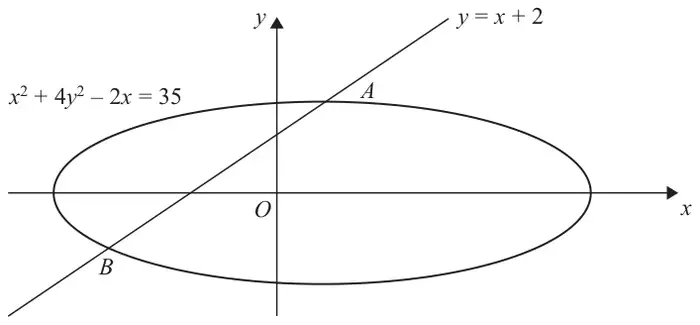
The line \(y = x + 2\) meets the curve \(x^2 + 4y^2 - 2x = 35\) at the points \(A\) and \(B\) as shown in Figure 2.
| Scheme | Marks |
|---|---|
| \(y = x + 2 \Rightarrow x^2 + 4(x + 2)^2 - 2x = 35\) | M1 |
| Alternative: \(\dfrac{2x - x^2 + 35}{4} = (x + 2)^2\) or \(\sqrt{\dfrac{2x - x^2 + 35}{4}} = (x + 2)\) | |
| \(5x^2 + 14x - 19 = 0\) | M1 |
| \((5x + 19)(x - 1) = 0 \Rightarrow x = ..\) | dM1 |
| \(x = -\dfrac{19}{5},\ x = 1\) | A1 for both |
| \(y = -\dfrac{9}{5},\ y = 3\) | M1 |
| Coordinates are \(\left(-\dfrac{19}{5}, -\dfrac{9}{5}\right)\) and \((1, 3)\) | A1 |
| (6) |
Notes
M1: Substitute \(y = \pm x \pm 2\) into \(x^2 + 4y^2 - 2x = 35\) to obtain an equation in \(x\) only.
M1: Multiply out and collects terms producing 3 term quadratic in any form.
dM1: Solves their quadratic, usual rules, as far as \(x\) = ... Dependent on the first M1 i.e. a correct method for eliminating \(y\) (or \(x\) – see below)
A1: Both correct
M1: Substitutes back into either given equation to find a value for \(y\)
A1: Correct matching pairs. Coordinates need not be given explicitly but it must be clear which \(x\) goes with which \(y\)
Alternative to part (a)
| Scheme | Marks |
|---|---|
| \(x = y - 2 \Rightarrow (y - 2)^2 + 4y^2 - 2(y - 2) =\) | M1 |
| \(5y^2 - 6y - 27 = 0\) | M1 |
| \((5y + 9)(y - 3) = 0 \Rightarrow y = ..\) | dM1 |
| \(y = -\dfrac{9}{5},\ y = 3\) | A1 for both |
| \(x = -\dfrac{19}{5},\ x = 1\) | M1 |
| Coordinates are \(\left(-\dfrac{19}{5}, -\dfrac{9}{5}\right)\) and \((1,3)\) | A1 |
M1: Substitutes \(x = \pm y \pm 2\) into \(x^2 + 4y^2 - 2x = 35\)
M1: Multiply out, collect terms producing 3 term quadratic in any form.
dM1: Solves their quadratic, usual rules, as far as \(y\) = ... Dependent on the first M1 i.e. a correct method for eliminating \(x\)
A1: Both correct
M1: Substitutes back into either given equation to find a value for \(x\)
A1: Correct matching pairs as above.
| Scheme | Marks |
|---|---|
| \(d^2 = \left(1 - -\dfrac{19}{5}\right)^2 + \left(3 - -\dfrac{9}{5}\right)^2\) or \(d = \sqrt{\left(1 - -\dfrac{19}{5}\right)^2 + \left(3 - -\dfrac{9}{5}\right)^2}\) | M1A1ft |
| \(d = \dfrac{24}{5}\sqrt{2}\) | A1cao |
| (3) | |
| (9 marks) |
Notes
M1: Use of \(d^2 = (x_1 - x_2)^2 + (y_1 - y_2)^2\) or \(d = \sqrt{(x_1 - x_2)^2 + (y_1 - y_2)^2}\) where neither \((x_1 - x_2)\) nor \((y_1 - y_2)\) are zero.
A1ft: Correct ft expression for \(d\) or \(d^2\) (may be un-simplified)
A1cao: Allow \(4.8\sqrt{2}\)