
C1 January 2014 (IAL) Q6
6.
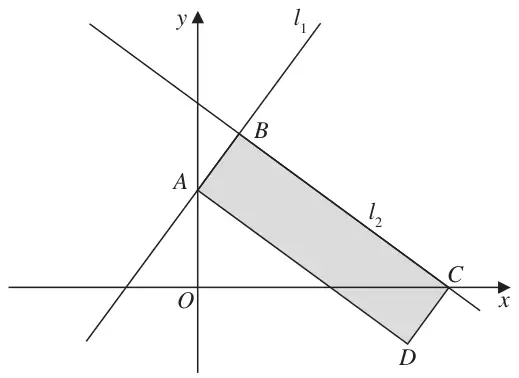
The straight line \(l_1\) has equation \(2y = 3x + 7\)
The line \(l_1\) crosses the \(y\)-axis at the point \(A\) as shown in Figure 2.
Another straight line \(l_2\) intersects \(l_1\) at the point \(B\,(1, 5)\) and crosses the \(x\)-axis at the point \(C\), as shown in Figure 2.
Given that \(\angle ABC = 90^\circ\),
The rectangle \(ABCD\), shown shaded in Figure 2, has vertices at the points \(A\), \(B\), \(C\) and \(D\).
| Scheme | Marks |
|---|---|
| (i) \(\dfrac{3}{2}\) or equivalents such as 1.5 | B1 |
| (ii) \((0, 3.5)\) Accept \(y = 3\tfrac{1}{2}\) | B1 |
| (2) |
Notes
B1: cao gradient =1.5. Accept equivalences such as \(\dfrac{3}{2}\)
B1: cao intercept =\((0, 3.5)\). Accept 3.5, \(y\)=3.5 and equivalences such as \(\dfrac{7}{2}\)
| Scheme | Marks |
|---|---|
| Perpendicular gradient \(l_2 = -\dfrac{2}{3}\) | B1ft |
| Equation of line is: \(y - 5 = -\dfrac{2}{3}(x - 1)\) | M1A1 |
| \(3y + 2x - 17 = 0\) | A1 |
| (4) |
Notes
B1ft: For using the perpendicular gradient rule, \(m_1 = -\dfrac{1}{m_2}\) on their ‘1.5’.
Accept \(-\dfrac{1}{\text{‘}1.5\text{’}}\) or this as part of their equation for \(l_2\) Eg. \(-\dfrac{1}{\text{‘}1.5\text{’}} = \dfrac{y - \ldots}{x - \ldots}\)
M1: For an attempt at finding the equation of \(l_2\) using (1,5) and their adapted gradient.
Condone for this mark a gradient of \(\dfrac{3}{2}\) going to \(\dfrac{2}{3}\). Eg. Allow for \(\dfrac{y - 5}{x - 1} = \dfrac{2}{3}\)
If the form \(y = mx + c\) is used it must be a full method to find \(c\) with (1,5) and an adapted gradient.
A1: For an a correct unsimplified equation of the line through (1,5) with the correct gradient.
Allow \(\dfrac{y - 5}{x - 1} = -\dfrac{2}{3}\) and \(5 = -\dfrac{2}{3}\times 1 + c \Rightarrow c = \dfrac{17}{3}\)
A1: cso \(\pm(3y + 2x - 17) = 0\)
An example of B1ftM0A0A0 would be \(-\dfrac{1}{3} = \dfrac{y - 5}{x + 1}\) following a gradient of ‘3’ in part (a)
An example of B1ftM1A0A0 would be \(-\dfrac{1}{3} = \dfrac{y - 5}{x - 1}\) following a gradient of ‘3’ in part (a)
An example of B0ftM1A0A0 would be \(\dfrac{1}{3} = \dfrac{y - 5}{x - 1}\) following a gradient of ‘3’ in part (a)
| Scheme | Marks |
|---|---|
| Point C: \(y = 0 \Rightarrow 2x = 17 \Rightarrow x = 8.5\) oe | M1, A1 |
| \(AB = \sqrt{(1 - 0)^2 + (5 - 3.5)^2} = \left(\dfrac{\sqrt{13}}{2}\right)\) \(BC = \sqrt{(8.5 - 1)^2 + (5 - 0)^2} = \left(\dfrac{\sqrt{325}}{2}\right)\) | M1 (either) |
| Area rectangle = \(AB\times BC = \dfrac{\sqrt{13}}{2}\times\dfrac{\sqrt{325}}{2} = \dfrac{\sqrt{13}}{2}\times\dfrac{\sqrt{13}\sqrt{25}}{2} = \dfrac{5\times 13}{4} = 16.25\) oe | dM1A1 |
| (5) | |
| (11 marks) |
Notes
M1: An attempt to use their equation found in part b to find the \(x\) coordinate of \(C\)
They must either use the equation of \(l_2\) and set \(y = 0 \Rightarrow x = \ldots\) or use its gradient \(\dfrac{17.5}{x} = \dfrac{3}{2} \Rightarrow x = ..\)
A1: \(C = (8.5, 0)\). Allow equivalents such as \(x\) =8.5 at \(C\)
M1: An attempt to use \(\sqrt{(x_1 - x_2)^2 + (y_1 - y_2)^2}\) for \(AB\) or \(BC\). There is no need to ‘calculate’ these.
Evidence of an attempt would be \(AB^2 = 1^2 + 1.5^2 \Rightarrow AB = ..\)
dM1: Multiplying together their values of \(AB\) and \(BC\) to find area \(ABCD\)
It is dependent upon both M’s having been scored.
A1: cao 16.25 or equivalents such as \(\dfrac{65}{4}\).