
C2 June 2013 Q10
10.
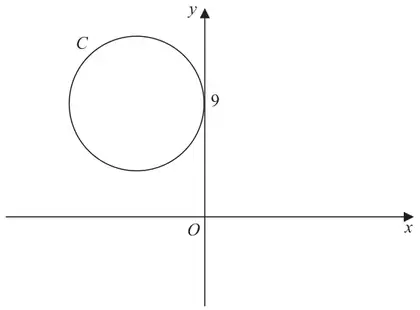
The circle \(C\) has radius 5 and touches the \(y\)-axis at the point \((0, 9)\), as shown in Figure 4.
A line through the point \(P(8, -7)\) is a tangent to the circle \(C\) at the point \(T\).
| Scheme | Marks |
|---|---|
| Equation of form \((x \pm 5)^2 + (y \pm 9)^2 = k\), \(k > 0\) | M1 |
| Equation of form \((x - a)^2 + (y - b)^2 = 5^2\), with values for \(a\) and \(b\) | M1 |
| \((x + 5)^2 + (y - 9)^2 = 25 = 5^2\) | A1 |
| (3) |
Alternative 2 for (a)
| Scheme | Marks |
|---|---|
| Equation of the form \(x^2 + y^2 \pm 10x \pm 18y + c = 0\) | M1 |
| Uses \(a^2 + b^2 - 5^2 = c\) with their \(a\) and \(b\) or substitutes \((0, 9)\) giving \(+9^2 \pm 2b \times 9 + c = 0\) | M1 |
| \(x^2 + y^2 + 10x - 18y + 81 = 0\) | A1 |
| (3) |
Notes
The three marks in (a) each require a circle equation – (see special cases which are not circles)
M1: Uses coordinates of centre to obtain LHS of circle equation (RHS must be \(r^2\) or \(k > 0\) or a positive value)
M1: Uses \(r = 5\) to obtain RHS of circle equation as 25 or \(5^2\)
A1: correct circle equation in any equivalent form
Special cases \((x \pm 5)^2 + (x \pm 9)^2 = (5^2)\) is not a circle equation so M0M0A0
Also \((x \pm 5)^2 + (y - 9) = (5^2)\) And \((x \pm 5)^2 - (y \pm 9)^2 = (5^2)\) are not circles and gain M0M0A0
But \((x - 0)^2 + (y - 9)^2 = 5^2\) gains M0M1A0
| Scheme | Marks |
|---|---|
| \(P(8, -7)\). Let centre of circle \(= X(-5, 9)\) | |
| \(PX^2 = \left(8 - \text{"}{-5}\text{"}\right)^2 + \left(-7 - \text{"}9\text{"}\right)^2\) or \(PX = \sqrt{\left(8 - -5\right)^2 + \left(-7 - 9\right)^2}\) | M1 |
| ( \(PX = \sqrt{425}\) or \(5\sqrt{17}\) ) \(PT^2 = \left(PX\right)^2 - 5^2\) with numerical \(PX\) | dM1 |
| \(PT\ \left\{= \sqrt{400}\right\} = 20\) (allow 20.0) | A1 cso |
| (3) | |
| [6] |
Notes
M1: Attempts to find distance from their centre of circle to \(P\) (or square of this value). If this is called \(PT\) and given as answer this is M0. Solution may use letter other than \(X\), as centre was not labelled in the question.
N.B. Distance from \((0, 9)\) to \((8, -7)\) is incorrect method and is M0, followed by M0A0.
dM1: Applies the subtraction form of Pythagoras to find \(PT\) or \(PT^2\) (depends on previous method mark for distance from centre to \(P\)) or uses appropriate complete method involving trigonometry
A1: 20 cso
Alternative 2 for (b)
| Scheme | Marks |
|---|---|
| An attempt to find the point \(T\) may result in pages of algebra, but solution needs to reach \((-8, 5)\) or \(\left(\dfrac{-8}{17}, 11\dfrac{2}{17}\right)\) to get first M1 (even if gradient is found first) | M1 |
| M1: Use either of the correct points with \(P(8, -7)\) and distance between two points formula | dM1 |
| A1: 20 | A1cso |
| (3) |
Alternative 3 for (b)
| Scheme | Marks |
|---|---|
| Substitutes \((8, -7)\) into circle equation so \(PT^2 = 8^2 + (-7)^2 + 10 \times 8 - 18 \times (-7) + 81\) | M1 |
| Square roots to give \(PT\ \left\{= \sqrt{400}\right\} = 20\) | dM1A1 |
| (3) |