
June 2022 Paper 1 Q4
4.
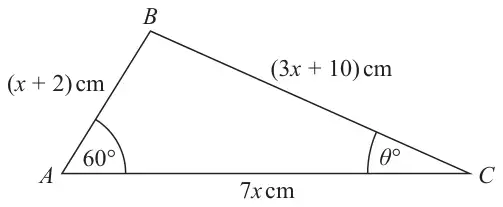
Figure 1 shows a sketch of triangle \(ABC\) with \(AB = (x + 2)\) cm, \(BC = (3x + 10)\) cm, \(AC = 7x\) cm, angle \(BAC = 60^\circ\) and angle \(ACB = \theta^\circ\)
| Scheme | Marks | AO |
|---|---|---|
| (i) \((3x + 10)^2 = (x + 2)^2 + (7x)^2 - 2(x + 2)(7x)\cos 60^\circ\) oe | M1 | 3.1a |
| Uses \(\cos 60^\circ = \frac{1}{2}\), expands the brackets and proceeds to a 3 term quadratic equation | dM1 | 1.1b |
| \(17x^2 - 35x - 48 = 0\) * | A1* | 2.1 |
| (3) | ||
| (ii) \(x = 3\) | B1 | 3.2a |
| (1) |
Notes
(a)(i) Mark (a) and (b) together
M1: Recognises the need to apply the cosine rule and attempts to use it with the sides in the correct positions and the formula applied correctly. Condone invisible brackets and slips on \(3x + 10\) as \(3x - 10\).
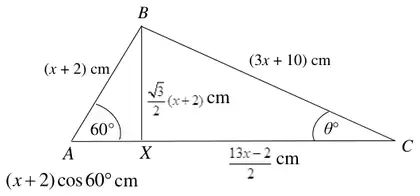
Alternatively, uses trigonometry to find \(AX\) and then equates two expressions for the length \(BX\). You may see variations of this if they use Pythagoras or trigonometry to find \(BX\) and then apply Pythagoras to the triangle \(BXC\). See the diagram below to help you.
The angles and lengths must be in the correct positions. Cos 60 may be \(\dfrac{1}{2}\) from the start
dM1: Uses \(\cos 60^\circ = \frac{1}{2}\), expands the brackets and proceeds to a 3TQ. You may see the use of \(\cos 60^\circ = \frac{1}{2}\) in earlier work, but they must proceed to a 3TQ as well to score this mark. It is dependent on the first method mark.
A1*: Obtains the correct quadratic equation with the \(= 0\) with no errors seen in the main body of their solution. Condone the recovery of invisible brackets as long as the intention is clear. You do not need to explicitly see cos 60 to score full marks.
(a)(ii)
B1: Selects the appropriate value i.e. \(x = 3\) only. The other root must either be rejected if found or \(x = 3\) must be the only root used in part (b). Can be implied by awrt 13.2 in (b)
| Scheme | Marks | AO |
|---|---|---|
| \(\dfrac{5}{\sin ACB} = \dfrac{19}{\sin 60^\circ} \Rightarrow \sin ACB = \ldots \left(\dfrac{5\sqrt{3}}{38}\right)\) or e.g. \(5^2 = 21^2 + 19^2 - 2 \times 19 \times 21\cos ACB \Rightarrow \cos ACB = \ldots \left(\dfrac{37}{38}\right)\) | M1 | 1.1b |
| \(\theta =\) awrt 13.2 | A1 | 1.1b |
| (2) | ||
| (6 marks) |
Notes
M1: Using their value for \(x\) this mark is for either:
- applying the sine rule correctly (or considers 2 right angled triangles) and proceeding to obtain a value for \(\sin ACB\) or
- applying the cosine rule correctly and proceeding to obtain a value for \(\cos ACB\).
(Also allow if the sine rule or cosine rule is applied correctly to find a value for \(\sin ABC\) \(\left(= \dfrac{21\sqrt{3}}{38}\right)\) or \(\cos ABC\) \(\left(= -\dfrac{11}{38}\right)\)) (corrected from the printed mark scheme: “\(\cos ACB\) \(\left(= -\dfrac{11}{38}\right)\)”; \(-\dfrac{11}{38}\) is \(\cos ABC\))
A1: awrt 13.2 (answers with little working eg just lengths on the diagram can score M1A1)