\(\theta\) is an angle between \(270^\circ\) and \(360^\circ\)
\(\qquad \cos\theta = \dfrac{1}{5k} \quad\) and \(\quad \tan\theta = -3k \qquad\) where \(k\) is a positive constant.
Work out the value of \(\theta\). [2 marks]
(b)
Work out the values of \(x\) between \(0^\circ\) and \(360^\circ\) for which
\[8\cos^2 x - \cos x = 0\]
[3 marks]
Mark scheme (a)
Answer
Mark
Comments
Alternative method 1: works out \(\sin\theta\)
\(\sin\theta = -\dfrac{3}{5}\) or \(\sin\theta = -\dfrac{3k}{5k}\) or \([-36.9, -36.8]\) or \(-37\) or [216.8, 216.9] or 217
M1
oe eg \(\sin\theta = -3k \div 5k\) or \(\sin\theta = -3k \times \dfrac{1}{5k}\) or \(\sin^{-1} -0.6\)
[323.1, 323.1301024] or 323 with no other value
A1
Alternative method 2: works out \(\tan\theta\) or uses \(\cos^{-1}\)
\(\tan\theta = -\dfrac{3}{4}\) or \(360 - \cos^{-1} 0.8\)
M1
oe eg \(\tan\theta = -3 \times \dfrac{1}{4}\) or \(\tan^{-1} -0.75\) or \(360 - [36.8, 36.9]\)
[323.1, 323.1301024] or 323 with no other value
A1
Additional guidance
M1 may be awarded for correct work with no answer or incorrect answer, even if this is seen amongst multiple attempts
Accept any indication of \(\theta\) eg \(x\)
Alt 1 \(\ 5\sin\theta = -3\) with no further correct working
M0
Alt 1 \(\ \cos\theta \times \tan\theta = -\dfrac{3}{5}\) with no further correct working
M0
Mark scheme (b)
Answer
Mark
Comments
90 and 270 and [82.8, 83] and [277, 277.2] with no other values in the range [0, 360]
B3
B2 four correct values with one other value in the range [0, 360] or three correct values with no other value in the range [0, 360] B1 four correct values with two other values in the range [0, 360] or three correct values with one other value in the range [0, 360] or two correct values with no other value in the range [0, 360]
Additional guidance
Ignore any values outside the range [0, 360]
If values are in the working lines and the answer line is blank, award marks from the working lines
If values are in the working lines but only some are listed on the answer line, award marks from the answer line
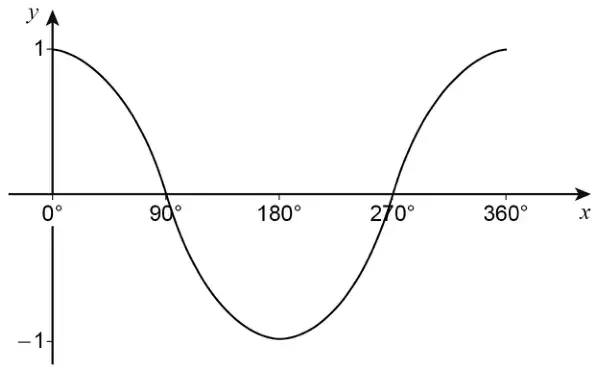
(a) Write down the value of \(x\) for \(\quad 0^\circ \leqslant x \leqslant 360^\circ \quad\) when \(\quad \sin x = -1\) [1 mark]
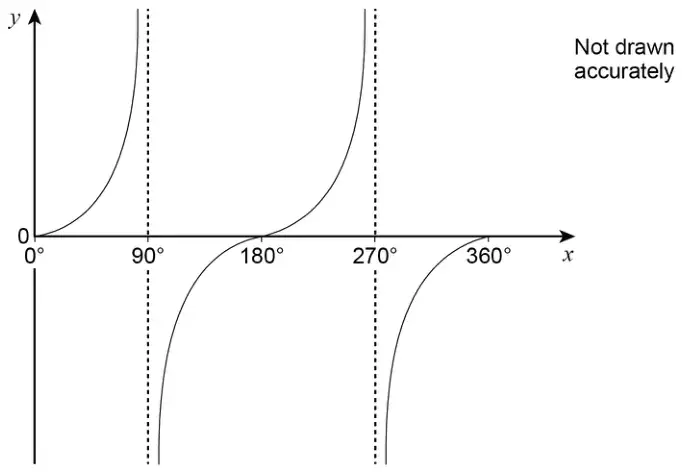
(b) Work out the values of \(y\) for \(\quad 0^\circ \leqslant y \leqslant 360^\circ \quad\) when \(\quad \sqrt{3}\tan y = 1\) [3 marks]
Mark scheme (a)
Answer
Mark
Comments
(\(x =\)) \(270^\circ\)
B1
Additional guidance
Do not accept answers outside of the given range or a choice of answers
Condone \(^\circ\) missing
Mark scheme (b)
Answer
Mark
Comments
\(\tan y = \dfrac{1}{\sqrt{3}}\) or \(\tan y = \dfrac{\sqrt{3}}{3}\) or \(y = \tan^{-1}\dfrac{\sqrt{3}}{3}\) or \(y = \tan^{-1}\dfrac{1}{\sqrt{3}}\)
M1
(\(y =\)) \(30^\circ\) or \(210^\circ\)
M1dep
could include up to two further incorrect values or \(30^\circ\) may be seen as part of a further calculation or on a diagram or embedded in \(\tan 30^\circ\) \(\tan 30^\circ\) embedded in a table with other exact trigonometric values (and not identified) would not gain M1dep
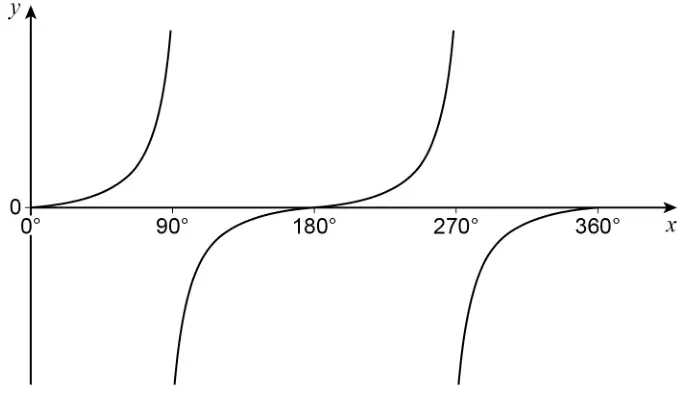
21 Work out the values of \(x\) between \(0^\circ\) and \(360^\circ\) for which
\[2\tan^2 x = 3\]
Give your answers to 1 decimal place.
You must show your working.[4 marks]
Mark scheme
Answer
Mark
Comments
Alternative method 1
\(\tan x = \sqrt{\dfrac{3}{2}}\) or \(\tan x = \dfrac{\sqrt{6}}{2}\) or [50.7, 50.8] or 51 or [230.7, 230.8] or 231
M1
oe eg \(\tan^{-1}\sqrt{\dfrac{3}{2}}\) allow [1.22, 1.225] for \(\sqrt{\dfrac{3}{2}}\)
\(\tan x = -\sqrt{\dfrac{3}{2}}\) or \(\tan x = -\dfrac{\sqrt{6}}{2}\) or [\(-50.8\), \(-50.7\)] or \(-51\) or [129.2, 129.3] or 129 or [309.2, 309.3] or 309
M1
oe eg \(\tan^{-1} -\sqrt{\dfrac{3}{2}}\) allow [\(-1.225\), \(-1.22\)] for \(-\sqrt{\dfrac{3}{2}}\)
50.8 and 129.2 and 230.8 and 309.2 with no other angles in range [0, 360]
A2
A1 [50.7, 50.8] or 51 and [230.7, 230.8] or 231 or [129.2, 129.3] or 129 and [309.2, 309.3] or 309
Alternative method 2
\(\sin x = \sqrt{\dfrac{3}{5}}\) or \(\sin x = \dfrac{\sqrt{15}}{5}\) or [50.7, 50.8] or 51 [129.2, 129.3] or 129
M1
oe eg \(\sin^{-1}\sqrt{\dfrac{3}{5}}\) allow [0.77, 0.775] for \(\sqrt{\dfrac{3}{5}}\)
\(\sin x = -\sqrt{\dfrac{3}{5}}\) or \(\sin x = -\dfrac{\sqrt{15}}{5}\) or [\(-50.8\), \(-50.7\)] or \(-51\) [230.7, 230.8] or 231 or [309.2, 309.3] or 309
M1
oe eg \(\sin^{-1} -\sqrt{\dfrac{3}{5}}\) allow [\(-0.775\), \(-0.77\)] for \(-\sqrt{\dfrac{3}{5}}\)
50.8 and 129.2 and 230.8 and 309.2 with no other angles in range [0, 360]
A2
A1 [50.7, 50.8] or 51 and [129.2, 129.3] or 129 or [230.7, 230.8] or 231 and [309.2, 309.3] or 309
Alternative method 3
\(\cos x = \sqrt{\dfrac{2}{5}}\) or \(\cos x = \dfrac{\sqrt{10}}{5}\) or [50.7, 50.8] or 51 or [309.2, 309.3] or 309
M1
oe eg \(\cos^{-1}\sqrt{\dfrac{2}{5}}\) allow [0.63, 0.6325] for \(\sqrt{\dfrac{2}{5}}\)
\(\cos x = -\sqrt{\dfrac{2}{5}}\) or \(\cos x = -\dfrac{\sqrt{10}}{5}\) or [129.2, 129.3] or 129 or [230.7, 230.8] or 231
M1
oe eg \(\cos^{-1} -\sqrt{\dfrac{2}{5}}\) allow [\(-0.6325\), \(-0.63\)] for \(-\sqrt{\dfrac{2}{5}}\)
50.8 and 129.2 and 230.8 and 309.2 with no other angles in range [0, 360]
A2
A1 [50.7, 50.8] or 51 and [309.2, 309.3] or 309 or [129.2, 129.3] or 129 and [230.7, 230.8] or 231
Additional guidance
Allow t for \(\tan x\) etc
\(\tan x = \pm\sqrt{\dfrac{3}{2}}\)
M1M1
Ignore any solutions outside the range [0, 360]
All four solutions with extra solutions in range [0, 360] scores M1M1A1 eg 50.8 and 230.8 and 129.2 and 309.2 and 180 and 60
M1M1A1
For A1 there may be extra solutions in range eg1 50.77 and 230.8 and 180 eg2 50.8 and 230.8 and 129.2 and 90
M1M0A1 M1M1A1
If answer line is blank, award any marks gained in the working lines
If correct angles are found in the working lines but only some are listed on the answer line award any M marks gained from the working lines award any A marks gained from the answer line eg1 working lines \(\tan x = \pm\sqrt{\dfrac{3}{2}} \quad\) 50.8 230.8 129.2 309.2 answer line 50.76 230.76 129.2 eg2 working lines \(\tan x = \sqrt{\dfrac{3}{2}} \quad\) 50.8 230.8 answer line 50.8 eg3 working lines \(\tan x = \sqrt{\dfrac{3}{2}} \quad\) 50.8 230.8 \(\tan x = -\sqrt{\dfrac{3}{2}} \quad\) 129.2 answer line 129.2
M1M1 A1 M1M0A0 M1M1 A0
Answers only (with no extra solutions in range) can score up to 4 marks 4 correct → 4 marks 3 correct → 3 marks 2 correct → 2 marks 1 correct → 1 mark
M1M0A1 or M0M1A1 are possible eg1 \(\tan x = \sqrt{\dfrac{3}{2}} \quad\) 50.76 230.8 eg2 \(\tan x = -\sqrt{\dfrac{3}{2}} \quad\) 129.2 and 309.2
(a) Show that \(\quad \dfrac{2\sin^2 x - 1 + \cos^2 x}{\sin x \cos x} \quad\) is equivalent to \(\ \tan x\) [3 marks]
(b) Hence solve \(\quad \dfrac{2\sin^2 x - 1 + \cos^2 x}{\sin x \cos x} = -1 \quad\) for \(\ 0^\circ \leqslant x \leqslant 360^\circ\) [2 marks]
Mark scheme (a)
Answer
Mark
Comments
Alternative method 1
\(2\sin^2 x - 1 + 1 - \sin^2 x\) or \(2\sin^2 x - (\sin^2 x + \cos^2 x) + \cos^2 x\) or \(2\sin^2 x - \sin^2 x - \cos^2 x + \cos^2 x\) or \(2\sin^2 x - \sin^2 x\) or \(\sin^2 x - \cos^2 x + \cos^2 x\) or \(1 + \sin^2 x - 1\)
M1
use of \(\sin^2 x + \cos^2 x = 1\) in numerator ignore any denominator
\(\dfrac{\sin^2 x}{\sin x \cos x}\) with M1 seen or \(\dfrac{\sin^2 x}{\tan x \cos^2 x}\) with M1 seen
M1dep
simplification to one step from \(\dfrac{\sin x}{\cos x}\) or simplification to one step from \(\dfrac{\tan^2 x}{\tan x}\)
\(\dfrac{\sin x}{\cos x}\) and \(\tan x\) with M2 seen or \(\dfrac{\tan^2 x}{\tan x}\) and \(\tan x\) with M2 seen
A1
SC3 equates given expression to \(\tan x\) and cross multiplies to show equivalence with full working shown
Alternative method 2
\(2(1 - \cos^2 x) - 1 + \cos^2 x\) or \(2 - 2\cos^2 x - 1 + \cos^2 x\)
M1
use of \(\sin^2 x + \cos^2 x = 1\) in numerator ignore any denominator
\(\dfrac{1 - \cos^2 x}{\sin x \cos x}\) and \(\dfrac{\sin^2 x}{\sin x \cos x}\) with M1 seen or \(\dfrac{1 - \cos^2 x}{\sin x \cos x}\) and \(\dfrac{\sin^2 x}{\tan x \cos^2 x}\) with M1 seen
M1dep
simplification to one step from \(\dfrac{\sin x}{\cos x}\) or simplification to one step from \(\dfrac{\tan^2 x}{\tan x}\)
\(\dfrac{\sin x}{\cos x}\) and \(\tan x\) with M2 seen or \(\dfrac{\tan^2 x}{\tan x}\) and \(\tan x\) with M2 seen
A1
SC3 equates given expression to \(\tan x\) and cross multiplies to show equivalence with full working shown
Alternative method 3
\(\dfrac{2\sin x}{\cos x} - \dfrac{\sin^2 x}{\sin x \cos x}\)
M1
from \(\dfrac{2\sin^2 x}{\sin x \cos x} - \dfrac{1 - \cos^2 x}{\sin x \cos x}\)
\(2\tan x - \dfrac{\sin^2 x}{\sin x \cos x}\) or \(\dfrac{2\sin x}{\cos x} - \dfrac{\sin x}{\cos x}\) with M1 seen
M1dep
simplification to one step from \(2\tan x - \tan x\)
\(2\tan x - \tan x\) and \(\tan x\) with M2 seen
A1
SC3 equates given expression to \(\tan x\) and cross multiplies to show equivalence with full working shown
Additional guidance
Equating given expression to \(\tan x\) and cross multiplying can score SC3 or M1M0A0 eg1 Alt 1 \(\dfrac{2\sin^2 x - 1 + \cos^2 x}{\sin x \cos x} = \tan x\) \(2\sin^2 x - 1 + \cos^2 x = \tan x \sin x \cos x\) \(2\sin^2 x - 1 + 1 - \sin^2 x = \tan x \sin x \cos x \quad\) (scores M1 here for LHS)
eg2 \(\dfrac{2\sin^2 x - 1 + \cos^2 x}{\sin x \cos x} = \tan x\) \(2\sin^2 x - 1 + \cos^2 x = \tan x \sin x \cos x\) \(2\sin^2 x - 1 + 1 - \sin^2 x = \tan x \sin x \cos x\) \(\sin^2 x = \tan x \sin x \cos x\) \(\sin^2 x = \dfrac{\sin x}{\cos x} \sin x \cos x\) \(\sin^2 x = \sin^2 x\)
M1M0A0
SC3
Use of \(\sin x = \dfrac{\text{opp}}{\text{hyp}}\) etc
M0M0A0
Allow sin or s for \(\sin x\) etc
Condone \(\sin x^2\) for \(\sin^2 x\) etc
Allow any letter for \(x\)
Alts 1 and 2 For A1 \(\dfrac{\sin x}{\cos x}\) is implied by \(\dfrac{\sin^2 x}{\sin x \cos x}\) with cancelling shown
Mark scheme (b)
Answer
Mark
Comments
135 and 315 with no other solutions [0, 360]
B2
B1 135 with no other solutions [0, 360] or 315 with no other solutions [0, 360]
SC1 135 and 315 with one other solution [0, 360]
Additional guidance
Mark the answer line unless blank eg 135 and 315 in working with 135 on answer line
B1
\(-45\) and 135 and 315
B2
\(-45\) and 135
B1
Ignore incorrect solutions outside the range [0, 360] eg 135 and 315 and \(-90\)
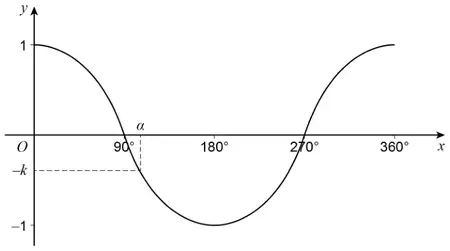
15 Here is a sketch graph of \(\quad y = \cos x \quad\) for \(\quad 0^\circ \leqslant x \leqslant 360^\circ\)
You are given that \(\quad \cos 36^\circ = 0.8090\)
Solve \(\quad \cos x = -0.8090 \quad\) for \(\quad 0^\circ \leqslant x \leqslant 360^\circ\) [2 marks]
Mark scheme
Answer
Mark
Comments
\(144^\circ\)
B1
answers should be on answer line but can be accepted if they are the only angles written on the diagram (other than \(36^\circ\) which is the question so fine) condone missing degree sign
\(216^\circ\)
B1
Additional guidance
Don’t accept \(\cos 144^\circ\), \(\cos 216^\circ\), \(\cos x = 144^\circ\), \(\cos x = 216^\circ\)
B0
Accept \(\cos 144^\circ = -0.8090\) and \(\cos 216^\circ = -0.8090\)
B1, B1
If more than 2 angles offered this is choice 4 or more angles 2 wrong 1 right 1 wrong 2 right 1 wrong 1 right
(a) Prove that \(\quad \sin^2 x - 3\cos^2 x \equiv 4\sin^2 x - 3\) [2 marks]
(b) Hence, or otherwise, work out the values of \(x\) between 0° and 360° for which\[\sin^2 x - 3\cos^2 x = 0\] [4 marks]
Mark scheme (a)
Answer
Mark
Comments
Alternative method 1 (LHS \(\to\) RHS)
\(\sin^2 x - 3(1 - \sin^2 x)\)
M1
Must see \((1 - \sin^2 x)\)
\(\sin^2 x - 3 + 3\sin^2 x = 4\sin^2 x - 3\)
A1
Must see correct expansion SC1 Correct rearrangement of given identity to \(3\sin^2 x + 3\cos^2 x = 3\) and \(3(\sin^2 x + \cos^2 x) = 3\) and \(\sin^2 x + \cos^2 x = 1\)
Alternative method 2 (LHS \(\to\) RHS)
\(1 - \cos^2 x - 3\cos^2 x = 1 - 4\cos^2 x\) \(= 1 - 4(1 - \sin^2 x)\)
M1
Must see \((1 - \cos^2 x)\) and \((1 - \sin^2 x)\)
\(1 - 4 + 4\sin^2 x = 4\sin^2 x - 3\)
A1
Must see correct expansion SC1 Correct rearrangement of given identity to \(3\sin^2 x + 3\cos^2 x = 3\) and \(3(\sin^2 x + \cos^2 x) = 3\) and \(\sin^2 x + \cos^2 x = 1\)
Alternative method 3 (RHS \(\to\) LHS)
\(4\sin^2 x - 3(\sin^2 x + \cos^2 x)\)
M1
Must see \((\sin^2 x + \cos^2 x)\)
\(4\sin^2 x - 3\sin^2 x - 3\cos^2 x\) \(= \sin^2 x - 3\cos^2 x\)
A1
Must see correct expansion SC1 Correct rearrangement of given identity to \(3\sin^2 x + 3\cos^2 x = 3\) and \(3(\sin^2 x + \cos^2 x) = 3\) and \(\sin^2 x + \cos^2 x = 1\)
Alternative method 4 (RHS \(\to\) LHS)
\(4(1 - \cos^2 x) - 3 = 4 - 4\cos^2 x - 3\) \(= 1 - 4\cos^2 x\) \(= \sin^2 x + \cos^2 x - 4\cos^2 x\)
M1
Must see \((1 - \cos^2 x)\) and \(\sin^2 x + \cos^2 x\) and correct expansion
\(= \sin^2 x - 3\cos^2 x\)
A1
SC1 Correct rearrangement of given identity to \(3\sin^2 x + 3\cos^2 x = 3\) and \(3(\sin^2 x + \cos^2 x) = 3\) and \(\sin^2 x + \cos^2 x = 1\)
Alternative method 5 (LHS and RHS \(\to\) common expression)
\(1 - \cos^2 x - 3\cos^2 x = 1 - 4\cos^2 x\) and \(4(1 - \cos^2 x) - 3 = 4 - 4\cos^2 x - 3\) \(= 1 - 4\cos^2 x\)
B2
Must see \((1 - \cos^2 x)\) and correct expansion SC1 Correct rearrangement of given identity to \(3\sin^2 x + 3\cos^2 x = 3\) and \(3(\sin^2 x + \cos^2 x) = 3\) and \(\sin^2 x + \cos^2 x = 1\)
Additional guidance
As shown in the mark scheme, allow = signs but they may be seen (correctly) as the identity symbol
= signs may be implied (eg working down the page, line by line)
To give M1 the working must not need any further identities applying
The other side of the identity may be seen throughout working in Alts 1 to 4 However, full working on one side of the identity is needed for M1 A1 eg (Alt 2) \(1 - \cos^2 x - 3\cos^2 x = 4\sin^2 x - 3\) \(1 - 4\cos^2 x = 4\sin^2 x - 3\) \(1 - 4(1 - \sin^2 x) = 4\sin^2 x - 3\) \(1 - 4 + 4\sin^2 x = 4\sin^2 x - 3\) (with \(4\sin^2 x - 3 = 4\sin^2 x - 3\) it would be M1 A1)
M1 A0
Other examples may be seen, escalate if necessary
Allow any variable or mixed variables or no variables
Allow \((\sin x)^2\) for \(\sin^2 x\) and \((\cos x)^2\) for \(\cos^2 x\) Allow \(\mathrm{s}^2\) for \(\sin^2 x\) and \(\mathrm{c}^2\) for \(\cos^2 x\)
Do not allow \(\sin x^2\) for \(\sin^2 x\) (but could still gain M1) eg1 Alt 1 \(\sin^2 x - 3(1 - \sin^2 x)\) \(= \sin^2 x - 3 + 3\sin x^2 = 4\sin x^2 - 3\) eg1 Alt 1 \(\sin x^2 - 3(1 - \sin^2 x)\) \(= \sin^2 x - 3 + 3\sin x^2 = 4\sin x^2 - 3\)
M1 A0 M0 A0
Do not allow recovery of missing brackets as this is a proof
SC1 Instead of factorisation, they can divide by 3
Other examples of SC1 may be seen where the identity is assumed to be correct and correct working with use of \(\sin^2 x + \cos^2 x = 1\) is seen
Mark scheme (b)
Answer
Mark
Comments
Alternative method 1
\(\sin^2 x = \dfrac{3}{4}\) or \(\sin x = \dfrac{\sqrt{3}}{2}\) or \(\sin x = \sqrt{\dfrac{3}{4}}\) or 60 or 120
M1
oe eg \((\sin x)^2 = \dfrac{3}{4}\) Allow 0.86... or 0.87 for \(\dfrac{\sqrt{3}}{2}\) Must have \(\sin^2 x =\) or \(\sin x =\) or \(\sin^{-1}\) Allow s for \(\sin x\) Do not allow \(\sin x^2\) for \(\sin^2 x\) but may be recovered
\(\sin x = -\dfrac{\sqrt{3}}{2}\) or \(\sin x = -\sqrt{\dfrac{3}{4}}\) or 240 or 300 or \(-60\)
M1
oe Allow \(-0.86\)... or \(-0.87\) for \(-\dfrac{\sqrt{3}}{2}\)
60 and 120 and 240 and 300 with no other angles in range
A2
A1 60 and 120 or 240 and 300
Alternative method 2
\(\tan^2 x = 3\) or \(\tan x = \sqrt{3}\) or 60 or 240
M1
oe eg \((\tan x)^2 = 3\) Allow 1.73... for \(\sqrt{3}\) Must have \(\tan^2 x =\) or \(\tan x =\) or \(\tan^{-1}\) Allow t for \(\tan x\) Do not allow \(\tan x^2\) for \(\tan^2 x\) but may be recovered
\(\tan x = -\sqrt{3}\) or 120 or 300 or \(-60\)
M1
Allow \(-1.73\)... for \(-\sqrt{3}\)
60 and 120 and 240 and 300 with no other angles in range
A2
A1 60 and 240 or 120 and 300
Alternative method 3
\(\cos^2 x = \dfrac{1}{4}\) or \(\cos x = \dfrac{1}{2}\) or \(\cos x = \sqrt{\dfrac{1}{4}}\) or 60 or 300
M1
oe eg \((\cos x)^2 = \dfrac{1}{4}\) Must have \(\cos^2 x =\) or \(\cos x =\) or \(\cos^{-1}\) Allow c for \(\cos x\) Do not allow \(\cos x^2\) for \(\cos^2 x\) but may be recovered
\(\cos x = -\dfrac{1}{2}\) or \(\cos x = -\sqrt{\dfrac{1}{4}}\) or 120 or 240
M1
oe
60 and 120 and 240 and 300 with no other angles in range
A2
A1 60 and 300 or 120 and 240
Additional guidance
Ignore any solutions outside of \(0 \lt x \lt 360\) ie 0 and 360 are outside the range and can be ignored
All four solutions with extra solutions in range, \(0 \lt x \lt 360\), are penalised one accuracy mark eg 60 90 120 150 240 300 Only penalise extra solutions in range when all four correct solutions are given
M1 M1 A1
Answer line blank, award any marks gained from working lines
If angles are found in working lines but only some are listed on answer line award any method marks gained from the working lines award any accuracy marks gained from the answer line eg1 Working lines \(\sin x = \pm\dfrac{\sqrt{3}}{2}\) 60 and 120 and 240 and 300 Answer line 60 and 120 and 240 eg2 Working lines \(\tan x = \sqrt{3}\) 60 240 Answer line 60 eg3 Working lines \(\sin x = \dfrac{\sqrt{3}}{2}\) 60 120 \(\sin x = -\dfrac{\sqrt{3}}{2}\) 300 Answer line 300
M1 M1 A1
M1 M0 A0
M1 M1 A0
Answers only can score up to 4 marks All 4 correct \(\to\) 4 marks 3 correct \(\to\) 3 marks 2 correct \(\to\) 2 marks 1 correct \(\to\) 1 mark
M1 M0 A1 or M0 M1 A1 are possible eg1 \(\sin x = \dfrac{\sqrt{3}}{2}\) 60 120 eg2 \(\sin x = -\dfrac{\sqrt{3}}{2}\) 240 300
M1 M0 A1 M0 M1 A1
Embedded answers can score up to M1 M1 A0
Working in rads or grads can score M marks if method seen