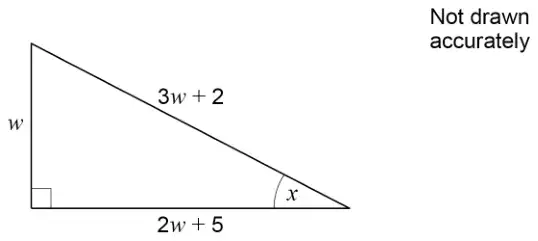
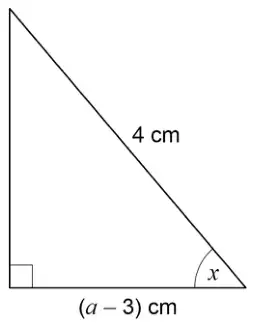
\((2w + 3)(2w - 7)\) or \(\dfrac{- -8 \pm \sqrt{(-8)^2 - 4 \times 4 \times -21}}{2 \times 4}\) or 3.5
M1
oe eg \(1 \pm \sqrt{\dfrac{25}{4}}\) or \(\dfrac{7}{2}\) in quadratic formula or completing the square allow \(\pm\) to be \(+\)
\(\sin x = \dfrac{3.5}{3 \times 3.5 + 2}\) or \(\cos x = \dfrac{2 \times 3.5 + 5}{3 \times 3.5 + 2}\) or \(\tan x = \dfrac{3.5}{2 \times 3.5 + 5}\)
M1dep
oe eg \(\sin^{-1}\dfrac{7}{25}\) or \(\sin^{-1} 0.28\) or \(\cos^{-1}\dfrac{24}{25}\) or \(\cos^{-1} 0.96\) or \(\tan^{-1}\dfrac{7}{24}\) or \(\tan^{-1}\) [0.29, 0.292]
[16.17, 16.3] with no other solution
A1
accept 16 with no other solution with M2 awarded
Additional guidance
Up to M2 may be awarded for correct work with no answer or incorrect answer, even if this is seen amongst multiple attempts
In the quadratic formula \(-8^2\) is M0 unless recovered
2nd M1 Using the sine rule or cosine rule must have \(\sin x\) or \(\cos x\) as the subject and a correct numerical expression or a correct value
\(\sin x = \dfrac{3.5 \sin 90}{12.5}\) with no further correct working
M1M0
Check 14(a) and diagram for working that may be valid in 14(b)
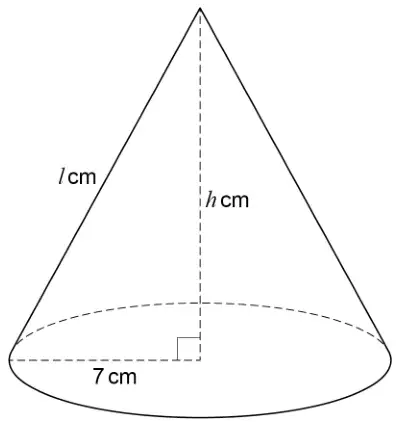
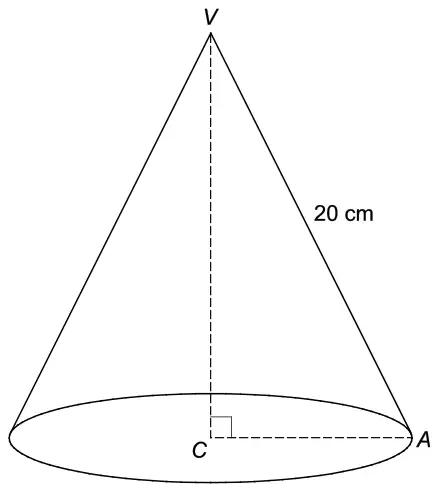
A solid cone has base radius 7 cm, perpendicular height \(h\) cm and slant height \(l\) cm
\[\text{Curved surface area of a cone} = \pi r l\]
The total surface area of the cone is \(224\pi\) cm\(^2\)
Work out the size of the angle between the slant height and the base. [4 marks]
(b)
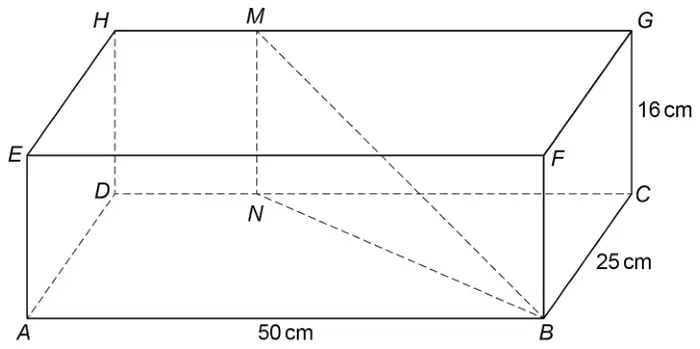
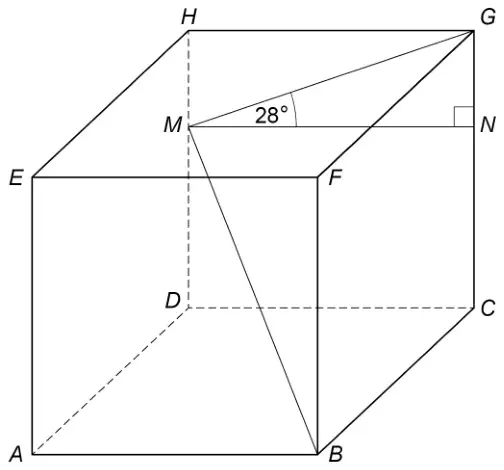
\(ABCDEFGH\) is a cuboid.
\(ABCD\) is horizontal.
\(MN\) is vertical.
The acute angle between the planes \(MNB\) and \(HDCG\) is \(36^\circ\)
Work out the length \(CN\). [2 marks]
Mark scheme (a)
Answer
Mark
Comments
Alternative method 1: works out value for slant height
\(224\pi - \pi \times 7 \times 7\) or \(175\pi\) or \(224 - 7 \times 7 = 7l\) or \(175 = 7l\)
M1
oe curved surface area accept a value [3.14, 3.142] for \(\pi\) eg \(224 \times 3.14 - 3.14 \times 49\) or oe equation with \(7l\) as the subject eg \(7l = 224 - 49\)
\((224\pi - \pi \times 7 \times 7) \div (\pi \times 7)\) or \(175 \div 7\) or 25
\(\cos x = \dfrac{7}{\text{their } 25}\) or \(\cos x = 0.28\) or \(\cos^{-1}\dfrac{7}{\text{their } 25}\) or \(\cos^{-1} 0.28\)
M1dep
oe eg \(\sin x = \dfrac{\sqrt{\text{their } 25^2 - 7^2}}{\text{their } 25}\) or \(\sin x = 0.96\) or \(\tan x = \dfrac{\sqrt{\text{their } 25^2 - 7^2}}{7}\) or \(\tan x =\) [3.4, 3.43]
[73.7, 73.74]
A1
accept 74 with correct method seen SC2 [76.5, 76.51] or [77.3, 77.4]
Alternative method 2: works out expression for slant height
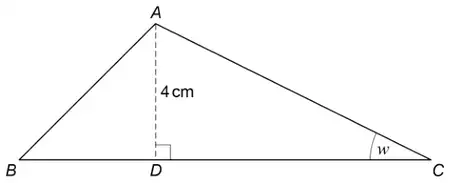
8 \(ABC\) is a triangle with perpendicular height \(AD\).
Not drawn accurately
Area of \(ABC = 25\text{ cm}^2\)
\(BD : DC = 2 : 3\)
Work out the size of angle \(w\). [4 marks]
Mark scheme
Answer
Mark
Comments
Alternative method 1
\(\dfrac{1}{2} \times BC \times 4 = 25\) or (\(BC =\)) \(25 \times 2 \div 4\) or (\(BC =\)) 12.5
M1
oe eg \(\dfrac{1}{2} \times BD \times 4 + \dfrac{1}{2} \times DC \times 4 = 25\) allow any unambiguous indication of \(BC\) or \(BD\) or \(DC\) may be seen on diagram
oe eg (\(DC =\)) their \(12.5 \div 5 \times 3\) may be seen on diagram
\(\tan w = \dfrac{4}{\text{their } DC}\) or \(\tan w = \dfrac{8}{15}\) or \(\tan^{-1} 0.53(\ldots)\)
M1
oe eg \(\sin w = \dfrac{4}{\sqrt{4^2 + (\text{their } DC)^2}}\) or \(\cos w = \dfrac{\text{their } DC}{\sqrt{4^2 + (\text{their } DC)^2}}\) or \(90 - \tan^{-1}\dfrac{\text{their } DC}{4}\)
[27.9, 28.4]
A1
SC3 [46.6, 46.94] or 47
Alternative method 2
Expression for area = 25 with \(BD : DC = 2 : 3\)
M1
eg \(\dfrac{1}{2} \times 2x \times 4 + \dfrac{1}{2} \times 3x \times 4 = 25\) or \(\dfrac{1}{2} \times y \times 4 + \dfrac{1}{2} \times \dfrac{3}{2}y \times 4 = 25\) implied by \(BD = 5\) may be seen on diagram
Method to work out \(DC\) or (\(DC =\)) 7.5
M1dep
eg (\(DC =\)) \(2.5 \times 3\) or (\(DC =\)) \(5 \times \dfrac{3}{2}\) may be seen on diagram
\(\tan w = \dfrac{4}{\text{their } DC}\) or \(\tan w = \dfrac{8}{15}\) or \(\tan^{-1} 0.53(\ldots)\)
M1
oe eg \(\sin w = \dfrac{4}{\sqrt{4^2 + (\text{their } DC)^2}}\) or \(\cos w = \dfrac{\text{their } DC}{\sqrt{4^2 + (\text{their } DC)^2}}\) or \(90 - \tan^{-1}\dfrac{\text{their } DC}{4}\)
[27.9, 28.4]
A1
SC3 [46.6, 46.94] or 47
Additional guidance
Up to M3 may be awarded for correct work with no answer or incorrect answer, even if this is seen amongst multiple attempts
\(BC = 12\) (no working seen) \(\qquad \dfrac{3}{5} \times 12 = 7.2\) \(\tan w = \dfrac{4}{7.2} \qquad w = 29.1\)
M0M0 M1A0
SC3 is from omitting the \(\dfrac{1}{2}\) from area of triangle formula
Alt 1 Using \(\dfrac{2}{3 + 2}\) instead of \(\dfrac{3}{3 + 2}\) is not a misread
2nd M0
3rd M1 oe must be of the form \(\tan w =\) (or \(\sin w =\) or \(\cos w =\)) or be a calculation that evaluates to [27.9, 28.4] eg applying cosine rule to triangle \(BAC\) \(\cos w = \dfrac{12.5^2 + 72.25 - 41}{2 \times 12.5 \times \sqrt{72.25}}\)
M3
3rd M1 Allow \(\sin w = 0.47(\ldots)\) or \(\cos w = 0.88(\ldots)\) or \(90 - [61.6, 62.1]\)
M3
3rd M1 Condone their \(DC = 3\) if not contradicted
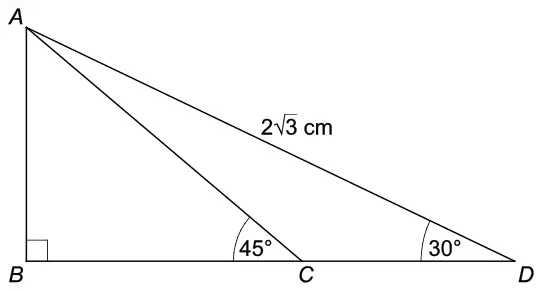
Use trigonometry to work out the range of values of \(x\). [2 marks]
Mark scheme
Answer
Mark
Comments
\((0 \lt)\; x \lt 60\) or \((0 \leqslant)\; x \lt 60\)
B2
B1 \(\cos x \gt \dfrac{5 - 3}{4}\) or \(\cos x \gt \dfrac{2}{4}\) or \(\cos x \gt \dfrac{1}{2}\) or \(x \lt \cos^{-1}\dfrac{1}{2}\) or \(a \lt x \lt 60\) where \(a\) is a non-zero value less than 60 or \(b \leqslant x \lt 60\) where \(b\) is a value less than 60 SC1 \((0 \lt)\; x \leqslant 60\) or \((0 \leqslant)\; x \leqslant 60\)
Additional guidance
Answer \((0 \lt)\; x \lt 60\) (can ignore working lines)
B2
\(60 \gt x \gt 0\) is equivalent to \(0 \lt x \lt 60\) etc
\(0 \lt x \lt 60\) is equivalent to the two inequalities \(x \gt 0 \quad x \lt 60\) etc
B2
Allow decimals for B1 responses eg \(\cos x \gt 0.5\)
B1
For B1 condone \(\cos x = \gt \dfrac{1}{2}\) for \(\cos x \gt \dfrac{1}{2}\)
\(\cos x \gt \dfrac{1}{2}\) followed by \(x \gt \cos^{-1}\dfrac{1}{2}\)
SC1 for a final answer of \(\dfrac{2\sqrt{3}\sin 15^\circ}{\sin 135^\circ}\), possibly with \(\dfrac{1}{\sqrt{2}}\) or \(\dfrac{\sqrt{2}}{2}\) for \(\sin 135^\circ\)
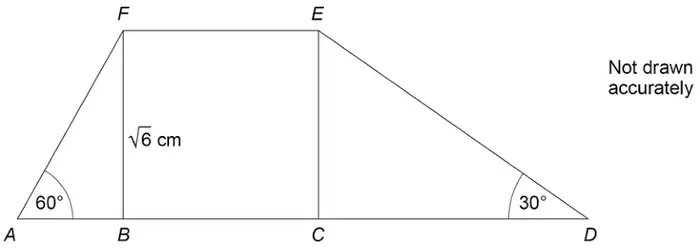
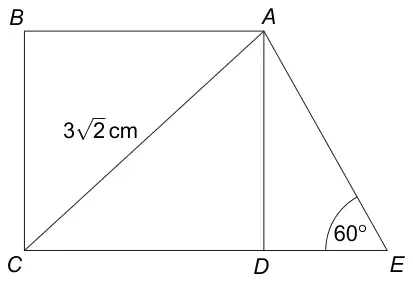
\(AC\) is \(3\sqrt{2}\) cm and angle \(DEA = 60^\circ\)
Not drawn accurately
(a) Show that the side of the square is 3 cm [2 marks]
(b) Show that the perimeter of trapezium \(ABCE\) is \(\ 3(3 + \sqrt{3})\) cm [4 marks]
Mark scheme (a)
Answer
Mark
Comments
Alternative method 1
\(x^2 + x^2 = (3\sqrt{2})^2\)
M1
where \(x\) is the side of the square It must say \((3\sqrt{2})^2\) ... \(x^2 + x^2 = 18\) is M0
\(2x^2 = 18\)
A1
oe
Alternative method 2
\(\sin 45^\circ = \dfrac{x}{3\sqrt{2}}\) or \(\cos 45^\circ = \dfrac{x}{3\sqrt{2}}\)
M1
where \(x\) is the side of the square allow use of the sine rule
\(\dfrac{1}{\sqrt{2}} = \dfrac{x}{3\sqrt{2}}\)
A1
oe
Additional guidance
In alt 1 ... Ignore further work after \(2x^2 = 18\) \(1 : 1 : \sqrt{2}\) scaled up by a factor of 3 to give \(3 : 3 : 3\sqrt{2}\) is 'verify' so scores SC1 or \(3^2 + 3^2 = 9 + 9 = 18\) and \((3\sqrt{2})^2 = 9 \times 2 = 18\) is also 'verify', so SC1
SC1
Mark scheme (b)
Answer
Mark
Comments
Alternative method 1
\(\tan 60 = \dfrac{3}{DE}\) or \(DE = \dfrac{3}{\sqrt{3}}\) or \(1 : \sqrt{3} : 2\) triangle
M1
oe
\(DE = \sqrt{3}\)
A1
oe eg \(\dfrac{3}{\sqrt{3}}\)
\(AE = 2\sqrt{3}\)
A1
oe eg \(\dfrac{6}{\sqrt{3}}\) or \(\sqrt{12}\)
\(3 \times 3 + \sqrt{3} + 2\sqrt{3}\)
A1
oe
Alternative method 2
\(\sin 60 = \dfrac{3}{AE}\) or \(AE = \dfrac{3}{(\sqrt{3}/2)}\)
M1
oe
\(AE = 2\sqrt{3}\)
A1
oe eg \(\dfrac{6}{\sqrt{3}}\) or \(\sqrt{12}\)
\(DE = \sqrt{3}\)
A1
oe eg \(\dfrac{3}{\sqrt{3}}\)
\(3 \times 3 + \sqrt{3} + 2\sqrt{3}\)
A1
oe
Additional guidance
They can leave \(DE\) and \(AE\) in unsimplified form for the first two A marks but must then simplify their expression for the perimeter to clearly show the required result for the final A mark.
\[\tan y = \frac{p + 1}{p - 1} \qquad \text{where } p \text{ is a constant greater than 1}\]
(a) Which of the statements below is correct?
Circle your answer. [1 mark]
\(y = 45^\circ\)
\(y \lt 45^\circ\)
\(y \gt 45^\circ\)
\(y\) could be any acute angle
(b) Work out the expression for \(\sin y\)
Give your answer in the form \(\ \dfrac{ap + b}{\sqrt{cp^2 + d}}\ \) where \(a\), \(b\), \(c\) and \(d\) are integers.
You may use a diagram to help you. [4 marks]
Mark scheme (a)
Answer
Mark
Comments
\(y \gt 45^\circ\)
B1
Mark scheme (b)
Answer
Mark
Comments
\((p + 1)^2 + (p - 1)^2\)
M1
oe May be within a square root
\(p^2 + p + p + 1 + p^2 - p - p + 1\) or \(p^2 + 1 + p^2 + 1\)
M1
oe May be within a square root Implies M1 M1
\(2p^2 + 2\) or \(2(p^2 + 1)\)
A1
May be within a square root Must be simplified May be implied by final mark
\(\dfrac{p + 1}{\sqrt{2p^2 + 2}}\)
A1
Allow \(a = b = 1 \quad c = d = 2\) SC2 \(\dfrac{p + 1}{\sqrt{(p + 1)^2 + (p - 1)^2}}\)
Additional guidance
\(\dfrac{p + 1}{\sqrt{2p^2 + 2}}\) and further incorrect work
M2 A1 A0
Allow \(1p\) for \(p\)
Use of \(\dfrac{\sin y}{\cos y} = \dfrac{p + 1}{p - 1}\) can be marked by the scheme eg \((p - 1)^2\sin^2 y = (p + 1)^2\cos^2 y\) \((p - 1)^2\sin^2 y = (p + 1)^2(1 - \sin^2 y)\) \(((p - 1)^2 + (p + 1)^2)\sin^2 y = (p + 1)^2\) First M1 gained here (M1 A1 A1 may subsequently be gained)