
June 2016 Paper 1 Q19
19
\(ABCD\) is a square.
\(CDE\) is a straight line.
\(AC\) is \(3\sqrt{2}\) cm and angle \(DEA = 60^\circ\)
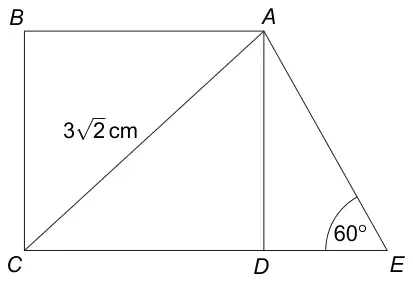
Not drawn accurately
(a) Show that the side of the square is 3 cm [2 marks]
(b) Show that the perimeter of trapezium \(ABCE\) is \(\ 3(3 + \sqrt{3})\) cm [4 marks]
| Answer | Mark | Comments |
|---|---|---|
| Alternative method 1 | ||
| \(x^2 + x^2 = (3\sqrt{2})^2\) | M1 | where \(x\) is the side of the square It must say \((3\sqrt{2})^2\) ... \(x^2 + x^2 = 18\) is M0 |
| \(2x^2 = 18\) | A1 | oe |
| Alternative method 2 | ||
| \(\sin 45^\circ = \dfrac{x}{3\sqrt{2}}\) or \(\cos 45^\circ = \dfrac{x}{3\sqrt{2}}\) | M1 | where \(x\) is the side of the square allow use of the sine rule |
| \(\dfrac{1}{\sqrt{2}} = \dfrac{x}{3\sqrt{2}}\) | A1 | oe |
Additional guidance
| In alt 1 ... Ignore further work after \(2x^2 = 18\) \(1 : 1 : \sqrt{2}\) scaled up by a factor of 3 to give \(3 : 3 : 3\sqrt{2}\) is 'verify' so scores SC1 or \(3^2 + 3^2 = 9 + 9 = 18\) and \((3\sqrt{2})^2 = 9 \times 2 = 18\) is also 'verify', so SC1 | SC1 |
| Answer | Mark | Comments |
|---|---|---|
| Alternative method 1 | ||
| \(\tan 60 = \dfrac{3}{DE}\) or \(DE = \dfrac{3}{\sqrt{3}}\) or \(1 : \sqrt{3} : 2\) triangle | M1 | oe |
| \(DE = \sqrt{3}\) | A1 | oe eg \(\dfrac{3}{\sqrt{3}}\) |
| \(AE = 2\sqrt{3}\) | A1 | oe eg \(\dfrac{6}{\sqrt{3}}\) or \(\sqrt{12}\) |
| \(3 \times 3 + \sqrt{3} + 2\sqrt{3}\) | A1 | oe |
| Alternative method 2 | ||
| \(\sin 60 = \dfrac{3}{AE}\) or \(AE = \dfrac{3}{(\sqrt{3}/2)}\) | M1 | oe |
| \(AE = 2\sqrt{3}\) | A1 | oe eg \(\dfrac{6}{\sqrt{3}}\) or \(\sqrt{12}\) |
| \(DE = \sqrt{3}\) | A1 | oe eg \(\dfrac{3}{\sqrt{3}}\) |
| \(3 \times 3 + \sqrt{3} + 2\sqrt{3}\) | A1 | oe |
Additional guidance
They can leave \(DE\) and \(AE\) in unsimplified form for the first two A marks but must then simplify their expression for the perimeter to clearly show the required result for the final A mark.