
June 2025 Paper 2 Q14
14 All lengths shown are in centimetres.
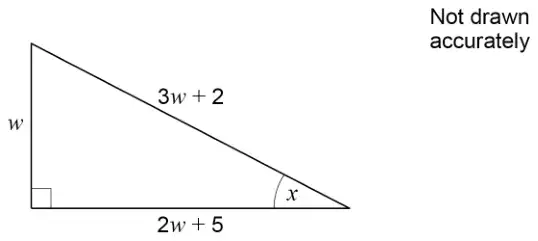
(a) Use Pythagoras’ theorem to show that \(\quad 4w^2 - 8w - 21 = 0\) [2 marks]
(b) Work out the size of angle \(x\). [3 marks]
| Answer | Mark | Comments |
|---|---|---|
| \((3w + 2)^2 = w^2 + (2w + 5)^2\) or \(9w^2 + 12w + 4\) \(= w^2 + 4w^2 + 20w + 25\) | M1 | oe Pythagoras’ theorem eg \(9w^2 + 6w + 6w + 4\) \(= w^2 + 4w^2 + 10w + 10w + 25\) or \(3w + 2 = \sqrt{w^2 + (2w + 5)^2}\) |
| \(9w^2 + 12w + 4\) \(= w^2 + 4w^2 + 20w + 25\) and \(4w^2 - 8w - 21 = 0\) with no errors | A1 | oe with brackets expanded eg \(9w^2 + 6w + 6w + 4\) \(= w^2 + 4w^2 + 10w + 10w + 25\) and \(4w^2 - 8w - 21 = 0\) with no errors allow \(5w^2\) for \(w^2 + 4w^2\) |
Additional guidance
| \((3w + 2)^2 = w^2 + (2w + 5)^2\) \(9w^2 + 6w + 6w + 4 = w^2 + 4w^2 + 10w + 10w + 10\) (error in expansion) \(4w^2 - 8w - 21 = 0\) | M1 A0 |
| \(9w^2 + 12w + 4 = w^2 + 4w^2 + 20w + 25\) \(4w^2 - 8w - 21\) (omission of \(= 0\)) | M1 A0 |
| Missing brackets must be recovered |
| Answer | Mark | Comments |
|---|---|---|
| \((2w + 3)(2w - 7)\) or \(\dfrac{- -8 \pm \sqrt{(-8)^2 - 4 \times 4 \times -21}}{2 \times 4}\) or 3.5 | M1 | oe eg \(1 \pm \sqrt{\dfrac{25}{4}}\) or \(\dfrac{7}{2}\) in quadratic formula or completing the square allow \(\pm\) to be \(+\) |
| \(\sin x = \dfrac{3.5}{3 \times 3.5 + 2}\) or \(\cos x = \dfrac{2 \times 3.5 + 5}{3 \times 3.5 + 2}\) or \(\tan x = \dfrac{3.5}{2 \times 3.5 + 5}\) | M1dep | oe eg \(\sin^{-1}\dfrac{7}{25}\) or \(\sin^{-1} 0.28\) or \(\cos^{-1}\dfrac{24}{25}\) or \(\cos^{-1} 0.96\) or \(\tan^{-1}\dfrac{7}{24}\) or \(\tan^{-1}\) [0.29, 0.292] |
| [16.17, 16.3] with no other solution | A1 | accept 16 with no other solution with M2 awarded |
Additional guidance
| Up to M2 may be awarded for correct work with no answer or incorrect answer, even if this is seen amongst multiple attempts | |
| In the quadratic formula \(-8^2\) is M0 unless recovered | |
| 2nd M1 Using the sine rule or cosine rule must have \(\sin x\) or \(\cos x\) as the subject and a correct numerical expression or a correct value | |
| \(\sin x = \dfrac{3.5 \sin 90}{12.5}\) with no further correct working | M1M0 |
| Check 14(a) and diagram for working that may be valid in 14(b) |