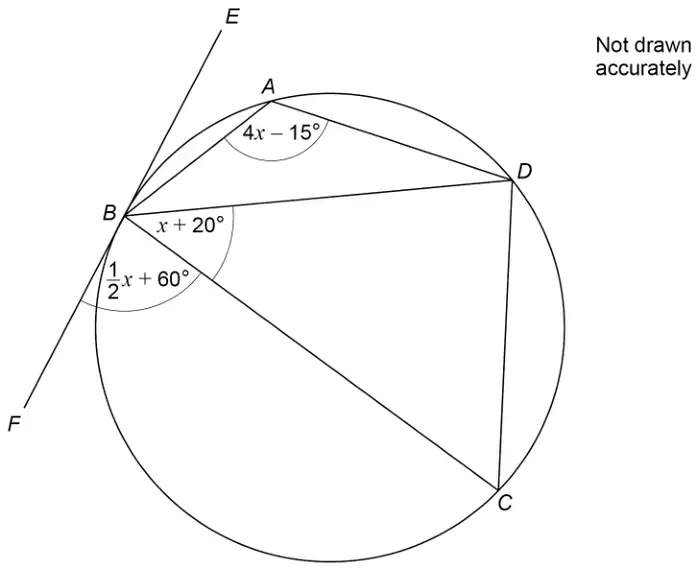
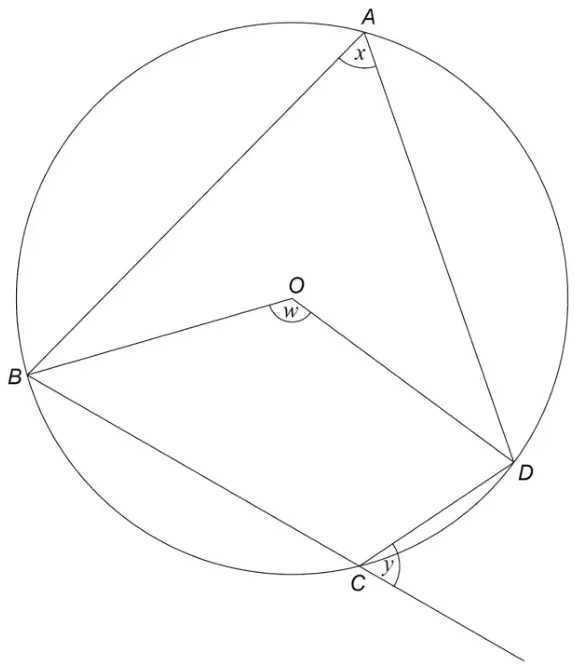
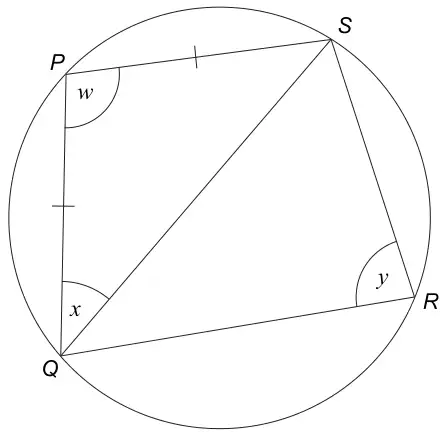
SC2 two different correct expressions for one of angle \(BDC\) or angle \(BCD\) or angle \(EBD\) SC2 two different correct expressions, one for angle \(BCD\), one for angle \(EBD\)
Additional guidance
Up to M2 or SC2 may be awarded for correct work with no answer or incorrect answer, even if this is seen amongst multiple attempts
A correct expression with no indication of which angle it represents cannot be awarded M marks or SC marks eg \(100 - \dfrac{3}{2}x\) not labelled as angle \(BCD\) or angle \(EBD\) in working or not shown in correct position on diagram (may be implied by a correct equation which will be awarded M3)
2nd M0
Other equations which are awarded M3 include \(4x - 15 + 100 - \dfrac{3}{2}x = 180\) or \(\dfrac{1}{2}x + 60 + x + 20 = 4x - 15\) or \(180 - (4x - 15) = 180 - \left(\dfrac{1}{2}x + 60\right) - (x + 20)\) or \(195 - 4x = 100 - \dfrac{3}{2}x\)
If an angle is written correctly, ignore any subsequent processing errors (3rd M1 may also be awarded) eg angle \(BDC = \dfrac{1}{2}x + 60\) angle \(BCD = 180 - (4x - 15) = 165 - 4x\) (should be \(195 - 4x\)) \(\dfrac{1}{2}x + 60 + x + 20 + 165 - 4x = 180\)
Angle at centre \(=\) 2 \(\times\) angle at circumference and opposite angles of a cyclic quad total 180 stated and used correctly
B1
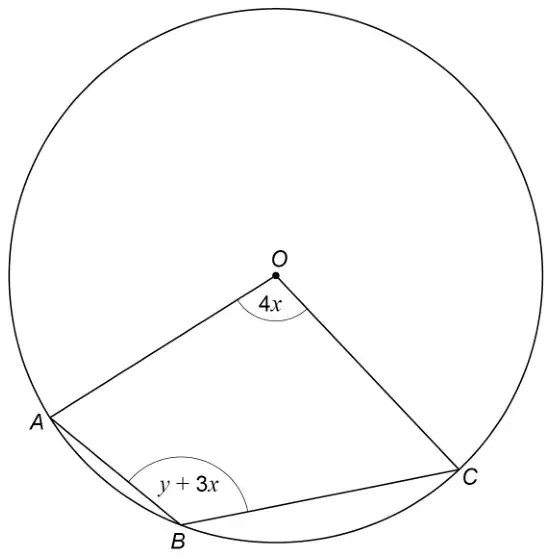
Alternative method 3: reflex angle AOC from angles at the centre
\(360 - 4x\)
M1
using angles at the centre
\(360 - 4x = 2(y + 3x)\)
M1dep
oe implies first M mark
\(2y + 10x = 360\) or \(2y = 360 - 10x\) Leading to \(y = 180 - 5x\)
A1
M2 must be scored either of the first two statements is sufficient or a correct equivalent statement that improves on M2
Angle at centre \(=\) 2 \(\times\) angle at circumference and angles at a point \(=\) 360 stated and used correctly
B1
Alternative method 4: isosceles triangles
Radius drawn from \(O\) to \(B\) to make two isosceles triangles and shows that \(OAB\) is equal to \(OBA\) and \(OCB\) is equal to \(OBC\) in working or on diagram
M1
\(y + 3x + 4x + OAB + OCB = 360\) and \(OAB + OCB = y + 3x\)
M1dep
oe implies first M mark
\(y + 3x + 4x + y + 3x = 360\) or \(2y = 360 - 10x\) Leading to \(y = 180 - 5x\)
A1
M2 must be seen either of the first two statements is sufficient or a correct equivalent statement that improves on M2
Angles of a quadrilateral add to 360 and isosceles triangles formed from radii have two equal angles stated and used correctly
B1
Additional guidance
A correct angle on the diagram from any Alt will score the first M mark then follow that Alt
Stop marking as soon as \(y = 180 - 5x\) is substituted in and used
If angles are stated in the working without being indicated on the diagram (the diagram will take precedence) they must be labelled accurately eg Reflex O or Concave AOC \(=\)
Omission of labels or incorrect labels (if not seen on diagram either) will lose the A mark but M marks can still be awarded
Prove that \(\quad x = 90 - \dfrac{3}{2}y\) [5 marks]
Mark scheme
Answer
Mark
Comments
Fully correct proof with
a correct unsimplified equation in \(x\) and \(y\)
rearrangement to \(x = 90 - \dfrac{3}{2}y\) with no rearrangement errors seen
all valid reasons stated
B5
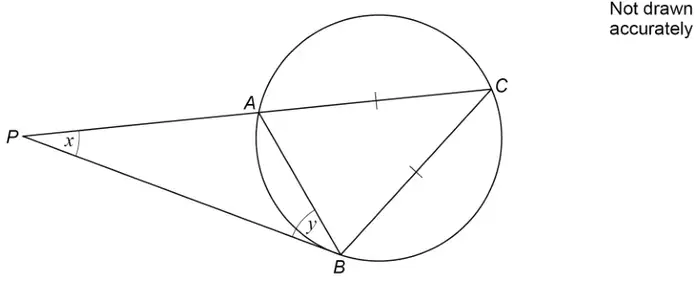
B4 a correct unsimplified equation in \(x\) and \(y\) and rearrangement to \(x = 90 - \dfrac{3}{2}y\) with no rearrangement errors seen B3 a correct unsimplified equation in \(x\) and \(y\) eg \(x + y = \dfrac{180 - y}{2}\) or \(y = 180 - (2x + 2y)\) or \(x + \dfrac{180 - y}{2} + y + y = 180\) or \(180 - (x + y) + \dfrac{180 - y}{2} = 180\) B2 two expressions for angles correct in terms of \(x\) and/or \(y\) eg two of angle \(ACB = y\) angle \(PAB = 180 - (x + y)\) angle \(CAB = x + y\) angle \(CAB = \dfrac{180 - y}{2}\) angle \(CBQ = x + y\) angle \(CBQ = \dfrac{180 - y}{2}\) B1 expression for one angle correct in terms of \(x\) and/or \(y\)
Additional guidance
Up to B2 may be awarded for correct work with no answer or incorrect answer, even if this is seen amongst multiple attempts
\(Q\) is the end of \(PB\) extended (\(Q\) may be eg \(D\))
angle \(PCB\) = angle \(ACB\)
Condone eg \(PCB\) for angle \(PCB\)
Accept unambiguous indication of angles eg1 angle \(C = y\) in working is unambiguous eg2 angle \(A = 180 - (x + y)\) in working is ambiguous unless shown in correct position on diagram
Missing brackets must be recovered
Up to B2 may be awarded from the diagram
B2 can be awarded for two different expressions for the same angle
B2 can be awarded for the same expression for angles \(CAB\) and \(ABC\)
Most unsimplified equations will be from one of (i) equating two expressions for angle \(CAB\) (ii) equating two expressions for angle \(ACB\) (iii) angle sum of triangle \(PBC = 180\) (iv) angle \(PAB\) + angle \(CAB = 180\) (v) angle sum of triangle \(ABC = 180\) (vi) angle \(ABP\) + angle \(ABC\) + angle \(CBQ = 180\)
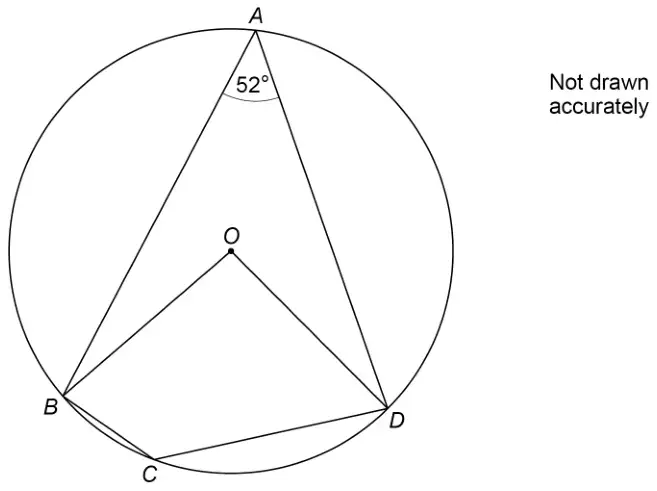
oe eg \(360^\circ - 232^\circ\) one of \(128^\circ\) and \(104^\circ\) must be correct this could imply B1 B1 oe
\((OBC =)\ 80^\circ\)
A1
can only be awarded with evidence of B2M1
Additional guidance
Angles may be seen on diagram
Check they are not splitting \(BCD\) in the ratio 5:3 (benefit of doubt may need to be applied). It is possible to draw a line from \(O\) to \(C\) which splits the quadrilateral into two isosceles triangles. This method does allow for \(BCD\) to be split in the ratio 5:3
\(OBC = 80^\circ\) and \(ODC = 48^\circ\) both on answer line
A1
\(80^\circ\) and \(48^\circ\) both on answer line would be choice
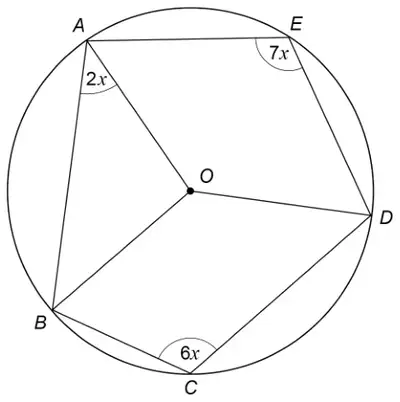
21 \(A\), \(B\), \(C\), \(D\) and \(E\) are points on a circle, centre \(O\).
Not drawn accurately
Work out the value of \(x\). [4 marks]
Mark scheme
Answer
Mark
Comments
angle \(AOD = 12x - (180 - 4x)\) or angle \(AOD = 16x - 180\) or angle \(BOD = 14x - (180 - 4x)\) or angle \(BOD = 18x - 180\) or angle \(AOB = 180 - 4x\) and angle \(BOD = 360 - 12x\) and angle \(AOD = 360 - 14x\) or angle \(AOB = 180 - 4x\) and reflex angle \(BOD = 12x\) and reflex angle \(AOD = 14x\)
B2
oe B1 angle \(AOB = 180 - 2x - 2x\) or angle \(AOB = 180 - 4x\) or reflex angle \(BOD = 12x\) or angle \(BOD = 360 - 12x\) or reflex angle \(AOD = 14x\) or angle \(AOD = 360 - 14x\) all angles for B2 or B1 may be seen on diagram
Up to B2 may be awarded for correct work with no answer or incorrect answer, even if this is seen amongst multiple attempts
An equation scoring M1 implies B2
Incorrect use of obtuse/acute must be recovered
Missing brackets must be recovered
Condone eg angle \(BOD = 12x\) if marked as reflex angle \(BOD = 12x\) on diagram
B1
NOTE 18 may be seen from incorrect working eg (interior angle of regular pentagon =) \(540 \div 5 = 108\) \(108 \div 6 = 18 \qquad\) (no other correct working seen)
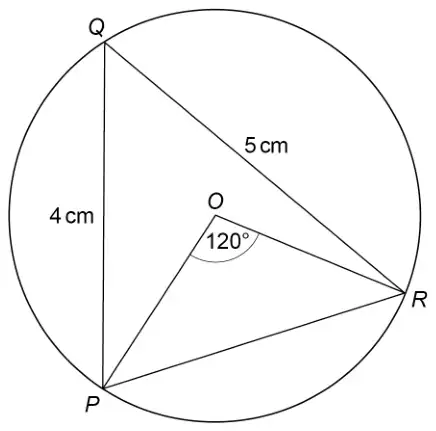
\(PR\) must have a value oe eg \(PO = \dfrac{\sqrt{21}}{2} \div \dfrac{\sqrt{3}}{2}\) could use cosine rule again or sine rule at this stage but it would need to lead directly in one calculation to \(\sqrt{7}\) eg \(\left(\dfrac{\text{their}\sqrt{21}\sin 30^\circ}{\sin 120^\circ}\right)\) must be explicit: \(\left(\dfrac{PO}{\sin 30^\circ} = \dfrac{\text{their}\sqrt{21}}{\sin 120^\circ}\right)\) is not M1 but this then followed by \(\left(\dfrac{PO}{\frac{1}{2}} = \dfrac{\text{their}\sqrt{21}}{\frac{1}{3}}\right)\) (error in denominator) and \(\left(PO = \dfrac{\frac{1}{2}\text{their}\sqrt{21}}{\frac{1}{3}}\right)\) (rearranged correctly) would be M1
(\(PO =\)) \(\sqrt{7}\)
A1
Additional guidance
\(POM = 60^\circ\) where \(M\) is the midpoint of \(PR\)
B0
Final answer coming from double errors in surd manipulation
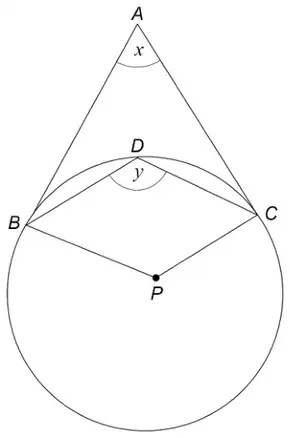
15 \(B\), \(C\) and \(D\) are points on a circle, centre \(P\).
\(AB\) and \(AC\) are tangents to the circle.
Not drawn accurately
Prove that \(\quad y = 90 + \dfrac{x}{2}\) [5 marks]
Mark scheme
Answer
Mark
Comments
States that \(\angle ABP\) or \(\angle ACP\) is 90
B1
can be seen on diagram (either 90 or a square angle)
Any one further angle correct (not \(\angle ABP\) or \(\angle ACP\))
B1
minor \(\angle BPC = 180 - x\) or \(360 - 2y\) or major \(\angle BPC = 2y\) or \(180 + x\) or \(\angle BQC = 180 - y\) or \(90 - \dfrac{x}{2}\) (where Q is a point on the major arc)
Another further angle correct (not \(\angle ABP\) or \(\angle ACP\))
B1
any two of minor \(\angle BPC = 180 - x\) or \(360 - 2y\) or major \(\angle BPC = 2y\) or \(180 + x\) or \(\angle BQC = 180 - y\) or \(90 - \dfrac{x}{2}\) (where Q is a point on the major arc) could be the same angle found in the previous B mark but an expression in \(y\) rather than \(x\)
A correct equation in terms of \(x\) and \(y\) and rearrange to \(y = 90 + \dfrac{x}{2}\)
B1dep
dependent on first three B marks awarded doesn’t imply the first 3 B marks
3 reasons given for the theorems used correctly for the angles stated in the first three marks
B1dep
dependent on first three B marks awarded reason - angle formed from a tangent and a radius is a right angle (can only be used once) reason - angles in a quadrilateral add up to 360 reason - angle at the centre is twice the angle at the circumference reason - opposite angles in a cyclic quadrilateral add up to 180 reason - angles at a point (or in a circle) add up to 360 reason - alternate segment theorem
Additional guidance
Angles must be identified with either our terminology such as \(\angle ABP\) or their own labelling such as m or \(\theta\) or can be seen on the diagram Accept supplementary for angles adding to 180 Accept complementary for angles adding to 90 Use of obtuse and reflex or interior and exterior instead of minor and major is fine. If it’s not clear then assume it’s the minor arc they are referring to Check candidates are not assuming that \(BDCP\) is a kite and using symmetry of this shape Check candidates are not using \(BDCP\) as a cyclic quadrilateral No credit for numbers used instead of \(x\) and \(y\) Mark the first three B marks positively Note – \(ABPC\) is a cyclic quadrilateral but \(D\) is not the centre of that circle Note – \(D\) is not the middle of minor arc \(BC\)
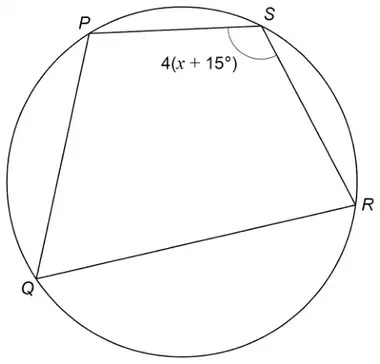
oe equation in \(x\) or pair of equations in \(x\) and \(y\) \(y\) may be any letter other than \(x\) eg \(180 - (4x + 60) + 40 = 4x + 60\) or \(4(x + 15) = 110\) or \(4(x + 15) - 40 = 70\) or \(y + 4x = 120\) and \(y = 4x + 20\) implied by \(y = 70\)
\(4x + 60 + 4x + 60 - 40 = 180\) or \(8x + 120 - 40 = 180\) or \(8x = 100\) or \(100 \div 8\) or \(4x = 50\) or \(50 \div 4\)
M1dep
oe equation or calculation equation with brackets expanded and fractions eliminated eg \(120 - 4x + 40 = 4x + 60\) or \(8x + 80 = 180\) or \(4x + 60 = 110\) or \(4x + 20 = 70\)
12.5 or \(\dfrac{25}{2}\) or \(12\dfrac{1}{2}\)
A1
oe eg \(\dfrac{100}{8}\) or \(\dfrac{50}{4}\) SC2 2.5 oe
Additional guidance
Ignore simplification or conversion if correct answer seen
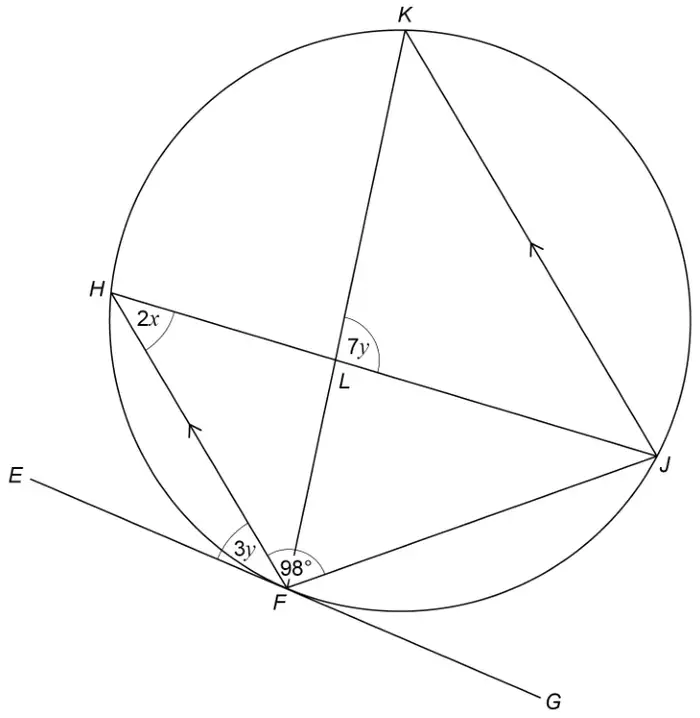
23 \(F\), \(H\), \(K\) and \(J\) are points on a circle.
Chords \(HJ\) and \(KF\) intersect at \(L\).
\(EFG\) is a tangent to the circle.
\(FH\) and \(JK\) are parallel.
Not drawn accurately
(a) Angle \(FHJ = 2x\)
Give reasons why angle \(FKJ\) and angle \(HJK\) are also equal to \(2x\). [2 marks]
(b) Work out the values of \(x\) and \(y\).
You must show your working.
Do not use trial and improvement. [4 marks]
Mark scheme (a)
Answer
Mark
Comments
Angles in the same segment
B1
oe eg angles at the circumference are equal
Alternate angles
B1
do not accept alternative or alternating
Additional guidance
Angles on the circumference from a chord
B1
Angles in the same sector, opposite angles, parallel lines, angles from a chord, similar triangles, isosceles triangle, corresponding angles, triangles on a chord, intersecting chords, allied angles, alternate segment theorem
B0
Mark scheme (b)
Answer
Mark
Comments
\(\angle HJF = 3y\) or \(\angle JFG = 2x\) or \(\angle HFL = 2x\)
M1
may be on the diagram implied by one correct equation in \(x\) and \(y\)
\(2x + 3y + 98 = 180\) and \(4x + 7y = 180\)
M1dep
two correct equations in \(x\) and \(y\)
A correct attempt to eliminate one of the variables from the two equations
Condone slips in notation only if angles are marked in correct position on the diagram eg1 Do not allow angle \(C = 180 - w\) unless marked in correct position on the diagram eg2 Allow \(ACB\) for angle \(ACB\)
For reasons, allow if the intention is clear eg1 Allow isos triangle for isosceles triangle eg2 Allow angles in a triangle for angle sum of a triangle eg3 Allow angles on a line for angles on a straight line
For reasons do not allow incorrect statements eg do not allow angles in a triangle add to 360
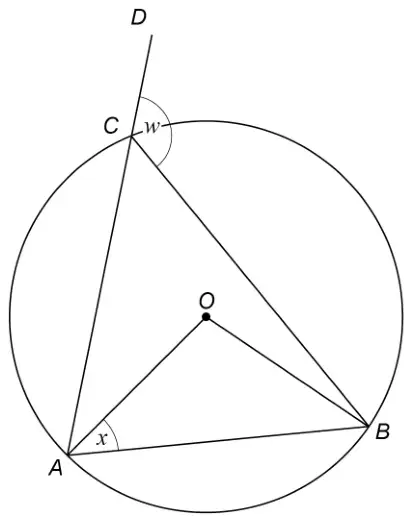
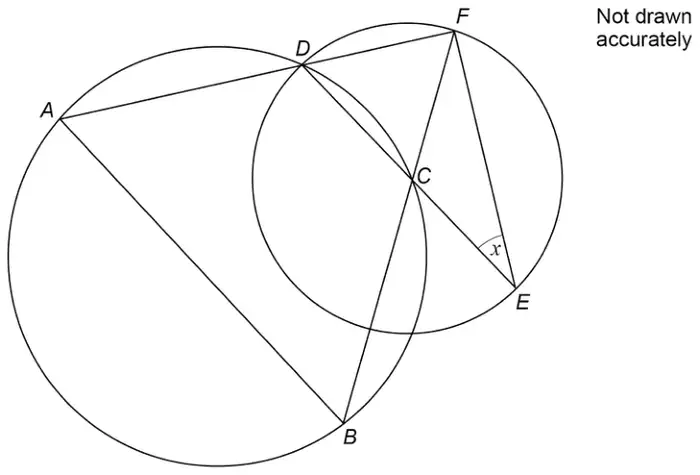
20 \(A\), \(B\), \(C\) and \(D\) are points on a circle.
\(D\), \(E\) and \(F\) are points on a different circle, centre \(C\). \(DCE\), \(ADF\) and \(BCF\) are straight lines. angle \(DEF = x\)
(a) Prove that \(\quad\) angle \(BAD = 2x\) [3 marks]
(b) In the case when \(AB\) is parallel to \(DE\), work out the size of angle \(x\). [2 marks]
Mark scheme (a)
Answer
Mark
Comments
Alternative method 1
Full method leading to angle \(BCD = 180 - 2x\)
M1
eg angle \(CFE = x\) and angle \(FCE = 180 - 2x\) and angle \(BCD = 180 - 2x\)
Full reasoning for their method
A1
eg (base angles of) isosceles (triangle are equal) and (sum of) angles in a triangle (is 180) and (vertically) opposite angles
angle \(BAD = 2x\) and (opposite angles of) cyclic quadrilateral (add to 180)
A1
must see M1
Alternative method 2 Working out angle \(DCF\) using angle at centre
angle \(DCF = 2x\)
M1
angle at centre (is double angle at circumference)
A1
Full method leading to angle \(BAD = 2x\) and full reasoning for their method
A1
must see M1 eg angle \(BCD = 180 - 2x\) and angle \(BAD = 2x\) and angles on a (straight) line (add to 180) and (opposite angles of) cyclic quadrilateral (add to 180)
Alternative method 3 Working out angle \(DCF\) not using angle at centre
Full method leading to angle \(DCF = 2x\)
M1
eg angle \(CFE = x\) and angle \(DCF = 2x\)
Full reasoning for their method
A1
eg (base angles of) isosceles (triangle are equal) and exterior angle (of triangle is sum of interior opposite angles)
Full method leading to angle \(BAD = 2x\) and full reasoning for their method
A1
must see M1 eg angle \(BCD = 180 - 2x\) and angle \(BAD = 2x\) and angles on a (straight) line (add to 180) and (opposite angles of) cyclic quadrilateral (add to 180)
Alternative method 4
Full method leading to angle \(DFC = 90 - x\) and angle \(ABC = 90 - x\)
M1
eg angle \(CFE = x\) and angle \(DFE = 90\) and angle \(DFC = 90 - x\) and angle \(CDF = 90 - x\) and angle \(ADC = 90 + x\) and angle \(ABC = 90 - x\)
Full reasoning for their method
A1
eg (base angles of) isosceles (triangle are equal) and (angle in a) semicircle (is 90) and (sum of) angles in a triangle (is 180) and angles on a (straight) line (add to 180) and (opposite angles of) cyclic quadrilateral (add to 180)
angle \(BAD = 2x\) and (sum of) angles in a triangle (is 180)
A1
must see M1
Additional guidance
It is possible to score M1A1A0 or M1A0A1
Do not award any marks from angles on the diagram
Angles must be stated unambiguously eg condone angle \(B\) but do not condone angle \(D\)
‘angle’ may be missing or replaced by a symbol - mark intention
angle \(CFE\) may be seen as angle \(EFC\) or angle \(BFE\) etc
For (base angles of) isosceles (triangle are equal) allow radii (are equal)
For (sum of) angles in a triangle (is 180) allow triangle is 180
Use judgement when considering wording of reasons and allow abbreviations
Alt 2 Final A1 reason may be exterior angle of cyclic quadrilateral (equals interior opposite angle)
Choose the scheme that favours the student
Ignore angles that are not needed for their scheme even if incorrect
Allow recovery of missing brackets
Starting with angle \(BAD = 2x\)
M0A0A0
Mark scheme (b)
Answer
Mark
Comments
30
B2
B1 correct equation or calculation eg \(90 + 2x + x = 180\) or \(90 - x = 2x\) or \(3x = 90\) or \(6x = 180\) or \(90 \div 3\)
Additional guidance
Ignore any expressions for angles and any other calculated angles
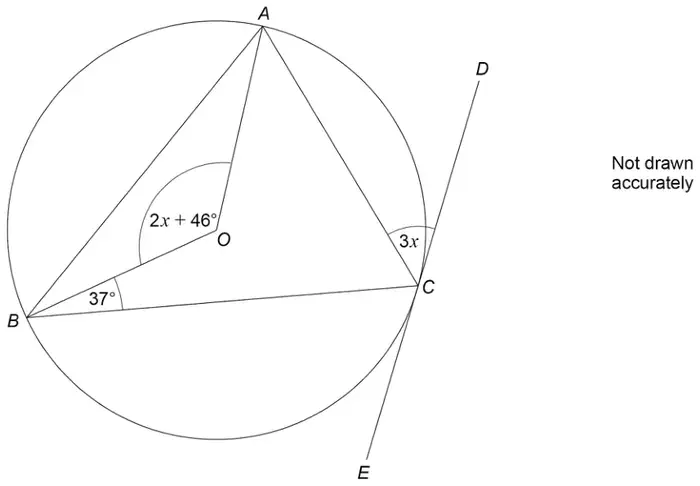
17 \(A\), \(B\) and \(C\) are points on the circumference of a circle, centre \(O\).
\(ECD\) is a tangent to the circle at \(C\). Angle \(AOB = 2x + 46^\circ\) Angle \(OBC = 37^\circ\) Angle \(ACD = 3x\)
Work out the value of \(x\). [4 marks]
Mark scheme
Answer
Mark
Comments
Any angle in terms of \(x\) either in working or on diagram. These could include: \(CBA = 3x\); \(ACB = x + 23\); \(OBA = 3x - 37\); \(OBA = \dfrac{180 - (2x + 46)}{2}\ (= 67 - x)\); \(BAC = BCE = 157 - 4x\);
\(BOA\) (reflex) \(= 314 - 2x\)
M1
oe but this must be an explicit expression for an angle
mark positively (look for any correct angle)
\(67 - x\) will be awarded M1 if seen on diagram but if in working would need \(OBA\) stating. Apply to other angles
A further angle that could be a different expression for one of the angles in the first mark
or
an angle that doesn’t include \(x\): eg \(OCE = 90\); \(BCP = 90\); \(OCB = 37\); \(BCE = 53\); \(PCD = 37\)
M1dep
look for isosceles triangles being formed by inserting a radius from O to C. P is the point on the circumference where BO is extended. could be a further angle that has the same expression as the first
A correct equation formed for \(x\) that would lead to the solution; eg \((3x - 37) + (3x - 37) + (2x + 46) = 180\) or \(3x + (x + 23) + 53 = 180\) many of these will lead to \(4x = 104\)
M1
oe
\((x =)\ 26\)
A1
Additional guidance
Look for angles on diagram
\((x =)\ 37.5\) could be a common error. Mark as per mark scheme
Labelling angle ABO as angle \(y\) and then writing \(2y + 2x + 46 = 180\) would not be enough for the first M mark. If they went on to write \(y = 67 - x\) this would gain the first M mark
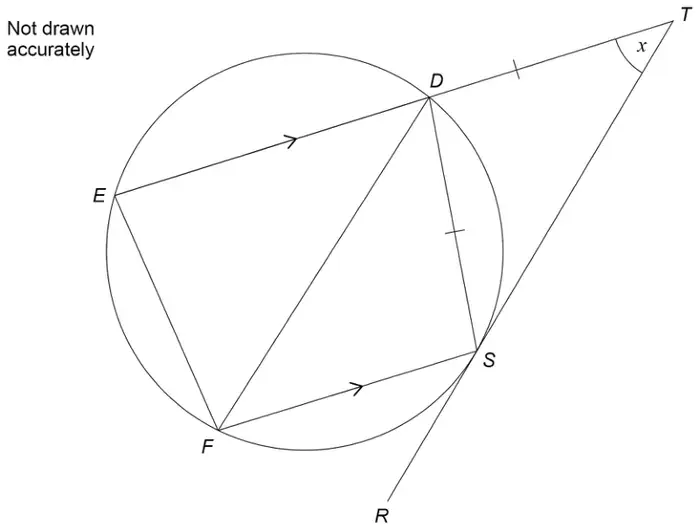
18 \(D\), \(E\), \(F\) and \(S\) are points on a circle.
\(RST\) is a tangent. The straight line \(EDT\) is parallel to \(FS\). \(DS = DT\)
Prove that \(FD\) is parallel to \(RST\).
Use angle \(DTS\) as \(x\) to help you. [5 marks]
Mark scheme
Answer
Mark
Comments
Angle \(DST = x\)
M1
‘base angles of isosceles triangle \(DST\)’ but we do not require a reason for this mark
Angle \(DFS = x \quad\) angle in alternate segment or Angle \(RSF = x \quad\) corresponding
M1
either of these angles with a correct reason scores this mark
no reason or an incorrect reason is M0
Further evaluation of angles, with correct reasons, to arrive at a stage where …
either … it is possible to use the converse of a theorem
or … which leads to the fact that \(DTSF\) is a parallelogram
M1dep
Here is a complete example … angle \(DST = x\) angle \(DSR = 180 - x \quad\) angles on a straight line angle \(RSF = x \quad\) corresponding angle \(FDS = x \quad\) \(FDS = RSF\), angle in alternate segment
A statement of the angles, or the values of the angles, that will complete the proof … the angles must be clearly identified
A statement of the correct reason to accompany these angles, thus completing the proof
A1
\(FD\) is parallel to \(RST\) because these angles add to 180 … using the (converse) of the co-interior angles theorem
Additional guidance
Some methods are much shorter than others. Follow their reasoning to see if it is free from error.
The 3rd mark is dependent on both of the previous two M marks. So, if they have not scored M1 M1 they cannot score any more marks
For the 3rd M mark … when following their work, stop as soon as there is an error in the value of any angle or in the reason given for any particular angle. The proof breaks down at that point and they can only score a maximum of 2 marks.
The 4th mark (M1dep) and the 5th mark (A1) are closely related. They can be thought of as a pair because the 4th mark is for identifying the two angles that make the completion of the proof possible and the 5th mark is for stating the correct reason. Condone the fact that you may not see the word ‘converse’.
Any sign of them using the result (eg \(DST = FDS\), alternate angles) means they have compromised the proof immediately and they can only score a maximum of 2 marks.
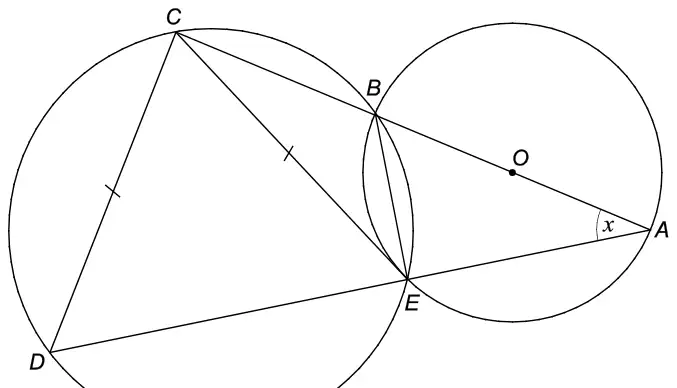
\(A\), \(B\) and \(E\) lie on the circle, centre \(O\). \(B\), \(C\), \(D\) and \(E\) lie on the other circle. \(AOBC\) and \(AED\) are straight lines. \(CD = CE\) angle \(BAE = x\)
Not drawn accurately
(a) Give a reason why angle \(BEA = 90^\circ\) [1 mark]
(b) Prove that angle \(DCE = 2x\) [4 marks]
Mark scheme (a)
Answer
Mark
Comments
Angle in a semicircle (is a right angle) or Angle at centre is \(180^\circ\), angle at circumference is half the angle at the centre (\(= 90^\circ\)) or Angle at centre is \(180^\circ\), angle at centre is twice the angle at the circumference or Angle subtended at circumference by a diameter
B1
Additional guidance
Do not allow half a circle to mean a semicircle
Allow extra words if not contradictory eg1 Angle at the circumference in a semicircle eg2 Angle inscribed in a semicircle
B1 B1
Angle subtended by a diameter (no mention of at circumference)
B0
Angle in a hemisphere is 90
B0
Angle at centre is 180
B0
Angle at circumference is half the angle at the centre
B0
2 chords on diameter meet at 90
B0
Triangle in a semicircle always has a right angle
B0
Angle in a semicircle is 180
B0
Angle on a diameter is a right angle
B0
Because \(AB\) is a diameter
B0
Mark scheme (b)
Answer
Mark
Comments
angle \(ABE = 90 - x\) or angle \(CBE = 90 + x\)
or
angle \(DEB = 90\) and angle \(DCB = 90\)
B1
angle \(CDE = 90 - x\)
B1dep
angle \(CED = 90 - x\)
B1dep
angle \(DCE = 2x\) and all reasons given for their proof
B1dep
See guidance for acceptable wording for reasons
Additional guidance
To award a particular mark, all previous marks must have been awarded
First three B marks can be awarded with no or incorrect reasons
Do not mark any working on the diagram – statements are needed
Angle \(CDE\) and angle \(CDA\) are the same angle etc
Angle \(EBA\) and angle \(ABE\) are the same angle etc
Condone \(ABE\) for angle \(ABE\) etc
Do not allow angle \(C\) for angle \(DCE\) etc
\(CE\) must be proven to be a tangent if used in a response
Reasons angle sum of triangle (is 180°) or angles in a triangle (add to 180°) or 180° in a triangle (adjacent) angles on a (straight) line (add to 180°) or 180° on a (straight) line exterior angle of triangle (= sum of opposite interior angles) (equal angles in an) isosceles (triangle) or \(CD = CE\) (opposite angles in a) cyclic quadrilateral (add to 180°) exterior angle of cyclic quadrilateral (= opposite interior angle)
Degrees symbol may be omitted
Abbreviations are allowed eg quad for quadrilateral
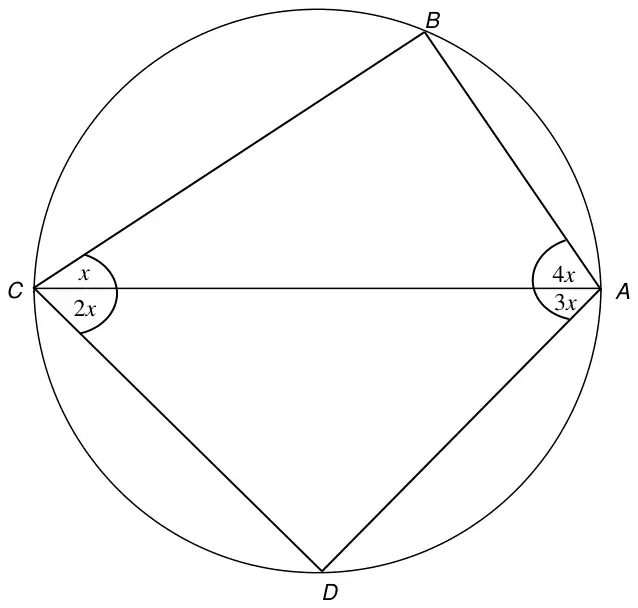
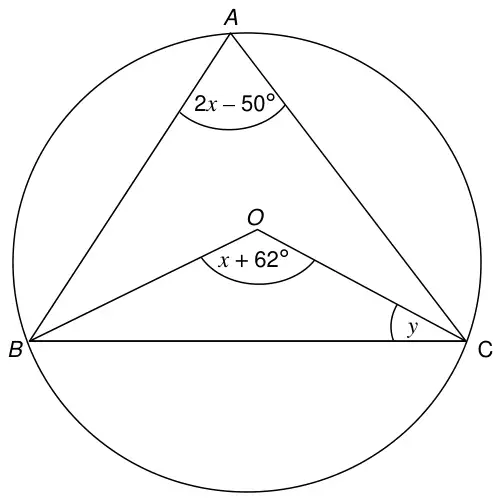
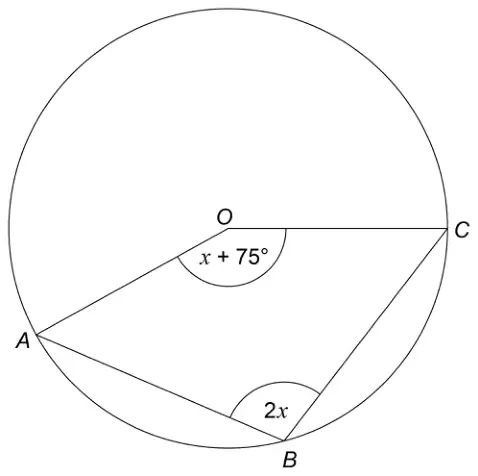
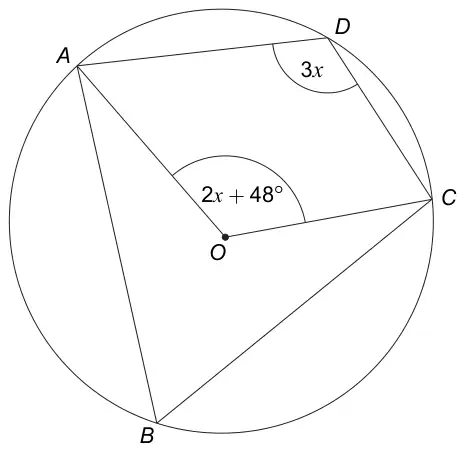
5 \(A\), \(B\), \(C\) and \(D\) are points on a circle, centre \(O\).
Not drawn accurately
Work out the value of \(x\). [3 marks]
Mark scheme
Answer
Mark
Comments
Alternative method 1
(Angle at circumference =) \(x + 24\)
M1
oe
\(x + 24 + 3x = 180\)
M1 dep
oe
39
A1
Alternative method 2
(Reflex angle at centre =) \(6x\)
M1
oe
\(2x + 48 + 6x = 360\)
M1dep
oe
39
A1
Alternative method 3
(Angle at circumference =) \(180 - 3x\)
M1
oe
\(2x + 48 = 2(180 - 3x)\)
M1 dep
oe
39
A1
Alternative method 4
(Reflex angle at centre =) \(360 - (2x + 48)\)
M1
oe
\(360 - (2x + 48) = 2(3x)\)
M1 dep
oe
39
A1
Additional guidance
Look on the diagram for evidence of the 1st M1
\(39^\circ\) seen on the answer line ... check to see that it has come from correct working
Reasons are not necessary
Here are two examples of equations coming from incorrect geometrical reasoning.
\(2(3x) = 2x + 48\) scores M0 M0
\(2x + 48 + 6x = 180\) scores M1 M0 ... because the \(6x\) in this equation implies the reflex angle at the centre, so it scores M1 in this particular case.