
June 2017 Paper 2 Q20
20 Two circles overlap.
\(A\), \(B\) and \(E\) lie on the circle, centre \(O\).
\(B\), \(C\), \(D\) and \(E\) lie on the other circle.
\(AOBC\) and \(AED\) are straight lines.
\(CD = CE\)
angle \(BAE = x\)
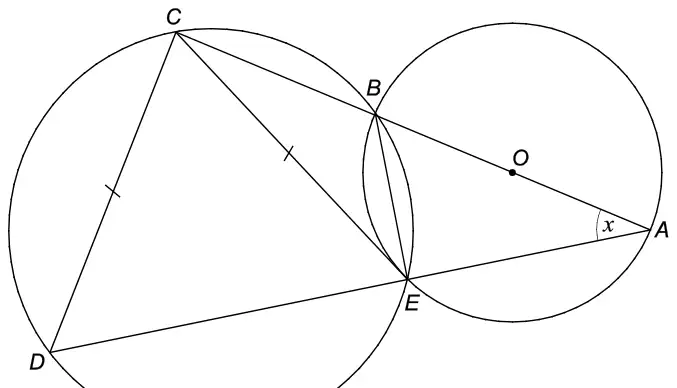
Not drawn accurately
(a) Give a reason why angle \(BEA = 90^\circ\) [1 mark]
(b) Prove that angle \(DCE = 2x\) [4 marks]
| Answer | Mark | Comments |
|---|---|---|
| Angle in a semicircle (is a right angle) or Angle at centre is \(180^\circ\), angle at circumference is half the angle at the centre (\(= 90^\circ\)) or Angle at centre is \(180^\circ\), angle at centre is twice the angle at the circumference or Angle subtended at circumference by a diameter | B1 |
Additional guidance
| Do not allow half a circle to mean a semicircle | |
| Allow extra words if not contradictory eg1 Angle at the circumference in a semicircle eg2 Angle inscribed in a semicircle | B1 B1 |
| Angle subtended by a diameter (no mention of at circumference) | B0 |
| Angle in a hemisphere is 90 | B0 |
| Angle at centre is 180 | B0 |
| Angle at circumference is half the angle at the centre | B0 |
| 2 chords on diameter meet at 90 | B0 |
| Triangle in a semicircle always has a right angle | B0 |
| Angle in a semicircle is 180 | B0 |
| Angle on a diameter is a right angle | B0 |
| Because \(AB\) is a diameter | B0 |
| Answer | Mark | Comments |
|---|---|---|
| angle \(ABE = 90 - x\) or angle \(CBE = 90 + x\) or angle \(DEB = 90\) and angle \(DCB = 90\) | B1 | |
| angle \(CDE = 90 - x\) | B1dep | |
| angle \(CED = 90 - x\) | B1dep | |
| angle \(DCE = 2x\) and all reasons given for their proof | B1dep | See guidance for acceptable wording for reasons |
Additional guidance
| To award a particular mark, all previous marks must have been awarded | |
| First three B marks can be awarded with no or incorrect reasons | |
| Do not mark any working on the diagram – statements are needed | |
| Incorrect angles score B0 eg1 angle \(ABE = 90 - x \quad\) angle \(DEC = 90 + x\) eg2 angle \(ABE = 90 - x \quad\) angle \(CDE = 90 - x \quad\) angle \(DCE = 90 + x\) | B1B0B0B0 B1B1B0B0 |
| Angle \(CDE\) and angle \(CDA\) are the same angle etc | |
| Angle \(EBA\) and angle \(ABE\) are the same angle etc | |
| Condone \(ABE\) for angle \(ABE\) etc | |
| Do not allow angle \(C\) for angle \(DCE\) etc | |
| \(CE\) must be proven to be a tangent if used in a response | |
| Reasons angle sum of triangle (is 180°) or angles in a triangle (add to 180°) or 180° in a triangle (adjacent) angles on a (straight) line (add to 180°) or 180° on a (straight) line exterior angle of triangle (= sum of opposite interior angles) (equal angles in an) isosceles (triangle) or \(CD = CE\) (opposite angles in a) cyclic quadrilateral (add to 180°) exterior angle of cyclic quadrilateral (= opposite interior angle) | Degrees symbol may be omitted Abbreviations are allowed eg quad for quadrilateral |