
June 2019 Paper 2 Q20
20 \(A\), \(B\), \(C\) and \(D\) are points on a circle.
\(D\), \(E\) and \(F\) are points on a different circle, centre \(C\).
\(DCE\), \(ADF\) and \(BCF\) are straight lines.
angle \(DEF = x\)
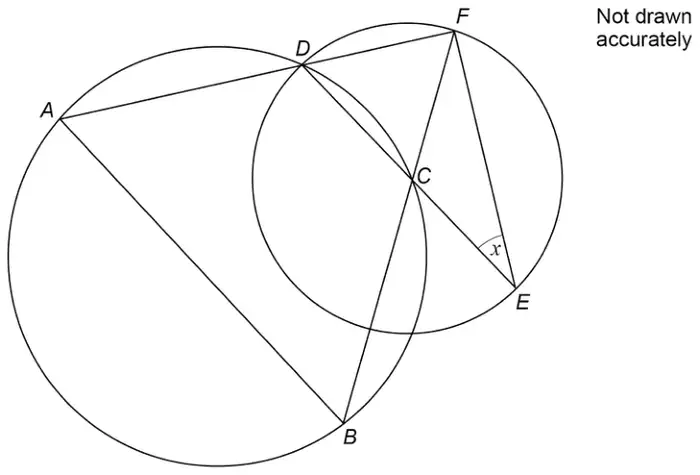
(a) Prove that \(\quad\) angle \(BAD = 2x\) [3 marks]
(b) In the case when \(AB\) is parallel to \(DE\), work out the size of angle \(x\). [2 marks]
| Answer | Mark | Comments |
|---|---|---|
| Alternative method 1 | ||
| Full method leading to angle \(BCD = 180 - 2x\) | M1 | eg angle \(CFE = x\) and angle \(FCE = 180 - 2x\) and angle \(BCD = 180 - 2x\) |
| Full reasoning for their method | A1 | eg (base angles of) isosceles (triangle are equal) and (sum of) angles in a triangle (is 180) and (vertically) opposite angles |
| angle \(BAD = 2x\) and (opposite angles of) cyclic quadrilateral (add to 180) | A1 | must see M1 |
| Alternative method 2 Working out angle \(DCF\) using angle at centre | ||
| angle \(DCF = 2x\) | M1 | |
| angle at centre (is double angle at circumference) | A1 | |
| Full method leading to angle \(BAD = 2x\) and full reasoning for their method | A1 | must see M1 eg angle \(BCD = 180 - 2x\) and angle \(BAD = 2x\) and angles on a (straight) line (add to 180) and (opposite angles of) cyclic quadrilateral (add to 180) |
| Alternative method 3 Working out angle \(DCF\) not using angle at centre | ||
| Full method leading to angle \(DCF = 2x\) | M1 | eg angle \(CFE = x\) and angle \(DCF = 2x\) |
| Full reasoning for their method | A1 | eg (base angles of) isosceles (triangle are equal) and exterior angle (of triangle is sum of interior opposite angles) |
| Full method leading to angle \(BAD = 2x\) and full reasoning for their method | A1 | must see M1 eg angle \(BCD = 180 - 2x\) and angle \(BAD = 2x\) and angles on a (straight) line (add to 180) and (opposite angles of) cyclic quadrilateral (add to 180) |
| Alternative method 4 | ||
| Full method leading to angle \(DFC = 90 - x\) and angle \(ABC = 90 - x\) | M1 | eg angle \(CFE = x\) and angle \(DFE = 90\) and angle \(DFC = 90 - x\) and angle \(CDF = 90 - x\) and angle \(ADC = 90 + x\) and angle \(ABC = 90 - x\) |
| Full reasoning for their method | A1 | eg (base angles of) isosceles (triangle are equal) and (angle in a) semicircle (is 90) and (sum of) angles in a triangle (is 180) and angles on a (straight) line (add to 180) and (opposite angles of) cyclic quadrilateral (add to 180) |
| angle \(BAD = 2x\) and (sum of) angles in a triangle (is 180) | A1 | must see M1 |
Additional guidance
| It is possible to score M1A1A0 or M1A0A1 | |
| Do not award any marks from angles on the diagram | |
| Angles must be stated unambiguously eg condone angle \(B\) but do not condone angle \(D\) | |
| ‘angle’ may be missing or replaced by a symbol - mark intention | |
| angle \(CFE\) may be seen as angle \(EFC\) or angle \(BFE\) etc | |
| For (base angles of) isosceles (triangle are equal) allow radii (are equal) | |
| For (sum of) angles in a triangle (is 180) allow triangle is 180 | |
| Use judgement when considering wording of reasons and allow abbreviations | |
| Alt 2 Final A1 reason may be exterior angle of cyclic quadrilateral (equals interior opposite angle) | |
| Choose the scheme that favours the student | |
| Ignore angles that are not needed for their scheme even if incorrect | |
| Allow recovery of missing brackets | |
| Starting with angle \(BAD = 2x\) | M0A0A0 |
| Answer | Mark | Comments |
|---|---|---|
| 30 | B2 | B1 correct equation or calculation eg \(90 + 2x + x = 180\) or \(90 - x = 2x\) or \(3x = 90\) or \(6x = 180\) or \(90 \div 3\) |
Additional guidance
| Ignore any expressions for angles and any other calculated angles | |
| Ignore any reasons |