
Higher November 2019 Unit 1 Q10
10. In this question, you will be assessed on the quality of your organisation, communication and accuracy in writing.
The diagrams below show a solid cone and a solid hemisphere.
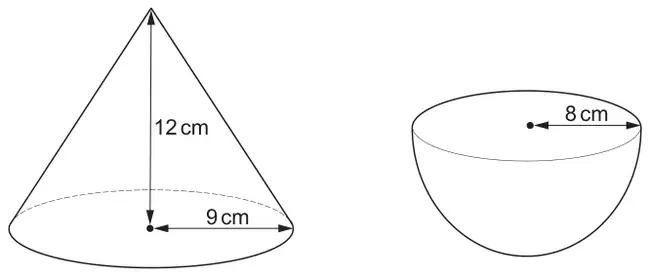
Diagrams not drawn to scale
The cone has a base radius of 9 cm and a vertical height of 12 cm.
The hemisphere has a radius of 8 cm.
Which of the two solids has the greater curved surface area?
You should express any areas in terms of \(\pi\).
You must show all your working. [7 + 2 OCW]
From the formula list: Surface area of sphere \(= 4\pi r^2\); Curved surface area of cone \(= \pi r l\)
| Scheme | Marks | Comments |
|---|---|---|
| (Slant height of cone =) \(\sqrt{(12^2 + 9^2)}\) | M1 | Method for finding hypotenuse. Accept use of (3,4,5) x 3. |
| = 15 (cm) | A1 | |
| (Curved surface area of cone =) \(\pi \times 9 \times 15\) | M1 | F.T. ‘their derived slant height’ (not 12). |
| \(= 135\,\pi\) (cm2) | A1 | ISW. [For reference, \(135\,\pi\) = 423.9] SC1 for an answer of \(108\,\pi\) (cm2) [= 339.1(2)] (from taking 12 cm as the slant height) An answer of \(216\,\pi\) (cm2) [= 678.2(4)] (from including area of circle) gains M1 A1 SC1 |
| (Curved surface area of hemisphere =) ½ × (4 × \(\pi\) × 82) or equivalent | M1 | |
| \(= 128\,\pi\) (cm2) | A1 | ISW. [\(128\,\pi\) = 401.9(2)] SC1 for an answer of \(256\,\pi\) (cm2) [= 803.8(4)] (from omitting ½) or for an answer of \(192\,\pi\) (cm2) [= 602.8(8)] (from including area of circle). Penalise -1 once only if any A or SC marks have previously been awarded for (correct) decimal answers. |
| Cone (has the greater curved surface area) | B1 | Do not accept an unsupported statement. F.T. ‘their areas’ provided at least M1 or SC1 awarded for each solid (regardless of any penalty for decimal answers). (For the cone, either M1 mark can contribute to this FT.) |
| Organisation and Communication. | OC1 | For OC1, candidates will be expected to:
|
| Accuracy of writing. | W1 | For W1, candidates will be expected to:
|