
Numeracy Higher June 2023 Unit 2 Q10
10.
Evan’s room, in the roof space of his house, has a uniform triangular cross-section.
The uniform cross-section is shown below.
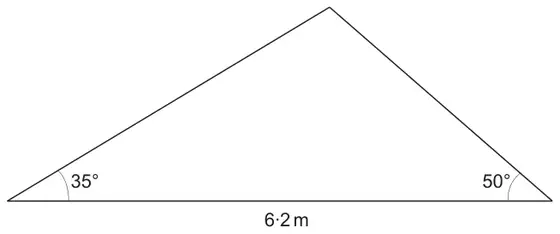
Diagram not drawn to scale
The room is 8 m long.
Calculate the volume of the room. [7]
Evan decides to add a symmetrical roof structure to bring light into the room.
The diagrams below show a simple design for this roof structure.
In the diagram below, \(AB\) = 3 m, \(DC\) = \(EF\) = 2 m and \(ED\) = \(FC\) = 2·4 m.
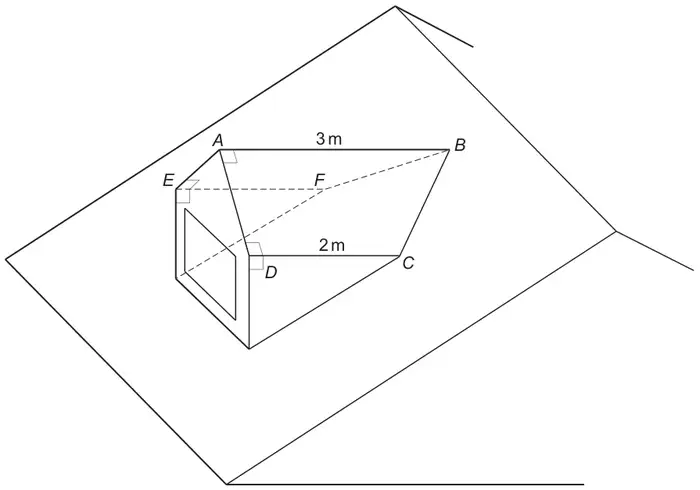
Diagram not drawn to scale
The width of the structure is 2·4 m and the vertical height from \(ED\) to \(A\) is 0·7 m.
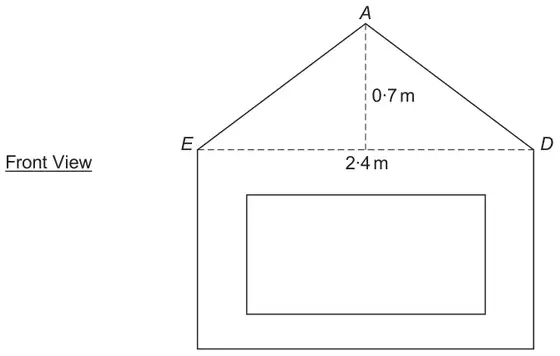
Diagram not drawn to scale
Evan will need to put strips of lead from \(B\) to \(C\) and from \(B\) to \(F\).
This is to ensure rainwater does not enter the room.
Calculate the total length of lead that Evan will need. [5]
The roof of the structure is to be tiled.
For the top edge, Evan has chosen to use half-round clay tiles.
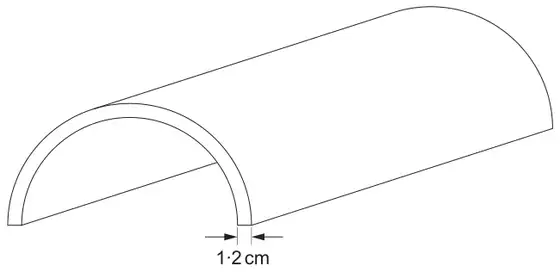
The cross-section of a tile is shown below.
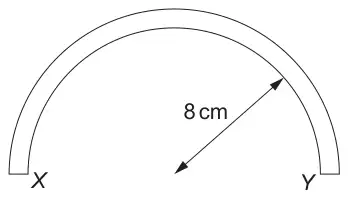
Diagrams not drawn to scale
The length of each tile is 30 cm.
\(XY\) is a semi-circular arc of radius 8 cm.
Each tile has a uniform thickness of 1·2 cm.
The tile manufacturer covers all 6 surfaces of each tile with a protective glaze.
Calculate the total surface area of one tile that is glazed. [5]
Evan has bought roof tiles for the structure from Tuff Tiles.
Tuff Tiles makes 2000 of these roof tiles every hour.
They randomly sample some of these 2000 tiles to check their quality.
Use the following list of random numbers to select the first 7 tiles for the sample.
You must start with the first number in the list, explaining clearly how you are using the numbers to select the sample. [3]
| 3205 | 2002 | 1924 | 1521 | 2735 | 1205 |
| 0114 | 9533 | 9507 | 3969 | 4941 | 1521 |
| 8377 | 1098 | 3473 | 0769 | 1003 | 5421 |
| 5533 | 4788 | 1003 | 6432 | 5630 | 2483 |
The tiles selected will be
………… ………… ………… ………… ………… ………… …………
From the formula list: Volume of prism = area of cross-section × length; In any triangle \(ABC\): Sine rule \(\dfrac{a}{\sin A} = \dfrac{b}{\sin B} = \dfrac{c}{\sin C}\); Area of triangle \(= \dfrac{1}{2}ab\sin C\)
| Scheme | Marks | Comments |
|---|---|---|
| Strategy of attempting to use the sine rule followed by 0.5absinC or right-angled trigonometry | S1 | |
| (left side =) \(\dfrac{6.2 \times \sin 50}{\sin(180-50-35)}\) or \(\dfrac{6.2}{\sin 95} \times \sin 50\) | M2 | M1 for \(\dfrac{\text{left side}}{\sin 50} = \dfrac{6.2}{\sin(180-50-35)}\) or equivalent |
| = 4.76(…) or 4.77 or 4.8 (m) | A1 | |
| (Area of triangle =) \(\dfrac{1}{2}\) × 4.76(…) × 6.2 × sin35 | M1 | FT ‘their 4.76(…)’ provided sine rule attempted Note: This calculation may come from use of right-angled trigonometry to find height = 4.76(…) x sin35 and then use of ½ × base × height |
| = 8.44 to 8.56 (m\(^{2}\)) | A1 | |
| (Volume of room =) 67.5 to 68.5 (m\(^{3}\)) | B1 | FT ‘their 8.44 to 8.56’ × 8 provided at least M1M1 (not M2M0) previously awarded |
Alternative
10(a) Alternative method 1:
| Scheme | Marks | Comments |
|---|---|---|
| Strategy of attempting to use the sine rule followed by 0.5absinC or right-angled trigonometry | S1 | |
| (right side =) \(\dfrac{6.2 \times \sin 35}{\sin(180-50-35)}\) or \(\dfrac{6.2}{\sin 95} \times \sin 35\) | M2 | M1 for \(\dfrac{\text{right side}}{\sin 35} = \dfrac{6.2}{\sin(180-50-35)}\) |
| = 3.56(…) or 3.57 or 3.6 (m) | A1 | |
| (Area of triangle =) \(\dfrac{1}{2}\) × 3.56(…) × 6.2 × sin50 | M1 | FT ‘their 3.56(…)’ provided sine rule attempted Note: This calculation may come from use of right-angled trigonometry to find height = 3.56(…) x sin50 and then use of ½ × base × height |
| = 8.44 to 8.56 (m\(^{2}\)) | A1 | |
| (Volume of room =) 67.5 to 68.5 (m\(^{3}\)) | B1 | FT ‘their 8.44 to 8.56’ × 8 provided at least M1M1 (not M2M0) previously awarded |
Alternative
10(a) Alternative method 2:
| Scheme | Marks | Comments |
|---|---|---|
| Strategy of attempting to use the sine rule followed by 0.5absinC or right-angled trigonometry | S1 | |
| (left side =) \(\dfrac{6.2 \times \sin 50}{\sin(180-50-35)}\) or \(\dfrac{6.2}{\sin 95} \times \sin 50\) OR (right side =) \(\dfrac{6.2 \times \sin 35}{\sin(180-50-35)}\) or \(\dfrac{6.2}{\sin 95} \times \sin 35\) | M2 | M1 for \(\dfrac{\text{left side}}{\sin 50} = \dfrac{6.2}{\sin(180-50-35)}\) or equivalent OR M1 for \(\dfrac{\text{right side}}{\sin 35} = \dfrac{6.2}{\sin(180-50-35)}\) OR M1 for correct full method to calculate their 2nd side using sine or cosine rules following an incorrect method to initially calculate the left or right side |
| left side = 4.76(…) or 4.77 or 4.8 (m) AND right side = 3.56(…) or 3.57 or 3.6 (m) | A1 | |
| (Area of triangle =) \(\dfrac{1}{2}\) × 4.76(…) × 3.56(…) × sin95 | M1 | FT ‘their 4.76(…)’ AND ‘their 3.56(…)’ AND ‘their 95’ provided sine rule attempted twice or the sine rule followed by the cosine rule attempted |
| = 8.44 to 8.61 (m\(^{2}\)) | A1 | |
| (Volume of room =) 67.5 to 68.5 (m\(^{3}\)) | B1 | FT ‘their 8.44 to 8.5625’ × 8 provided at least M1M1 (not M2M0) previously awarded Note: An area of e.g. 8.61 leads to a volume of 68.88 which is outside the acceptable range and is B0 |
| Scheme | Marks | Comments |
|---|---|---|
| (i) Strategy of attempting to use 3D Pythagoras | S1 | Must be for carrying through an initial Pythagoras step from one plane into a second plane |
| 1\(^{2}\) + 0.7\(^{2}\) OR 1\(^{2}\) + 1.2\(^{2}\) OR 0.7\(^{2}\) + 1.2\(^{2}\) or \(\sqrt{1^2 + 0.7^2}\) OR \(\sqrt{1^2 + 1.2^2}\) OR \(\sqrt{0.7^2 + 1.2^2}\) (=1.22…) (=1.56…) (=1.389…) | M1 | FT ‘their 2.4 ÷ 2’ May be embedded in further working |
| (Total length of lead =) \(\sqrt{1^2 + 0.7^2 + 1.2^2}\) (×2) or (= \(\sqrt{2.93}\) (×2)) | M2 | Implies S1 and previous M1 Note: √2.93 = 1.71(1…) and may come from sight of \(\sqrt{1.93 + 1}\) or \(\sqrt{2.44 + 0\ .49}\) or \(\sqrt{1.49 + 1.44}\) M1 for 1\(^{2}\) + 0.7\(^{2}\) + 1.2\(^{2}\) or 1 + 0.49 + 1.44 |
| (Total length of lead needed =) 3.4 to 3.5 (m) | A1 | Do not accept answers outside this range that round to 3.4 or 3.5 i.e. needs to come from 2 × ( \(\sqrt{2.89}\) to \(\sqrt{3.0625}\) ) |
| (ii) (Area of a curved surface =) \(\boldsymbol{\pi}\) × 9.2 × 30 OR \(\boldsymbol{\pi}\) × 8 × 30 (= 866.6 to 867.2 or 276\(\boldsymbol{\pi}\) cm\(^{2}\)) (= 753.6 to 754.1 or 240\(\boldsymbol{\pi}\) cm\(^{2}\)) | B1 | Or equivalents. Do not award if they go on to multiply by another length creating a volume |
| (Area of a semicircular ring =) \(\dfrac{\boldsymbol{\pi} \times 9.2^2}{2} - \dfrac{\boldsymbol{\pi} \times 8^2}{2}\) or equivalent (= 32.4 to 32.43 or 10.3(2)\(\boldsymbol{\pi}\) cm\(^{2}\)) | B1 | May be implied by sight of double these values i.e. 64.8 to 64.86 or 20.6(4)\(\boldsymbol{\pi}\) Do not award if they go on to multiply by another length creating a volume |
| (Total surface area =) \(\boldsymbol{\pi}\times9.2\times30 + \boldsymbol{\pi}\times8\times30 + 1.2\times30 + 1.2\times30\) \(+ \left(\dfrac{\boldsymbol{\pi}\times9.2^2}{2} - \dfrac{\boldsymbol{\pi}\times8^2}{2}\right) + \left(\dfrac{\boldsymbol{\pi}\times9.2^2}{2} - \dfrac{\boldsymbol{\pi}\times8^2}{2}\right)\) ( = (866.6 to 867.2) + (753.6 to 754.1) + 36 + 36 + (32.4 to 32.43) + (32.4 to 32.43)) | M2 | Must be 6 correct areas and no further incorrect areas added/subtracted M1 for the sum of 4 or 5 correct surface areas |
| = 1756.9 to 1758.3 (cm\(^{2}\)) | A1 | (Or 536.6(4)\(\boldsymbol{\pi}\) + 72) For an answer in this range only, and must come from M2 |
| Scheme | Marks | Comments |
|---|---|---|
| Statements required: | E2 | All 4 needed for E2 E1 for any 2 or 3 correct statements |
| • Number the tiles from 0001 to 2000 | Allow (000)1 to 2000 Allow an equivalent numbering system e.g. (000)0 to 1999 | |
| • Consider successive 4-digit numbers | Allow this statement to be implied by their numbering of the tiles (from 0001) AND their use of 4-digit numbers in their answer OR 4-digit numbers used in their answer and 0114 or 0769 seen | |
| • Do not use numbers outside the range | e.g. Do not use 0000 and 2001 – 9999, OR Use the numbers (000)1 to 2000 Do not allow ‘Use numbers less than 2000’ if they have numbered the tiles from 0001 to 2000 | |
| • Ignore repeats | ||
| (Working in rows would give tiles) 1924, 1521, 1205, (0)114, ISW, OR (Working in columns would give tiles) (0)114, 1098, 1924, 1003, 1521, (0)769, ISW | B1 | Allow in any order provided no repeats |
Alternative
10(c) Alternative method:
| Scheme | Marks | Comments |
|---|---|---|
| Statements required: | E2 | All 4 needed for E2 E1 for any 2 or 3 correct statements |
| • Number the tiles from 0001 to 2000 | Allow (000)1 to 2000 Allow an equivalent numbering system e.g. (000)0 to 1999 Their numbering system can be implied by the range of numbers they state they will choose from | |
| • Consider successive 4-digit numbers | Allow this statement to be implied by their numbering of the tiles (from 0001) AND their use of 4-digit numbers in their answer OR 4-digit numbers used in their answer and e.g. 0002, 0735 or 0114 seen | |
| • Divide each number by 2000 and use the remainder to choose a tile | 0000 or remainder of 0 means tile 2000 is chosen If (000)0 to 1999 is used, when the remainder is 0, tile 0000 is selected | |
| • Ignore repeats | ||
| (Working in rows would give tiles) 1205, (000)2, 1924, 1521, (0)735, ISW OR (Working in columns would give tiles) 1205,(0)114,(0)377, 1533, (000)2, ISW | B1 | Allow in any order provided no repeats |