
Higher June 2025 Paper 1 Q4
4. The shape below is a triangular prism with CD = 7 cm.
The cross-section of the prism is a right-angled triangle where AB = 6 cm and AC = 10 cm.
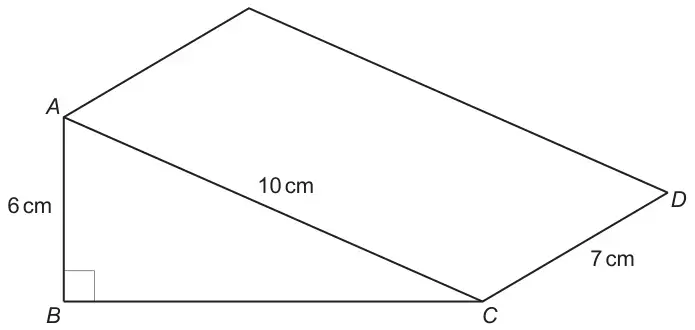
Diagram not drawn to scale
Calculate the total surface area of the triangular prism. [6]
| Scheme | Marks | Comments |
|---|---|---|
| \((BC =)\ \sqrt{10^2 - 6^2}\) or \(BC^2 = 10^2 - 6^2\) or better | M2 | M2 for appropriate sight of 6, 8, 10 M1 for any one of the following:
|
| \((BC =)\ 8\) (cm) | A1 | May be seen on diagram |
| (Surface area =) \((2\times\tfrac12\times)\ 8\times6 + 6\times7 + 8\times7 + 10\times7\) or \(8\times6 + (6+8+10)\times7\) oe \((= 2\times24 + 42 + 56 + 70)\) | M2 | M1 for a sum including 3 different correct calculations for areas ie omitting or miscalculating just one/both triangles or one rectangle FT for M2 or M1 provided Pythagoras attempted.
|
| 216 (cm2) | A1 | FT for ‘their surface area’ correctly evaluated, provided the second M2 awarded. |
| (6) |