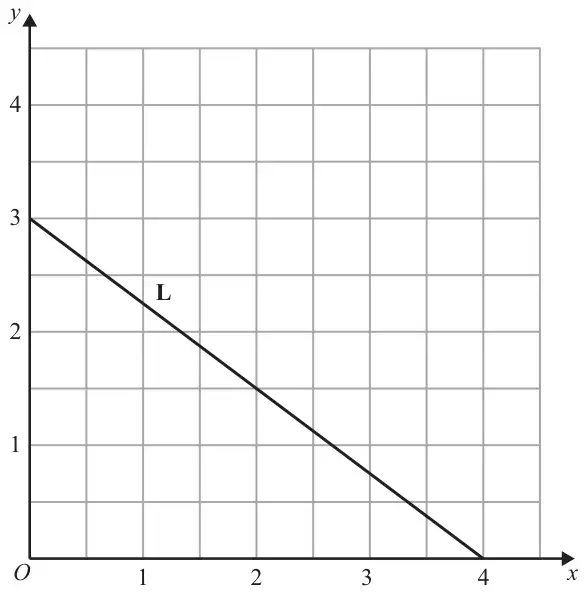
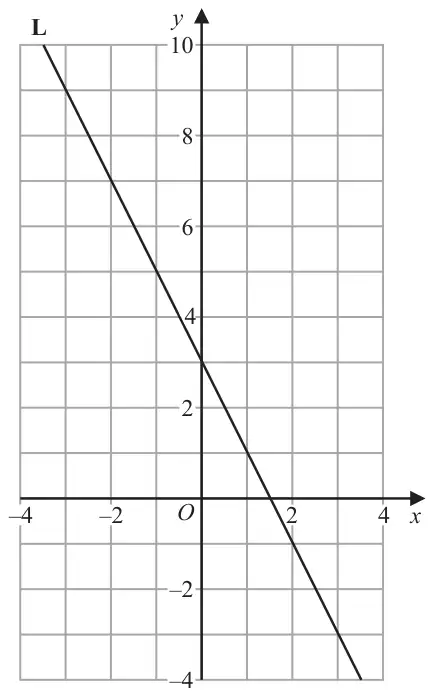
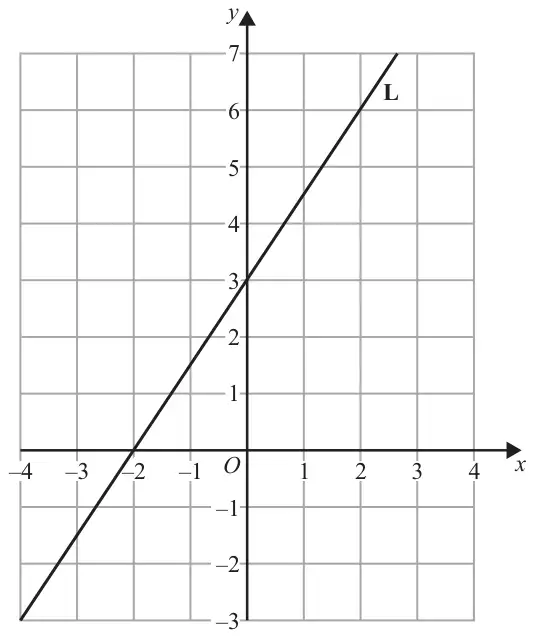
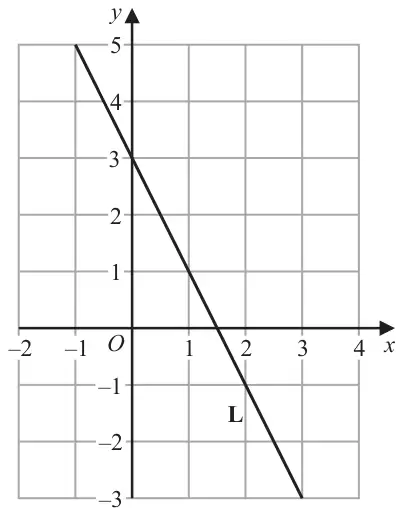
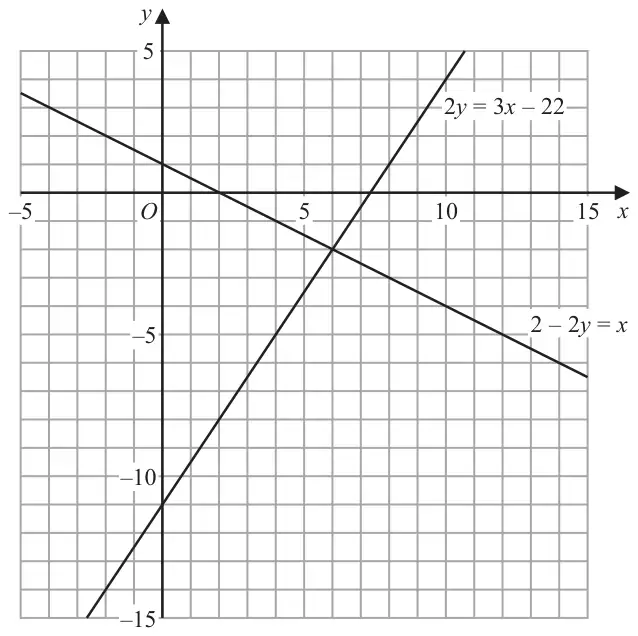
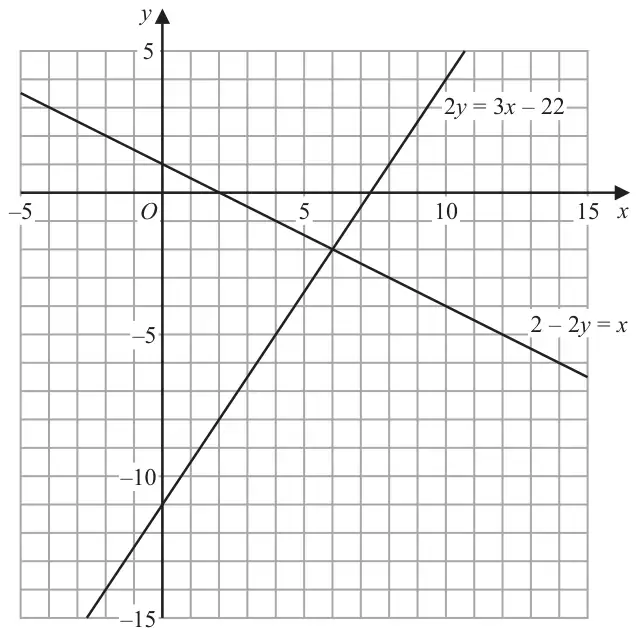
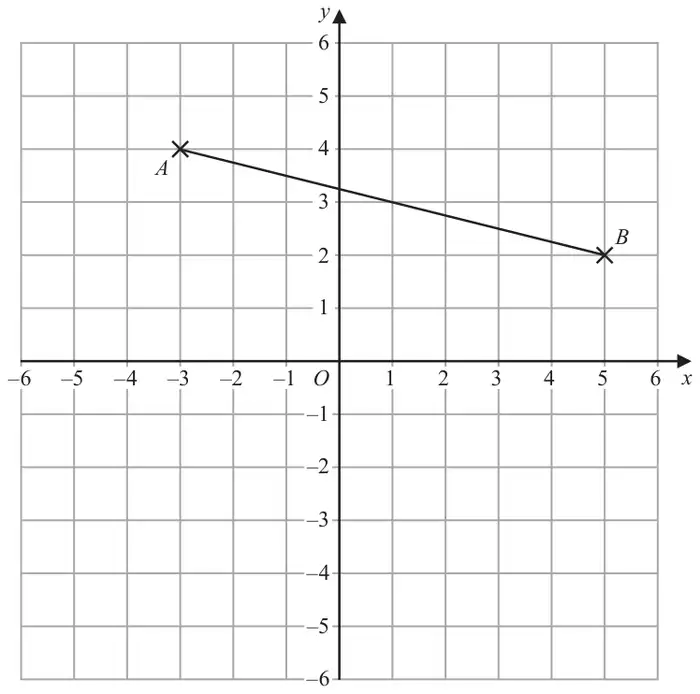
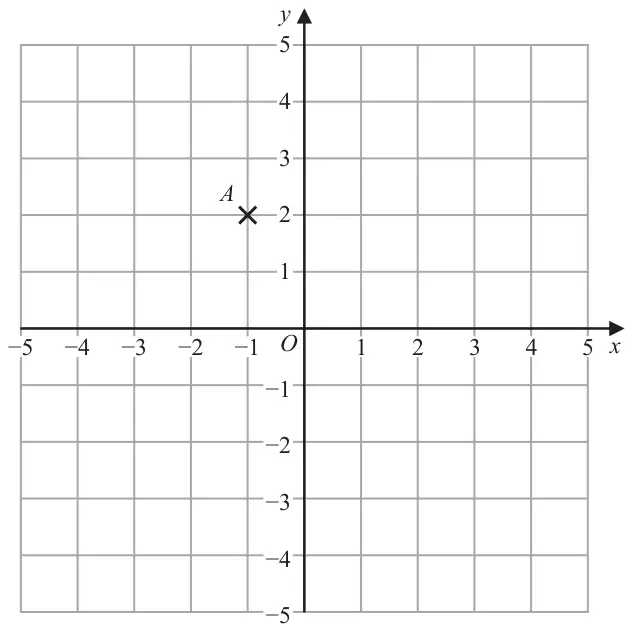
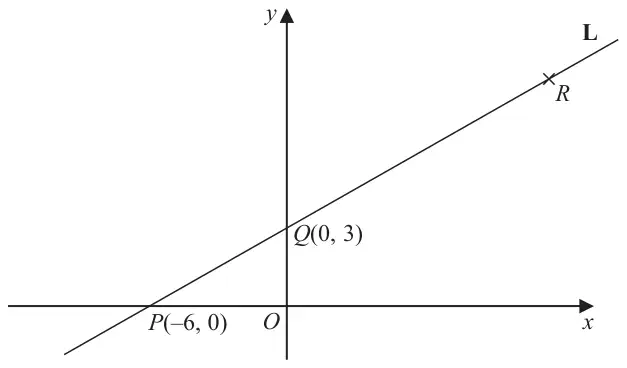
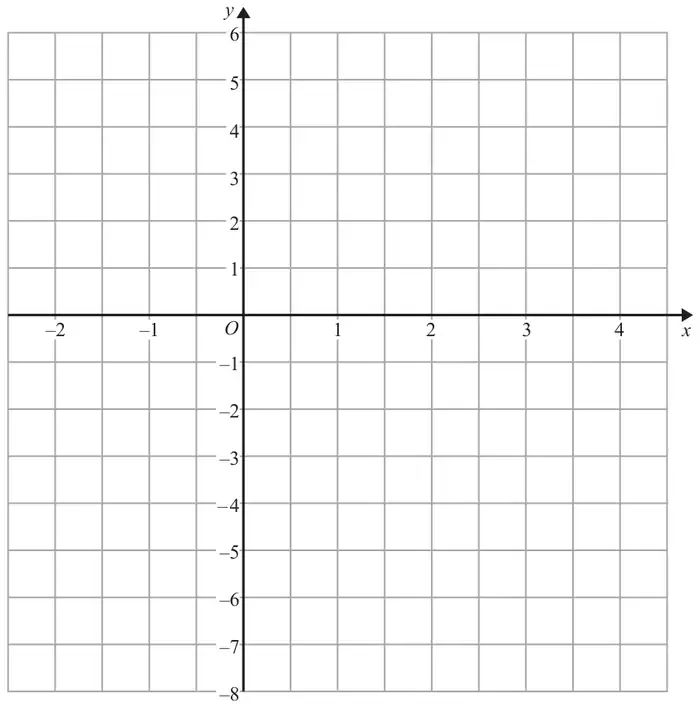
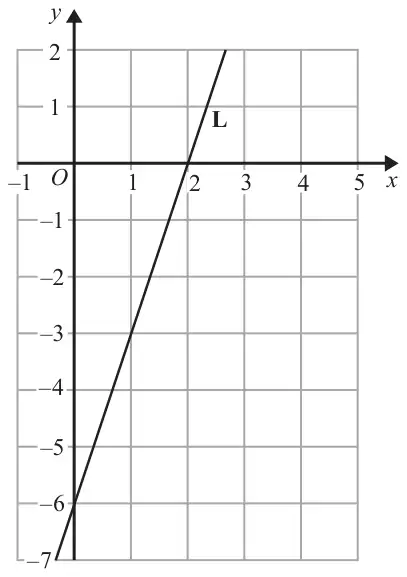
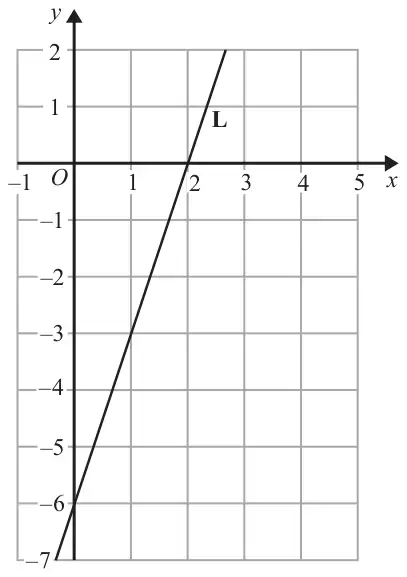
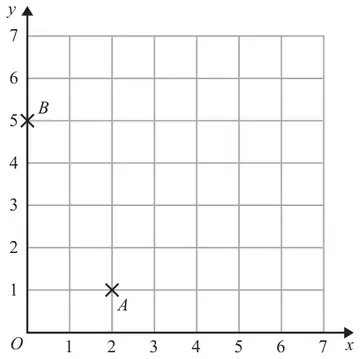
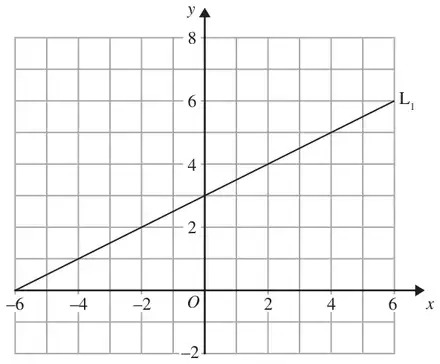
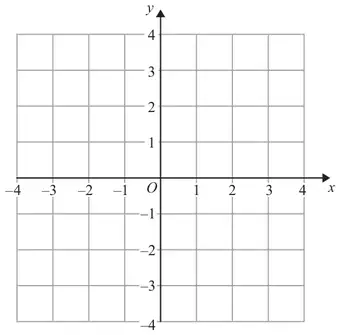
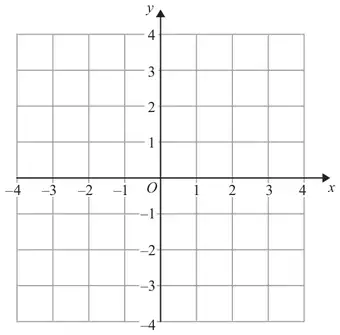
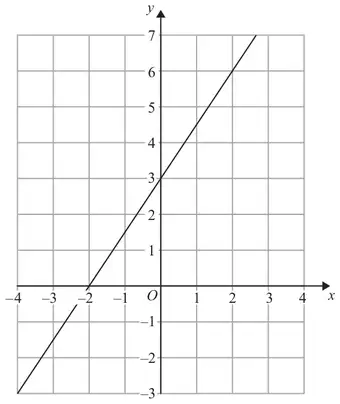
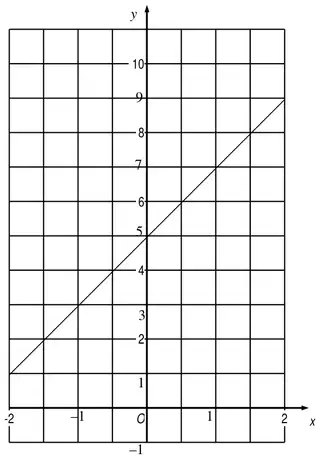
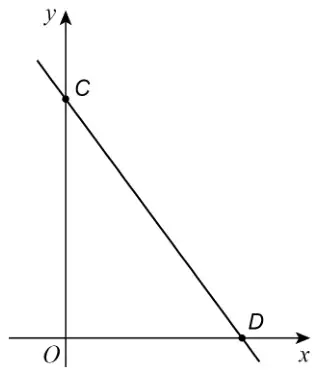
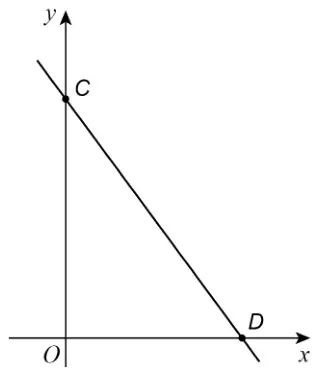
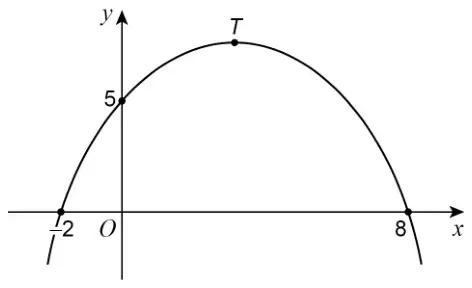
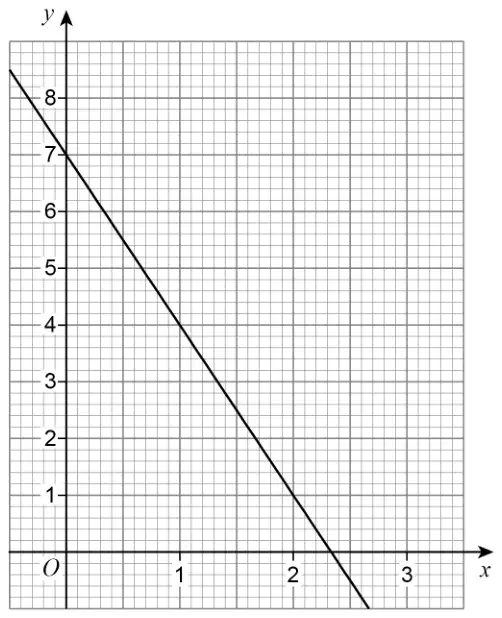
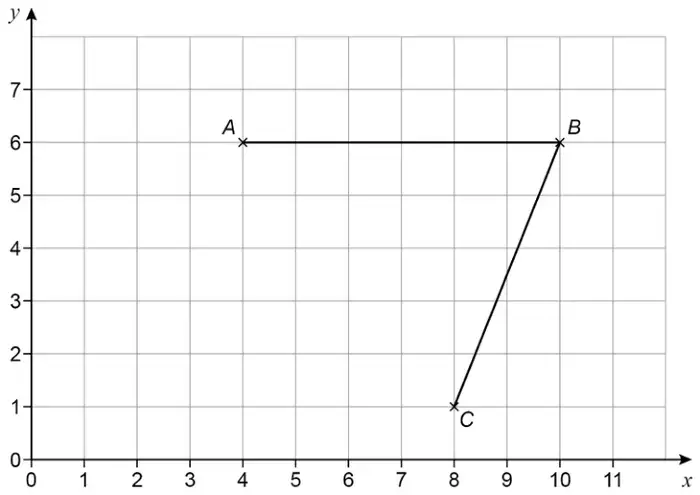
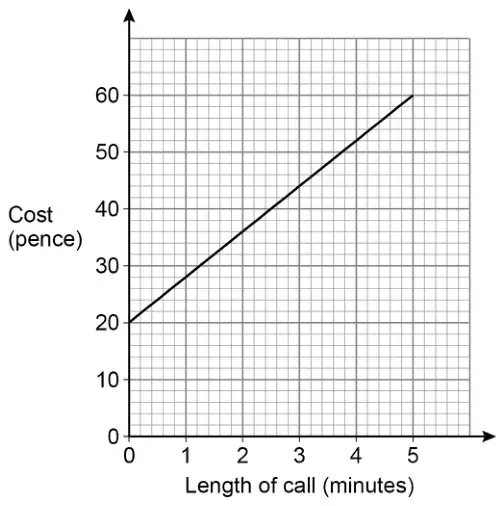
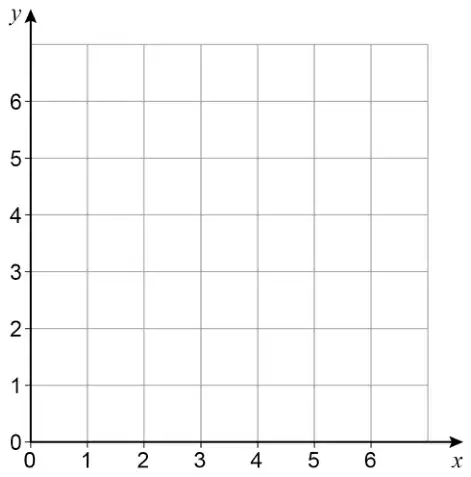
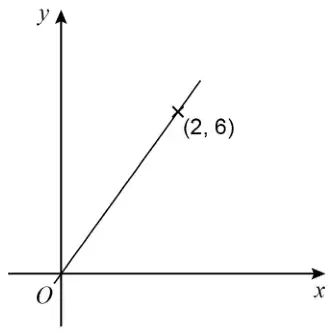
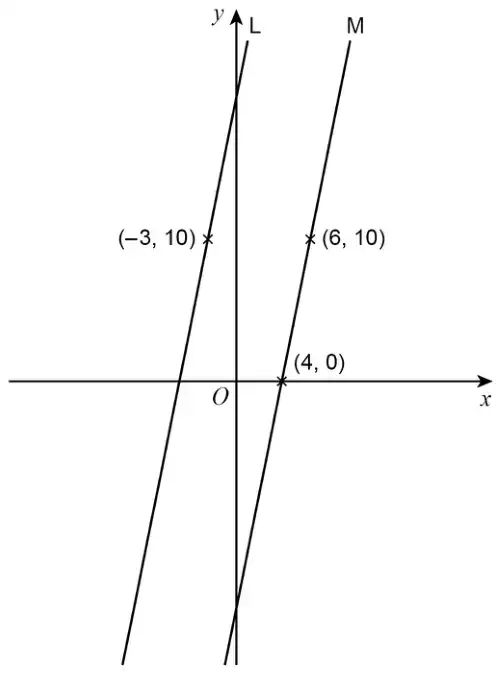
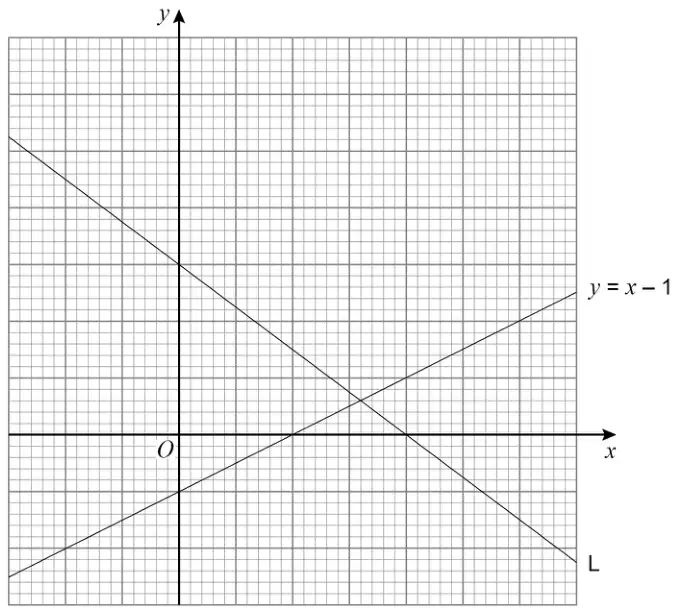
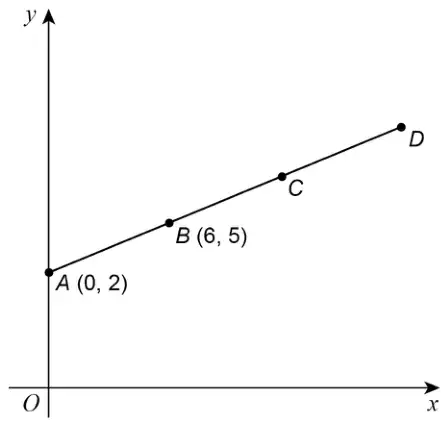
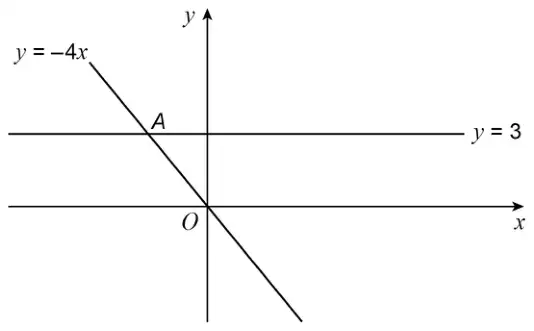
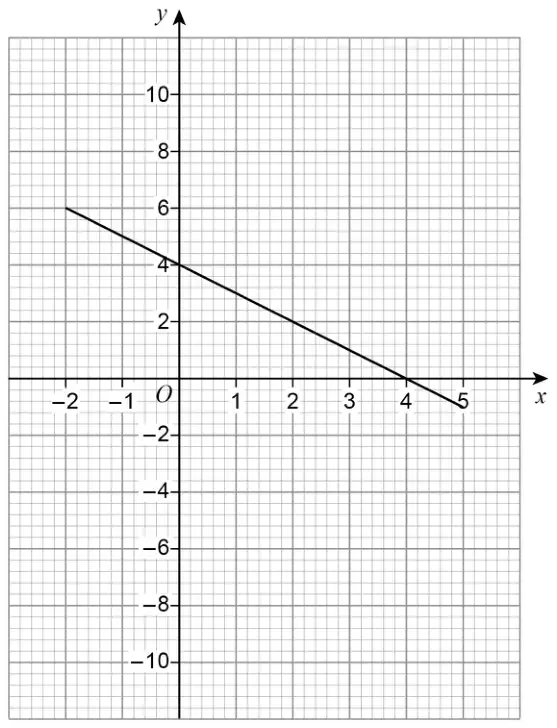
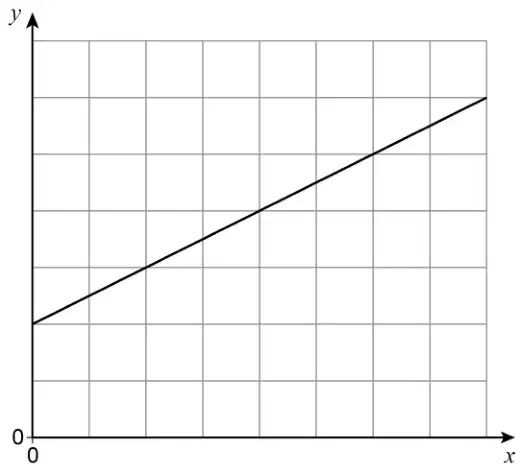
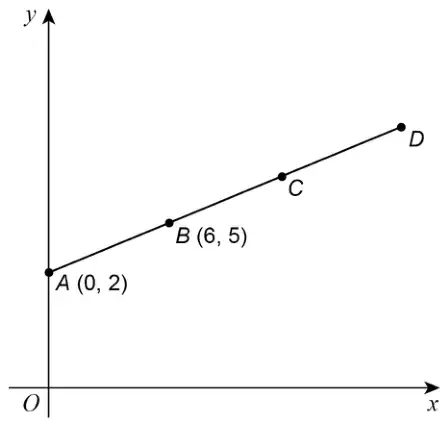
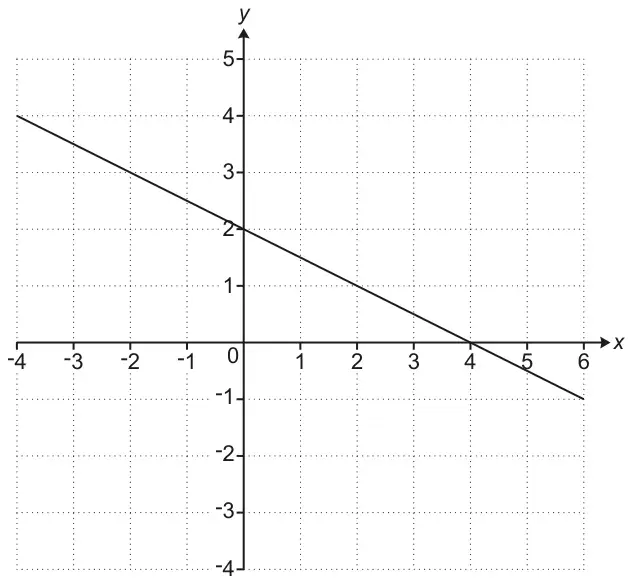
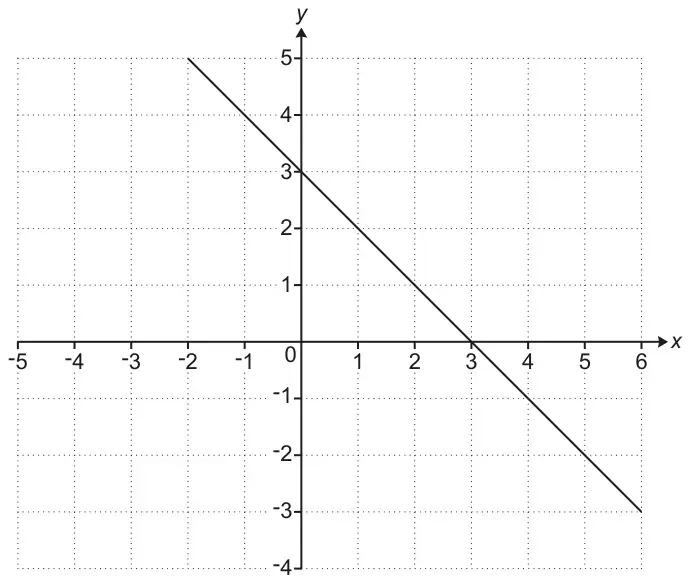
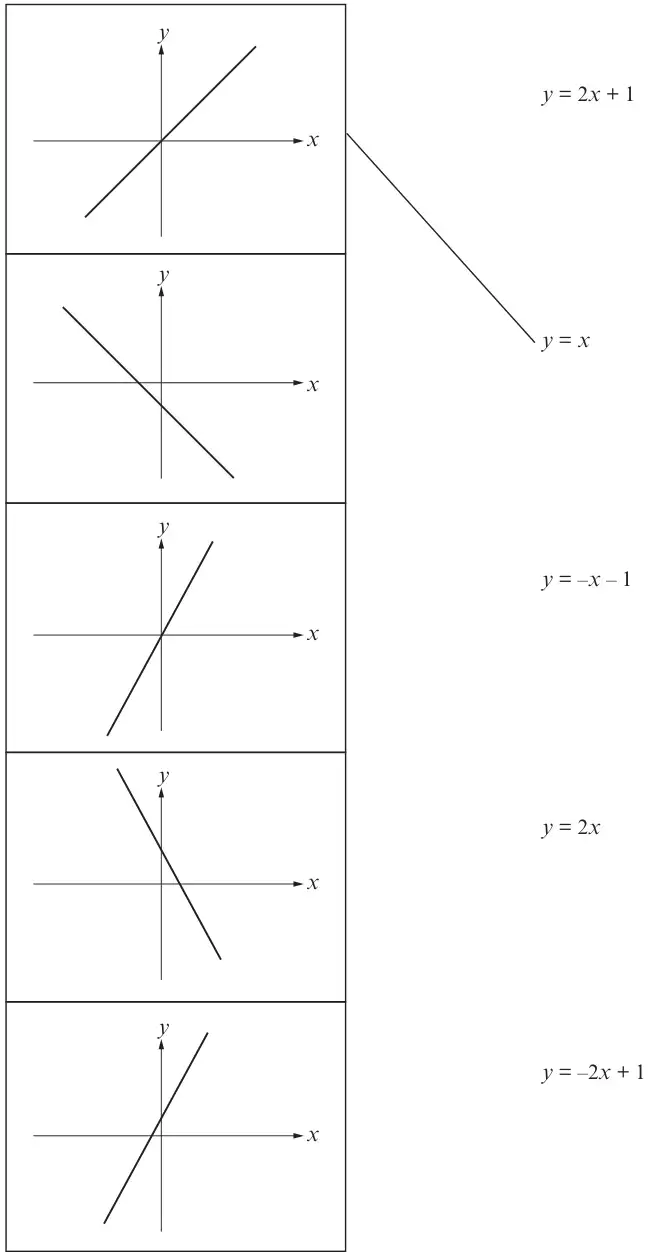
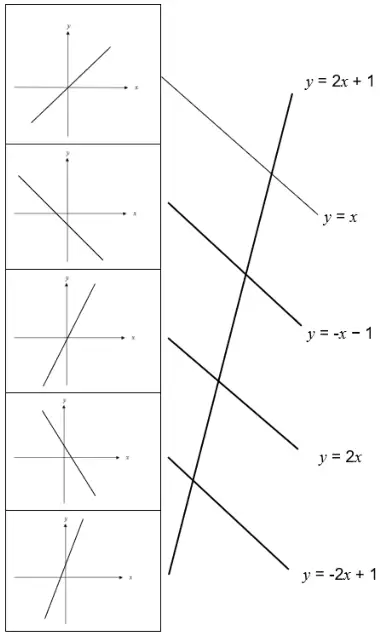
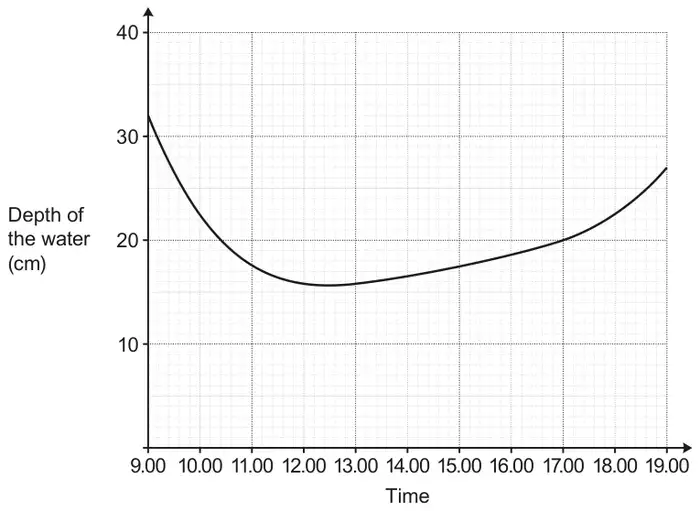
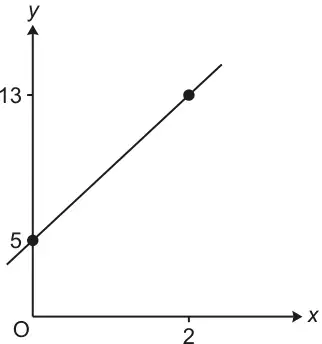
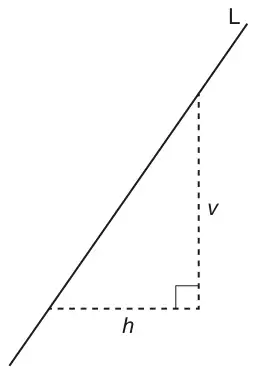
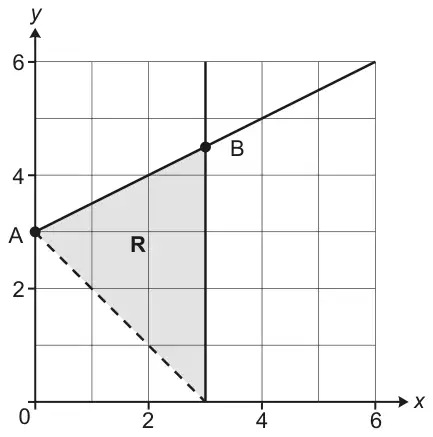
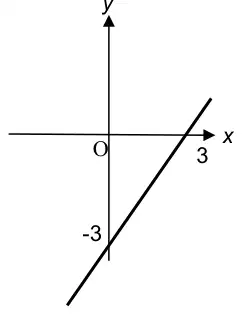
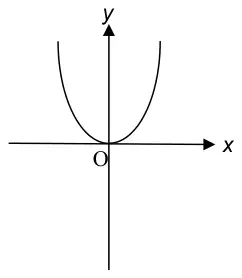
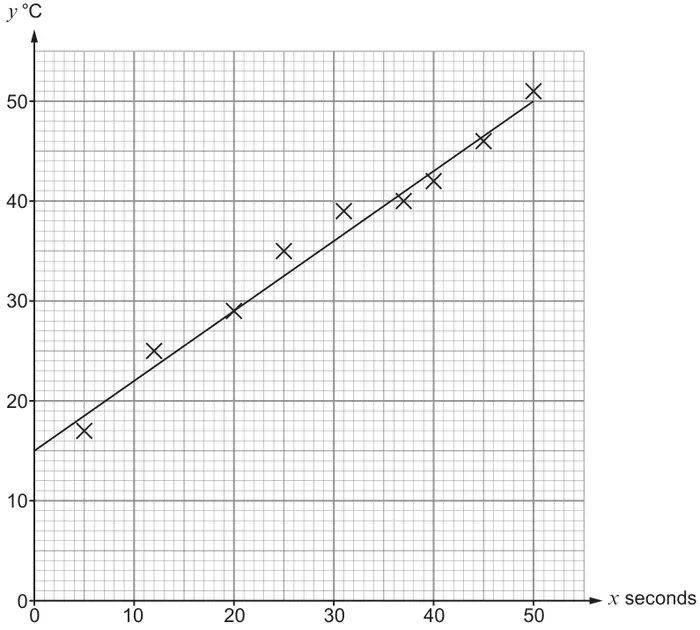
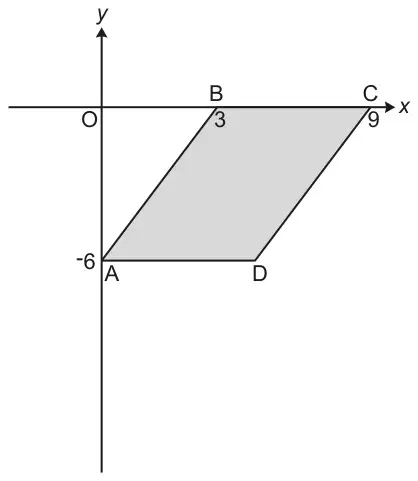
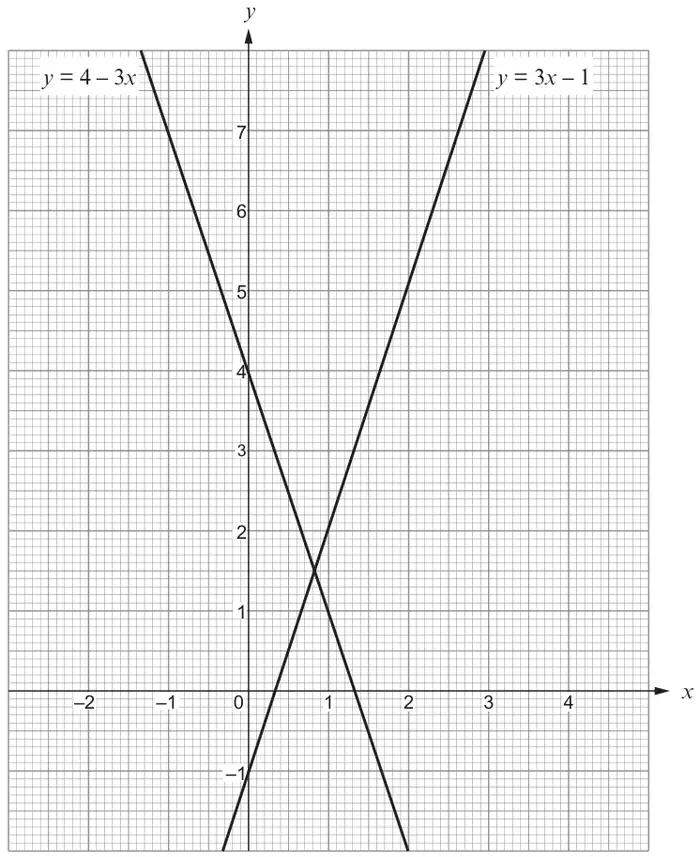
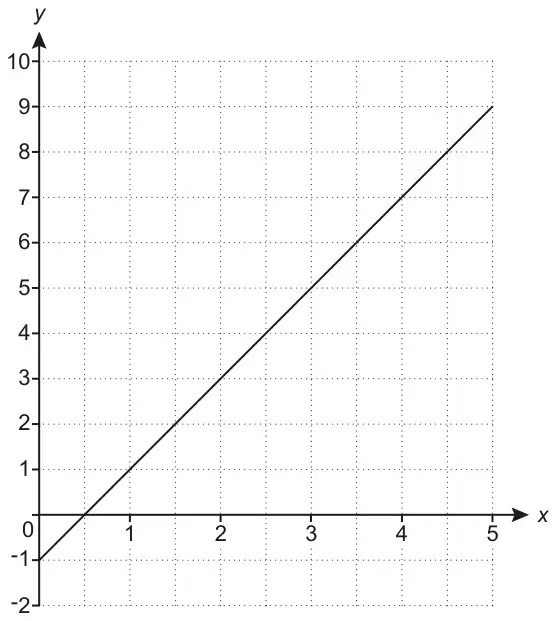
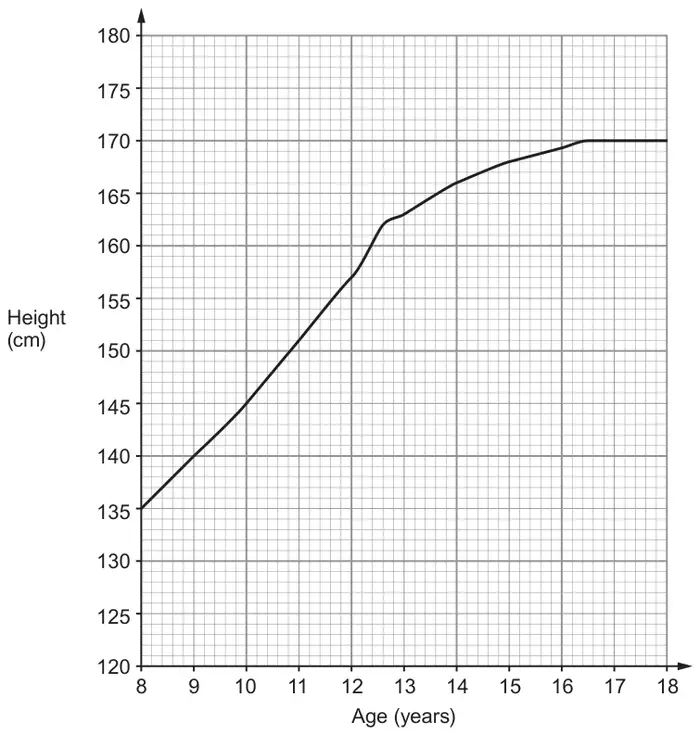
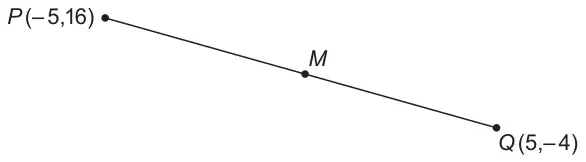
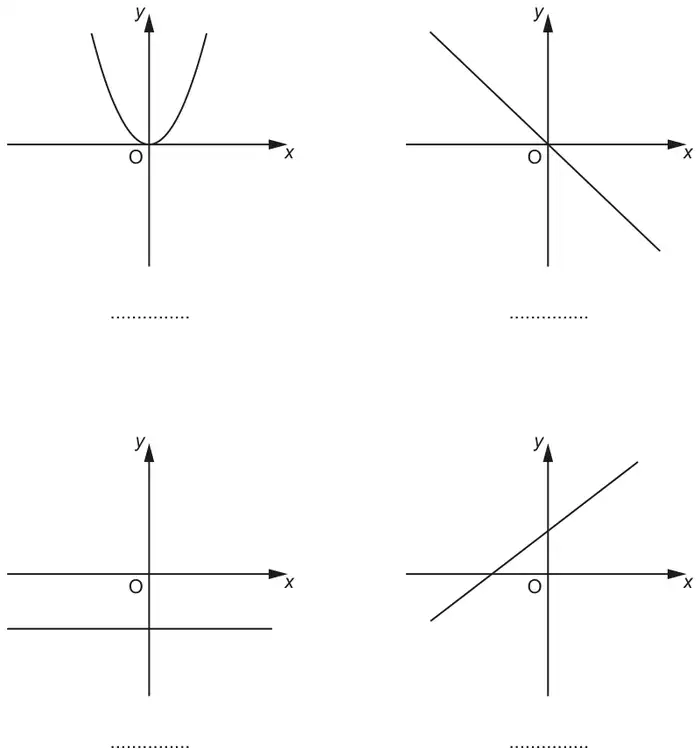
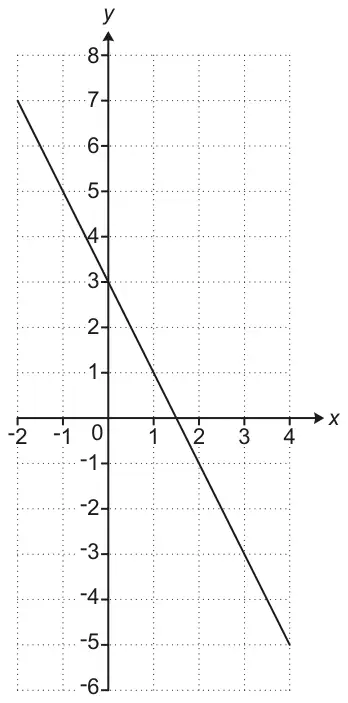
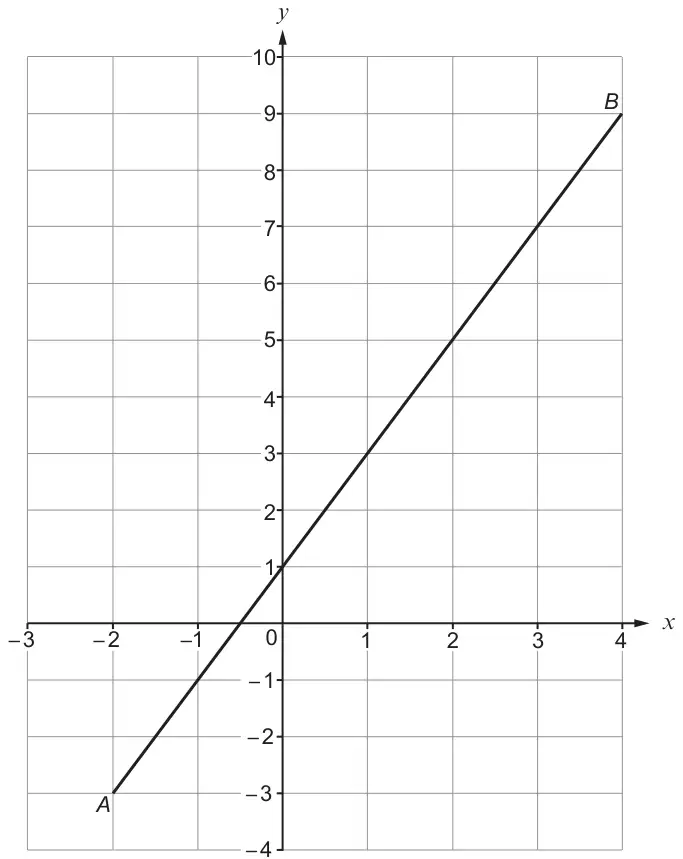
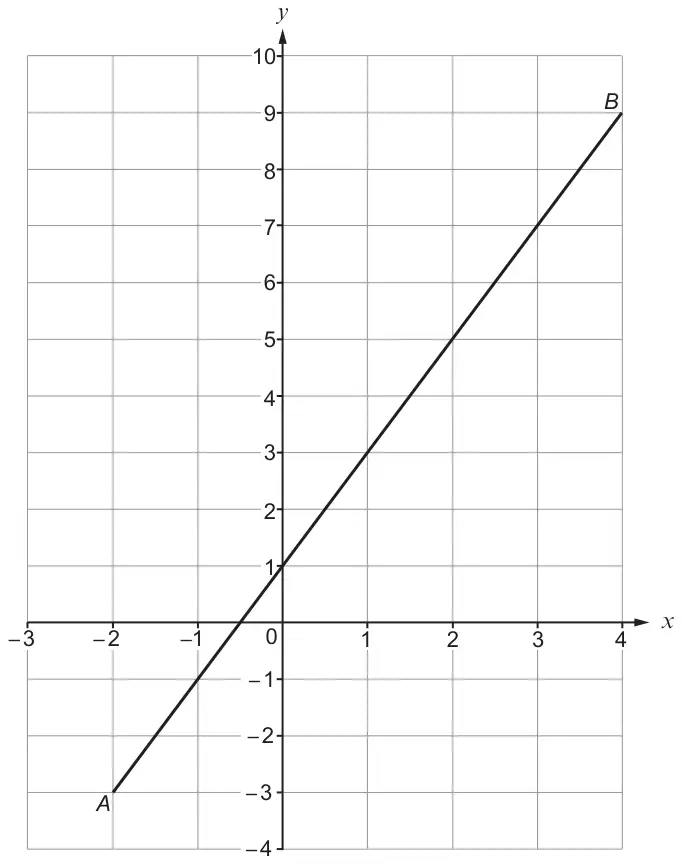
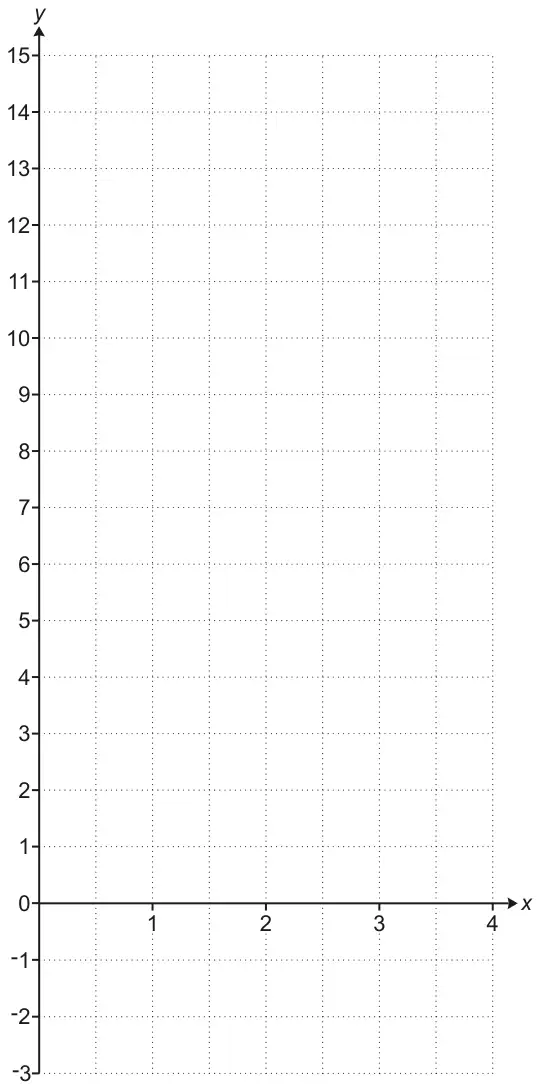
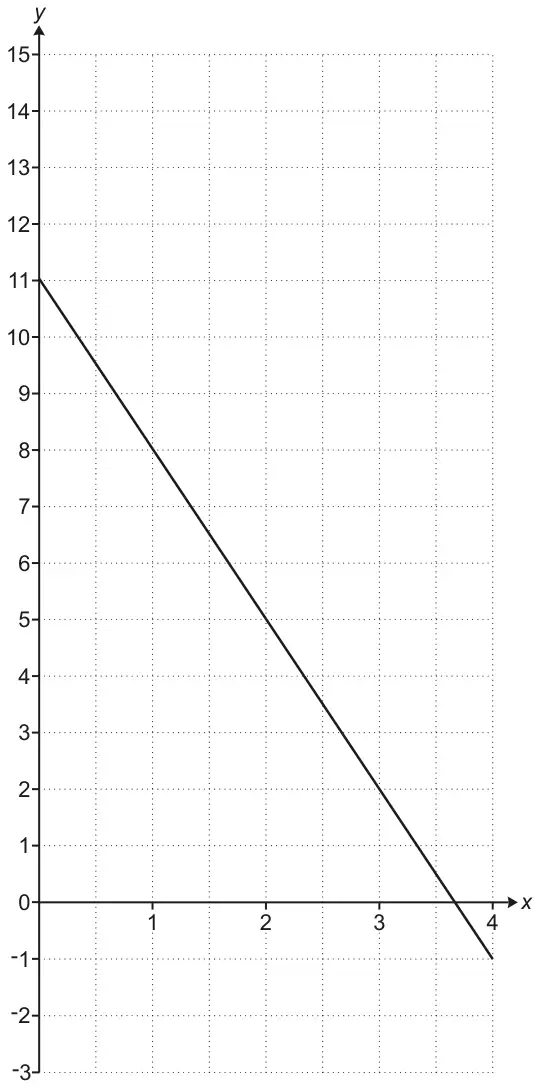
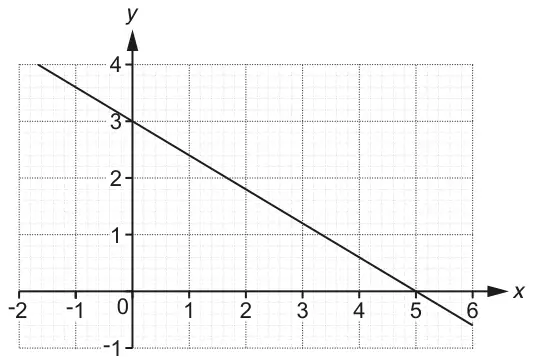
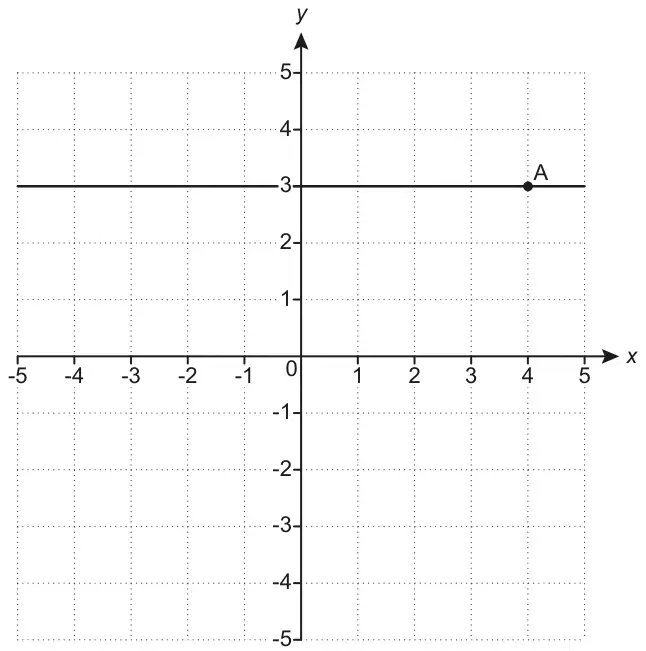
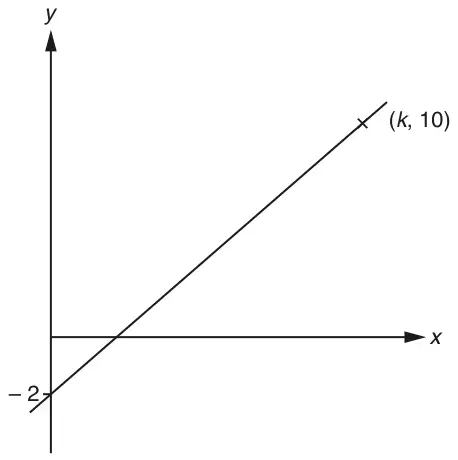
Find an equation for L. Give your answer in the form \(y = mx + c\) (3)
Mark scheme
Answer
Mark
Mark scheme
\(y = -\dfrac{3}{4}x + 3\)
M1
for a correct method to find the gradient of the line, eg \(\dfrac{3-0}{0-4}\ \left(= -\dfrac{3}{4}\right)\) or identifies 3 as the intercept in words or in a partial equation or for \(y = \left[-\dfrac{3}{4}\right]x + c\) or for \(y - b = \left[-\dfrac{3}{4}\right](x - a)\) where \((a, b)\) is a correct coordinate
M1
for \(y = -\dfrac{3}{4}x\ (+\ c)\) oe or for \(y = \text{``}{-}\dfrac{3}{4}\text{''}x + 3\), \(m \neq 0\) or (L =) \(-\dfrac{3}{4}x + 3\) or \(y - y_1 = -\dfrac{3}{4}(x - x_1)\) or \(y - b = \text{``}{-}\dfrac{3}{4}\text{''}(x - a)\) where \((a, b)\) is a correct coordinate or for an answer of \(y = \dfrac{3}{4}x + 3\) oe
A1
for \(y = -\dfrac{3}{4}x + 3\) oe provided the equation in the required form
Additional guidance
Just circling 3 is insufficient
\(\left[-\dfrac{3}{4}\right]\) must be identifiable as their gradient \(c\) must be seen either as a letter or a number
Allow eg \(y = 3 - \dfrac{3}{4}x\) A correct equation not in the required form scores M1M1A0
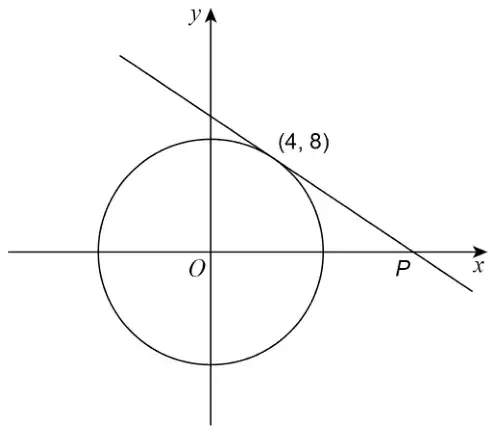
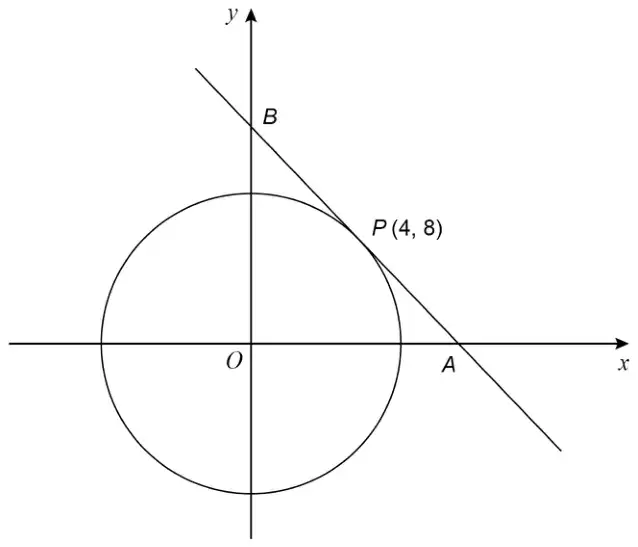
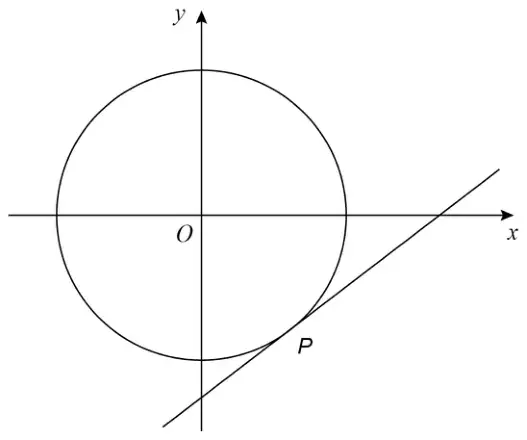
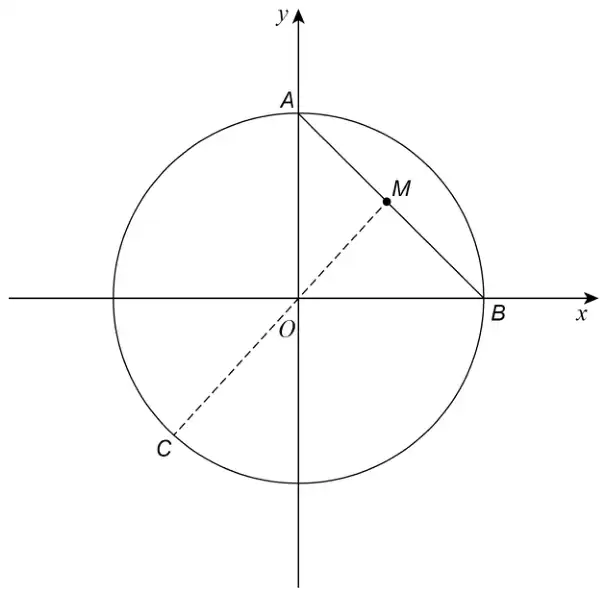
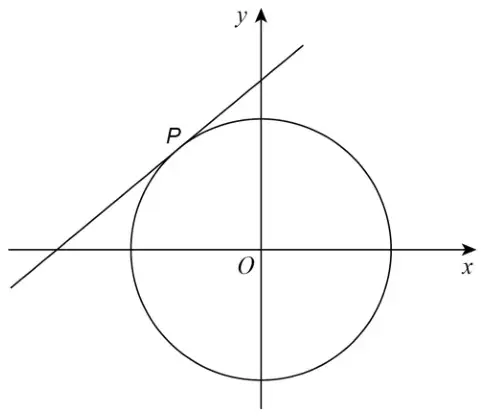
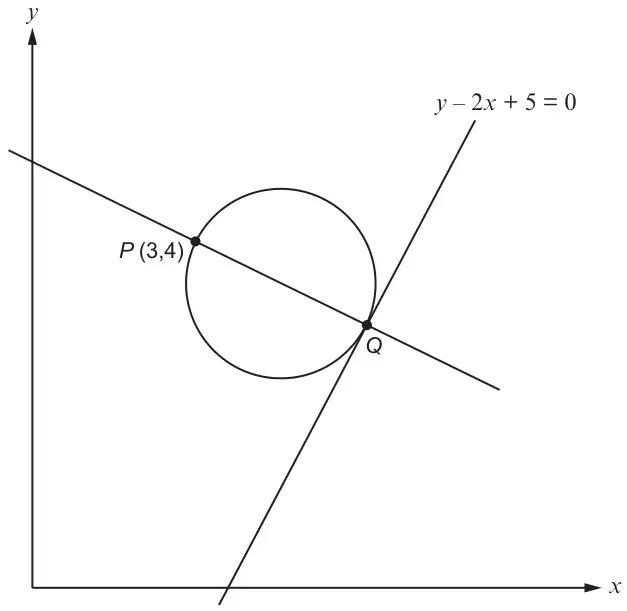
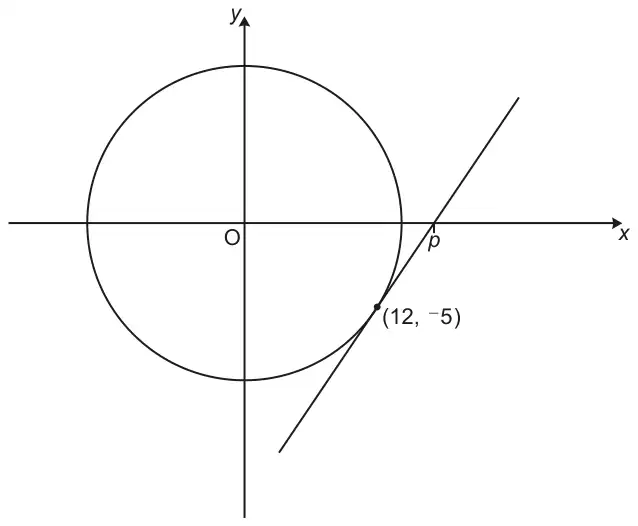
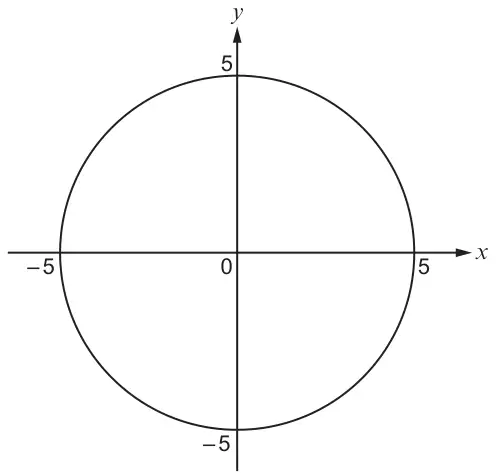
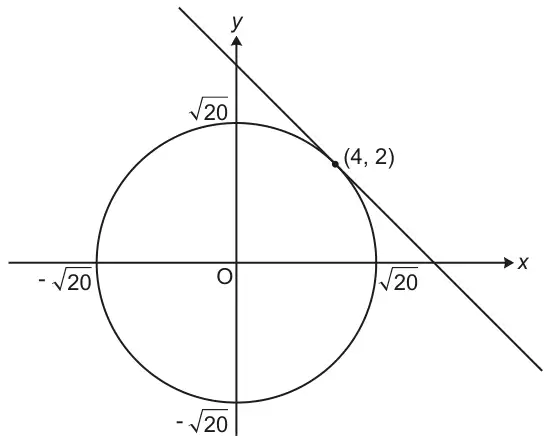
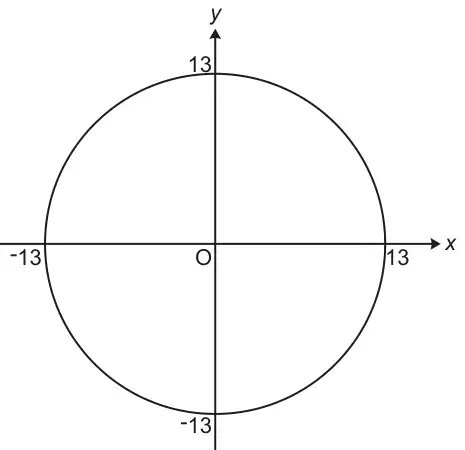
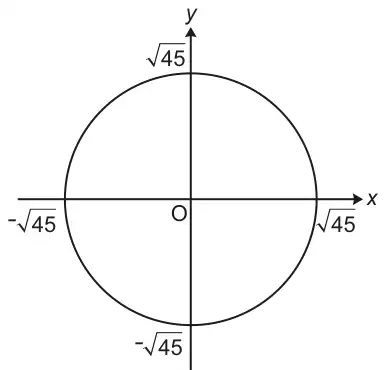
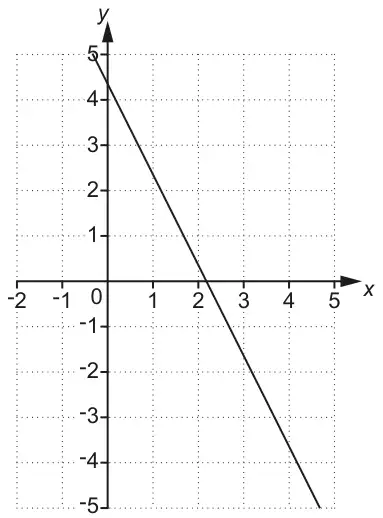
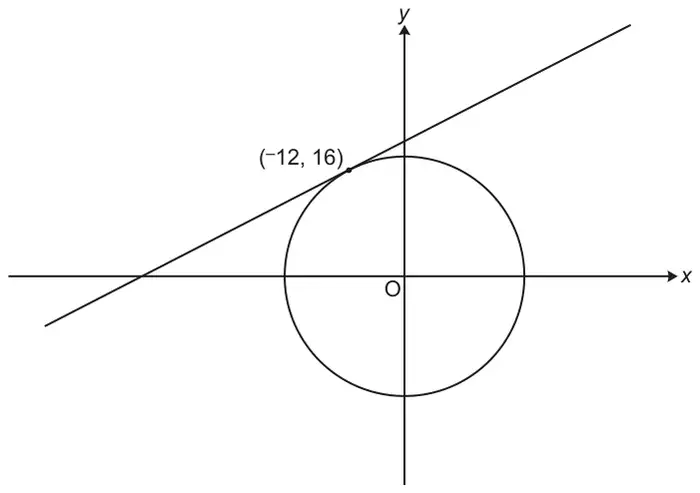
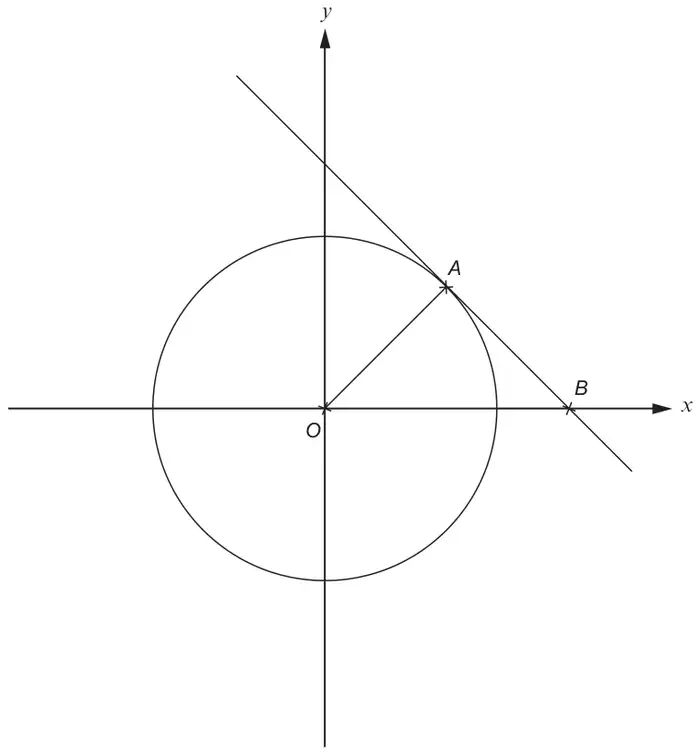
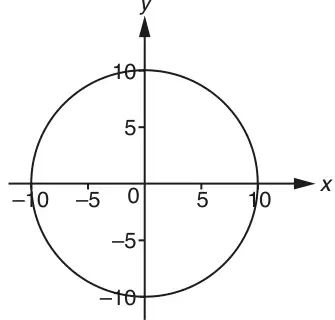
22 \(\mathbf{C}\) is a circle with centre \((0, 0)\) The straight line with equation \(3x - 2y = 52\) is the tangent to \(\mathbf{C}\) at the point \(P\).
Find the coordinates of \(P\). (4)
Mark scheme
Answer
Mark
Mark scheme
(12, −8)
P1
for process to rearrange the equation to give \(y\) in terms of \(x\), eg \(y = \dfrac{3x - 52}{2}\) or \(y = \dfrac{3}{2}x - 26\) or \(m = \dfrac{3}{2}\)
P1
for process to find gradient of \(OP\), eg \(-1 \div \text{``}\dfrac{3}{2}\text{''}\ \left(= -\dfrac{2}{3}\right)\) or \(-1 \div [m]\)
P1
(dep on equation of the form \(y = \dfrac{-1}{[m]}x\) for the radius may be implied in subsequent working) for starting to solve \(3x - 2y = 52\) with \(y = \dfrac{-1}{[m]}x\) simultaneously to find the value of \(x\) or \(y\) eg substituting \(y = \dfrac{-2}{3}x\) or \(y = \dfrac{-1}{[m]}x\) into \(y = \dfrac{3}{2}x - 26\) or \(3x - 2y = 52\) or an equation of the form \(y = \dfrac{3}{2}x + c\) eg \(-\dfrac{2}{3}x = \dfrac{3}{2}x - 26\) or \(3x - 2\left(-\dfrac{2}{3}x\right) = 52\) or \(-\dfrac{2}{3}x = \dfrac{3}{2}x + c\) or \(-\dfrac{1}{[m]}x = \dfrac{3}{2}x - 26\) or \(3x - 2\left(-\dfrac{1}{[m]}x\right) = 52\) or \(-\dfrac{1}{[m]}x = \dfrac{3}{2}x + c\)
A1
cao
Additional guidance
Condone an incorrect value for the \(y\) intercept (\(= c\))
Where \([m]\) is clearly identified as the gradient of the straight line \(3x - 2y = 52\) Allow 0.66(6…) or 0.67 for \(\dfrac{2}{3}\) throughout
Where \([m]\) is clearly identified as the gradient of the straight line \(3x - 2y = 52\)
Can be done by elimination Award P1 for a correct method to eliminate \(x\) or \(y\): coefficient of \(x\) or \(y\) the same and correct operator to eliminate selected variable eg
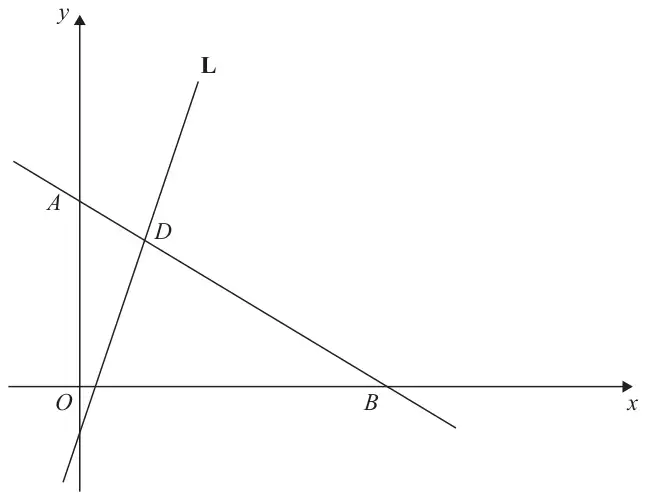
In the diagram \(A\) is the point \((0, 8)\) \(B\) is the point \((16, 0)\)
The point \(D\) divides the line segment \(AB\) in the ratio 1 : 3 The line L passes through \(D\). The gradient of L is \(\sqrt{3}\)
L passes through the point with coordinates \((-2, f)\)
Show that \(f \lt -4\) (5)
Mark scheme
Answer
Mark
Mark scheme
Shown
M1
for the method to find a coordinate of the point \(D\) eg \(\dfrac{1}{1 + 3} \times 16\ (= 4)\) or \(\dfrac{3}{1 + 3} \times 8\ (= 6)\) or (4, 6) labelled
M1
for a correct form for L, eg \(y = \sqrt{3}x + c\) OR a correct equation for the gradient of L, eg \(\dfrac{[6] - f}{[4] - -2} = \sqrt{3}\)
M1
for correct substitution to find \(c\) eg \([6] = \sqrt{3} \times [4] + c\) or \(y - [6] = \sqrt{3}(x - [4])\) or \(c = [6] - [4]\sqrt{3}\ (= -0.928\ldots)\) OR starts to rearrange equation for gradient, eg \([6] - f = ([4] - -2)\sqrt{3}\)
M1
(dep on previous M1) for the method to substitute in \(-2\), eg \(\sqrt{3} \times (-2) + [6] - \sqrt{3} \times [4]\) or \(\sqrt{3} \times (-2) + [c]\) OR a correct unevaluated expression for \(f\), eg \(f = [6] - ([4] - -2)\sqrt{3}\)
C1
accurate figure eg \(f = -4.39\ldots\) or \(-4.39\ldots \lt -4\)
Additional guidance
First two marks may be seen in either order Accept 4 or 6 stated or (6, 4)
Condone incorrect value for \(c\) when awarding this mark
[4] must be clearly identified as the \(x\)-coordinate of \(D\) if incorrect Award of this mark implies the previous mark [6] must be clearly identified as the \(y\)-coordinate of \(D\) if incorrect
[\(c\)] must be clearly what they have found to be the \(y\)-intercept of Land must have come from correct processes to evaluate
\(-4.39\ldots\) must come from correct working Accept \(-4.4\) or better
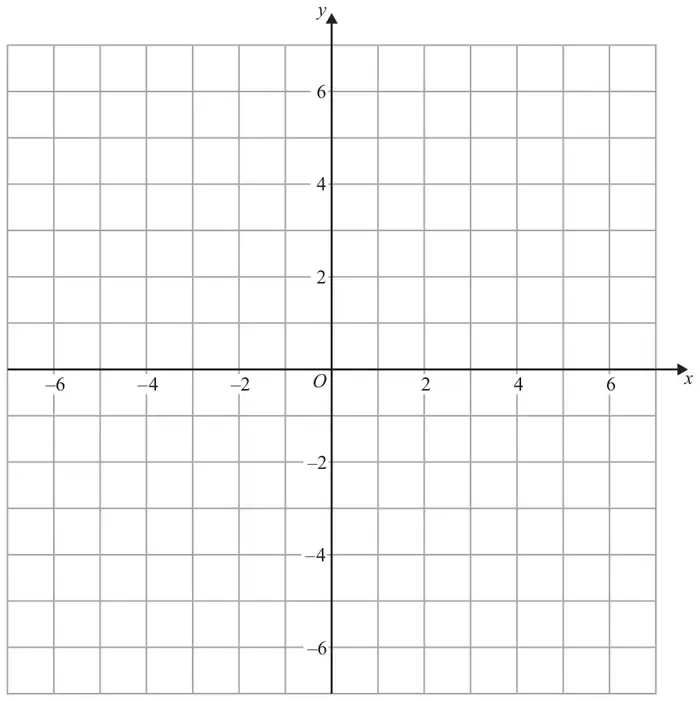
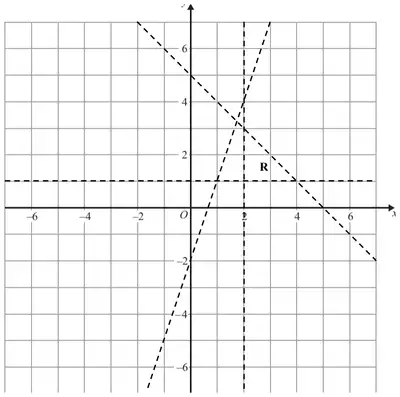
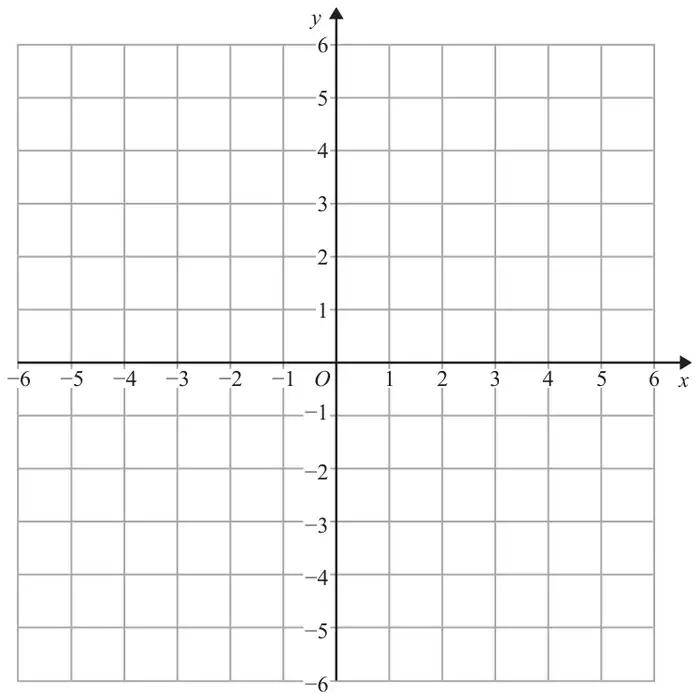
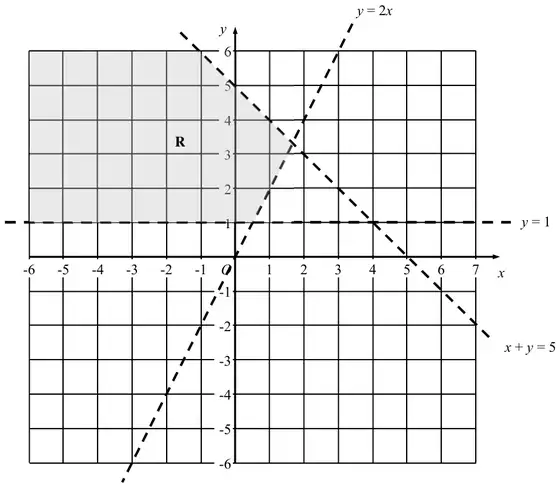
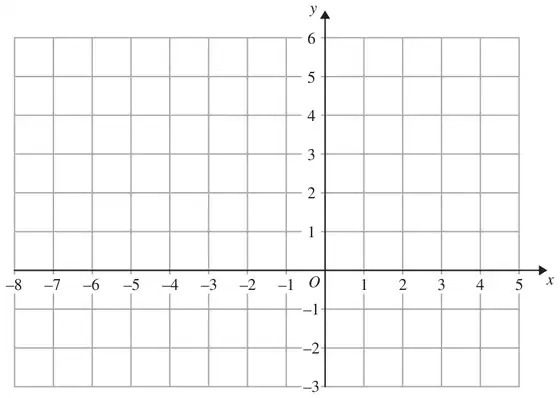
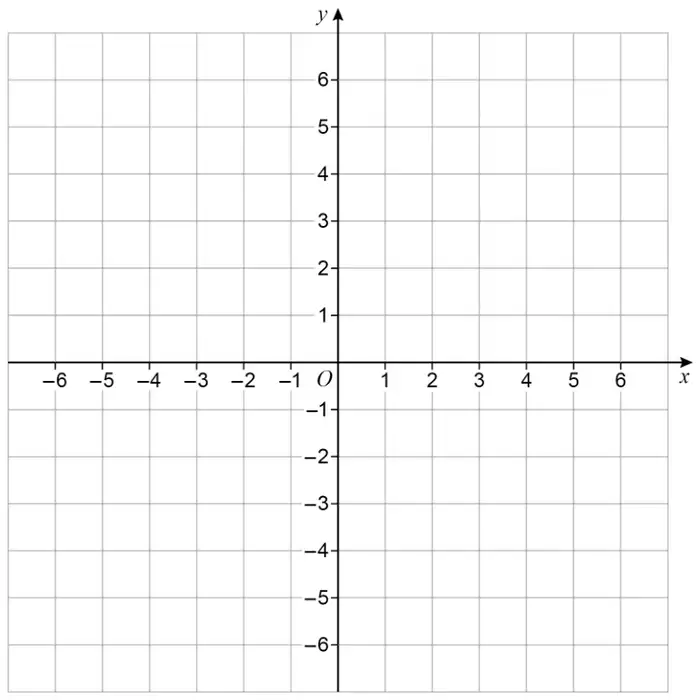
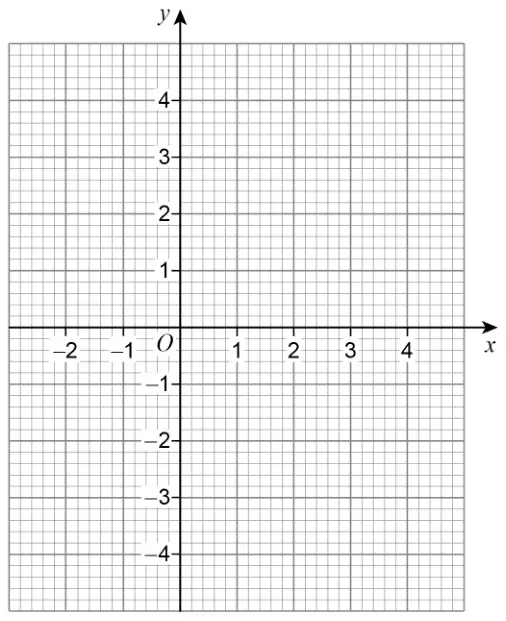
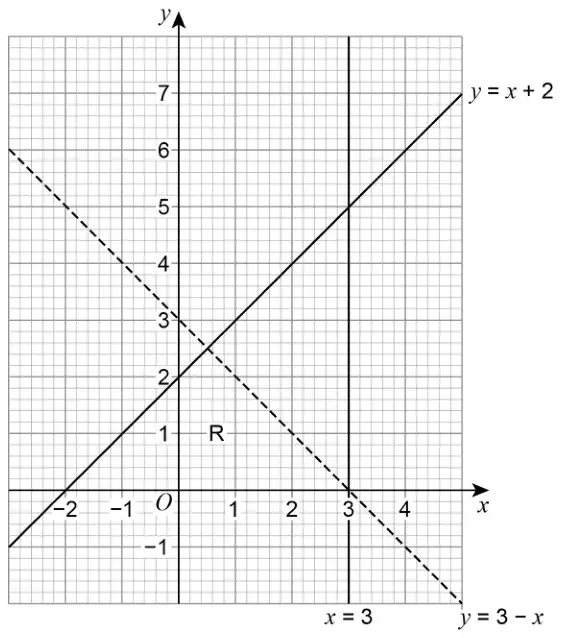
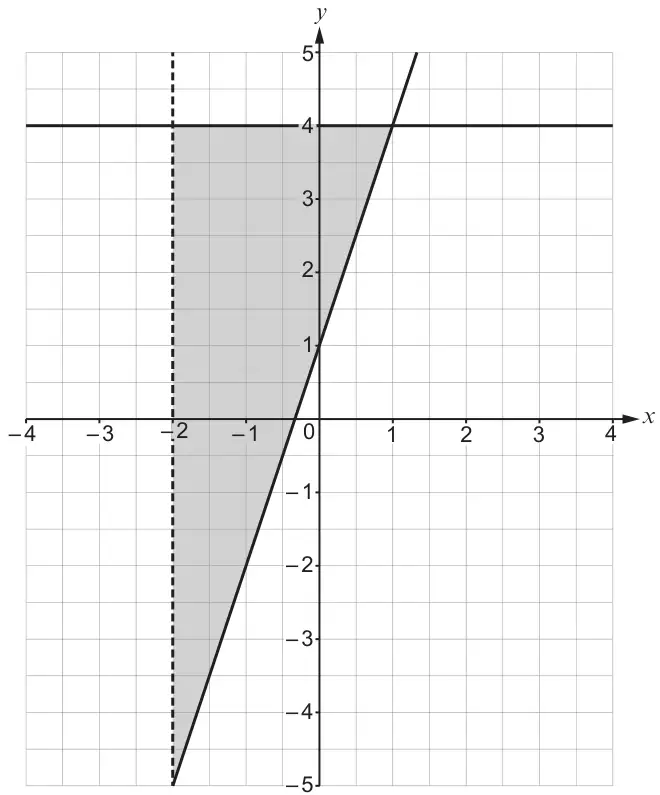
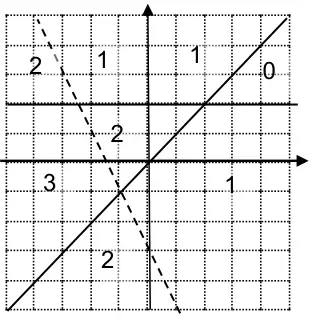
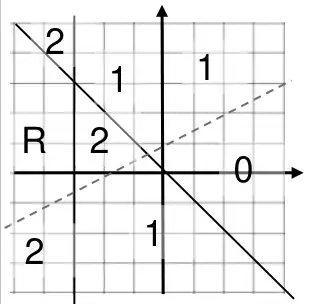
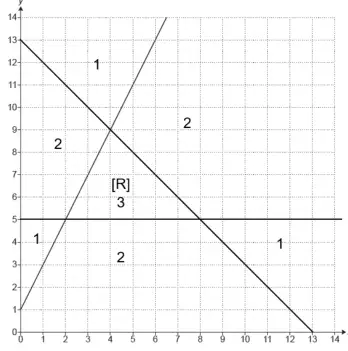
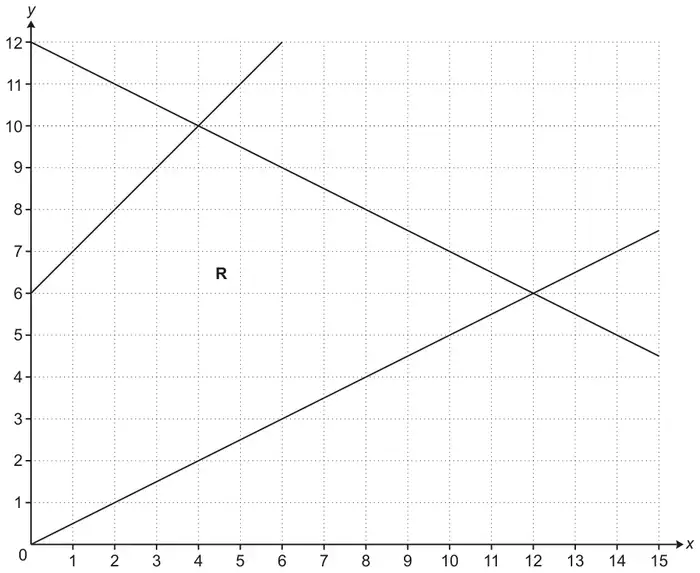
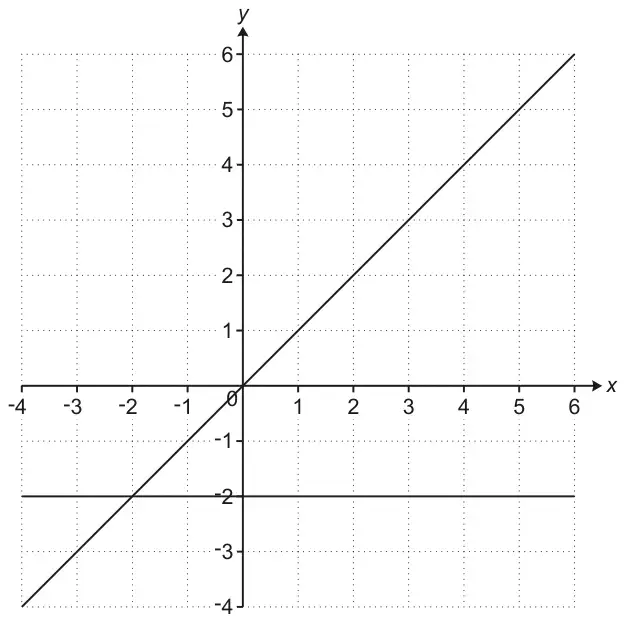
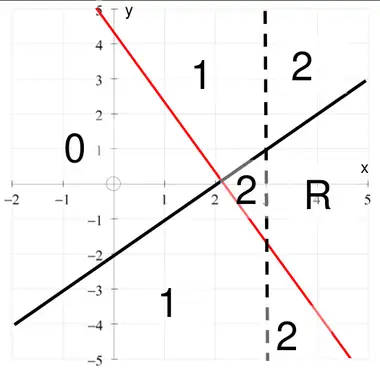
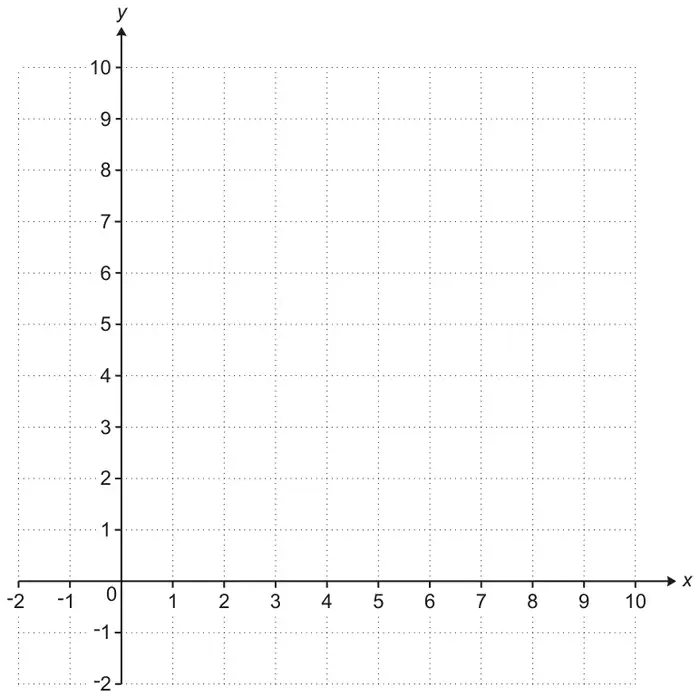
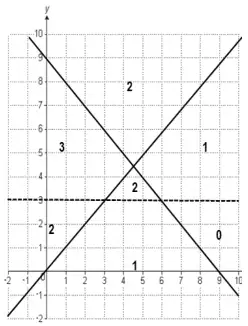
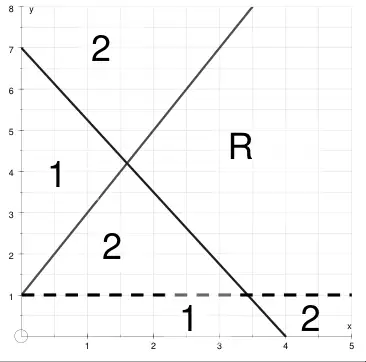
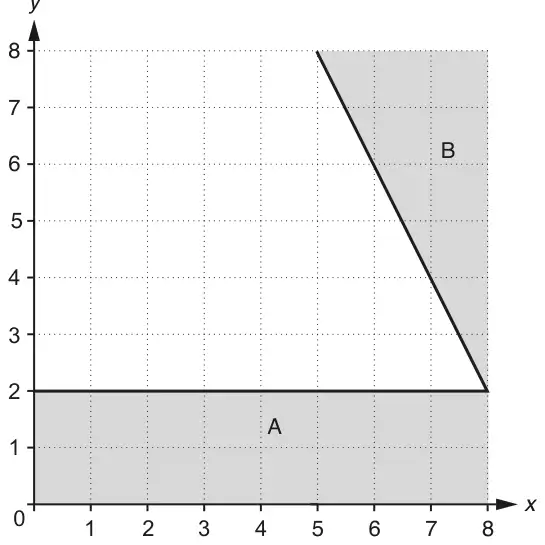
(a) On the grid, show by shading, the region that satisfies all of these inequalities.\[x + y \lt 5 \qquad y \gt 1 \qquad x \gt 2 \qquad y \lt 3x - 2\]Label the region R.(4)
Ron says,
“I can remove one of the four inequalities from the grid so that the region R will not change.”
Ron is correct.
(b) Which inequality can be removed so that the region R will not change? (1)
Mark scheme (a)
Answer
Mark
Mark scheme
Region shown
B4
for a fully correct region identified
(B3
for drawing three correct lines)
(B2
for drawing two correct lines, must include at least one of \(x + y = 5\) or \(y = 3x - 2\))
(B1
for drawing \(x = 2\) and \(y = 1\) correctly OR for drawing \(x + y = 5\) correctly OR for drawing \(y = 3x - 2\) correctly)
Additional guidance
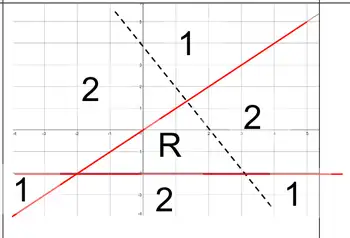
See diagram at end of mark scheme Can exclude \(y = 3x - 2\) for B4 Condone solid lines for all marks Region can be identified by shading in or shading out Lines need to be long enough to enclose the region
Mark scheme (b)
Answer
Mark
Mark scheme
\(y \lt 3x - 2\)
B1
(dep on B1 in (a)) for \(y \lt 3x - 2\) or ft their diagram if 1 line is redundant
Additional guidance
Condone use of ‘=’ or ‘\(\leqslant\)’ and \(3x - 2\)
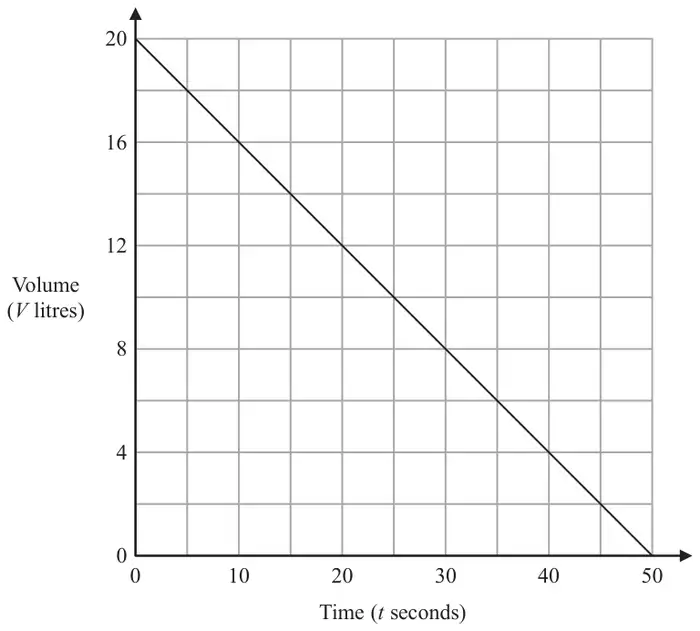
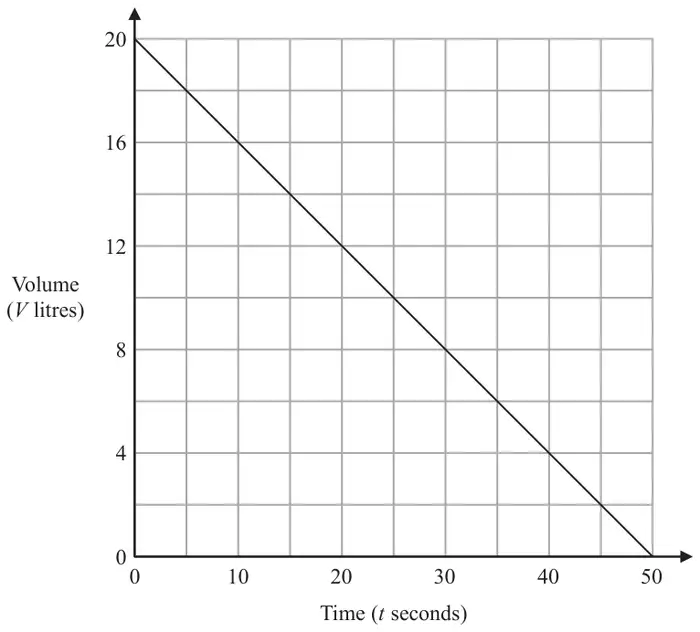
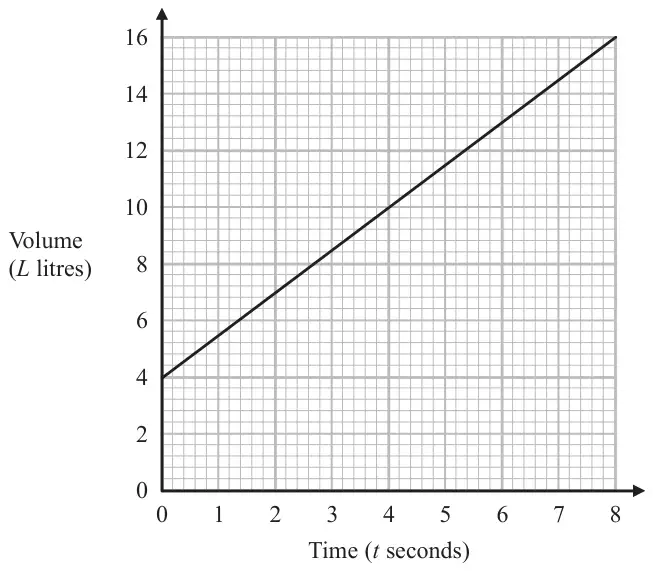
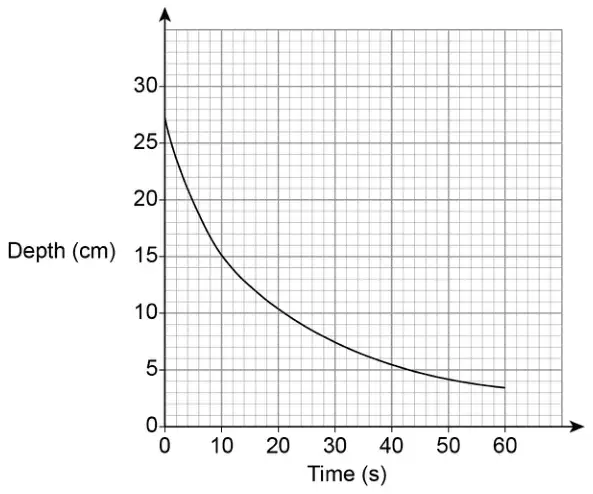
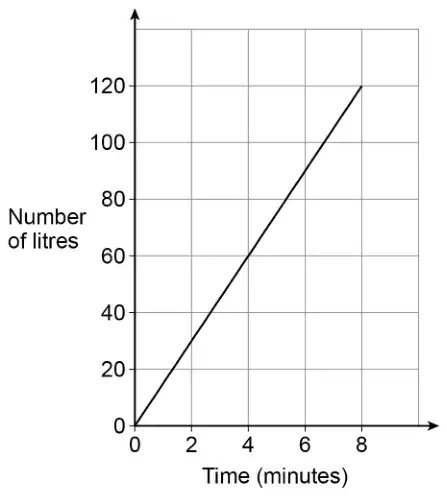
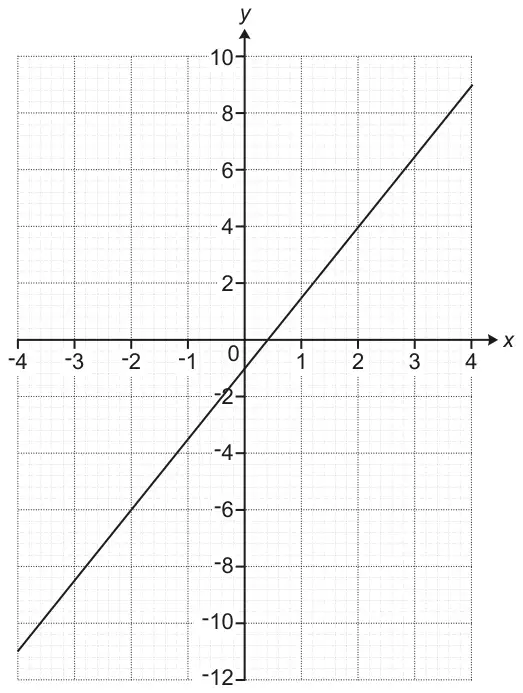
24 The graph shows the volume of water, \(V\) litres, in a tank at time \(t\) seconds.
What does the gradient of this graph represent? (1)
Mark scheme
Answer
Mark
Mark scheme
Rate of change of volume
C1
for a correct explanation
Acceptable examples The rate of water poured Speed of pouring water out from the tank How fast the water is being used (in the tank over time) Amount of water decreasing in the tank each second
Not acceptable examples Negative correlation / negative gradient Amount of water decreasing in the tank in seconds As time increases the volume of water in the tank decreases It is negative, the volume of litres is going down It represents the deceleration or changing speed
Additional guidance
Allow amount of water increasing in the tank each second
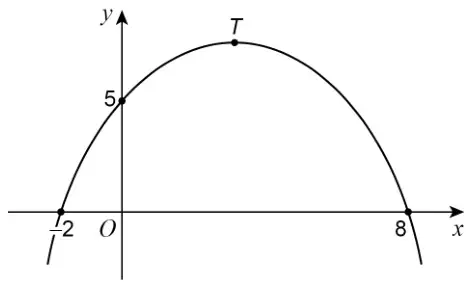
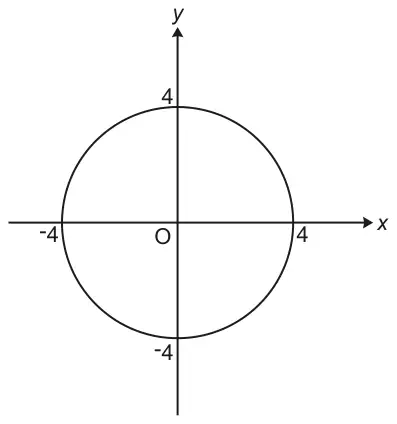
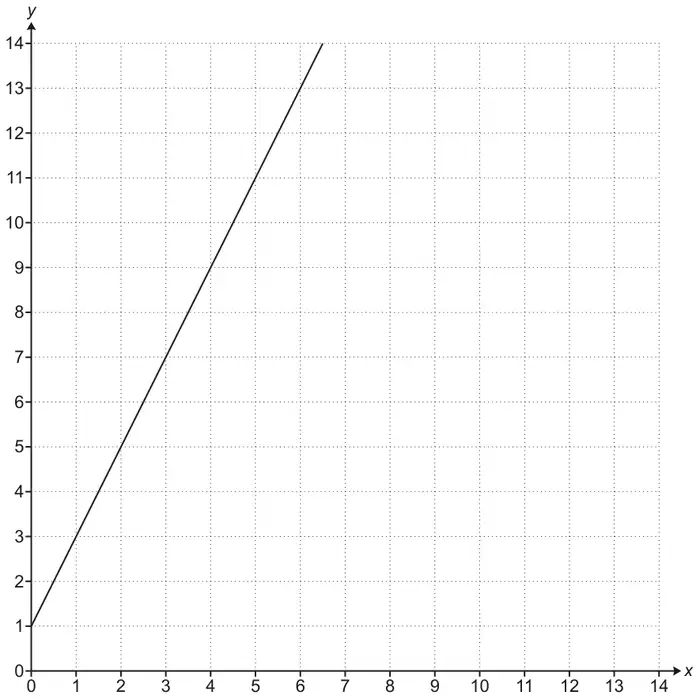
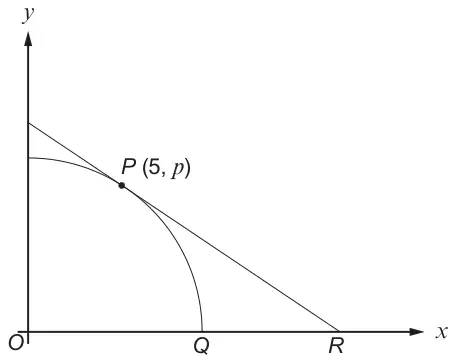
Find an equation of the tangent to C at the point \((p, 1)\) where \(p \gt 0\) Give your answer in the form \(y + \sqrt{a}x = b\) where \(a\) and \(b\) are integers. You must show all your working. (4)
Mark scheme
Answer
Mark
Mark scheme
\(y + \sqrt{3}x = 4\)
P1
for process to find the value of \(p\), eg \(\sqrt{4 - 1^2}\ (= \sqrt{3})\)
P1
for a start of a process to find gradient of tangent, eg gradient of normal/radius \(= \dfrac{1}{p}\) or \(\dfrac{1}{\text{``}\sqrt{3}\text{''}}\) or \(\dfrac{1}{[p]}\) or for gradient of tangent \(= -p\) or \(-\text{``}\sqrt{3}\text{''}\) or \(-[p]\)
P1
(dep P1) for substituting \((\text{``}\sqrt{3}\text{''}, 1)\) into \(y = \text{``}{-}\sqrt{3}\text{''}x + c\) or for \(y - 1 = \text{``}{-}\sqrt{3}\text{''}(x - \text{``}\sqrt{3}\text{''})\) oe or for \(1 = -p \times p + c\) or for substituting \(([p], 1)\) into \(y = -[p]x + c\) or for substituting \((\text{``}\sqrt{3}\text{''}, 1)\) into \(y = -\dfrac{1}{[m]}x + c\)
A1
for \(y + \sqrt{3}x = 4\)
Additional guidance
May occur later in the process
Where \([p]\) is their stated value of \(p\)
Where \([m]\) is clearly their gradient of the normal/radius
A correct answer with no supportive working gets 0 marks
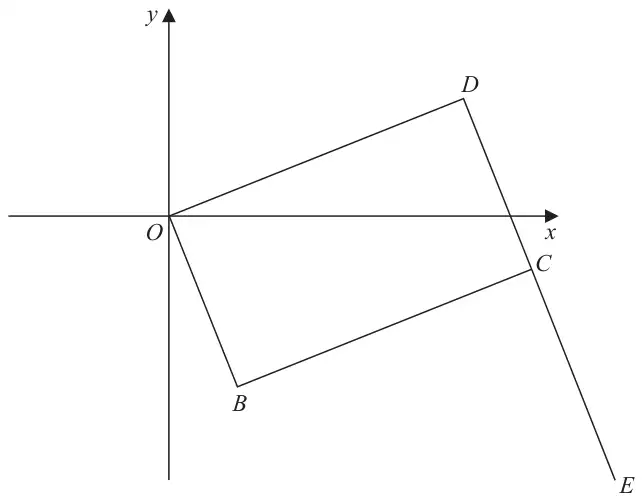
16 \(OBCD\) is a rectangle. \(DCE\) is a straight line.
\(B\) has coordinates \((2, -4)\) \(E\) has coordinates \((12, -6.5)\)
Work out the coordinates of \(D\). You must show all your working. (5)
Mark scheme
Answer
Mark
Mark scheme
(7, 3.5)
P1
process to find the gradient of \(OB\), eg \(\dfrac{-4 - 0}{2 - 0}\ (= -2)\)
P1
process to find the equation of \(DE\), eg substitutes \((12, -6.5)\) into \(y = \text{``}{-}2\text{''}x + c\) or \(y = [-2]x + c\) or \(y - -6.5 = \text{``}{-}2\text{''}(x - 12)\) or \(y - -6.5 = [-2](x - 12)\)
P1
process to find the equation of \(OD\), eg substitutes \((0, 0)\) into \(y = \dfrac{-1}{\text{``}{-}2\text{''}}x + c\) or \(y = \dfrac{-1}{[-2]}x + c\) or \(y - 0 = \dfrac{-1}{\text{``}{-}2\text{''}}(x - 0)\) or \(y - 0 = \dfrac{-1}{[-2]}(x - 0)\)
P1
(dep P3) forms an equation that can be solved to find \(x\) coordinate of \(D\), eg \(\text{``}{-}2x + 17.5\text{''} = \text{``}\dfrac{1}{2}x\text{''}\)
A1
cao
Additional guidance
Equation of \(DE\) is \(y = -2x + 17.5\) Where [−2] can be \(\dfrac{-1}{2}\) or 2 or \(\dfrac{1}{2}\) and must be labelled as the gradient of \(OB\)
Equation of \(OD\) is \(y = \dfrac{1}{2}x\) Where [−2] can be \(\dfrac{-1}{2}\) or 2 or \(\dfrac{1}{2}\) and must be labelled as the gradient of \(OB\)
A correct answer with no supportive working gets 0 marks
7 The graph shows the volume of water, \(V\) litres, in a tank at time \(t\) seconds.
What does the gradient of this graph represent? (1)
Mark scheme
Answer
Mark
Mark scheme
Rate of change of volume
C1
for a correct explanation
Acceptable examples The rate of water poured Speed of pouring water out from the tank How fast the water is being used (in the tank over time) Amount of water decreasing in the tank each second
Not acceptable examples Negative correlation / negative gradient Amount of water decreasing in the tank in seconds As time increases the volume of water in the tank decreases It is negative, the volume of litres is going down It represents the deceleration or changing speed
Additional guidance
Allow amount of water increasing in the tank each second
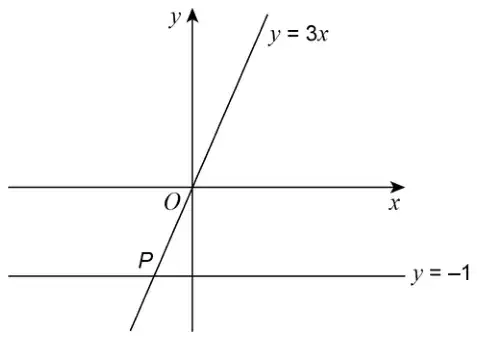
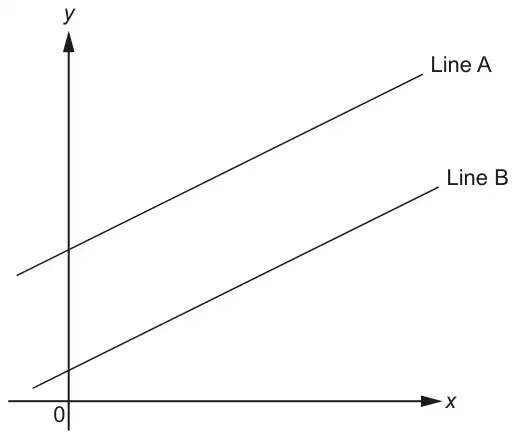
M is a different straight line with equation \(\ y = 5x\)
(b) Write down the equation of a straight line parallel to M. (1)
Mark scheme (a)
Answer
Mark
Mark scheme
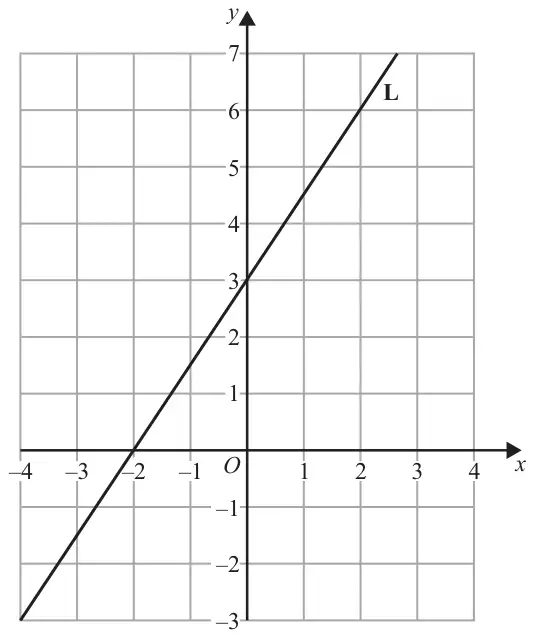
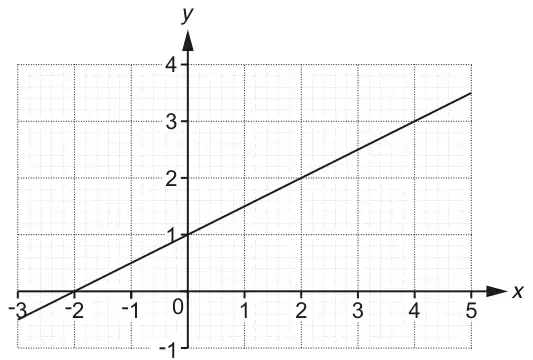
\(y = \dfrac{3}{2}x + 3\)
M1
for a correct method to find the gradient of the line, eg \(\frac{6-3}{2-0}\ \left(= \frac{3}{2}\right)\)
or identifies 3 as the intercept in words or in a partial equation
or for \(y = \left[\frac{3}{2}\right]x + c\)
or for \(y - b = \left[\frac{3}{2}\right](x - a)\) where \((a, b)\) is a correct coordinate
M1
for \(y = \dfrac{3}{2}x\ (+\ c)\) oe or for \(y = \text{``}\dfrac{3}{2}\text{''}x + 3,\ m \ne 0\) or (L =) \(\dfrac{3}{2}x + 3\) or \(y - y_1 = \dfrac{3}{2}(x - x_1)\) or \(y - b = \text{``}\dfrac{3}{2}\text{''}(x - a)\) where \((a, b)\) is a correct coordinate
A1
oe
Additional guidance
Just circling 3 is insufficient
\(\left[\frac{3}{2}\right]\) must be identifiable as their gradient \(c\) must be seen either as a letter or a number
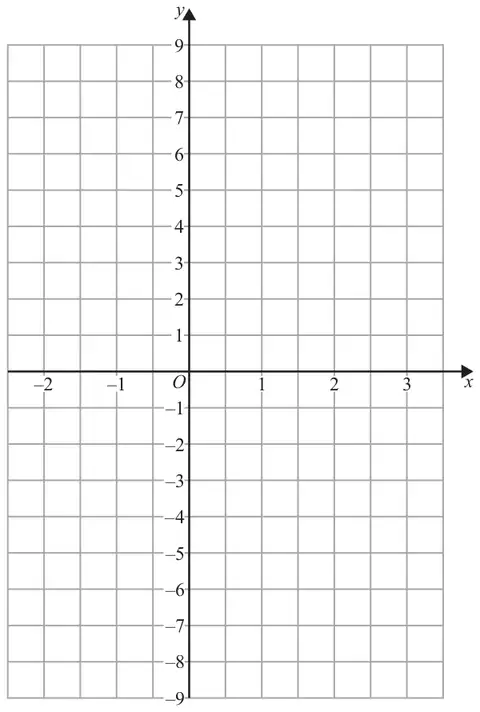
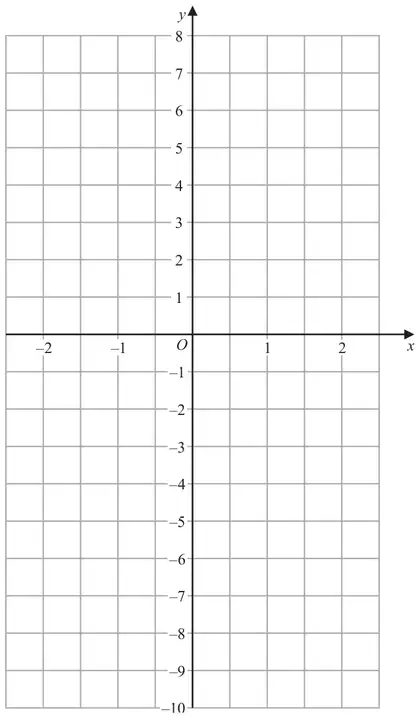
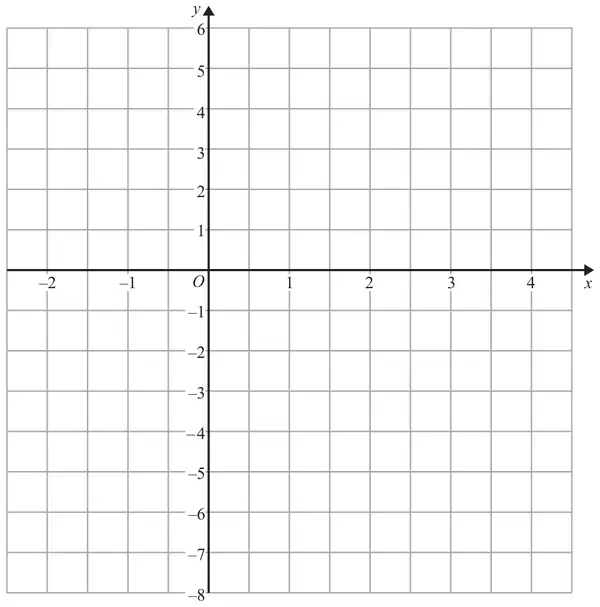
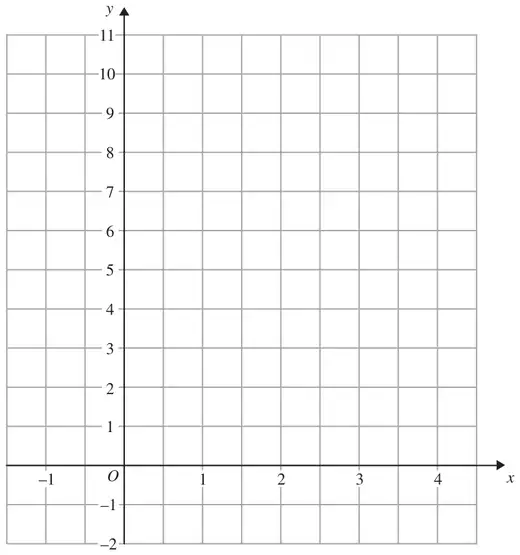
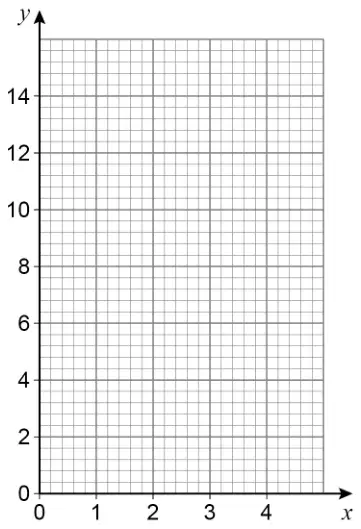
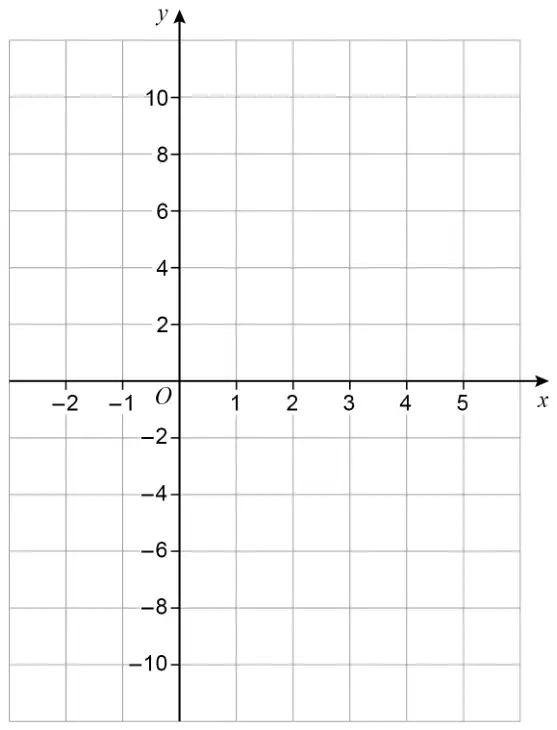
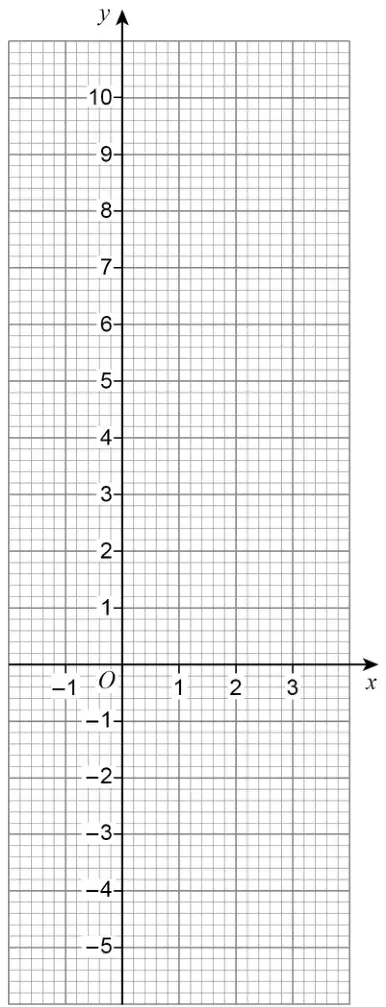
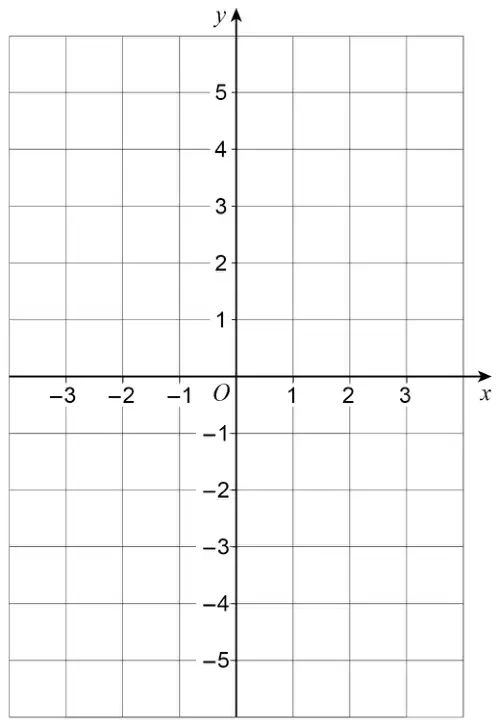
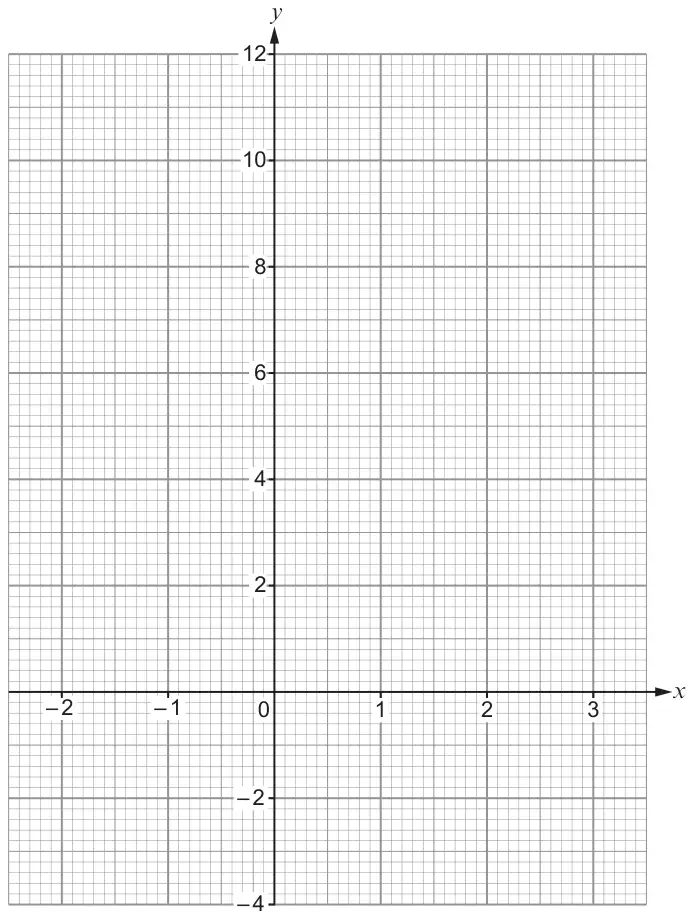
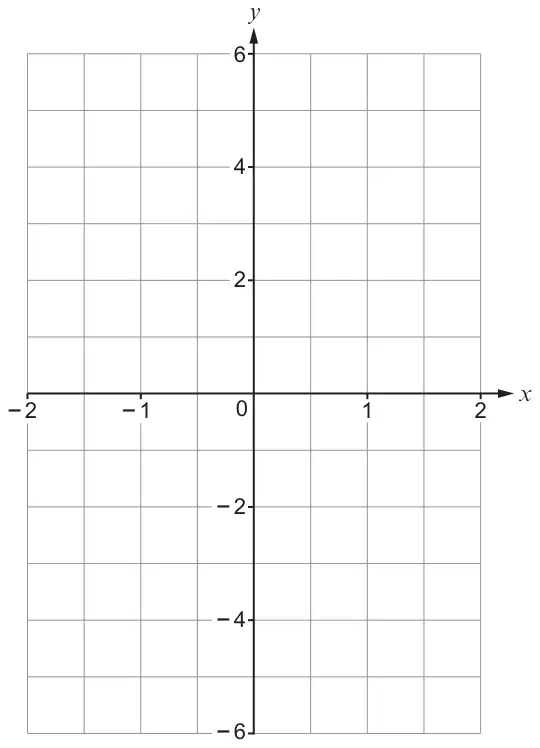
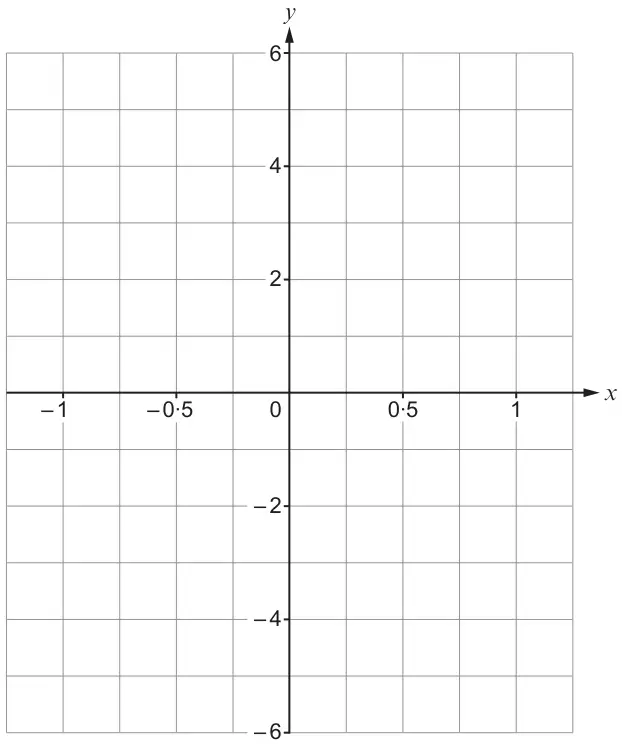
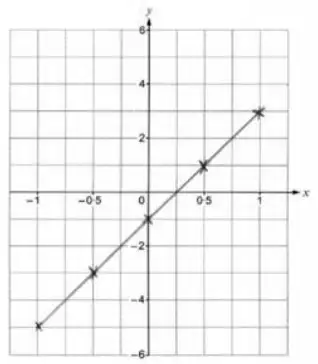
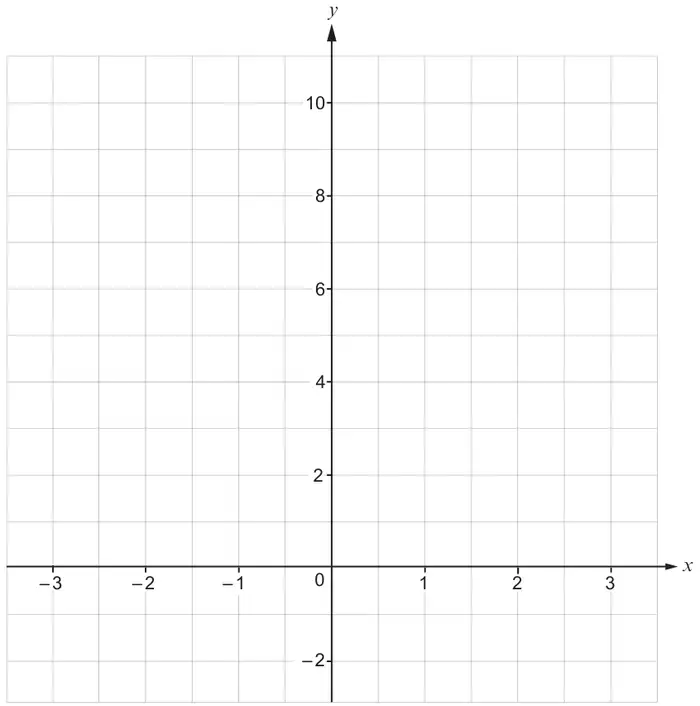
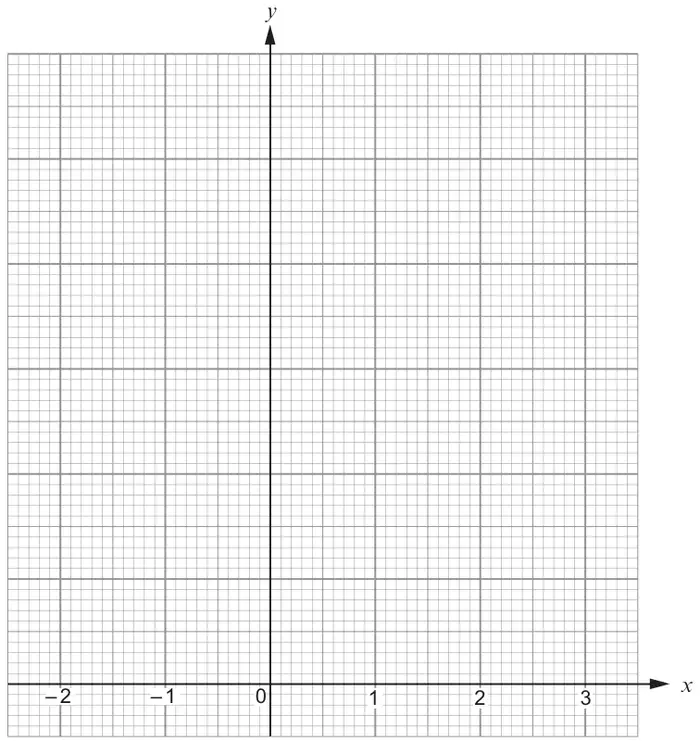
19 On the grid below, draw the graph of \(\ y = 3x - 2\ \) for values of \(x\) from \(-2\) to 3 (3)
Mark scheme
Answer
Mark
Mark scheme
\(y = 3x - 2\) drawn
B3
for a correct line between \(x = -2\) and \(x = 3\)
(B2
for a correct straight line segment through at least 3 of \((-2, -8), (-1, -5), (0, -2), (1, 1), (2, 4), (3, 7)\)
or for all of these points plotted but not joined
OR for a line drawn with positive gradient through \((0, -2)\) and clear intention to use a gradient of 3, eg line through \((0, -2)\) going across 2 squares and up 6 squares)
(B1
at least 2 correct points stated or plotted
OR for a line drawn with positive gradient through \((0, -2)\)
OR a line with gradient of 3)
Additional guidance
\(x\)
\(-2\)
\(-1\)
0
1
2
3
\(y\)
\(-8\)
\(-5\)
\(-2\)
1
4
7
Ignore any incorrect points. Points need not be plotted for a correct line (segment) drawn
Ignore any incorrect points Coordinates may be in a table or in working
M is a different straight line with equation \(y = 5x\)
(b) Write down the equation of a straight line parallel to M. (1)
Mark scheme (a)
Answer
Mark
Mark scheme
\(y = \dfrac{3}{2}x + 3\)
M1
for a correct method to find the gradient of the line, eg \(\dfrac{6 - 3}{2 - 0}\ \left(= \dfrac{3}{2}\right)\) or identifies 3 as the intercept in words or in a partial equation or for \(y = \left[\dfrac{3}{2}\right]x + c\) or for \(y - b = \left[\dfrac{3}{2}\right](x - a)\) where \((a, b)\) is a correct coordinate
M1
for \(y = \dfrac{3}{2}x\ (+ c)\) oe or for \(y = \text{``}\dfrac{3}{2}\text{''}x + 3\), \(m \neq 0\) or \((\mathbf{L} =)\ \dfrac{3}{2}x + 3\) or \(y - y_1 = \dfrac{3}{2}(x - x_1)\) or \(y - b = \text{``}\dfrac{3}{2}\text{''}(x - a)\) where \((a, b)\) is a correct coordinate
A1
oe
Additional guidance
Just circling 3 is insufficient
\(\left[\dfrac{3}{2}\right]\) must be identifiable as their gradient \(c\) must be seen either as a letter or a number
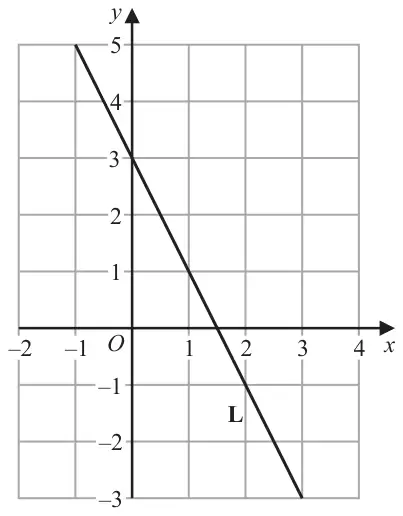
for a correct method to find the gradient of the line, eg \(\dfrac{-1 - 3}{2 - 0}\ (= -2)\) or uses 3 as the intercept in \(y = mx + c\), eg \(y = mx + 3\) oe, \(y = 1.5x + 3\)
M1
for \(y = [-2]x + c\) or for (L =) \(3 - 2x\) or uses their gradient and a point on the line, eg \(y - {-1} = [-2](x - 2)\)
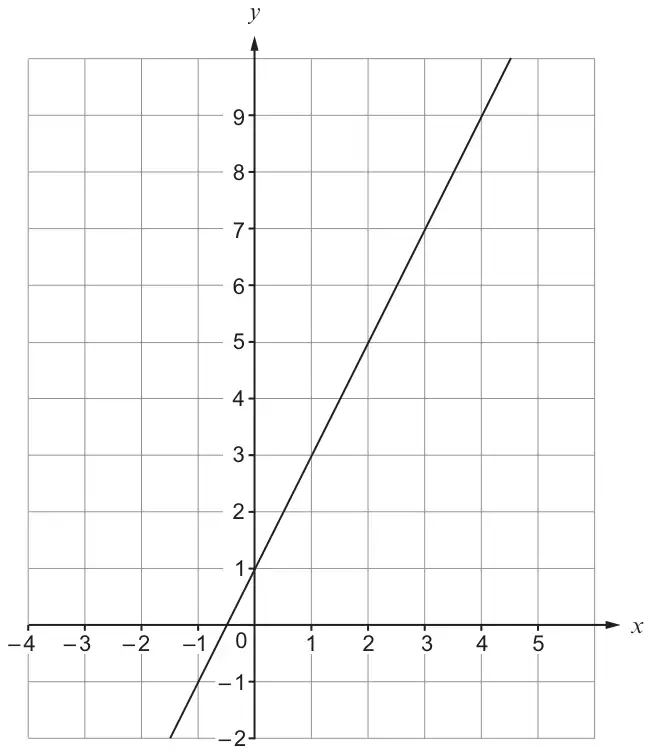
14 On the grid, draw the graph of \(\ y = 4x - 1\ \) for values of \(x\) from \(-2\) to 2 (3)
Mark scheme
Answer
Mark
Mark scheme
Graph drawn
B3
for a correct line between \(x = -2\) and \(x = 2\)
(B2
for a correct straight-line segment through at least 3 of \((-2, -9), (-1, -5), (0, -1), (1, 3), (2, 7)\)
or for all these points plotted but not joined
or for a line drawn with a positive gradient through \((0, -1)\) and clear intention to use a gradient of 4, eg line through \((0, -1)\) and \((1, 3)\))
(B1
for at least 2 correct points stated or plotted
or for a line drawn with a positive gradient through \((0, -1)\)
or a line with gradient 4)
Additional guidance
Accept freehand line drawn
Ignore any incorrect points.
Table of values
\(x\)
\(-2\)
\(-1\)
0
1
2
\(y\)
\(-9\)
\(-5\)
\(-1\)
3
7
(B1) Ignore any incorrect points. Coordinates may be in a table or working. Do not accept \(y = -1\) drawn
12 The straight line L has equation \(2y = 3x - 7\)
Find an equation of the straight line perpendicular to L that passes through \((6, -5)\) (3)
Mark scheme
Answer
Mark
Mark scheme
\(y = -\dfrac{2}{3}x - 1\)
M1
for a method to find gradient of perpendicular line, eg \(y = \dfrac{3}{2}x\left(-\dfrac{7}{2}\right)\) and \(\dfrac{3}{2} \times m = -1\) or gradient of perpendicular shown as \(-\dfrac{2}{3}\)
M1
for a method to find the value of \(c\), eg \(-5 = \text{``}{-\dfrac{2}{3}}\text{''} \times 6 + c\) or \(y - {-5} = \text{``}{-\dfrac{2}{3}}\text{''}(x - 6)\) oe
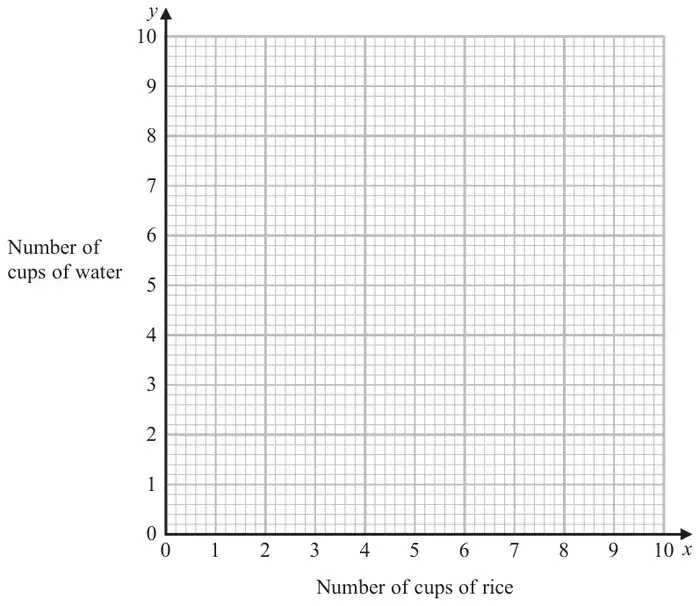
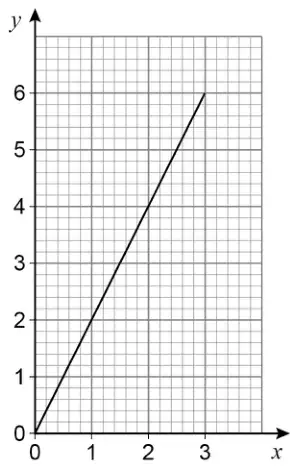
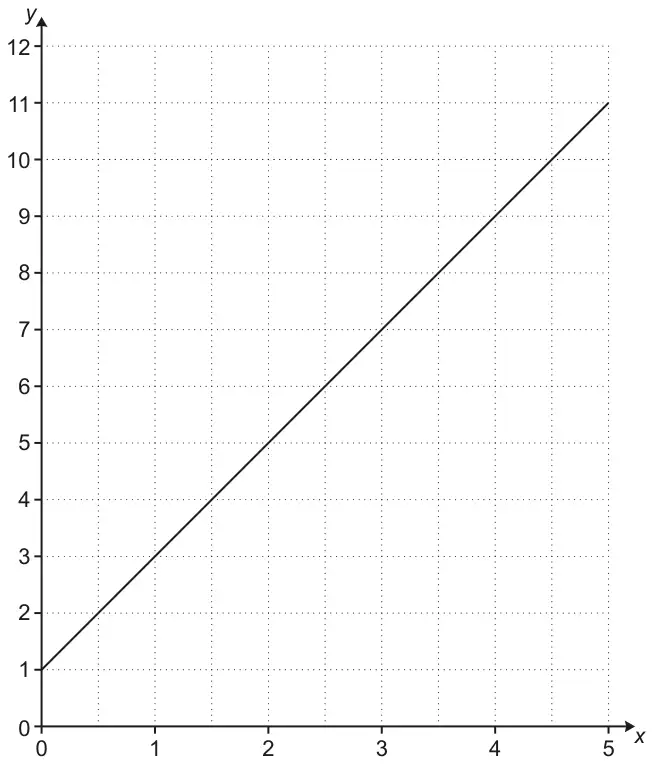
\[\text{the number of cups of rice } (x) : \text{the number of cups of water } (y) = 4 : 5\]
(a) Use this information to draw a graph to show the relationship between the number of cups of rice and the number of cups of water needed to cook rice.(2)
(b)
(i) Find the gradient of the line drawn in part (a). (1)
(ii) Explain what this gradient represents. (1)
Mark scheme (a)
Answer
Mark
Mark scheme
Graph drawn
B2
for a correct line drawn
(B1
for stating or plotting at least 2 points on the line eg \((0, 0)\) and \((4, 5)\) or \((4, 5)\) and \((8, 10)\) or giving the equation of the line eg \(y = \dfrac{5}{4}x\))
Mark scheme (b)
Answer
Mark
Mark scheme
(i) 1.25
B1
oe or ft their line in part (a)
(ii) Explanation
C1
for explanation Acceptable examples the number of cups of water per cup of rice every cup of rice has 1.25 cups of water for every 4 cups of rice there are 5 cups of water
Not acceptable examples cups of water ÷ cups of rice the gradient represents the steepness of the line the number of cups of rice for each cup of water
Additional guidance
(i) Accept answers in the form \(\dfrac{a}{b}\) where \(a\) and \(b\) are integers
(ii) If figures are given as part of the answer they must be correct, but can allow ft
for a correct method to find the gradient of the line, eg \(\dfrac{-1 - 3}{2 - 0}\ (= -2)\) or uses 3 as the intercept in \(y = mx + c\), eg \(y = mx + 3\) oe, \(y = 1.5x + 3\)
M1
for \(y = [-2]x + c\), \(c \neq 0\) or for (L=) \(3 - 2x\) or uses their gradient and a point on the line, eg \(y - {-1} = [-2](x - 2)\)
The point \(P\) with coordinates (−3, 4) lies on the circle.
Alex says that the tangent to the circle at \(P\) crosses the \(x\)-axis at the point (−8, 0)
Is Alex correct? You must show how you get your answer. (4)
Mark scheme
Answer
Mark
Mark scheme
No (supported)
P1
for a first step, eg to find the gradient of the line (normal) joining (0, 0) to (−3, 4), eg \(\dfrac{4 - 0}{-3 - 0}\ \left(= -\dfrac{4}{3}\right)\) OR finds the length2 for one side of triangle, eg \((-3 - -8)^2 + (4 - 0)^2\ (= 41)\) or \((-3 - 0)^2 + (4 - 0)^2\ (= 25)\) or 64
P1
for a second step, eg to find the gradient of the tangent, eg \(-1 \div \text{``}\dfrac{-4}{3}\text{''}\ \left(= \dfrac{3}{4}\right)\) OR finds the length2 for two sides of triangle, two of 25, 41 and 64
P1
for a third step, eg to find the gradient of the line joining (−8, 0) to (−3, 4), \(\dfrac{4 - 0}{-3 - -8}\ \left(= \dfrac{4}{5}\right)\) or finds the equation of the tangent, eg \(y = \dfrac{3}{4}x + \dfrac{25}{4}\) or \(y - 4 = \dfrac{3}{4}(x - -3)\) OR for process to use Pythagoras’ rule, eg \(41 + 25\ (= 66)\) or \(64 - 25\ (= 39)\) or \(64 - 41\ (= 23)\)
C1
for No from correct figures and a complete process from comparison of gradients, eg \(\dfrac{3}{4}\) and \(\dfrac{4}{5}\) or showing the equation of the tangent does not pass through (−8, 0), eg when \(x = -8\), \(y = \dfrac{1}{4}\) (not 0) or when \(y = 0\), \(x = -\dfrac{25}{3}\) (not −8) OR correct figures from Pythagoras’ rule, eg \(41 + 25\ (= 66) \neq 64\) or \(64 - 41 \neq 25\) or \(64 - 25 \neq 41\) oe
Additional guidance
Alternative processes may be seen and should be duly credited.
Award 0 marks for No without complete and correct supportive working
15 The equation of line \(\mathbf{L}_1\) is \(y = 2x - 5\) The equation of line \(\mathbf{L}_2\) is \(6y + kx - 12 = 0\)
\(\mathbf{L}_1\) is perpendicular to \(\mathbf{L}_2\)
Find the value of \(k\). You must show all your working. (3)
Mark scheme
Answer
Mark
Mark scheme
3
P1
for process to make the \(y\) term the subject of \(6y + kx - 12 = 0\) eg \(6y = 12 - kx\) or \(y = 2 - \dfrac{k}{6}x\)
P1
for process to find gradient of line perpendicular to \(\mathbf{L}_1\), eg \(2 \times m = -1\) or \(m = -\dfrac{1}{2}\) or for process to find \(k\), eg \(-\dfrac{k}{6} \times 2 = -1\)
A1
cao
Additional guidance
A correct answer with no supportive working gets 0 marks
The point \(P\) lies on the circle. The coordinates of \(P\) are \((2.1, 2.8)\)
The line L is the tangent to the circle at point \(P\).
Find an equation of L. Give your answer in the form \(ax + by = c\), where \(a\), \(b\) and \(c\) are integers. (4)
Mark scheme
Answer
Mark
Mark scheme
\(6x + 8y = 35\)
M1
for a process to find the gradient of the radius, eg \(\dfrac{2.8 - 0}{2.1 - 0}\ \left(= \dfrac{4}{3}\right)\)
M1
for process to find the gradient of the tangent, eg uses \(\dfrac{-1}{\text{``}m\text{''}}\)
M1
for substitution of \((2.1, 2.8)\) into \(y = \text{``}{-}\dfrac{3}{4}\text{''}x + c\) or into \((y - y_1) = \text{``}{-}\dfrac{3}{4}\text{''}(x - x_1)\)
A1
oe as long as in the form \(ax + by = c\), where \(a\), \(b\) and \(c\) are integers
Is Oscar correct? You must give a reason for your answer. (2)
Mark scheme
Answer
Mark
Mark scheme
Yes with comparisons shown
M1
for starting to manipulate equation eg \(y = \dfrac{3}{6}x + \dfrac{7}{6}\) or \(y = \dfrac{1}{2}x + \dfrac{7}{6}\) or \(3y = \dfrac{3}{2}x - 6 \times 3\) or \(6y = 3x - 36\)
A1
for statement and equation(s) which can be used to show that the gradients of the two lines are the same eg \(y = \dfrac{1}{2}x + \dfrac{7}{6}\) and both have a gradient of \(\dfrac{1}{2}\) or Yes, \(6y = 3x - 36\) and both have the same \(x\) coefficients
20 The centre of a circle is the point with coordinates \((-1, 3)\)
The point \(A\) with coordinates \((6, 8)\) lies on the circle.
Find an equation of the tangent to the circle at \(A\). Give your answer in the form \(ax + by + c = 0\) where \(a\), \(b\) and \(c\) are integers. (4)
Mark scheme
Answer
Mark
Mark scheme
\(7x + 5y - 82 = 0\)
P1
for process to work out the gradient of the line from the centre of the circle to the point (6,8) eg \(\dfrac{8 - 3}{6 - -1}\ \left(= \dfrac{5}{7}\right)\)
P1
(dep P1) for using \(mn = -1\) eg \(-1 \div \text{``}\dfrac{5}{7}\text{''}\ \left(= -\dfrac{7}{5}\right)\)
P1
for substituting \((6, 8)\) into \(y = \text{``}{-}\dfrac{7}{5}\text{''}x + c\) or for \((y - 8) = \text{``}{-}\dfrac{7}{5}\text{''}(x - 6)\) or for \(y = -\dfrac{7}{5}x + \dfrac{82}{5}\) oe
A1
\(7x + 5y - 82 = 0\) oe
SC B2 for answer of \(5x + 7y - 86 = 0\) oe in any form
Additional guidance
Must be in form \(ax + by + c = 0\) with integer coefficients, eg \(82 - 7x - 5y = 0\)
17 On the grid below, draw the graph of \(y = 4 - x\) for values of \(x\) from \(-2\) to 4 (3)
Mark scheme
Answer
Mark
Mark scheme
Line Drawn
B3
for a correct line between \(x = -2\) and \(x = 4\)
(B2
for a correct straight-line segment through at least 3 of \((-2, 6), (-1, 5), (0, 4), (1, 3), (2, 2), (3, 1), (4, 0)\) or for all of these points plotted but not joined or for a line drawn with a negative gradient through \((0, 4)\) and clear intention to use a gradient of \(-1\), eg a line through \((0, 4)\) going across 1 square and down 1 square)
(B1
for at least 2 correct points stated or plotted or a line drawn with negative gradient through \((0, 4)\) or a line with gradient \(-1\))
Additional guidance
Accept freehand line drawn
Ignore any incorrect points
Table of values
\(x\)
\(-2\)
\(-1\)
0
1
2
3
4
\(y\)
6
5
4
3
2
1
0
Ignore any incorrect points Coordinates may be in a table or working
12 The equation of the line \(\mathbf{L}_1\) is \(y = 2x + 3\) The equation of the line \(\mathbf{L}_2\) is \(5y - 10x + 4 = 0\)
Show that these two lines are parallel. (2)
Mark scheme
Answer
Mark
Mark scheme
comparison shown
M1
for starting to manipulate equation, eg \(5y = 10x + 15\) or \(5y = 10x - 4\) or \(y - 2x + \frac{4}{5} = 0\) or \(y - 2x = 3\)
A1
for statement and equation(s) which can be used to show that the gradients of the two lines are the same, eg \(5y = 10x + 15\) and \(5y = 10x - 4\) and both have the same \(x\) coefficient OR \(y = 2x - \frac{4}{5}\) and both have a gradient of 2
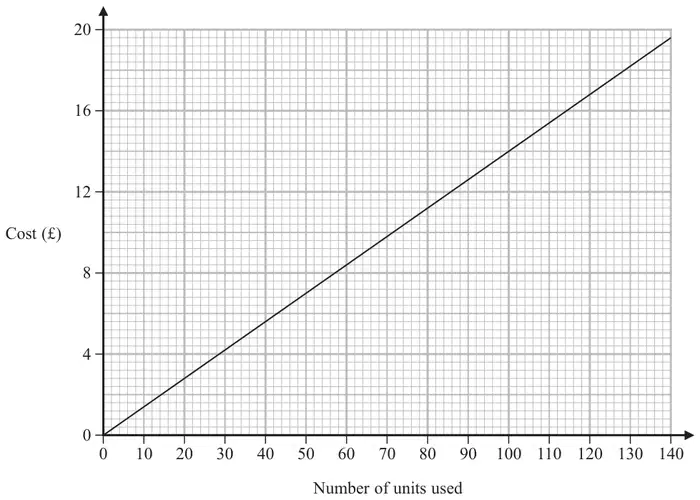
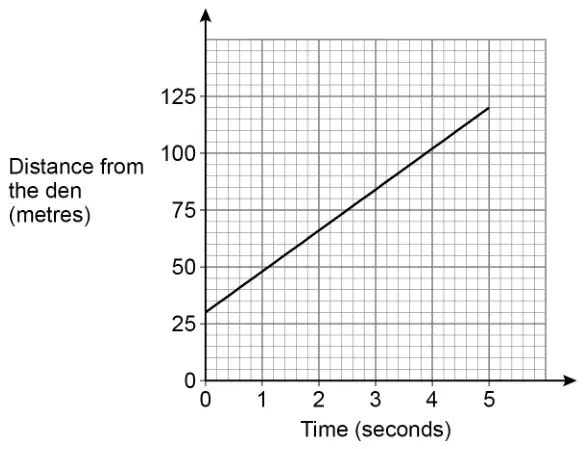
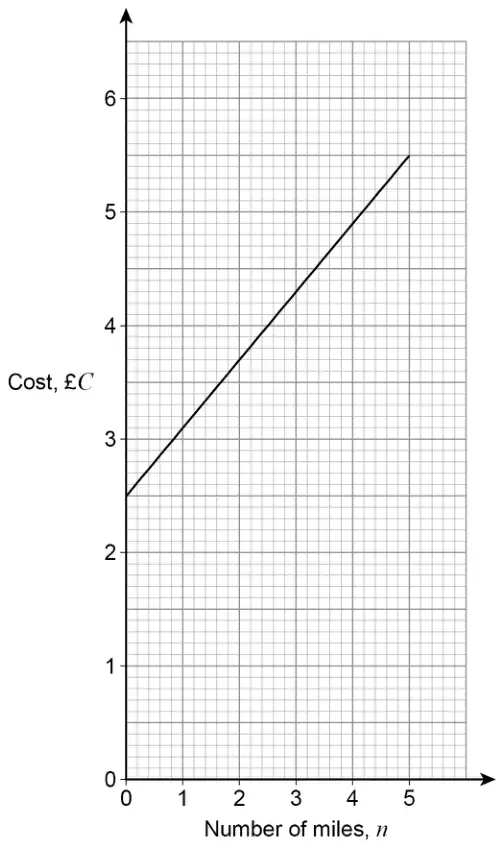
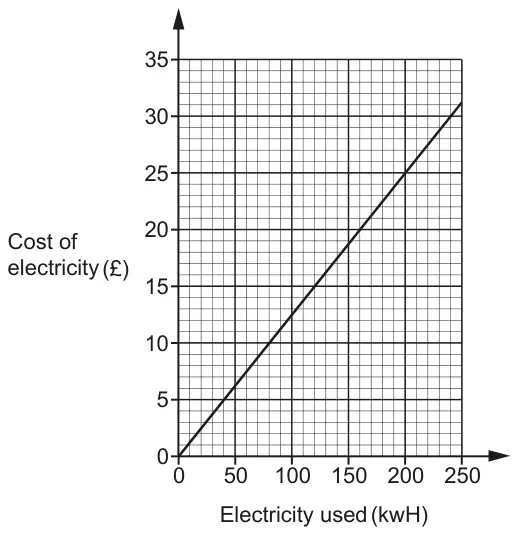
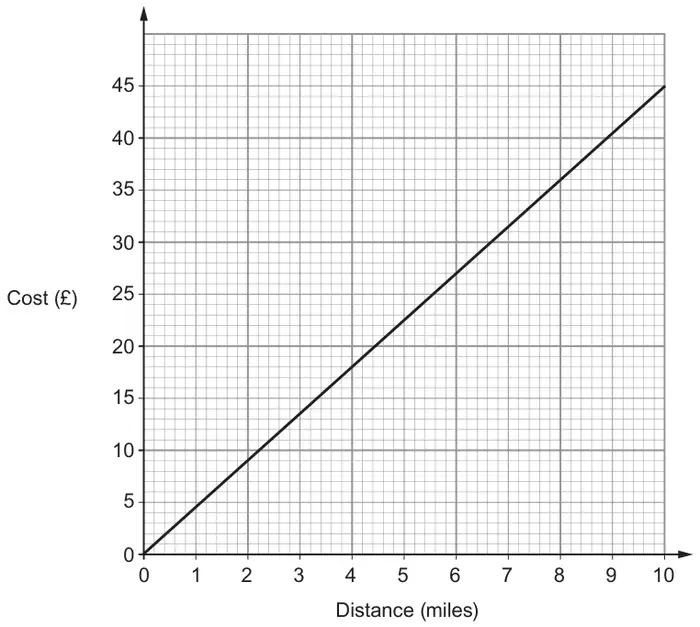
8 An electricity company charges the same fixed amount for each unit of electricity used.
David uses this graph to work out the total cost of the electricity he has used.
(a) Work out the gradient of the straight line. (2)
(b) What does the gradient of this line represent? (1)
Mark scheme (a)
Answer
Mark
Mark scheme
0.14
M1
for a method to find the gradient, eg \(14 \div 100\) using readings from the graph, at least one correct or for an answer of \(0.14x\)
A1
for answer in the range 0.135 to 0.145 or ft correct readings from the graph
Additional guidance
Must use the scales on the graph
May be expressed as a fraction
Mark scheme (b)
Answer
Mark
Mark scheme
Cost per unit of electricity
C1
for a correct explanation
Acceptable examples eg cost of each unit (of electricity) rate of change of cost with units of electricity used cost per unit of electricity each unit costs 14p average cost charged for each unit of electricity used
Not acceptable examples cost of how many units used costs in pounds per number of units used how much the cost of electricity goes up the relationship of cost and number of units used how steep it is
18 On the grid below, draw the graph of \(y = 2x - 2\) for values of \(x\) from \(-2\) to 3 (3)
Mark scheme
Answer
Mark
Mark scheme
Line drawn
B3
for a correct line drawn between \(x = -2\) and \(x = 3\)
(B2
for a correct straight-line segment through at least 3 of \((-2, -6), (-1, -4), (0, -2), (1, 0), (2, 2), (3, 4)\) or for all of the above points plotted but not joined or for a single line drawn with a positive gradient through \((0, -2)\) and clear intention to use a gradient of 2, eg a line through \((0, -2)\) and \((0.5, 0)\)
(B1
for at least 2 correct points stated or plotted or a single line drawn with positive gradient through \((0, -2)\) or a single line with gradient 2)
25 The straight line L has equation \(3x + 2y = 17\)
The point \(A\) has coordinates (0, 2) The straight line M is perpendicular to L and passes through \(A\).
Line L crosses the \(y\)-axis at the point \(B\). Lines L and M intersect at the point \(C\).
Work out the area of triangle \(ABC\). You must show all your working. (5)
Mark scheme
Answer
Mark
Mark scheme
9.75
P1
process to find the gradient of L \(\left(= -\dfrac{3}{2}\right)\)
P1
process to find the gradient of the perpendicular line M eg use of \(-\dfrac{1}{m}\) or states gradient as \(\dfrac{2}{3}\) or \(y = \dfrac{2}{3}x + c\)
B1
(indep) gives \(y\) coordinate of \(B = 8.5\) oe
P1
(dep P2) process to find \(x\) coordinate of \(C\) (= 3) or \(y\) coordinate of \(C\) (= 4) eg the first stage of solving equations or using elimination by substitution, to find a coordinate of \(C\).
A1
9.75 oe
Additional guidance
Could be indicated other ways, eg 8.5 on the \(y\) axis of a diagram
ft their linear equation for M with L; allow some error in manipulation of these linear equations as long as the overall process is correct.
Award 0 marks for a correct answer with no supportive working.
21 On the grid below, draw the graph of \(y = 2x - 3\) for values of \(x\) from \(-2\) to 4 (3)
Mark scheme
Answer
Mark
Mark scheme
Graph
B3
for a correct line between \(x = -2\) and \(x = 4\)
(B2
for a correct straight line segment through at least 3 of \((-2, -7), (-1, -5), (0, -3), (1, -1), (2, 1), (3, 3), (4, 5)\) or for all of these points plotted but not joined OR for a line drawn with a positive gradient through \((0, -3)\) and clear intention to use a gradient of 2, eg line through \((0,-3)\) going across 2 squares and up 4 squares )
(B1
for at least 2 correct points stated or plotted OR for a line drawn with a positive gradient through \((0, -3)\) OR a line with gradient 2)
Additional guidance
For B2: Ignore any incorrect points. Points need not be plotted for a correct line (segment) drawn
Table of values
\(x\)
\(-2\)
\(-1\)
0
1
2
3
4
\(y\)
\(-7\)
\(-5\)
\(-3\)
\(-1\)
1
3
5
For B1: Ignore any incorrect points Coordinates may be in a table or in working
16 The straight line \(\mathbf{L}\) has the equation \(3y = 4x + 7\) The point \(A\) has coordinates \((3, -5)\)
Find an equation of the straight line that is perpendicular to \(\mathbf{L}\) and passes through \(A\). (3)
Mark scheme
Answer
Mark
Mark scheme
\(y = -\dfrac{3}{4}x - \dfrac{11}{4}\)
M1
for identifying a gradient of \(\dfrac{4}{3}\) (ignore constant term)
M1
for beginning a method to find the gradient of the perpendicular line eg \(\dfrac{4}{3} \times m = -1\) or identifies the gradient of the perpendicular line as \(-\dfrac{3}{4}\) (can ft providing gradient is clearly stated)
A1
for \(y = -\dfrac{3}{4}x - \dfrac{11}{4}\) or any equivalent equation
2 On the grid below, draw the graph of \(y = 2x - 3\) for values of \(x\) from \(-2\) to 4 (3)
Mark scheme
Answer
Mark
Mark scheme
Graph
B3
for a correct line between \(x = -2\) and \(x = 4\)
(B2
for a correct straight line segment through at least 3 of \((-2, -7)\), \((-1, -5)\), \((0, -3)\), \((1, -1)\), \((2, 1)\), \((3, 3)\), \((4, 5)\) or for all of these points plotted but not joined OR for a line drawn with a positive gradient through \((0, -3)\) and clear intention to use a gradient of 2, eg line through \((0, -3)\) going across 2 squares and up 4 squares)
(B1
for at least 2 correct points stated or plotted OR for a line drawn with a positive gradient through \((0, -3)\) OR a line with gradient 2)
Additional guidance
Ignore any incorrect points. Points need not be plotted for a correct line (segment) drawn
Table of values
\(x\)
−2
−1
0
1
2
3
4
\(y\)
−7
−5
−3
−1
1
3
5
Ignore any incorrect points Coordinates may be in a table or in working
25 \(A\) is the point with coordinates (5, 9) \(B\) is the point with coordinates (\(d\), 15)
The gradient of the line \(AB\) is 3
Work out the value of \(d\). (3)
Mark scheme
Answer
Mark
Mark scheme
7
P1
process to use gradient eg \(y = 3x + c\) or \(c = -6\) or \(\dfrac{15 - 9}{d - 5}\) or \((15 - 9) \div 3\) or (6, 12)
P1
(dep) full process to rearrange equation formed to isolate \(d\) eg rearrangement of \(15 = 3d - 6\) or \(3 = \dfrac{15 - 9}{d - 5}\) or for \(5 + \dfrac{15 - 9}{3}\)
A1
cao
Additional guidance
Condone use of a letter other than \(d\), for \(d\)
18 The straight line \(\mathbf{L}_1\) passes through the points with coordinates \((4, 6)\) and \((12, 2)\) The straight line \(\mathbf{L}_2\) passes through the origin and has gradient \(-3\)
The lines \(\mathbf{L}_1\) and \(\mathbf{L}_2\) intersect at point \(P\).
Find the coordinates of \(P\). (4)
Mark scheme
Answer
Mark
Mark scheme
\(\left(\dfrac{-16}{5}, \dfrac{48}{5}\right)\)
P1
for a method to find gradient of \(\mathbf{L}_1\) eg \(\dfrac{6 - 2}{4 - 12}\ \left(= -\frac{1}{2}\right)\) or states \(\mathbf{L}_2\) as \(y = -3x\)
P1
(dep on P1) for a method to find equation of \(\mathbf{L}_1\) eg subs into \(y = \text{``}{-}\frac{1}{2}\text{''}x + c\) OR states \(\mathbf{L}_1\) as \(y = \text{``}{-}\frac{1}{2}\text{''}x + 8\)
P1
(dep on P2) complete method to equate both lines eg \(\text{``}{-}\frac{1}{2}\text{''}x + 8 = -3x\)
6 \(A\) is the point with coordinates (5, 9) \(B\) is the point with coordinates (\(d\), 15)
The gradient of the line \(AB\) is 3
Work out the value of \(d\). (3)
Mark scheme
Answer
Mark
Mark scheme
7
P1
process to use gradient eg \(y = 3x + c\) or \(c = -6\) or \(\dfrac{15 - 9}{d - 5}\) or \((15 - 9) \div 3\) or (6, 12)
P1
(dep) full process to rearrange equation formed to isolate \(d\) eg rearrangement of \(15 = 3d - 6\) or \(3 = \dfrac{15 - 9}{d - 5}\) or for \(5 + \dfrac{15 - 9}{3}\)
A1
cao
Additional guidance
Condone use of a letter other than \(d\), for \(d\)
25 On the grid below, draw the graph of \(y = 1 - 4x\) for values of \(x\) from \(-3\) to 3 (3)
Mark scheme
Answer
Mark
Mark scheme
Line drawn
B3
for a correct line between \(x = -3\) and \(x = 3\)
(B2
for a correct straight-line segment through at least 3 of \((-3, 13)\), \((-2, 9)\), \((-1, 5)\), \((0, 1)\), \((1, -3)\), \((2, -7)\), \((3, -11)\)
or for all of these points plotted but not joined
or for a line drawn with a negative gradient through \((0, 1)\) and clear intention to use a gradient of \(-4\), eg line through \((0, 1)\) and \((0.5, -1)\)
(B1
for at least 2 correct points stated or plotted or for a line drawn with a negative gradient through \((0, 1)\) or a line with gradient \(-4\))
Additional guidance
Ignore any incorrect points
Table of values
\(x\)
\(-3\)
\(-2\)
\(-1\)
\(0\)
\(1\)
\(2\)
\(3\)
\(y\)
\(13\)
\(9\)
\(5\)
\(1\)
\(-3\)
\(-7\)
\(-11\)
Ignore any incorrect points coordinates may be in a table or in working
for a correct method to find the gradient of the line, or \(m = 3\) OR identifies \(-6\) as the intercept in words or in a partial equation OR \(y - b = m(x - a)\) where \(m \neq 3\) and \((a, b)\) is a correct coordinate
M1
for \(y = 3x + c\) or (L=) \(3x - 6\) or \(y = \text{``}3\text{''}x - 6\) OR \(y - y_1 = 3(x - x_1)\) or \(y - b = \text{``}3\text{''}(x - a)\) where \((a, b)\) is a correct coordinate
A1
accept \(y = 3x + -6\) oe
Additional guidance
Just ringing -6 is insufficient
Award of this mark implies the first M1 \(c\) must be seen either as a letter or a number
19 The point \(P\) has coordinates \((3, 4)\) The point \(Q\) has coordinates \((a, b)\)
A line perpendicular to \(PQ\) is given by the equation \(3x + 2y = 7\)
Find an expression for \(b\) in terms of \(a\). (5)
Mark scheme
Answer
Mark
Mark scheme
\(b = \dfrac{2}{3}a + 2\)
P1
for process to rearrange the equation to give \(y\) in terms of \(x\) eg \(y = \dfrac{7 - 3x}{2}\) or \(y = -\dfrac{3}{2}x + \left(\dfrac{7}{2}\right)\) or \(m = -\dfrac{3}{2}\)
P1
for using their gradient in \(mn = -1\)
P1
for showing a process to find the gradient of \(PQ\) eg \(\dfrac{b - 4}{a - 3}\) OR for substituting \(x = 3\) and \(y = 4\) in \(y = \text{``}\tfrac{2}{3}\text{''}x + c\)
P1
(dep P3) for forming an equation in \(a\) and \(b\) eg \(\dfrac{b - 4}{a - 3} = \text{``}\tfrac{2}{3}\text{''}\) or \(b = \text{``}\tfrac{2}{3}\text{''}a + \text{``}2\text{''}\) OR correct equation in terms of \(x\) and \(y\) eg \(y = \dfrac{2}{3}x + 2\)
12 The graph shows the volume of liquid (\(L\) litres) in a container at time \(t\) seconds.
(a) Find the gradient of the graph. (2)
(b) Explain what this gradient represents. (1)
The graph intersects the volume axis at \(L = 4\)
(c) Explain what this intercept represents. (1)
Mark scheme (a)
Answer
Mark
Mark scheme
1.5
M1
for method to find the gradient of the line, eg \(\dfrac{12}{8}\)
A1
for 1.5 oe
Additional guidance
Must see use of scales.
Mark scheme (b)
Answer
Mark
Mark scheme
Explanation
C1
Explanation relating to rate of change of volume with time, eg rate at which the container fills or change in number of litres per second or number of litres added per second
Additional guidance
Ignore any quantities given. Award the mark for an explanation involving rate.
Mark scheme (c)
Answer
Mark
Mark scheme
Explanation
C1
Explanation relating to volume (amount) of liquid in the container at the start eg number of litres in the container when \(t = 0\), amount of liquid in the container to start with
for a correct method to find the gradient of the line, or \(m = 3\) OR identifies \(-6\) as the intercept in words or in a partial equation OR \(y - b = m(x - a)\) where \(m \neq 3\) and \((a, b)\) is a correct coordinate
M1
for \(y = 3x + c\) or (L=) \(3x - 6\) or \(y = \text{``}3\text{''}x - 6\) OR \(y - y_1 = 3(x - x_1)\) or \(y - b = \text{``}3\text{''}(x - a)\) where \((a, b)\) is a correct coordinate
A1
accept \(y = 3x + -6\) oe
Additional guidance
Just ringing -6 is insufficient
Award of this mark implies the first M1 \(c\) must be seen either as a letter or a number
19 A triangle has vertices \(P\), \(Q\) and \(R\).
The coordinates of \(P\) are \((-3, -6)\) The coordinates of \(Q\) are \((1, 4)\) The coordinates of \(R\) are \((5, -2)\)
\(M\) is the midpoint of \(PQ\). \(N\) is the midpoint of \(QR\).
Prove that \(MN\) is parallel to \(PR\). You must show each stage of your working. (4)
Mark scheme
Answer
Mark
Notes
Proof (supported)
M1
for a method to find coordinates of \(M\,(-1, -1)\) or \(N\,(3, 1)\)
M1
for method to find gradient of \(MN\) or \(PR\) or for method to find column vector for \(MN\) or \(PR\) or for differences of \(x\) coordinates and differences of \(y\) coordinates for \(MN\) or \(PR\)
A1
for gradients of \(MN\) and \(PR\), ie \(\frac{1}{2}\) oe or for column vectors of \(MN\) and \(PR\), \(\overrightarrow{MN} = \begin{pmatrix}4\\2\end{pmatrix}\) and \(\overrightarrow{PR} = \begin{pmatrix}8\\4\end{pmatrix}\) or for differences of \(x\) coordinates and of \(y\) coordinates for \(MN\) and \(PR\)
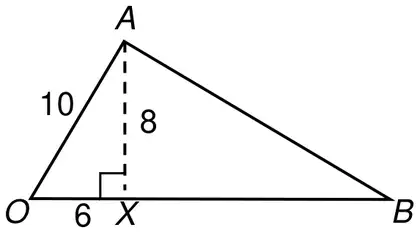
for method to find gradient of \(OP\), eg \(\dfrac{\sqrt{7}}{2} \div \dfrac{3}{2}\ \left(= \dfrac{\sqrt{7}}{3} \text{ or } 0.88\ldots\right)\) oe
M1
(dep) for method to find gradient of tangent, \(m\), eg. \(\dfrac{\frac{\sqrt{7}}{2}}{\frac{3}{2}} \times m = -1\ \left(m = \dfrac{-3}{\sqrt{7}} \text{ or } -1.13\ldots\right)\)
A1
for \(y - \dfrac{\sqrt{7}}{2} = \dfrac{-3}{\sqrt{7}}\left(x - \dfrac{3}{2}\right)\) or \(y = \dfrac{-3\sqrt{7}}{7}x + \dfrac{8\sqrt{7}}{7}\) oe or \(y - 1.32\ldots = -1.13\ldots(x - 1.5)\)
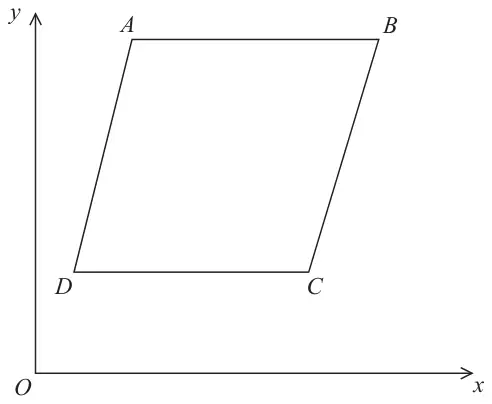
\(ABCD\) is a rhombus. The coordinates of \(A\) are \((5, 11)\) The equation of the diagonal \(DB\) is \(y = \dfrac{1}{2}x + 6\)
Find an equation of the diagonal \(AC\). (4)
Mark scheme
Answer
Mark
Notes
\(y = -2x + 21\)
P1
shows evidence of understanding that \(AC\) is perpendicular to \(DB\), or states the gradient of \(DB\) as 0.5 oe
P1
shows a process to find the gradient of a perp. line e.g. use of \(-\dfrac{1}{m}\) or states \(y = -2x + c\) or states the gradient of \(AC\) as \(-2\)
P1
(dep on P2) for sub. of \(x = 5\), \(y = 11\) into \(y = mx + c\) where \(m\) is their found gradient for \(AC\).
(a) Complete the table of values for \(x + y = 4\)
\(x\)
\(-1\)
0
1
2
3
4
\(y\)
3
0
(2)
(b) On the grid, draw the graph of \(x + y = 4\) for values of \(x\) from \(-1\) to 4(2)
Mark scheme (a)
Answer
Mark
Notes
5, 4, (3), 2, 1, (0)
2
M1 for 1 or 2 or 3 correct entries A1 cao
Mark scheme (b)
Answer
Mark
Notes
Line drawn
2
M1 plots 5 of their points correctly or a straight line with gradient \(-1\) or a straight line through (0, 4) A1 correct line between \(x = -1\) and \(x = 4\)
(a) Complete the table of values for \(y = 8 - 2x\)
\(x\)
\(-1\)
0
1
2
3
4
\(y\)
6
0
(2)
(b) On the grid, draw the graph of \(y = 8 - 2x\) for values of \(x\) from \(-1\) to 4(2)
Mark scheme (a)
Answer
Mark
Notes
10, 8, (6), 4, 2, (0)
2
B2 for fully correct table (B1 for 2 or 3 entries correct)
Mark scheme (b)
Answer
Mark
Notes
line drawn
2
B2 for correct straight line between \(x = -1\) and \(x = 4\) (B1 for a single straight line which passes through (0, 8) or for a single straight line with negative gradient \(-2\) or for at least 5 points from their table plotted correctly)
The midpoint of the line segment \(AB\) has coordinates (3, 5) Point \(A\) has coordinates (9, 2)
(a) Work out the coordinates of point \(B\). (2)
(b) Work out an equation of the straight line that passes through (9, 2) and (3, 5) (3)
Mark scheme (a)
Answer
Mark
Notes
\(-3\), 8
2
M1 for \(3 + (3 - 9)\) (\(= -3\)) oe or \(5 + (5 - 2)\) (= 8) oe or \(\dfrac{x + 9}{2} = 3\) or \(\dfrac{y + 2}{2} = 5\) A1 cao
Mark scheme (b)
Answer
Mark
Notes
\(y = -0.5x + 6.5\)
3
M1 for a correct method to find the gradient (\(= -0.5\)), ft the possible use of coordinates in part (a) M1 for method to find \(c\) eg substituting into \(y = \text{``}{-}0.5\text{''}x + c\) A1 for \(y = -0.5x + 6.5\) oe
7 On the grid, draw the graph of \(y = 8 - 2x\) for values of \(x\) from \(-1\) to 4
(3)
Mark scheme
Working
Answer
Mark
Notes
\(x\)
\(-1\)
0
1
2
3
4
\(y\)
10
8
6
4
2
0
\(y = 8 - 2x\) drawn
3
B3 for a correct line between \(x = -1\) and \(x = 4\)
OR B2 for a correct straight line segment through at least 3 of \((-1, 10)\), (0, 8), (1, 6), (2, 4), (3, 2), (4, 0) or for all of these points plotted but not joined or for a line drawn with a negative gradient through (0, 8) and clear intention to use of a gradient of \(-2\), eg line through (0,8) and (0.5, 6)
OR B1 for at least 2 correct points stated or plotted or for a line drawn with a negative gradient through (0, 8) or a line with gradient \(-2\)
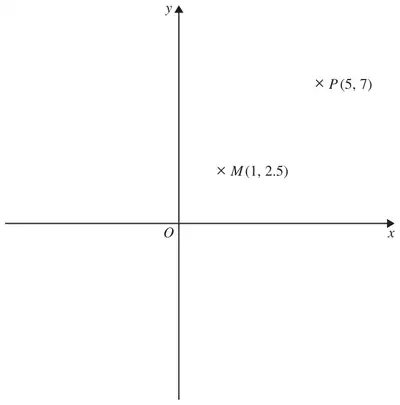
Point \(P\) has coordinates (5, 7). Point \(M\) has coordinates (1, 2.5).
Point \(M\) is the midpoint of the line \(PQ\).
Find the coordinates of point \(Q\). (2)
Mark scheme
Answer
Mark
Notes
\(-3\), \(-2\)
2
M1 for \(x = -3\) or \(y = -2\); for finding the difference between the \(x\) or \(y\) coordinates of \(M\) and \(P\) (eg \(\pm 4\) or \(\pm 4.5\)); for \(\dfrac{x + 5}{2} = 1\) or for \(\dfrac{y + 7}{2} = 2.5\) A1 for \(x = -3\), \(y = -2\)
17 \(\mathbf{L}_1\) and \(\mathbf{L}_2\) are parallel lines.
The equation of \(\mathbf{L}_1\) is \(y = 3x + 2\)
\(\mathbf{L}_2\) passes through the point (3, 4).
Find an equation for \(\mathbf{L}_2\). (3)
Mark scheme
Answer
Mark
Notes
\(y = 3x - 5\)
3
M1 for recognition that the gradient of \(\mathbf{L}_2\) is 3 M1 for substitution of \(x = 3\) and \(y = 4\) into \(y = \text{``}m\text{''}x + c\) A1 \(y = 3x - 5\) oe (SC B2 for \(3x - 5\) or \(\mathbf{L}_2 = 3x - 5\))
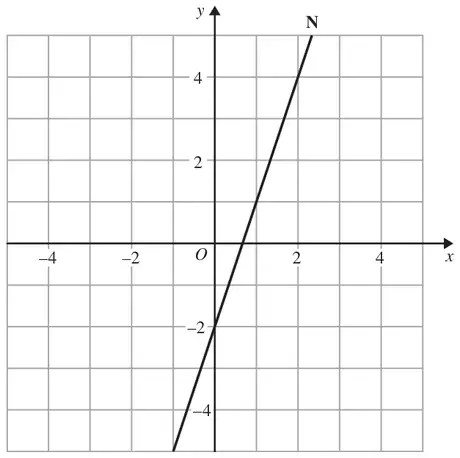
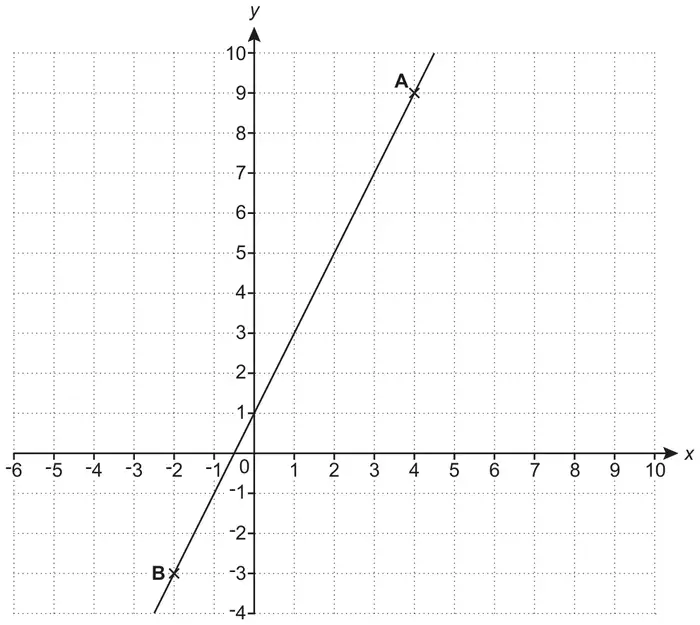
Find an equation of the line perpendicular to line \(\mathbf{N}\) that passes through the point (0, 1). (3)
Mark scheme
Working
Answer
Mark
Notes
Gradient of N = 3 Gradient of perpendicular to line N = \(-\tfrac{1}{3}\)
\(y = -\dfrac{1}{3}x + 1\)
3
M1 for complete method to find gradient of line N or for drawing a perpendicular line M1 for method to find the gradient of a perpendicular line A1 \(y = -\dfrac{1}{3}x + 1\) oe
Point \(A\) has coordinates \((-2, 4)\). Point \(B\) has coordinates (8, 9).
\(C\) is the midpoint of the line segment \(AB\).
(a) Find the coordinates of \(C\). (2)
\(D\) is the point with coordinates (100, 56).
*(b) Does point \(D\) lie on the straight line that passes through \(A\) and \(B\)? You must show how you work out your answer. (3)
Mark scheme (a)
Answer
Mark
Notes
(3, 6.5)
2
M1 for a method to find either the \(x\) coordinate or the \(y\) coordinate of the midpoint or \(x = 3\) or \(y = 6.5\) oe A1 cao [SC: B1 for (6.5, 3)]
Mark scheme (b)
Answer
Mark
Notes
No and correct working
3
M1 for a method to work out a gradient between any relevant pair of points (ie 2 of points A, B, C or D), eg. \(\dfrac{9 - 4}{8 - {-2}} \left(= \dfrac{5}{10}\right)\) M1 (dep) for a method to work out the gradient between another pair of points which can be used for comparison; one gradient must be through D. C1 for “no” and a correct explanation based on two correct gradients
OR M1 for a method to work out a gradient between any relevant pair of points (ie 2 of points A, B, C or D), eg. \(\dfrac{9 - 4}{8 - {-2}} \left(= \dfrac{5}{10}\right)\) M1 (dep) for using their gradient to work out an equation of a straight line in the form \(y = mx + c\) and substituting in an appropriate point C1 for “no” and a correct explanation based on correct working
OR M2 for (100, 55) or (102, 56) C1 for “no” and a correct explanation based on correct coordinates.
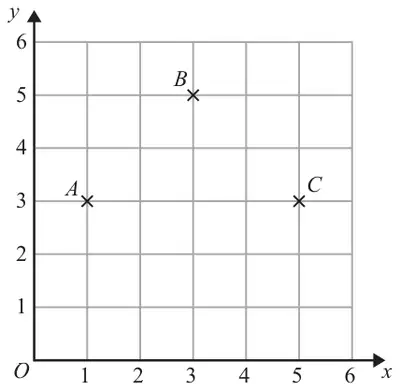
12 The points \(A\), \(B\) and \(C\) lie in order on a straight line.
The coordinates of \(A\) are (2, 5) The coordinates of \(B\) are \((4, p)\) The coordinates of \(C\) are \((q, 17)\)
Given that \(AC = 4AB\), find the values of \(p\) and \(q\). (3)
Mark scheme
Answer
Mark
Notes
\(p = 8\), \(q = 10\)
3
M1 for finding the difference between the \(x\) or \(y\) coordinates eg \(4 - 2\) (= 2) or \(17 - 5\) (= 12) M1 for a complete method to find the value of \(p\) or the value of \(q\) A1 cao
25 On the grid, draw the graph of \(y = 2x - 3\) for values of \(x\) from \(-2\) to 3 (4)
Mark scheme
Answer
Mark
Notes
Straight line from \((-2, -7)\) to \((3, 3)\)
4
(Table of values) C1 for axes scaled and labelled M1 for at least 2 correct attempts to find points by substituting values of \(x\) M1 ft for plotting at least 2 of their points (any points plotted from their table must be plotted correctly) A1 for correct line between \(x = -2\) and \(x = 3\)
(No table of values) C1 for axes scaled and labelled M1 for at least 2 correct points with no more than 2 incorrect points M1 for at least 2 correct points (and no incorrect points) plotted OR line segment of \(y = 2x - 3\) drawn A1 for correct line between \(x = -2\) and \(x = 3\)
(Use of \(y = mx + c\)) C1 for axes scaled and labelled M1 for line drawn with gradient of 2 OR line drawn with a \(y\) intercept of \(-3\) M1 for line drawn with gradient of 2 AND with a \(y\) intercept of \(-3\) A1 for correct line between \(x = -2\) and \(x = 3\)
[SC B2 (indep of C1) for the correct line between \(x = 0\) and \(x = 3\), ignore any additional incorrect line segment(s)]
M1 for \(\tfrac{3}{2}\) oe or \(y = \tfrac{3}{2}x \left(-\tfrac{4}{2}\right)\) oe M1 for method to find gradient of AB, eg \(\dfrac{-1 - 3}{4 - 1}\) or \(\dfrac{3 - -1}{1 - 4}\) or \(\dfrac{-4}{3}\) oe A1 for identifying gradients as \(\tfrac{3}{2}\) oe and \(-\tfrac{4}{3}\) oe C1 (dep on M1) for a conclusion with a correct reason, eg No as product of \(\tfrac{3}{2}\) and \(\dfrac{-4}{3}\) is not \(-1\), ft from their two gradients
12 On the grid, draw the graph of \(y = 2x - 3\) for values of \(x\) from \(-2\) to 3
(4)
Mark scheme
Answer
Mark
Notes
Straight line from \((-2, -7)\) to (3, 3)
4
(Table of values) C1 for axes scaled and labelled M1 for at least 2 correct attempts to find points by substituting values of \(x\) M1 ft for plotting at least 2 of their points (any points plotted from their table must be plotted correctly) A1 for correct line between \(x = -2\) and \(x = 3\)
(No table of values) C1 for axes scaled and labelled M1 for at least 2 correct points with no more than 2 incorrect points M1 for at least 2 correct points (and no incorrect points) plotted OR line segment of \(y = 2x - 3\) drawn A1 for correct line between \(x = -2\) and \(x = 3\)
(Use of \(y = mx + c\)) C1 for axes scaled and labelled M1 for line drawn with gradient of 2 OR line drawn with a \(y\) intercept of \(-3\) M1 for line drawn with gradient of 2 AND with a \(y\) intercept of \(-3\) A1 for correct line between \(x = -2\) and \(x = 3\)
SC : B2 for the correct line from \(x = 0\) to \(x = 3\)
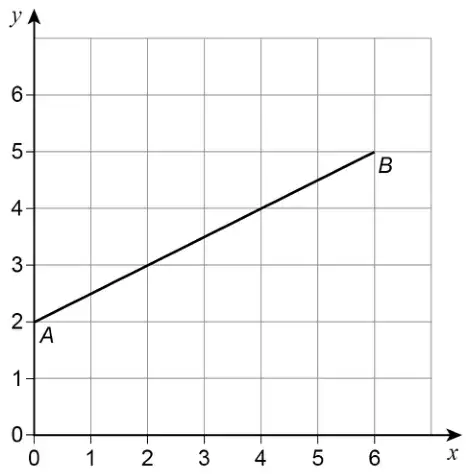
19 The diagram shows a straight line, \(\mathrm{L}_1\), drawn on a grid.
A straight line, \(\mathrm{L}_2\), is parallel to the straight line \(\mathrm{L}_1\) and passes through the point \((0, -5)\).
Find an equation of the straight line \(\mathrm{L}_2\). (3)
Mark scheme
Answer
Mark
Notes
\(y = \dfrac{1}{2}x - 5\)
3
M1 for method to find gradient of \(\mathrm{L}_1\) e.g \(\dfrac{6 - 3}{6 - 0}\) \(\left(= \dfrac{1}{2}\right)\) M1 for \(y = \text{``}\dfrac{1}{2}\text{''}x + c\) or \(y = mx - 5\) (\(c\), \(m\) do not have to be numerical, or correct numerical values) or for \((L =) \dfrac{1}{2}x - 5\) A1 \(y = \dfrac{1}{2}x - 5\) oe
26 On the grid, draw the graph of \(y = 3x + 2\) for values of \(x\) from \(-2\) to 2
(4)
Mark scheme
Working
Answer
Mark
Notes
\(x\)
\(-2\)
\(-1\)
0
1
2
\(y\)
\(-4\)
\(-1\)
2
5
8
\(y = 3x + 2\) drawn
4
B1 for axes scaled and labelled (Table of values) M1 for at least 2 correct attempts to find points by substituting values of \(x\) M1 ft for plotting at least 2 of their points (any points from their table must be correctly plotted) A1 for correct line between \(x = -2\) and \(x = 2\) (No table of values) M1 for at least 2 correct points with no more than 2 incorrect points M1 for at least 2 correct points (and no incorrect points) plotted OR line segment of \(y = 3x + 2\) drawn A1 for correct line between \(x = -2\) and \(x = 2\) (Use of \(y = mx + c\)) M1 for line drawn with gradient of 3 OR line drawn with \(y\) intercept at 2 M1 for line drawn with gradient of 3 AND with \(y\) intercept at 2 A1 for correct line between \(x = -2\) and \(x = 2\) [SC B2 (indep of B1) for correct line segment between \(x = 0\) and \(x = 2\) – ignore any additional incorrect line segment(s)]
Line A has equation \(2y = 3x + 8\) Line B goes through the points \((-1, 2)\) and (2, 8)
Do lines A and B intersect? You must show all your working. (3)
Mark scheme
Answer
Mark
Notes
Yes with explanation
3
M1 For Line A: writes equation as \(y = 1.5x + 4\) or gives the gradient as 1.5 or constant term of 4 OR for Line B: shows a method which could lead to finding the gradient or gives the gradient as 2 or constant term of 4 or calculates a sequence of points including (0,4) or writes equation of line as \(y = 2x + 4\) M1 Shows correct aspects relating to an aspect of Line A and an aspect of Line B that enables some comparison to be made eg gradients, equations or points. C1 for gradients 1.5 and 2 and Yes with explanation that the gradients are different or states the lines intersect at (0,4) or explanation that interprets common constant term (4) from equations
OR
M1 for a diagram that shows both lines drawn and intersecting at (0,4) M1 for a diagram that shows both lines and their intersection point identified as (0,4) C1 for Yes and states the intersection point as (0,4)
12 On the grid, draw the graph of \(y = 3x + 2\) for values of \(x\) from \(-2\) to 2 (4)
Mark scheme
Answer
Mark
Notes
\(y = 3x + 2\) drawn
4
B1 for axes scaled and labelled
(Table of values) M1 for at least 2 correct attempts to find points by substituting values of \(x\) M1 ft for plotting at least 2 of their points (any points from their table must be correctly plotted) A1 for correct line between \(x = -2\) and \(x = 2\)
(No table of values) M1 for at least 2 correct points with no more than 2 incorrect points M1 for at least 2 correct points (and no incorrect points) plotted OR line segment of \(y = 3x + 2\) drawn A1 for correct line between \(x = -2\) and \(x = 2\)
(Use of \(y = mx + c\)) M1 for line drawn with gradient of 3 OR line drawn with \(y\) intercept at 2 M1 for line drawn with gradient of 3 AND with \(y\) intercept at 2 A1 for correct line between \(x = -2\) and \(x = 2\)
SC B2 (indep of B1) for correct line segment between \(x = 0\) and \(x = 2\) (ignore any additional incorrect line segment(s))
On the grid, draw the graph of \(y = \frac{1}{2}x + 5\) for values of \(x\) from \(-2\) to 4 (3)
Mark scheme
Working
Answer
Mark
Notes
\(x\)
\(-2\)
\(-1\)
0
1
2
3
4
\(y\)
4
4.5
5
5.5
6
6.5
7
\(y = \frac{1}{2}x + 5\) drawn
3
(Table of values / calculation of values) M1 for at least 2 correct attempts to find points by substituting values of \(x\). M1 ft for plotting at least 2 of their points (any points plotted from their table must be plotted correctly) A1 for correct line between \(x = -2\) and \(x = 4\) (No table of values) M1 for at least 2 correct points with no more than 2 incorrect points M1 for at least 2 correct points (and no incorrect points) plotted OR line segment of \(y = \frac{1}{2}x + 5\) drawn A1 for correct line between \(x = -2\) and \(x = 4\) (Use of \(y = mx + c\)) M1 for line drawn with gradient of 0.5 OR line drawn with a \(y\) intercept of 5 M1 for line drawn with gradient of 0.5 AND with a \(y\) intercept of 5 A1 for correct line between \(x = -2\) and \(x = 4\) SC : B2 for the correct line from \(x = 0\) to \(x = 4\)
12 On the grid, draw the graph of \(y = \dfrac{1}{2}x + 5\) for values of \(x\) from \(-2\) to 4 (3)
Mark scheme
Answer
Mark
Notes
\(y = \frac{1}{2}x + 5\) drawn
3
(Table of values/calculation of values) M1 for at least 2 correct attempts to find points by substituting values of \(x\). M1 ft for plotting at least 2 of their points (any points plotted from their table must be plotted correctly) A1 for correct line between \(x = -2\) and \(x = 4\)
(No table of values) M1 for at least 2 correct points with no more than 2 incorrect points M1 for at least 2 correct points (and no incorrect points) plotted OR line segment of \(y = \frac{1}{2}x + 5\) drawn A1 for correct line between \(x = -2\) and \(x = 4\)
(Use of \(y = mx + c\)) M1 for line drawn with gradient 0.5 OR line drawn with \(y\) intercept at 5 M1 for line drawn with gradient 0.5 AND line drawn with \(y\) intercept at 5 A1 For correct line between \(x = -2\) and \(x = 4\)
SC B2 for a correct line from \(x = 0\) to \(x = 4\)
(a) Complete the table of values for \(y = 2x + 5\)
\(x\)
\(-2\)
\(-1\)
0
1
2
\(y\)
1
5
(2)
(b) On the grid, draw the graph of \(y = 2x + 5\) for values of \(x\) from \(x = -2\) to \(x = 2\)(2)
Mark scheme (a)
Working
Answer
Mark
Notes
\(x\)
\(-2\)
\(-1\)
0
1
2
\(y\)
(1)
3
(5)
7
9
3, 7, 9
2
B2 for all three values correct in the table (B1 for 2 values correct)
Mark scheme (b)
Working
Answer
Mark
Notes
graph of \(y = 2x + 5\)
2
(From their table of values) M1 ft for plotting at least 2 of their points (any points from their table must be correctly plotted) A1 for correct line from \(x = -2\) to \(x = +2\)
(Use of \(y = mx + c\)) M1 for line drawn with gradient of 2 or line drawn with a \(y\) intercept of 5 and a positive gradient) A1 for correct line from \(x = -2\) to \(x = +2\)
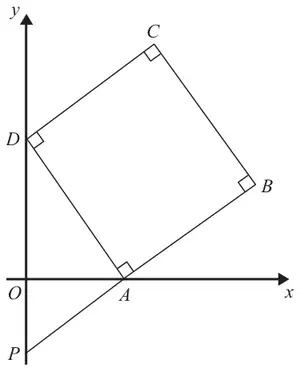
\(ABCD\) is a square. \(P\) and \(D\) are points on the \(y\)-axis. \(A\) is a point on the \(x\)-axis. \(PAB\) is a straight line.
The equation of the line that passes through the points \(A\) and \(D\) is \(y = -2x + 6\)
Find the length of \(PD\). (4)
Mark scheme
Answer
Mark
Notes
7.5
4
B1 for identifying \(A\) at 3 or \(D\) at 6 or \(A(3, 0)\) or \(D(0, 6)\) oe eg may be seen as labels on the diagram M1 for \(0 = \frac{-1}{-2} \times 3 + c\) M1 (dep on previous M1) for 6 + ‘1.5’ A1 cao OR B1 for identifying \(A\) at 3 or \(D\) at 6 or \(A(3, 0)\) or \(D(0, 6)\) oe eg may be seen as labels on the diagram M1 for \(3/6 = OP/3\) or 1.5 oe seen (from similar triangles) M1 for 6 + ‘1.5’ A1 cao OR B1 for identifying \(A\) at 3 or \(D\) at 6 or \(A(3, 0)\) or \(D(0, 6)\) oe eg may be seen as labels on the diagram M1 for \((6 + OP)^2 = (6^2 + 3^2) + (3^2 + OP^2)\) oe (from Pythagoras) M1 for 6 + ‘1.5’ A1 cao
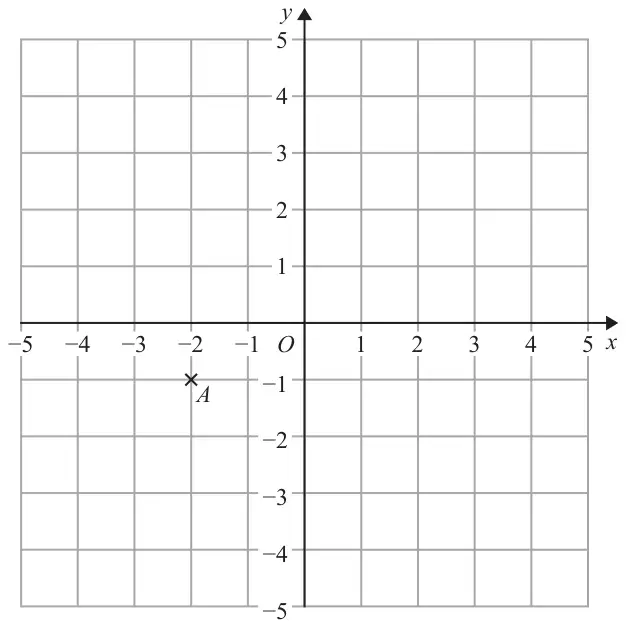
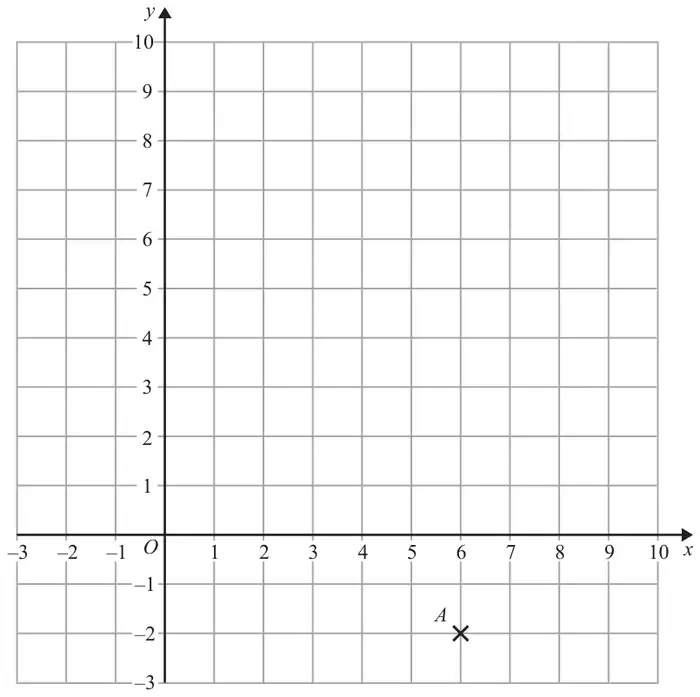
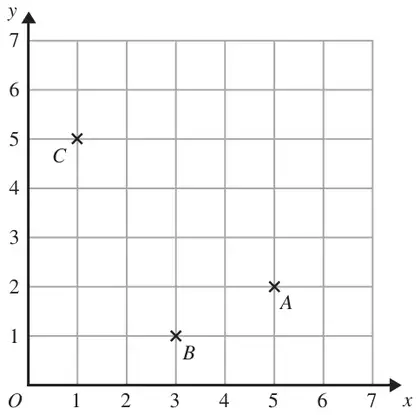
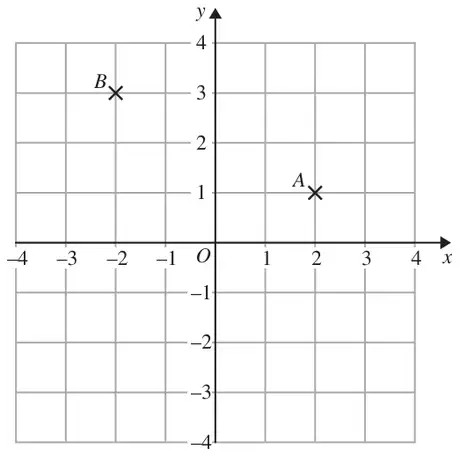
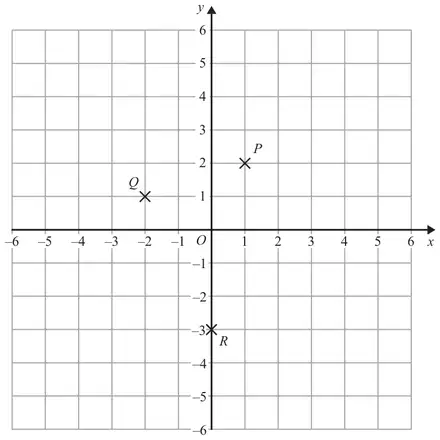
(a) Write down the coordinates of the point \(P\). (1)
(b) Write down the coordinates of the point \(R\). (1)
\(P\), \(Q\) and \(R\) are three vertices of a parallelogram.
(c) Write down the coordinates of the fourth vertex of this parallelogram. (1)
Mark scheme (a)
Answer
Mark
Notes
(1, 2)
1
B1 cao (accept coordinates just shown on the grid)
Mark scheme (b)
Answer
Mark
Notes
(0, \(-3\))
1
B1 cao (accept coordinates just shown on the grid)
Mark scheme (c)
Answer
Mark
Notes
(3, \(-2\))
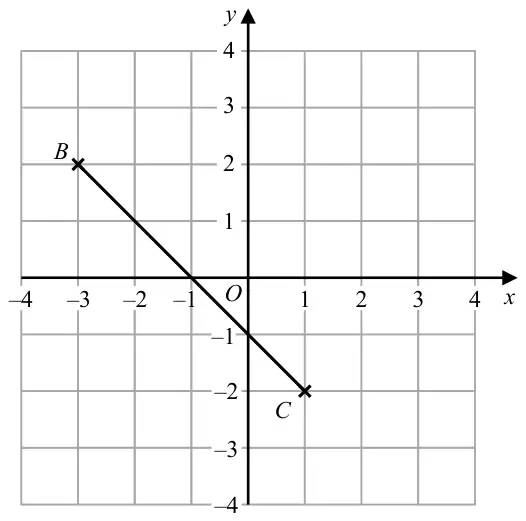
1
B1 for (3, \(-2\)) or (\(-3\), \(-4\)) or (\(-1\), 6) [SC: B1 for coordinates reversed, (\(-2\), 3) or (\(-4\), \(-3\)) or (6, \(-1\)) if coordinates reversed in parts (a) and (b)]
21 On the grid, draw the graph of \(y = 3x - 2\) for values of \(x\) from \(-1\) to 3 (3)
Mark scheme
Working
Answer
Mark
Notes
x
−1
0
1
2
3
y
−5
−2
1
4
7
Straight line from (\(-1\), \(-5\)) to (3, 7)
3
(Table of values) M1 for at least 2 correct attempts to find points by substituting values of \(x\). M1 ft for plotting at least 2 of their points (any points plotted from their table must be correctly plotted) A1 for correct line between \(-1\) and 3
(No table of values) M2 for at least 2 correct points (and no incorrect points) plotted OR line segment of \(y = 3x - 2\) drawn (ignore any additional incorrect segments) (M1 for at least 3 correct points plotted with no more than 2 incorrect points) A1 for correct line between \(-1\) and 3
(Use of \(y = mx + c\)) M2 for line segment of \(y = 3x - 2\) drawn (ignore any additional incorrect segments) (M1 for line drawn with gradient of 3 OR line drawn with a \(y\) intercept of \(-2\) and a positive gradient) A1 for correct line between \(-1\) and 3
4 On the grid, draw the graph of \(y = 3x - 2\) for values of \(x\) from \(-1\) to 3 (3)
Mark scheme
Working
Answer
Mark
Notes
\(x\)
\(-1\)
0
1
2
3
\(y\)
\(-5\)
\(-2\)
1
4
7
OR Using \(y = mx + c\) gradient = 3 \(y\) intercept = \(-2\)
Straight line from \((-1, -5)\) to \((3, 7)\)
3
(Table of values) M1 for at least 2 correct attempts to find points by substituting values of \(x\). M1 ft for plotting at least 2 of their points (any points plotted from their table must be correctly plotted) A1 for correct line between \(-1\) and 3 (No table of values) M2 for at least 2 correct points (and no incorrect points) plotted OR line segment of \(y = 3x - 2\) drawn (ignore any additional incorrect segments) (M1 for at least 3 correct points plotted with no more than 2 incorrect points) A1 for correct line between \(-1\) and 3 (Use of \(y = mx + c\)) M2 for line segment of \(y = 3x - 2\) drawn (ignore any additional incorrect segments) (M1 for line drawn with gradient of 3 OR line drawn with a \(y\) intercept of \(-2\) and a positive gradient) A1 for correct line between \(-1\) and 3
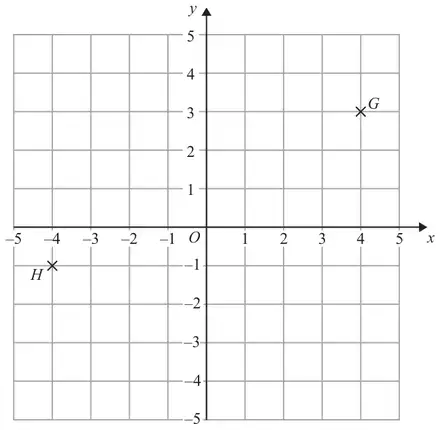
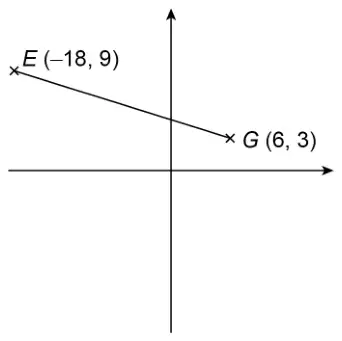
\(F\) is a point on \(EG\) such that \(\quad EF = \dfrac{1}{3}EG\)
Work out the coordinates of \(F\). [3 marks]
Mark scheme
Answer
Mark
Comments
Correct method for finding the difference between the \(x\) or \(y\) coordinates for the points \(E\) and \(G\) (positive or negative differences)
M1
eg \(6 - (-18)\) or 24 or \(3 - 9\) or \(-6\) implied by gradient \(= -\dfrac{1}{4}\)
Correct method for finding the difference between the \(x\) or \(y\) coordinates for the points \(E\) and \(F\) or the points \(F\) and \(G\) (positive or negative differences)
M1dep
eg \(\dfrac{-18 - 6}{3}\) or \(-8\) or \(-16\) or \(\dfrac{9 - 3}{3}\) or 2 or 4
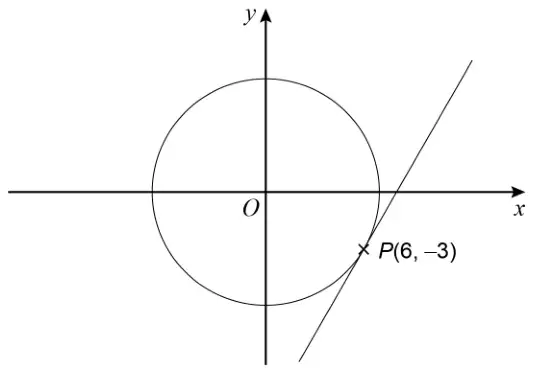
21 A circle with centre \(O\) and radius \(\sqrt{45}\) has a tangent drawn at point \(P(6, -3)\)
Not drawn accurately
(a) Write down the equation of the circle. [1 mark]
(b) Work out the equation of the tangent.
Give your answer in the form \(y = mx + c\) [4 marks]
Mark scheme (a)
Answer
Mark
Comments
\(x^2 + y^2 = 45\)
B1
oe accept \(\sqrt{45}^{\,2}\) or \(\sqrt{45^2}\) or \((3\sqrt{5})^2\) or \([6.7, 6.71]^2\) for 45
Additional guidance
Accept \((x - 0)^2\) for \(x^2\) and \((y - 0)^2\) for \(y^2\)
Do not accept eg \(a^2 + b^2 = 45\)
Mark scheme (b)
Answer
Mark
Comments
\(\dfrac{-3 - 0}{6 - 0}\) or \(-\dfrac{1}{2}\)
M1
oe gradient of \(OP\) eg \(\dfrac{0 - (-3)}{0 - 6}\) may be embedded in an equation
\(-1 \div\) their \(-\dfrac{1}{2}\) or 2
M1
oe gradient of tangent may be seen in equation of tangent their \(-\dfrac{1}{2}\) cannot be from using 45 gradient of tangent \(= 2\) with no incorrect working is M1M1
\(y - (-3) =\) their \(2(x - 6)\) or \(-3 =\) their \(2 \times 6 + c\) or \(c = -15\)
M1dep
oe equation eg \(y + 3 = 2x - 12\) dep on 2nd M1
\(y = 2x - 15\)
A1
oe in form \(y = mx + c\) eg \(y = \dfrac{6}{3}x - 15\) accept \(y = -15 + 2x\)
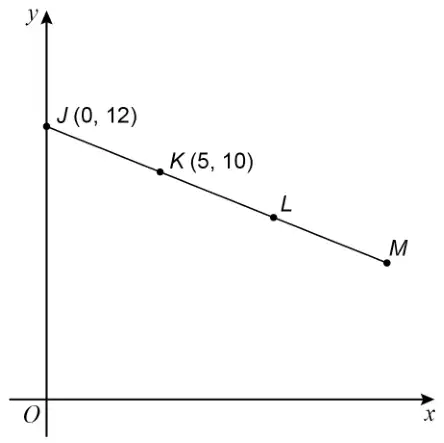
18 \(J\,(0, 12)\) and \(K\,(5, 10)\) are points on the straight line \(JKLM\).
Not drawn accurately
\(JK = KL = LM\)
Work out the coordinates of \(M\). [3 marks]
Mark scheme
Answer
Mark
Comments
\(x\)-coordinate of \(L = 10\) or \(y\)-coordinate of \(L = 8\) or 10 marked on \(x\)-axis below \(L\) and 8 marked on \(y\)-axis left of \(L\) or (\(x\)-coordinate of \(M =\)) \(5 + 5 + 5\) or (\(y\)-coordinate of \(M =\)) \(12 - 2 - 2 - 2\) or 15 marked on \(x\)-axis below \(M\) or 6 marked on \(y\)-axis left of \(M\)
M1
oe
(\(L\)) (10, 8) or (\(M\)) (15, …) or (…, 6) or 15 marked on \(x\)-axis below \(M\) and 6 marked on \(y\)-axis left of \(M\)
A1
condone missing brackets if intention is clear
15, 6
A1
SC2 (6, 15)
Additional guidance
(10, 8, 15, 6) (ie both sets of coordinates on answer line) correctly assigned to \(L\) and \(M\) previously (10, 8, 15, 6) on answer line not correctly assigned to \(L\) and \(M\) previously
M1A1A1 M1A1A0
Accept correct working on diagram and/or correct answer on diagram if not contradicted by answer line
(a) A circle has centre (0, 0) and circumference \(36\pi\)
Work out the equation of the circle. [2 marks]
(b) Point \(J\) has coordinates (15, 0) and point \(K\) has coordinates (30, −5)
Work out the equation of the straight line through \(J\) and \(K\). [4 marks]
Mark scheme (a)
Answer
Mark
Comments
\((r =)\ 36\pi \div 2\pi\) or \((r =)\ 36 \div 2\) or \((r =)\ 18\) or \((36\pi \div 2\pi)^2\) or \((36 \div 2)^2\) or \(18^2\) or 324
M1
\(x^2 + y^2 = 18^2\) or \(x^2 + y^2 = 324\)
A1
Additional guidance
\(x^2 + y^2 = 18\) or \(a^2 + b^2 = 18\)
M1A0
\(a^2 + b^2 = 18^2\) or \(a^2 + b^2 = 324\)
M1A0
Allow \(x^2 + y^2 = 18^2\) followed by an incorrect evaluation of \(18^2\) eg \(x^2 + y^2 = 18^2\), \(18 \times 18 = 506\), \(x^2 + y^2 = 506\)
M1A1
Mark scheme (b)
Answer
Mark
Comments
Alternative method 1: uses the gradient with either point to work out the intercept
\(\dfrac{0 - (-5)}{15 - 30}\) or \(-\dfrac{1}{3}\)
M1
oe
their \(-\dfrac{1}{3} \times 15 + c = 0\) or their \(-\dfrac{1}{3} \times 30 + c = -5\)
M1dep
oe
\((m =)\ -\dfrac{1}{3}\) and \((c =)\ 0 + \dfrac{1}{3} \times 15\) or \((m =)\ -\dfrac{1}{3}\) and \((c =)\ -5 + \dfrac{1}{3} \times 30\) or \((m =)\ -\dfrac{1}{3}\) and \((c =)\ 5\)
M1dep
oe equation in \(c\) or expression for \(c\)
\(y = -\dfrac{1}{3}x + 5\) or \(x + 3y - 15 = 0\)
A1
oe equation with terms collected
Alternative method 2: uses the gradient with \(y - y_1 = m(x - x_1)\)
\(\dfrac{0 - (-5)}{15 - 30}\) or \(-\dfrac{1}{3}\)
M1
oe
\(y - 0 =\) their \(-\dfrac{1}{3}(x - 15)\) or \(y - (-5) =\) their \(-\dfrac{1}{3}(x - 30)\)
M1dep
oe
\(y = -\dfrac{1}{3}x + 5\) or \(x + 3y - 15 = 0\)
A2
oe equation with terms collected A1 \((m =)\ -\dfrac{1}{3}\) and \((c =)\ 5\)
Alternative method 3: finds gradient and \(y\)-intercept separately
\(\dfrac{0 - (-5)}{15 - 30}\) or \(-\dfrac{1}{3}\)
M1
oe
(\(y\)-intercept =) (0, 5) or \(c = 5\)
M1
\(y = -\dfrac{1}{3}x + 5\) or \(x + 3y - 15 = 0\)
A2
oe equation with terms collected A1 \((m =)\ -\dfrac{1}{3}\) and \((c =)\ 5\)
Alternative method 4: simultaneous equations using both points
Correct elimination of one variable
M1
eg \(0 = 15m + c\) and \(-5 = 30m + c\) and \(15m - 30m = 0 - (-5)\) or \(-15m = 5\) or \(m = -\dfrac{1}{3}\)
Correct substitution into a correct equation
M1dep
eg \(0 = 15 \times -\dfrac{1}{3} + c\)
\(y = -\dfrac{1}{3}x + 5\) or \(x + 3y - 15 = 0\)
A2
oe equation with terms collected A1 \((m =)\ -\dfrac{1}{3}\) and \((c =)\ 5\)
Additional guidance
Allow an equivalent fraction for \(-\dfrac{1}{3}\) throughout
As a decimal, allow \(-0.33\) or better for \(-\dfrac{1}{3}\) for the method marks, but correct recurring notation or at least \(-0.33..\) is needed for the A mark
In alts 1 and 2, do not allow use of the negative inverse of their gradient
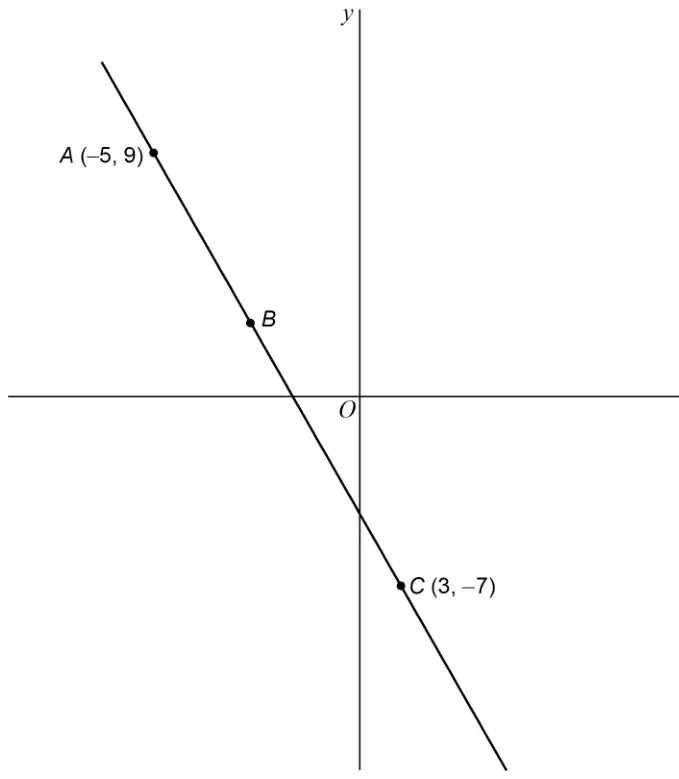
15 A straight line passes through points \(A\,(-5, 9)\), \(B\) and \(C\,(3, -7)\).
Not drawn accurately
(a) \(AB : BC = 1 : 3\)
Work out the coordinates of point \(B\). [3 marks]
(b) Work out the equation of the line perpendicular to \(AC\) that passes through \(C\). [4 marks]
Mark scheme (a)
Answer
Mark
Comments
Correct method for finding the difference between the \(x\) or \(y\) coordinates for line \(AC\)
M1
may be on diagram eg \(9 - -7\) or 16 or \(3 - -5\) or 8
Correct method for finding the difference between the \(x\) or \(y\) coordinates for line \(AB\) or line \(BC\)
M1dep
may be on diagram eg \(16 \div (1 + 3)\) or 4 or \(8 \div (1 + 3)\) or 2 or \(16 \times \dfrac{3}{(1 + 3)}\) or 12 or \(8 \times \dfrac{3}{(1 + 3)}\) or 6
\((-3, 5)\)
A1
Additional guidance
Up to M2 may be awarded for correct work, with no or incorrect answer, even if this is seen amongst multiple attempts
Condone any missing minus signs if absolute values for the differences are correct
\((-3, \ldots)\) or \((\ldots, 5)\)
M1M1A0
Mark scheme (b)
Answer
Mark
Comments
\((m_1 =)\ \dfrac{-7 - 9}{3 - -5}\) or \((m_1 =)\ \dfrac{9 - -7}{-5 - 3}\) or \(-2\)
M1
gradient of \(AC\)
\(-1 \div\) their \(-2\) or \(\dfrac{1}{2}\)
M1
gradient of line perpendicular to \(AC\) their \(-2\) must be identified as a gradient \(\dfrac{1}{2}\) implies M1M1
\(-7 =\) their \(\dfrac{1}{2} \times 3 + c\) or \((c =)\ -8.5\) or \(y - -7 =\) their \(\dfrac{1}{2}(x - 3)\)
11 Here is a table of values for the equation \(\quad y = 3x + 1\)
\(x\)
1
2
3
4
\(y\)
4
7
10
13
(a) Draw the graph of \(\quad y = 3x + 1 \quad\) for values of \(x\) from 1 to 4 [2 marks]
(b) Work out the value of \(y\) when \(\; x = 2.5\) [2 marks]
Mark scheme (a)
Answer
Mark
Comments
All 4 points plotted correctly with a straight line joining them
B2
\(\pm\)\(\dfrac{1}{2}\) square B1 at least two correct points plotted mark intention for straight line
Additional guidance
Ignore additional or incorrect points for B2 or B1
Ignore any line or curve extended outside the range
The correct position of the line implies correctly plotted points
Mark scheme (b)
Answer
Mark
Comments
Alternative method 1: uses the graph
Vertical line from \(x = 2.5\) to their straight line
M1
\(\pm\)\(\dfrac{1}{2}\) square implied by mark at correct point on graph or on vertical axis
their 8.5
A1ft
\(\pm\)\(\dfrac{1}{2}\) square ft their straight line graph if at least B1 awarded in (a)
Alternative method 2: substitutes into the equation
\(3 \times 2.5 + 1\)
M1
oe
8.5
A1
Alternative method 3: uses values from the table
\(\dfrac{7 + 10}{2}\)
M1
oe eg \(\dfrac{4 + 7 + 10 + 13}{4}\)
8.5
A1
Additional guidance
Alternative method 1 – must have a line in part (a)
Alternative method 1 A vertical line from the \(x\)-axis does not need to be drawn if the reading from the graph is correct within tolerance for their graph
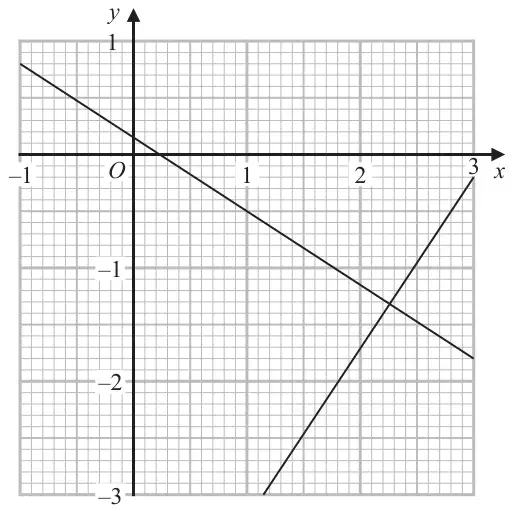
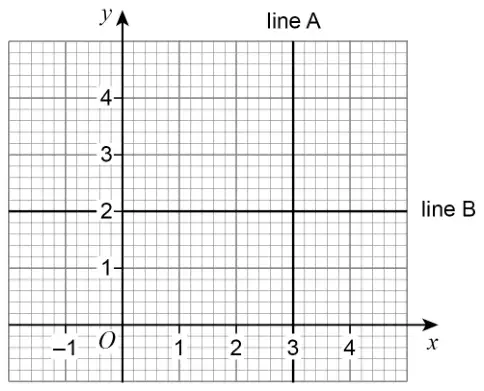
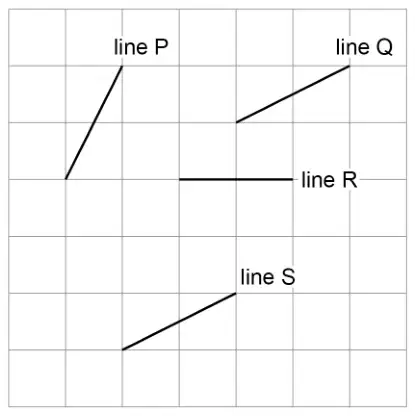
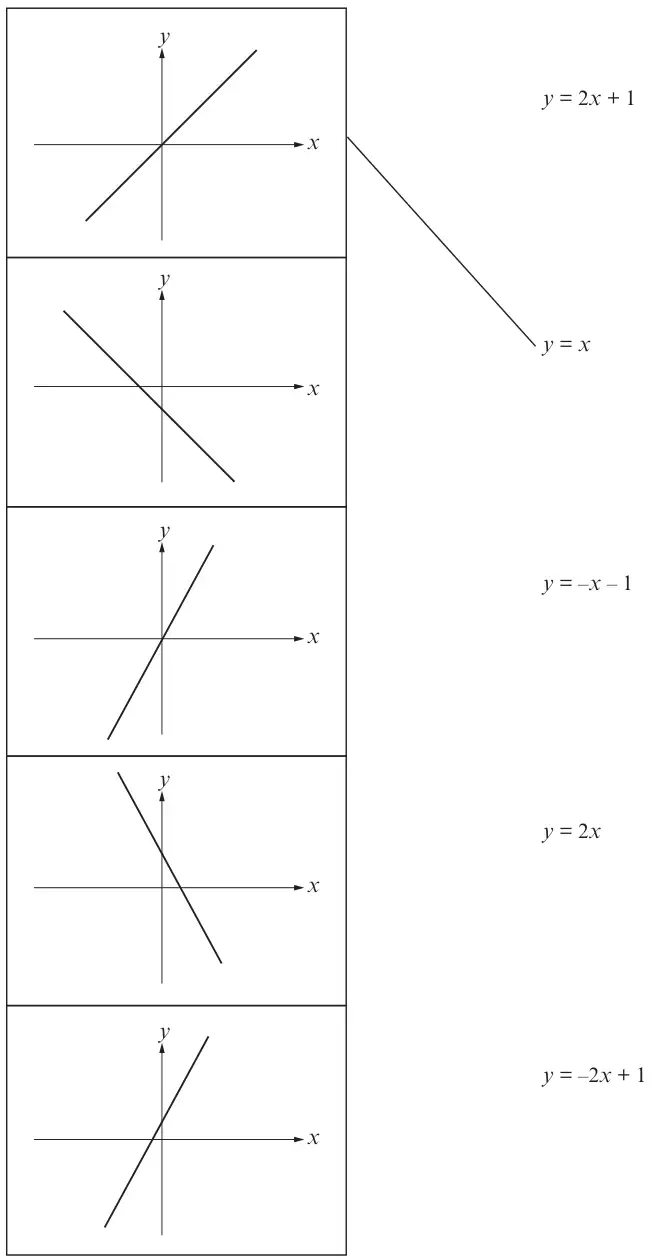
line \(\ldots\ldots\ldots\) and line \(\ldots\ldots\ldots\)
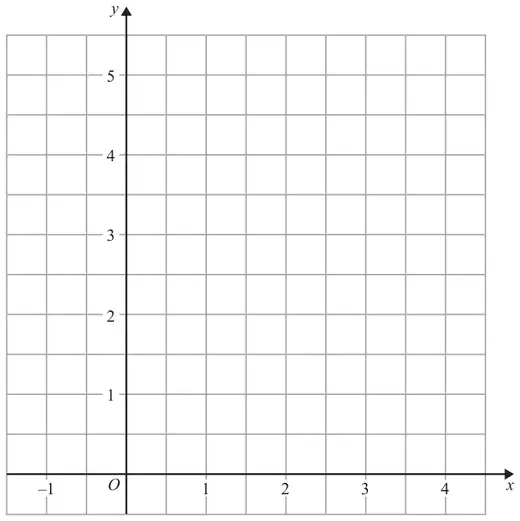
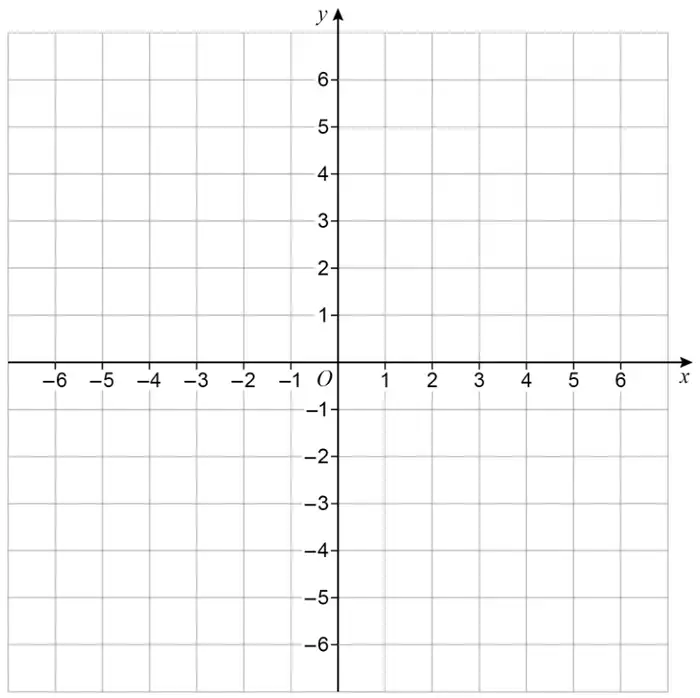
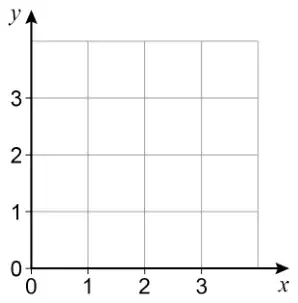
(b) Here is a different grid.
There are four points on this grid that each have
both coordinates that are whole numbers and \(x\)-coordinate \(+\) \(y\)-coordinate \(= 3\)
Plot the four points on the grid. [2 marks]
Mark scheme (a)
Answer
Mark
Comments
line Q and line S
B1
either order, may be indicated on the diagram
Mark scheme (b)
Answer
Mark
Comments
(0, 3), (1, 2), (2, 1) and (3, 0) plotted with no other points plotted on the grid
B2
B1 at least two of (0, 3), (1, 2), (2, 1) and (3, 0) plotted with up to two other points plotted on the grid or at least four points plotted that would lie on the line \(x + y = 3\) where each \(x\) and \(y\) are not all integers, with no other points plotted on the grid or all four correct coordinates given but not plotted, with no additional coordinates
Additional guidance
Mark intention
Line joining the four correct points with only the four correct points plotted
B2
Line connecting the four correct points but without points plotted
\(14 =\) their \(2 \times 3 + c\) or \(32 =\) their \(2 \times 12 + c\) or \((m =)\ 2\) and \(c = 8\) or \(y - 14 =\) their \(2(x - 3)\) or \(y - 32 =\) their \(2(x - 12)\)
M1dep
oe
\(y = 2x + 8\)
A1
Alternative method 2
\(14 = 3m + c\) and \(32 = 12m + c\) and \(32 - 14 = 12m - 3m\) or \(m = 2\) or \(56 = 12m + 4c\) and \(32 = 12m + c\) and \(56 - 32 = 4c - c\) or \(c = 8\)
M1
oe correct method to work out \(m\) or \(c\) using simultaneous equations implied by \(y = 2x \ldots\) or \(y = mx + 8\)
Correct substitution of their \(m\) into one of the original equations or correct substitution of their \(c\) into one of the original equations or \(m = 2\) and \(c = 8\)
\(14 =\) their \(2 \times 3 + c\) or \(32 =\) their \(2 \times 12 + c\) or \((m =)\ 2\) and \(c = 8\) or \(y - 14 =\) their \(2(x - 3)\) or \(y - 32 =\) their \(2(x - 12)\)
M1dep
oe
\(y = 2x + 8\)
A1
Alternative method 2
\(14 = 3m + c\) and \(32 = 12m + c\) and \(32 - 14 = 12m - 3m\) or \(m = 2\) or \(56 = 12m + 4c\) and \(32 = 12m + c\) and \(56 - 32 = 4c - c\) or \(c = 8\)
M1
oe correct method to work out \(m\) or \(c\) using simultaneous equations implied by \(y = 2x\) … or \(y = mx + 8\)
Correct substitution of their \(m\) into one of the original equations or correct substitution of their \(c\) into one of the original equations or \(m = 2\) and \(c = 8\)
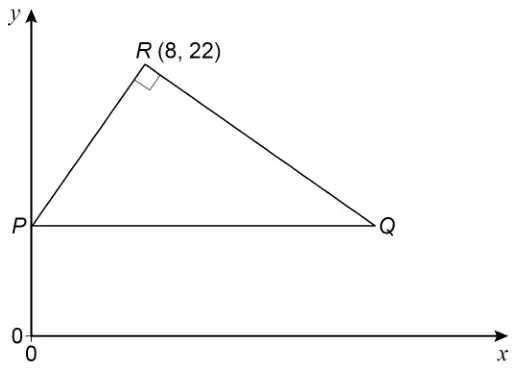
24 Points \(P\), \(Q\) and \(R\) (8, 22) form a triangle.
Not drawn accurately
\(PQ\) is a horizontal line, with \(P\) on the \(y\)-axis.
Angle \(PRQ\) is a right angle.
The gradient of \(PR\) is 2
Work out the coordinates of \(Q\). [5 marks]
Mark scheme
Answer
Mark
Comments
Alternative method 1 – using the equations of the lines
\(\dfrac{22 - y}{8 - 0} = 2\) or \(22 = 2 \times 8 + c\) or \((c =)\ 22 - 2 \times 8\) or \(c = 6\) or \(P\) is at (0, 6) or \((PR =)\ y = 2x + 6\) or \(y\)-coordinate of \(P\) is 6 or \(y\)-coordinate of \(Q\) is 6
M1
oe equation using any letter \(y\) is the \(y\)-coordinate of \(P\)
ignore missing brackets
may be seen on diagram may be seen on diagram
\(2m = -1\) or \((m =)\ -\dfrac{1}{2}\)
M1
oe gradient of \(RQ\)
\(22 =\) their \(-\dfrac{1}{2} \times 8 + c\) or \(22 = -4 + c\) or \(c = 26\) or \((RQ =)\ y = -\dfrac{1}{2}x + 26\)
M1dep
oe equation in \(c\) dep on previous mark
oe equation of \(RQ\)
their \(\left(-\dfrac{1}{2}x + 26\right) =\) their 6 or \(x\)-coordinate of \(Q\) is 40
M1dep
oe equation in \(x\) where \(x\) is the \(x\)-coordinate of \(Q\) dep on M3 \(-\dfrac{1}{2} = \dfrac{22 - \text{their } 6}{8 - x}\) implies M4 if their 6 is correct or from correct working
(40, 6)
A1
Alternative method 2 – using similar triangles
Drops a perpendicular from \(R\) to point \(S\) on \(PQ\) and uses \(RS = 2PS = 16\) to work out that \(P\) is at (0, 6)
M1
any or no letter
eg \(22 - 2 \times 8\)
\(2m = -1\) or \((m =)\ -\dfrac{1}{2}\) or \(\dfrac{RS}{SQ} = \dfrac{1}{2}\)
M1
oe gradient of \(RQ\)
\(16 \times 2\) or 32
M1dep
length of \(SQ\) may be seen on diagram dep on previous mark
8 + their 32 or \(x\)-coordinate of \(Q\) is 40
M1dep
(40, 6)
A1
Additional guidance
Note that 40 (for the \(x\)-coordinate of \(Q\)) implies M3 (on alt 2) and implies M4 if 6 is also seen (on alt 1)
Up to M2 may be awarded for correct work with no answer or incorrect answer, even if this is seen amongst multiple attempts
Condone incorrect \(y\)-intercept eg \(a = 2 \qquad y = \dfrac{3}{5}x + 4\) gradient A = 2 gradient B \(= \dfrac{3}{5}\)
M1M1 A1
It must be clear that the values 2 and \(\dfrac{3}{5}\) are being used to answer the question to award A1 eg1 gradient A = 2 and gradient B \(= \dfrac{3}{5}\) (no statement needed) eg2 \(a = 2 \qquad y = \dfrac{3}{5}x + \dfrac{4}{5}\) eg3 \(y = 2x - 1\) and \(y = \dfrac{3}{5}x + \dfrac{4}{5}\) 2 is greater than \(\dfrac{3}{5}\) eg4 \(y = 2x - 1\) and \(y = \dfrac{3}{5}x + \dfrac{4}{5}\) gradient of A \(\gt\) gradient of B
M2A1 M2A0 M2A1 M2A0
\(13 = 7x - 1\) or \(x = 2\) must be recovered to award 1st M1
The \(x\)-coordinate of \(Q\) is 4 more than the \(x\)-coordinate of \(P\). The \(y\)-coordinate of \(Q\) is 5 less than the \(y\)-coordinate of \(P\).
Work out the gradient of the straight line through \(P\) and \(Q\). [2 marks]
Mark scheme
Answer
Mark
Comments
\(-\dfrac{5}{4}\) or \(-1\dfrac{1}{4}\) or −1.25
B2
B1 \(\dfrac{5}{4}\) or \(1\dfrac{1}{4}\) or 1.25 or \(x + 4\) and \(y - 5\) or possible coordinates for \(P\) and \(Q\) stated or shown on a diagram eg \(P(0, 5)\) and \(Q(4, 0)\) or right-angled triangle shown with 4 as horizontal length and 5 as vertical length
Additional guidance
B1 may be awarded for correct work, with no or incorrect answer, even if this is seen amongst multiple attempts
Ignore attempts at rounding after correct answer seen
Accept \(\dfrac{-5}{4}\)
B2
Condone \(\dfrac{5}{-4}\)
B2
\((x + 4)\;\;(y - 5)\)
B1
\(x + 4\) and \(y - 5\) may be seen embedded in a fraction eg \(\dfrac{y - (y - 5)}{x - (x + 4)}\) or \(\dfrac{y - (y - 5)}{x + (x + 4)}\)
For eg \(40 - 24 = 16\) condone \(24 - 40 = 16\) or \(24 - 40 = -16\)
Condone incorrect use of equals sign eg \(1.2 \times 20 = 24 + 16 = 40\) or \(1.2 \times 20 = 24 - 40 = 16\)
B1
Correct response with irrelevant work
B1
16 from two different ways with one way incorrect is choice eg \(1.2 \times 20 = 24\) and \(40 - 24 = 16\) and \(20 \div 1.2 = 16\)
B0
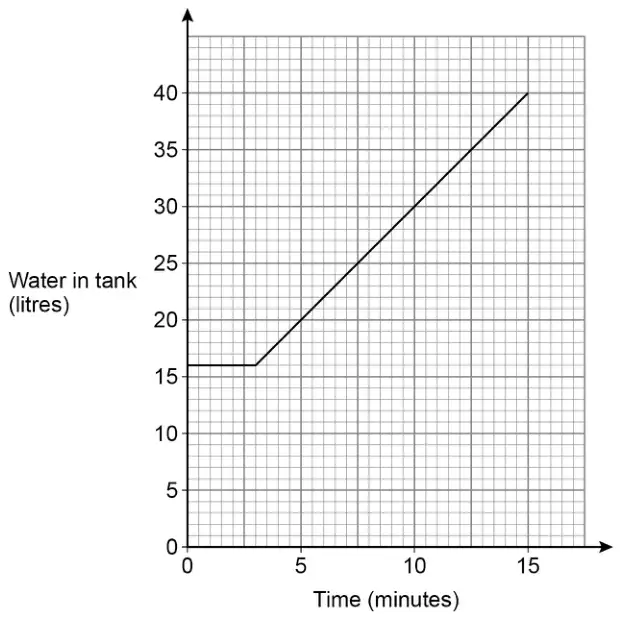
Mark scheme (b)
Answer
Mark
Comments
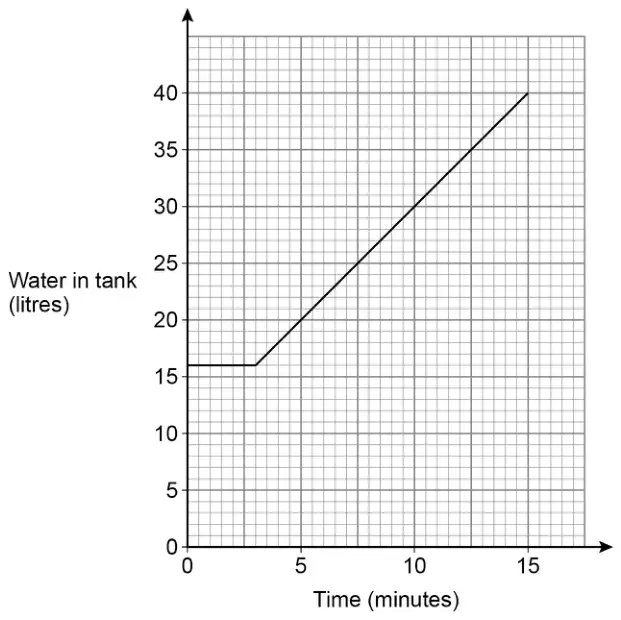
3
B1
Correct method for gradient eg \(\dfrac{40 - 16}{15 - \text{their } 3}\) or \(\dfrac{24}{12}\)
M1
oe eg \(\dfrac{30 - 25}{10 - 7.5}\) or \(\dfrac{10}{5}\) or \(40 - 38\)
2
A1ft
correct or ft their 3
Additional guidance
Note that their 3 can be used to work out the rate but does not have to be
Values seen on graph must be used correctly eg 24 and 12 seen on the graph is M0 unless subsequently used correctly in attempt to work out the gradient
A1ft answers must be to 1 dp or better eg 3.5 \(\dfrac{40 - 16}{15 - 3.5}\) 2.1 (accept 2.08…)
B0 M1 A1ft
After B0 the method may be implied (use \(\dfrac{40 - 16}{15 - \text{their } 3}\) to check) eg 6 2.7 (accept 2.66…)
B0 M1A1ft
If the report is blank, 3 and 2 must be unambiguously identified in working to be acceptable
The \(x\)-coordinate of Q is 4 more than the \(x\)-coordinate of P. The \(y\)-coordinate of Q is 5 less than the \(y\)-coordinate of P.
Work out the gradient of the straight line through P and Q. [2 marks]
Mark scheme
Answer
Mark
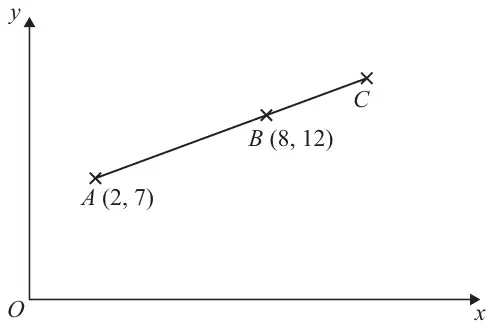
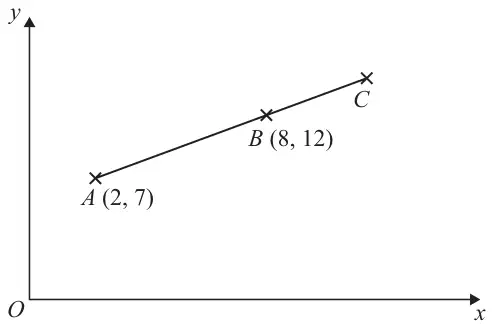
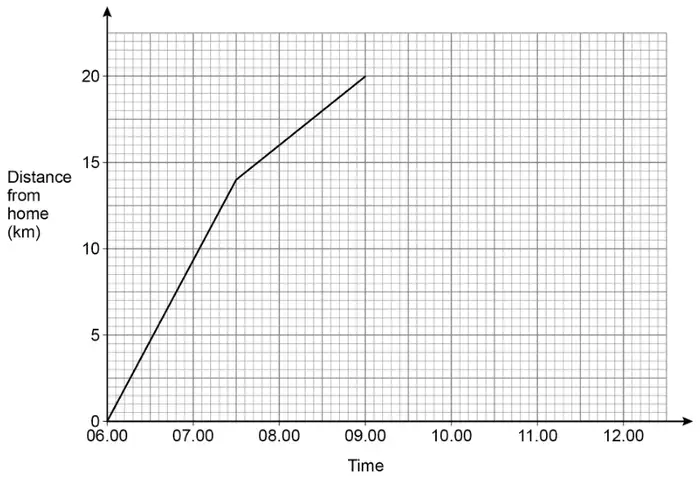
Comments
\(-\dfrac{5}{4}\) or \(-1\dfrac{1}{4}\) or \(-1.25\)
B2
B1 \(\dfrac{5}{4}\) or \(1\dfrac{1}{4}\) or 1.25 or \(x + 4\) and \(y - 5\) or possible coordinates for P and Q stated or shown on a diagram eg P(0, 5) and Q(4, 0) or right-angled triangle shown with 4 as horizontal length and 5 as vertical length
Additional guidance
B1 may be awarded for correct work, with no or incorrect answer, even if this is seen amongst multiple attempts
Ignore attempts at rounding after correct answer seen
Accept \(\dfrac{-5}{4}\)
B2
Condone \(\dfrac{5}{-4}\)
B2
\((x + 4) \quad (y - 5)\)
B1
\(x + 4\) and \(y - 5\) may be seen embedded in a fraction eg \(\dfrac{y - (y - 5)}{x - (x + 4)}\) or \(\dfrac{y - (y - 5)}{x + (x + 4)}\)
(b) Write down the coordinates of the midpoint of \(AB\). [1 mark]
(c) \(D\) is the point on the grid that makes \(ABCD\) a parallelogram.
Work out the coordinates of \(D\). [1 mark]
(d) Write down the equation of the line passing through \(A\) and \(B\). [1 mark]
Mark scheme (a)
Answer
Mark
Comments
(8, 1)
B1
accept \((\overset{x}{8},\ \overset{y}{1})\)
Additional guidance
\((8x, 1y)\)
B0
Mark scheme (b)
Answer
Mark
Comments
(7, 6)
B1
accept \((\overset{x}{7},\ \overset{y}{6})\)
Additional guidance
\((7x, 6y)\)
B0
Mark scheme (c)
Answer
Mark
Comments
(2, 1)
B1
accept \((\overset{x}{2},\ \overset{y}{1})\)
Additional guidance
\((2x, 1y)\)
B0
If two or more parts have \((x, y)\) as \((y, x)\) then give the first 0 and condone the other(s) eg1 (a) (1, 8) (b) (6, 7) (c) (1, 2) eg2 (a) (1, 8) (b) (7, 6) (c) (1, 2) eg3 (a) (1, 8) (b) (6, 10) (c) (1, 2) eg4 (a) (8, 1) (b) (6, 7) (c) (1, 2)
The costs of phone calls up to 5 minutes are represented by the graph.
(a) Write down the fixed charge. [1 mark]
(b) Work out the charge per minute. [2 marks]
(c) Work out the cost of a phone call lasting 7 minutes. [2 marks]
Mark scheme (a)
Answer
Mark
Comments
20
B1
Mark scheme (b)
Answer
Mark
Comments
\(28 - 20\) or \(\dfrac{36 - 20}{2}\) or \(\dfrac{44 - 20}{3}\) or \(\dfrac{52 - 20}{4}\) or \(\dfrac{60 - 20}{5}\) or correct calculation using any two points, eg \(\dfrac{60 - 44}{2}\) or \(2 \times 4\)
M1
8
A1
Additional guidance
\((60 \div 5 =)\ 12\)
M0A0
Mark scheme (c)
Answer
Mark
Comments
Alternative method 1
their \(20 + 7 \times\) their 8
M1
oe
76
A1ft
correct answer or ft their values in (a) and (b)
Alternative method 2
\(60 + 2 \times\) their 8
M1
oe
76
A1ft
correct answer or ft their values in (b)
Additional guidance
For Alt 2, they may read off any cost for \(n\) minutes (from 1 to 5) and add on \((7 - n) \times\) their (b) for M1. A1 or A1ft may follow from their working
18 On the grid, identify the region represented by
\(x \leqslant 5 \qquad y \leqslant 4 \qquad x + y \gt 6\)
Label the region R. [3 marks]
Mark scheme
Answer
Mark
Comments
\(x = 5\) and \(y = 4\) drawn as solid lines and \(x + y = 6\) drawn as dashed line and correct region identified
B3
B2 \(x = 5\) and \(y = 4\) drawn as solid lines and \(x + y = 6\) drawn as dashed line and correct region not identified or \(x = 5\) and \(y = 4\) and \(x + y = 6\) drawn as solid or dashed lines and correct region identified B1 \(x = 5\) and \(y = 4\) drawn as solid or dashed lines or \(x + y = 6\) drawn as solid or dashed line
Additional guidance
Allow any unambiguous identification of the correct region eg Labelled R or shaded in or shaded out
Use gradients to show that angle \(PQR\) is not a right angle. [3 marks]
Mark scheme
Answer
Mark
Comments
(Gradient of \(PQ\) =) \(\dfrac{14 - 8}{2 - 6}\) or \(\dfrac{8 - 14}{6 - 2}\) or \(-1.5\) or \(\dfrac{-3}{2}\) or (gradient of \(QR\) =) \(\dfrac{8 - 5}{6 - 2}\) or \(\dfrac{5 - 8}{2 - 6}\) or 0.75 or \(\dfrac{3}{4}\) or \(\dfrac{-3}{-4}\)
M1
oe
(Gradient of \(PQ\) =) \(-1.5\) or \(\dfrac{-3}{2}\) and (gradient of \(QR\) =) 0.75 or \(\dfrac{3}{4}\) or \(\dfrac{-3}{-4}\)
M1dep
oe
No and \(-1.5 \times 0.75 \ne -1\) or No and \(-1.5 \times 0.75 = -1.125\)
A1ft
oe eg No and \(\dfrac{-3}{2}\) \(\times\) \(\dfrac{3}{4}\) \(= -\)\(\dfrac{9}{8}\) ft their two gradients with M1 scored accept No and \(-1.5\) is not the negative reciprocal of 0.75
Additional guidance
Accept \(-\)\(\dfrac{3}{2}\) or \(\dfrac{3}{-2}\) for \(\dfrac{-3}{2}\)
Gradient of \(PQ\) = \(\dfrac{-3}{2}\), gradient of \(QR\) = \(\dfrac{4}{3}\), No and \(\dfrac{-3}{2}\) \(\times\) \(\dfrac{4}{3}\) \(= -2\)
M1M0A1ft
Answers involving Pythagoras’ theorem or scale drawing
The graph shows how the height of the plant changes during the next 4 days.
Work out a formula for \(h\) in terms of \(n\). [3 marks]
Mark scheme
Answer
Mark
Comments
\(h = 3n + 20\) or \(h = 20 + 3n\)
B3
oe in the form \(h =\) B2 correct equation not in the form \(h =\) or \(3n + 20\) or \(20 + 3n\) or \(h = 3n\ (+ k)\) (\(k\) is a number or letter) or \(h = (k +)\ 3n\) (\(k\) is a number or letter) or \(h = an + 20\) (\(a \neq 0\)) or \(h = 20 + an\) (\(a \neq 0\)) B1 \(3n\ (+ k)\) (\(k\) is a number or letter) or \((k +)\ 3n\) (\(k\) is a number or letter) or \(an + 20\) (\(a \neq 0\)) or \(20 + an\) (\(a \neq 0\)) SC1 \(n = 3h + 20\)
Additional guidance
Allow \(h =\) in working but omitted on answer line For an equation in the form \(h =\) in working, but rearranged (correctly or incorrectly) for the answer line, award 1 mark less than the \(h =\) form
Condone an unsimplified fraction for 3 if it has integer numerator and denominator eg \(h = \dfrac{12}{4}n + 20\)
B3
An unsimplified fraction for 3 can still score marks if it does not have integer numerator and denominator eg \(h = \dfrac{32 - 20}{4}n + 20\)
B2
Allow \(3 \times n\) or \(n \times 3\) for \(3n\)
Ignore units
Condone capital \(H\) or \(N\), but for incorrect variable(s) award 1 mark less than correct variable(s) would get eg1 \(h = 3x + 20\) or \(y = 3x + 20\) eg2 \(3x + 20\) eg3 \(3x\)
15 The table shows the cost of hiring a concrete mixer for up to 5 days.
Number of days
1
2
3
4
5
Cost
£14
£24
£34
£44
£54
Eva hires the concrete mixer for 5 days.
She says,
“The rate is £14 per day because the cost for 1 day is £14”
Is she correct?
Give a reason for your answer. [2 marks]
Mark scheme
Answer
Mark
Comments
No and fully correct reason
B2
eg No and it is (£)10 (per day after the first day) or No and it is (£)10.8(0) per day for five days or No and it would be (£)70 for five days or No and you pay more for the first day B1 No and partially correct reason eg No and (£)10.8(0) or fully correct reason with no decision or incorrect decision eg it is (£)10 (per day after the first day)
Additional guidance
Equivalent values for (£)10.8(0) per day for five days (£)11.(00) per day for four days (£)11.33 per day for three days (£)12.(00) per day for two days
Equivalent values for (£)70 for five days (£)56 for four days (£)42 for three days (£)28 for two days
Do not ignore incorrect reasons with a correct reason for B2
15 Here is line L and the graph of \(\quad y = x - 1\)
The scales of the axes are not shown.
Work out the equation of line L. [4 marks]
Mark scheme
Answer
Mark
Comments
\(y = -\dfrac{3}{2}x + 3\)
B4
oe eg \(2y + 3x = 6\) or \(y = -1.5x + 3\) B3 \(-\dfrac{3}{2}x + 3\) or gradient \(= -\dfrac{3}{2}\) stated or equation of line with gradient \(-\dfrac{3}{2}\)
B2 scales on both axes identified correctly or scale on one axis identified correctly and correct gradient of L for their two scales seen
B1 scale on one axis identified correctly or correct gradient of L for their two scales seen
SC2 \(y = -\dfrac{3}{4}x + 3\) oe or \(y = \dfrac{3}{2}x + 3\) oe SC1 \(-\dfrac{3}{4}x + 3\) or gradient \(= -\dfrac{3}{4}\) stated or equation of line with gradient \(-\dfrac{3}{4}\)
Additional guidance
Examples of scale on \(y\)-axis identified correctly include intersection of \(y = x - 1\) with \(y\)-axis labelled \(-1\) or intersection of line L with \(y\)-axis labelled 3 or equation of line with \(y\)-intercept 3
Examples of scale on \(x\)-axis identified correctly include intersection of \(y = x - 1\) with \(x\)-axis labelled 1 or intersection of line L with \(x\)-axis labelled 2
(a) Work out the coordinates of the midpoint of the line \(AB\). [1 mark]
(b) \(C\) is another point on \(AB\).
\(C\) is closer to \(B\) than to \(A\).
The coordinates of \(C\) are whole numbers.
Work out the coordinates of \(C\). [1 mark]
(c) On the grid above, draw a line from point \((0, 0)\) that is
parallel to \(AB\) and two thirds as long as \(AB\).
[2 marks]
Mark scheme (a)
Answer
Mark
Comments
\((3, 3.5)\) or \(\left(3, 3\dfrac{1}{2}\right)\)
B1
Additional guidance
A comma used as a decimal point ie (3, 3,5)
B1
(03, 03.5)
B1
(0,3, 0,3.5)
B0
Mark scheme (b)
Answer
Mark
Comments
\((4, 4)\)
B1
Additional guidance
(04, 04)
B1
(0,4, 0,4)
B0
Mark scheme (c)
Answer
Mark
Comments
Line from \((0, 0)\) to \((4, 2)\)
B2
B1 line from \((0, 0)\) to \((4, 2)\) with slight inaccuracy or line parallel to \(AB\) from any point which extends across at least two horizontal squares
Additional guidance
Parallel line that extends beyond the grid
B1
Line drawn that is completely off the grid
B0
Use the full length of the line to judge accuracy – there should be no gap between their line and the relevant integer points
Mark intention for straightness
Ignore other lines that could be working for parts (a) and (b)
(a) Show that the lines \(\quad y = 3x + 7 \quad\) and \(\quad 2y - 6x = 8 \quad\) are parallel.
Do not use a graphical method. [3 marks]
(b) Is the point \((-5, -6)\) above, below or on the line \(\quad y = 3x + 7\) ?
Tick one box.
Above
Below
On the line
You must show your working.
Do not use a graphical method. [2 marks]
Mark scheme (a)
Answer
Mark
Comments
Alternative method 1 – Using gradients
Gradient of \(y = 3x + 7\) is 3
and \(y = 3x + 4\)
and gradient of \(2y - 6x = 8\) is 3 or \(6 \div 2\)
B3
May come from using points on line eg using (0, 7) and (1, 10) and \(\dfrac{10 - 7}{1 - 0} = 3\) or correct calculation for gradient from points on line \(2y - 6x = 8\) eg using (0, 4) and (1, 7) and \(\dfrac{7 - 4}{1 - 0} = 3\)
B2 for \(y = 3x + 4\) and lines have same gradient or \(y = 3x + 4\) and gradient of \(2y - 6x = 8\) is 3 or \(6 \div 2\) or gradient of \(y = 3x + 7\) is 3 and \(y = 3x + 4\)
B1 for gradient of \(y = 3x + 7\) is 3 or \(y = 3x + 4\) or gradient of \(2y - 6x = 8\) is 3 or \(6 \div 2\)
Alternative method 2 – Using coordinates and distances
Chooses a value for \(x\) and correctly evaluates the \(y\) value for both lines
M1
eg (0, 7) and (0, 4)
Chooses a different value for \(x\) and correctly evaluates the \(y\) value for both lines
M1dep
eg (1, 10) and (1, 7)
States that \(y\) values are a constant distance apart so parallel
A1
oe
Alternative method 3 – Using simultaneous equations
\(y = 3x + 4\) or \(y - 3x = 4\) or \(2y = 6x + 14\) or \(2y - 6x = 14\)
M1
oe Equates coefficients in any form
Any attempt to eliminate both variables from their equations
M1dep
States simultaneous equations have no (real) solution and concludes parallel
A1
Additional guidance
To award A mark on Alternative method 2, the working must be seen
\(y = 3x + 4\) and lines have gradient of \(3x\)
B2
\(y = 3x + 4\) and \(3x\) identified in both equations
B2
Both lines have gradient \(3x\)
B1
\(y = 3x + 7\), gradient 3 and \(y = 3x + 8\), gradient 3 (error in rearrangement)
B1
\(y = 3x + 8\), gradient 3 (error in rearrangement)
26 \(A\) (0, 2) and \(B\) (6, 5) are points on the straight line \(ABCD\).
Not drawn accurately
\(AB = BC = CD\)
Work out the coordinates of \(D\). [3 marks]
Mark scheme
Answer
Mark
Comments
\(x\)-coordinate of \(C = 12\) or \(y\)-coordinate of \(C = 8\) or 12 marked on \(x\)-axis below \(C\) and 8 marked on \(y\)-axis left of \(C\) or \(x\)-coordinate of \(D = 6 + 6 + 6\) or \(y\)-coordinate of \(D = 2 + 3 + 3 + 3\) or \(\dfrac{x}{6} = 3\) or \(6 = (2 \times 0 + x) \div 3\) or \(\dfrac{y - 2}{5 - 2} = 3\) or \(5 = (2 \times 2 + y) \div 3\) or 18 marked on \(x\)-axis below \(D\) or 11 marked on \(y\)-axis left of \(D\)
M1
oe
sets up a correct equation for \(x\)-coordinate of \(D\) or \(y\)-coordinate of \(D\)
(\(C\) is the point) (12, 8) or (\(D\) is the point) (18, \(\ldots\)) or (\(\ldots\), 11) or 18 marked on \(x\)-axis below \(D\) and 11 marked on \(y\)-axis left of \(D\)
A1
condone missing brackets if intention is clear
18, 11
A1
Additional guidance
(12,8 , 18,11) on answer line with previous link to \(C\) and \(D\) (12,8 , 18,11) on answer line with no previous link to \(C\) and \(D\)
M1A1A1 M1A1A0
12, 8 on answer line with no other working
M1A1A0
Accept correct working on diagram and correct answer on diagram if not contradicted by answer line
11, 18 on answer line does not score the last mark, but may score M1A0 or M1A1
(a) Show that the lines \(\quad y = 3x + 7 \quad\) and \(\quad 2y - 6x = 8 \quad\) are parallel.
Do not use a graphical method. [3 marks]
(b) Is the point \((-5, -6)\) above, below or on the line \(y = 3x + 7\) ?
Tick one box.
Above
Below
On the line
You must show your working.
Do not use a graphical method. [2 marks]
Mark scheme (a)
Answer
Mark
Comments
Alternative method 1 – Using gradients
Gradient of \(\;y = 3x + 7\;\) is 3
and \(\;y = 3x + 4\)
and gradient of \(\;2y - 6x = 8\;\) is 3 or \(6 \div 2\)
B3
May come from using points on line eg using (0, 7) and (1, 10) and \(\dfrac{10 - 7}{1 - 0} = 3\) or correct calculation for gradient from points on line \(2y - 6x = 8\) eg using (0, 4) and (1, 7) and \(\dfrac{7 - 4}{1 - 0} = 3\) B2 for \(y = 3x + 4\) and lines have same gradient
or \(\;y = 3x + 4\) and gradient of \(\;2y - 6x = 8\;\) is 3 or \(6 \div 2\)
or gradient of \(\;y = 3x + 7\;\) is 3 and \(\;y = 3x + 4\)
B1 for gradient of \(\;y = 3x + 7\;\) is 3 or \(y = 3x + 4\) or gradient of \(\;2y - 6x = 8\;\) is 3 or \(6 \div 2\)
Alternative method 2 – Using coordinates and distances
Chooses a value for \(x\) and correctly evaluates the \(y\) value for both lines
M1
eg (0, 7) and (0, 4)
Chooses a different value for \(x\) and correctly evaluates the \(y\) value for both lines
M1dep
eg (1, 10) and (1, 7)
States that \(y\) values are a constant distance apart so parallel
A1
oe
Alternative method 3 – Using simultaneous equations
\(y = 3x + 4\) or \(\;y - 3x = 4\) or \(2y = 6x + 14\) or \(\;2y - 6x = 14\)
M1
oe Equates coefficients in any form
Any attempt to eliminate both variables from their equations
M1dep
States simultaneous equations have no (real) solution and concludes parallel
A1
Additional guidance
To award A mark on Alternative method 2, the working must be seen
\(y = 3x + 4\) and lines have gradient of \(3x\)
B2
\(y = 3x + 4\) and \(3x\) identified in both equations
B2
Both lines have gradient \(3x\)
B1
\(y = 3x + 7\), gradient 3 and \(y = 3x + 8\), gradient 3 (error in rearrangement)
B1
\(y = 3x + 8\), gradient 3 (error in rearrangement)
7 \(A\) (0, 2) and \(B\) (6, 5) are points on the straight line \(ABCD\).
Not drawn accurately
\(AB = BC = CD\)
Work out the coordinates of \(D\). [3 marks]
Mark scheme
Answer
Mark
Comments
\(x\)-coordinate of \(C = 12\) or \(y\)-coordinate of \(C = 8\) or 12 marked on \(x\)-axis below \(C\) and 8 marked on \(y\)-axis left of \(C\) or \(x\)-coordinate of \(D = 6 + 6 + 6\) or \(y\)-coordinate of \(D = 2 + 3 + 3 + 3\) or \(\dfrac{x}{6} = 3\) or \(6 = (2 \times 0 + x) \div 3\) or \(\dfrac{y - 2}{5 - 2} = 3\) or \(5 = (2 \times 2 + y) \div 3\) or 18 marked on \(x\)-axis below \(D\) or 11 marked on \(y\)-axis left of \(D\)
M1
oe sets up a correct equation for \(x\)-coordinate of \(D\) or \(y\)-coordinate of \(D\)
(\(C\) is the point) (12, 8) or (\(D\) is the point) (18, …) or (…, 11) or 18 marked on \(x\)-axis below \(D\) and 11 marked on \(y\)-axis left of \(D\)
A1
condone missing brackets if intention is clear
18, 11
A1
Additional guidance
(12,8 , 18,11) on answer line with previous link to \(C\) and \(D\) (12,8 , 18,11) on answer line with no previous link to \(C\) and \(D\)
M1A1A1 M1A1A0
12, 8 on answer line with no other working
M1A1A0
Accept correct working on diagram and correct answer on diagram if not contradicted by answer line
11, 18 on answer line does not score the last mark, but may score M1A0 or M1A1
\(\left(\dfrac{6 + 0}{2}, \dfrac{0 + 6}{2}\right)\) or (3, 3)
M1
coordinates of \(M\)
gradient \(OM = 1\) (and \(y = x\)) or (0, 0) and (3, 3) (and \(y = x\))
A1
must see correct working for M1
Mark scheme (d)
Answer
Mark
Comments
\(x^2 + x^2 = 36\) or \(2x^2 = 36\) or \(y^2 + y^2 = 36\) or \(2y^2 = 36\) or (–)\(6 \cos 45°\) or (–)\(6 \sin 45°\)
M1
oe equation
(–)\(\sqrt{\dfrac{36}{2}}\) or (–)\(\sqrt{18}\) or (–)\(3\sqrt{2}\) or (–)\(\dfrac{6\sqrt{2}}{2}\) or (–)\(\dfrac{6}{\sqrt{2}}\)
M1
\(\left(-\sqrt{18}, -\sqrt{18}\right)\) or \(\left(-3\sqrt{2}, -3\sqrt{2}\right)\) or \(\left(-\dfrac{6\sqrt{2}}{2}, -\dfrac{6\sqrt{2}}{2}\right)\) or \(\left(-\dfrac{6}{\sqrt{2}}, -\dfrac{6}{\sqrt{2}}\right)\)
(a) Show that the gradient of the straight line passing through A and B is \(-2\) [2 marks]
(b)C is the point \((-301, 601)\)
Does C lie on the straight line passing through A and B?
You must show your working. [2 marks]
Mark scheme (a)
Answer
Mark
Comments
Alternative method 1
\(\dfrac{-9 - -5}{4 - 2}\) or \(\dfrac{-5 - -9}{2 - 4}\) or \((2, -5) - (4, -9) = (-2, 4)\) or \((4, -9) - (2, -5) = (2, -4)\) or \(\dfrac{\text{change in } y}{\text{change in } x}\) or \(\dfrac{\Delta y}{\Delta x}\) or triangle drawn with points A and B and side lengths of 4 and (–)2 identified or correct explanation of pattern of graph and \(\dfrac{-4}{2}\) \(= -2\) or \(\dfrac{4}{-2}\) \(= -2\)
B2
oe fraction eg \(\dfrac{-9 + 5}{4 - 2}\) or \(\dfrac{-5 + 9}{2 - 4}\) B1 for \(\dfrac{-9 - -5}{4 - 2}\) or \(\dfrac{-5 - -9}{2 - 4}\) or \((2, -5) - (4, -9) = (-2, 4)\) or \((4, -9) - (2, -5) = (2, -4)\) or \(\dfrac{\text{change in } y}{\text{change in } x}\) or \(\dfrac{\Delta y}{\Delta x}\) or triangle drawn with points A and B and side lengths of 4 and (–)2 identified or correct explanation of pattern of graph or \(\dfrac{-4}{2}\) \(= -2\) or \(\dfrac{4}{-2}\) \(= -2\)
Alternative method 2
Gives \(y = -2x + c\) and substitutes \((2, -5)\) or \((4, -9)\) to find \(c = -1\) or \(y - -5 = -2(x - 2)\) or \(y + 5 = -2(x - 2)\) or \(y - -9 = -2(x - 4)\) or \(y + 9 = -2(x - 4)\) and gives \(y = -2x - 1\) and correctly substitutes and evaluates with the other pair of coordinates to check
B2
B1 for \((2, -5)\) or \((4, -9)\) to find \(c = -1\) or \(y - -5 = -2(x - 2)\) or \(y + 5 = -2(x - 2)\) or \(y - -9 = -2(x - 4)\) or \(y + 9 = -2(x - 4)\) or gives \(y = -2x - 1\) and correctly substitutes and evaluates with one or both pair(s) of coordinates
Alternative method 3
\(-5 = 2m + c\) and \(-9 = 4m + c\) and works out \(m = -2\) using a correct algebraic method
B2
oe equations B1 for \(-5 = 2m + c\) and \(-9 = 4m + c\)
Alternative method 4
\(-5 = -2(2) + c\) and \(-9 = -2(4) + c\) and works out \(c = -1\) for both
B2
oe equations B1 for \(-5 = -2(2) + c\) and \(-9 = -2(4) + c\)
Additional guidance
In alt 1, examples of correct explanation are: 2 left and 4 up 2 right and 4 down
In alt 1, points A and B can be identified on a diagram by their coordinates
In alt 2, accept rearrangements of \(y = -2x - 1\) eg \(\;2x + y = -1\)
\(\dfrac{-5 - 9}{2 - 4}\) or \(\dfrac{-9 - 5}{4 - 2}\) \(\;(= -2\) or \(= 2)\)
B0
Mark scheme (b)
Answer
Mark
Comments
Alternative method 1 – uses given point with one from (a) to show gradient \(= -2\)
at least two correct points correctly plotted or their two points, from (a), correctly plotted or if they restart with a table of values, at least two of their points correctly plotted
M1
may be from a table of values may be implied by their line tolerance \(\pm\) 2mm ignore incorrect points
Straight, ruled line from \((-3,\ 7.5)\) to \((3,\ -1.5)\)
A1
Additional guidance
If their points in (a) give a line which cannot be drawn from \(x = -3\) to \(x = 3\) allow the line drawn to be between the possible integer values of \(x\)
If they restart with a table of values and achieve M1, the only way to achieve M1A1 is for the line to be the correct one i.e. \(y = 3 - 1.5x\)
No tolerance on length of line, it must reach at least from \(-3\) to 3 on \(x\)-axis
14 The graph shows the cost of some taxi journeys.
Work out a formula for \(C\) in terms of \(n\). [3 marks]
Mark scheme
Answer
Mark
Comments
\(C = 0.6(0)n + 2.5(0)\)
B3
oe Must have \(C =\) for B3 B2 \(C = 0.6n + k\ (k \ne 0)\) or \(C = an + 2.5\ (a \ne 0)\) or \(0.6n + 2.5\) B1 \(0.6n\) or \(an + 2.5\ (a \ne 0)\) or \(C = 60n + 250\)
Additional guidance
Allow correct fractions eg \(\dfrac{3}{5}\) or \(\dfrac{1}{1.\dot{6}}\) for 0.6 and/or \(\dfrac{5}{2}\) for 2.5
Allow \(0.6 \times n\) or \(n \times 0.6\) for \(0.6n\) eg \(C = 0.6 \times n + 2.5\) \(n \times 0.6 + 2.5\) \(0.6 \times n\)
B3 B2 B1
Penalise by one mark the use of \(n0.6\) for \(0.6n\) eg \(C = n0.6 + 2.5\) \(n0.6 + 2.5\) \(n0.6\)
B2 B1 B0
Penalise by one mark the use of different letters eg \(y = 0.6x + 2.5\) \(0.6x + 2.5\) \(2p + 2.5\)
B2 B1 B0
Transposing 0.6 and 2.5 scores zero \(\;\) eg \(C = 2.5n + 0.6\)
(a) For each of the algebraic statements below decide whether it is an equation or an identity.
\((x - 1)(x - 2) = 12\)
is an ..........................
\((x - 1)(x - 2) = x^2 - 3x + 2\)
is an ..........................
\(x^2 = 3x + 10\)
is an ..........................
[1]
(b) A straight line is parallel to \(y = 3x\) and passes through the point \((2, 11)\).
Find the equation of the line in the form \(y = mx + c\). [3]
Mark scheme (a)
Answer
Marks
Part marks and guidance
Equation Identity Equation
1
Mark scheme (b)
Answer
Marks
Part marks and guidance
\(y = 3x + 5\) as final answer
3
B2 for final answer \(3x + 5\) or for a correct equation but not in required form isw
OR
M2 for using \((2, 11)\) correctly in \(y = 3x + c\) oe or M1 for “\(y = 3x + c\)” or for \(y = 3x + k\) oe where \(k\) is any numerical value except 0 or 5 or for correctly substituting \((2, 11)\) in \(y = mx + c\) oe \((m \ne 3)\)
B2 for e.g. \((y - 11) = 3(x - 2)\) or \(y - 3x = 5\) or \(3x - y + 5 = 0\) as the answer B2 for \(y = 3x + 5\) seen in working and subsequently spoilt (excluding changing to a perpendicular gradient)
Show that point A does not lie on the circle and state, with a reason, whether it lies inside the circle or outside the circle. [3]
Mark scheme (a)
Answer
Marks
Part marks and guidance
\(x^2 + y^2 = 4^2\) oe final answer
2
B1 for \(x^2 + y^2 = k\) (\(k \ne 0\) or 16) or answer \(a^2 + b^2 = 4^2\) oe
\(k\) could be \(r^2\)
Mark scheme (b)
Answer
Marks
Part marks and guidance
\(2.3^2 + 3.3^2\) 16.18 or 16.2 or 4.02[…]
M1 B1
If they have the correct working, produce an incorrect figure they can earn M1 B0 A1FT providing their decision is correct for their figure allow the reasoning to be in the working and condone ‘above’ for ‘outside’ see appendix for some comments
a correct decision e.g. outside and (16.18 or 16.2) and 16 or 4.02[…] and 4
A1FT
A1 is dependent on awarding M1 and is a correct decision based on their figure
Appendix: exemplar responses for Q17(b)
Allow the reason to be in the working.
Decision must be outside and
Response
Mark
16.18 is greater than 16
1
\(16.18 \gt 16\)
1
16.18 and 16
1(BOD)
\(16.18 \ne 16\) and is bigger
1
\(\sqrt{16.18} = 4.02[\ldots]\) which is bigger than 4
1
Radius is \(4.02 \gt 4\)
1
above and 16.18 and 16
1
\(4 \lt 4.02[\ldots]\)
1
\(2.3^2 \gt 4^2 - 3.3^2\)
1
\(3.3 \gt \sqrt{4^2 - 2.3^2}\)
1
Exception : \(2.3^2 + 3.3^2 = 15.73\) and inside because \(15.73 \lt 16\)
M1 B0 A1FT
Note : To be outside the circle \(2.3^2 + 3.3^2 \gt 4^2\) which can be rearranged to \(2.3^2 \gt 4^2 - 3.3^2\) or \(3.3^2 \gt 4^2 - 2.3^2\) all these are valid methods.
7 The graph of the line \(x + y = 3\) is shown on this grid.
(a) By drawing a suitable line on the grid, solve these simultaneous equations.
\(x + y = 3\) and \(y = 2x - 3\) [4]
(b) Umi says,
The simultaneous equations \(y = 2x + 3\) and \(2y - 4x = 7\) will have no solutions.
Is Umi correct?
Explain how you decide. [2]
Mark scheme (a)
Answer
Marks
Part marks and guidance
Draws ruled line \(y = 2x - 3\)
4
M2 for drawing ruled line \(y = 2x - 3\)
or M1 for correct line but freehand or for ruled line with gradient 2 or for ruled line with positive gradient passing through (0, –3)
Accuracy - use overlay as a guide and line must touch circles For M2 must reach at least (0, –3) and intersection with \(x + y = 3\)
AND
\(x = 2\) and \(y = 1\)
B2FT for \(x = 2\) and \(y = 1\) or B1FT for one correct value
FTtheir intersection of their ruled or freehand line with given line Allow correct or FT for B2 and B1 If intersection is not on integer values allow reasonable estimated readings
Mark scheme (b)
Answer
Marks
Part marks and guidance
Showing \(2y - 4x = 7\) can be written as \(y = 2x + 3.5\) oe Or Rearranges equations to the same form for comparison e.g. \(2y = 4x + 6\) and \(2y = 4x + 7\), or \(2y - 4x = 6\) and \(2y - 4x = 7\) or states that both have gradient of 2 with no error in rearrangement seen
1
Accept other working that supports a conclusion of parallel or no solutions
eg \(2(2x + 3) - 4x = 7\) and \(4x + 6 - 4x = 7\) or better \(2y = 4x + 6\) and \(2y - 4x = 7\) then eliminates \(x\) or \(y\) leading e.g. 6 – 7 oe or ‘no solutions’
correct oe and the lines are parallel/have same gradient/ have no solutions oe
(a) Five straight-line graphs and their equations are shown below. Draw a line to connect each graph to its equation. One has been completed for you. [2]
(b) Circle the equation of the straight line that is parallel to \(y = 3x + 5\). [1]
(c) Make \(y\) the subject of the following formula. [2]\[\frac{y}{a} + b = x\]
Mark scheme (a)
Scheme
Marks
Comments
All four equations correctly matched.
B2
B1 for two or three equations correctly matched not including \(y = x\)
Mark scheme (b)
Scheme
Marks
Comments
Correct equation circled or clearly indicated.
\(2y = 6x + 8\)
B1
Mark scheme (c)
Scheme
Marks
Comments
\(y = a(x - b)\) or \(a(x - b) = y\) or \(y = -a(-x + b)\) or \(y = ax - ab\) oe
B2
Allow B2 for \(y = (x - b) \times a\) or \(y = a \times (x - b)\) Mark final answer.
B1 for one of the following as the first step
\(\frac{y}{a} = x - b\) or \(x - b = \frac{y}{a}\)
\(-\frac{y}{a} = -x + b\)
\(y + ab = ax\)
Allow B1 if ‘\(y =\)’ missing e.g. \(a(x - b)\) or \(a \times (x - b)\) or \(ax - ab\) OR an answer of \(y = a(x + b)\) or \(y = ax + ab\) oe (from \(\frac{y}{a} = x + b\))
B0 for an unsupported answer of \(y = ax - b\) or \(y = a \times x - b\)
(a) For each of the algebraic statements below decide whether it is an equation or an identity. [1]
\((x - 1)(x - 2) = 12\)
is an
\((x - 1)(x - 2) = x^2 - 3x + 2\)
is an
\(x^2 = 3x + 10\)
is an
(b) A straight line is parallel to \(y = 3x\) and passes through the point (2, 11).
Find the equation of the line in the form \(y = mx + c\). [3]
Mark scheme (a)
Answer
Marks
Part marks and guidance
Equation Identity Equation
1
Mark scheme (b)
Answer
Marks
Part marks and guidance
\(y = 3x + 5\) as final answer
3
B2 for final answer \(3x + 5\) or for a correct equation but not in required form isw
B2 for e.g. \((y - 11) = 3(x - 2)\) or \(y - 3x = 5\) or \(3x - y + 5 = 0\) as the answer B2 for \(y = 3x + 5\) seen in working and subsequently spoilt (excluding changing to a perpendicular gradient)
OR
M2 for using (2, 11) correctly in \(y = 3x + c\) oe or M1 for “\(y = 3x + c\)” or for \(y = 3x + k\) oe where \(k\) is any numerical value except 0 or 5 or for correctly substituting (2, 11) in \(y = mx + c\) oe \((m \ne 3)\)
e.g. \(11 = 3 \times 2 + c\) e.g. \(11 = \frac{1}{3} \times 2 + c\)
16 In the diagram below, the shaded region is a parallelogram. The parallelogram can be identified by four inequalities. Two of the inequalities are \(y \geqslant 6\) and \(y \geqslant x\).
Not to scale
(a) Write down the other two inequalities that identify the parallelogram. [3]
(b) Work out the area of the parallelogram. You must show your working. [4]
Mark scheme (a)
Answer
Marks
Part marks and guidance
\(y \leqslant x + 4\) oe
and
\(y \lt 9\)
3
B2 for \(y \leqslant x + 4\) oe or B1 for \(y \ldots x + 4\) oe but with = or an incorrect inequality symbol
B1 for \(y \lt 9\)
Accept inequalities in either order
Mark scheme (b)
Answer
Marks
Part marks and guidance
12 nfww
4
B2 for (2, 6) and (6, 6) or (5, 9) and (9, 9) identified or for base 4 and perpendicular height 3 both identified or B1 for (2, 6) or (6, 6) or (5, 9) or (9, 9) or for base = 4 or height = 3
May be seen on diagram
AND
M1 for their base × their perpendicular height
Must identify base and perpendicular height of parallelogram in working or on diagram Do not allow if slant height used
22. A line, L, passes through the point (–1, 5) and is perpendicular to \(y = \frac{1}{2}x + 5\). Find the equation of the line L. Give your answer in the form \(ax + by + c = 0\). [3]
Mark scheme
Scheme
Marks
Comments
(Gradient of the perpendicular line =) \(-2\)
B1
May be implied in later working
\(5 = -2\times-1 + c\) or \((y - 5) = -2(x + 1)\) oe or \(y = -2x + 3\)
M1
FT for gradients of 2 and \(-\frac{1}{2}\) only
\(2x + y - 3 = 0\) or \(-2x - y + 3 = 0\)
A1
FT Allow \(y + 2x - 3 = 0\) oe Mark final answer
Note: B0 M1 A1 for the following Gradient of 2 leading to \(2x - y + 7 = 0\) oe
Gradient of \(-\frac{1}{2}\) leading to \(x + 2y - 9 = 0\) oe
19 The diagram shows a circle with centre (0, 0) and a tangent at (12, \(-5\)). The tangent at (12, \(-5\)) crosses the \(x\)-axis at (\(p\), 0).
Not to scale
Find the exact value of \(p\). You must show your working. [5]
Mark scheme
Answer
Marks
Part marks and guidance
\(\frac{169}{12}\) or \(14\frac{1}{12}\) or \(14.08\dot{3}\) with correct working
5
‘Correct working’ requires evidence of at least M2M1 or M1M1M1 SC3 applies to all methods
Gradients and equation of straight line M2 for gradient of tangent = \(\frac{12}{5}\) oe soi or for gradient of tangent = \(\frac{5}{p - 12}\) or M1 for gradient of radius = \(-\frac{5}{12}\) soi or gradient of tangent = \(\frac{-1}{\textit{their gradient of radius}}\)
AND
Mark to candidate’s advantage if gradients not labelled Do not mix marks across two methods (ie do not give gradient marks and another M1 for 13 from Pythagoras)
M2 for \(0 = \frac{12}{5}p - \frac{169}{5}\) or better or for \(5 = \frac{12}{5}(p - 12)\) or better or for \(\frac{5}{p - 12} = \frac{12}{5}\) or better
or
M1 for \(y = \textit{their } \frac{12}{5}x + c\) or better or for \(y = \frac{5}{p - 12}x + c\) or better or for \(y - {}^{-}5 = \textit{their } \frac{12}{5}(x - 12)\) or better or \(\frac{-1}{\textit{their gradient of radius}} = \frac{5}{p - 12}\) or better
M2 must be a correct equation solely in terms of \(p\) or solely in terms of \(x\) e.g. \(0 = \frac{12}{5}x - \frac{169}{5}\) or better
For M1 allow FT their \(\frac{12}{5}\) if from \(m_1 = \frac{-1}{m_2}\)
If 0, 1 or 2 scored, instead award SC3 for answer \(\frac{169}{12}\) or \(14\frac{1}{12}\) or \(14.08\dot{3}\) with no or insufficient working
PTO for alternative methods
Alternative methods
Alternative method (Pythagoras and trig):
Alternative method (Pythagoras and equations)
M1 for [O to (12, -5)] \(\sqrt{12^2 + 5^2}\) may be implied by 13 in working or on diagram
M1 for [angle at O] \(\sin\theta = \frac{5}{13}\) or \(\cos\theta = \frac{12}{13}\) or \(\tan\theta = \frac{5}{12}\) or better (do not imply from just an angle)
AND
M2 for [\(p =\)] \(\dfrac{13}{\frac{12}{13}}\) or M1 for \(\cos \textit{their}\theta = \frac{13}{p}\) or \(p = \frac{13}{\cos \textit{their}\theta}\) (Their \(\theta\) from earlier trig work)
M2 for \(13^2 + (p - 12)^2 + 5^2 = p^2\) oe or M1 for \((p - 12)^2 + 5^2\) oe or for \(\sqrt{12^2 + 5^2}\) may be implied by 13 in working or on diagram
AND
M2 for \(338 - 24p = 0\) oe
or
M1 for \(169 + p^2 - 24p + 144 + 25 = p^2\) or better
Correctly rewriting the equations in the form \(y = mx + c\)
\(y = 4x + 3\) AND \(y = 4x - 6{\cdot}5\)
(so lines parallel)
B3
B2 for:
one correct equation and a correct but incomplete rearrangement of the other seen e.g. \(y = 4x - 6{\cdot}5\) and \(3y = 12x + 9\)
both in the form \(y = 4x + c\) with an error in one constant term, provided constants aren’t equal. e.g \(y = 4x - 6{\cdot}5\) and \(y = 4x + 9\)
B1 for:
one correct equation \(y = 4x - 6{\cdot}5\) or \(y = 4x + 3\)
two equations of the form \(y = 4x + \ldots\) with errors in both constant terms or no constant terms.
Allow all marks for equivalent complete methods e.g. \(6y - 24x = 18\) AND \(6y - 24x = -39\) or (\(3y = 12x + 9\) AND \(3y = 12x - 19{\cdot}5\)) and a clear statement that the two equations are of the same form and the only difference is the constant, so they are parallel.
The region R satisfies the following inequalities.
\(y \geqslant x \qquad y \leqslant 2 \qquad y < -2x - 3\)
By drawing two more straight lines on the grid, find and label the region R. [6]
Mark scheme
Answer
Marks
Part marks and guidance
\(y = 2\) ruled and \(y = -2x - 3\) broken line and correct region indicated
6
B1 for \(y = 2\) ruled B2 for \(y = -2x - 3\) broken line or B1 for \(y = -2x - 3\) solid line
Penalise one mark only for good freehand lines Additional lines treat as choice Length of line should be fit for purpose to identify their region
AND B1 for R on correct side of \(y = x\)
B1 for R on correct side of \(y = 2\)
B1 for R on correct side of their \(y = -2x - 3\)
See marks on diagram for the final B3 marks provided all lines drawn correctly For region, FT their \(y = -2x - 3\) provided line with negative gradient only but no FT for \(y = 2\) if incorrect
Condone shading in or out of region provided R is clearly identified
one correct equation and a correct but incomplete rearrangement of the other seen e.g. \(y = 4x - 6{\cdot}5\) and \(3y = 12x + 9\)
both in the form \(y = 4x + c\) with an error in one constant term, provided constants aren’t equal. e.g \(y = 4x - 6{\cdot}5\) and \(y = 4x + 9\)
B1 for:
one correct equation \(y = 4x - 6.5\) or \(y = 4x + 3\)
two equations of the form \(y = 4x + \ldots\) with errors in both constant terms or no constant terms.
Allow all marks for equivalent complete methods e.g. \(6y - 24x = 18\) AND \(6y - 24x = -39\) or (\(3y = 12x + 9\) AND \(3y = 12x - 19.5\)) and a clear statement that the two equations are of the same form and the only difference is the constant, so they are parallel.
Corrected by Westie's Workshop
The board's mark scheme printed “or or”. Changed to “or” because the word “or” was printed twice.
Original: see the board's mark scheme PDF (link above).
Mark scheme (b)
Scheme
Marks
Comments
(−2, 9)
B2
B1 for each
If no final coordinate given, award B2 for an unambiguous \(x = -2\) and \(y = 9\) seen in working
B1 for one of \(x = -2\) or \(y = 9\) seen in working
One diagonal of the rhombus has equation \(y = \frac{1}{2}x + 3\).
The other diagonal passes through the point (1, 7).
Find the equation of the other diagonal of the rhombus. Give your answer in the form \(y = mx + c\). [4]
Mark scheme
Answer
Marks
Part marks and guidance
[\(y\) =] \(-2x + 9\) final answer
4
B2 for grad = – 2 soi or M1 for diagonals cross at 90° soi
M1 for substituting (1, 7) into \(y\) = (their m)\(x + c\) oe soi
Accept \(\frac{-2}{1}\) for all marks B2 implied by e.g. [\(y\) =] \(-2x + c\) oe M1 could be on a diagram
e.g. \(y - 7\) = (their m)\((x - 1)\) Answer [\(y\) =] ½ \(x + 6.5\) implies M1 M1 soi by answer with their gradient e.g. \(y = 2x + 5\) satisfies (1, 7) so gets M1
14 The graphs of \(x = -3\) and \(y = -x\) are drawn on the grid.
The region R satisfies the following inequalities.
\[x \leqslant -3 \qquad y \leqslant -x \qquad y - 1 \gt \frac{1}{2}x\]
By drawing one more line, find and label the region R. [5]
Mark scheme
Answer
Marks
Part marks and guidance
Correct region indicated
5
B2 for \(y - 1 = \frac{1}{2}x\) broken line or B1 for \(y - 1 = \frac{1}{2}x\) solid line
AND B1FT for \(R\) correct side of \(y - 1 = \frac{1}{2}x\)
B1 for \(R\) correct side of \(x = -3\) B1 for \(R\) correct side of \(y = -x\)
Use overlay as a guide for accuracy must pass through or touch small circles (when extended if necessary) position is 2 small dots each way from correct position of ends of line Allow shorter accurate line provided it defines their region
See marks on diagram for next 3 marks Grid assumes \(y - 1 = \frac{1}{2}x\) is correct Mark position of R first. If R not labelled then accept other clear indication. If \(y - 1 = \frac{1}{2}x\) not attempted then allow B1B1 max for region FT dep on sloping line drawn that is long enough to define the region chosen on grid
(b) The line AB joins point A to point B. Point B is at \((2, 3)\).
Find the length of the line AB. [1]
(c) On the grid, draw the line \(x = 2\). [1]
(d) ABCD is a square that fits on the grid. Point C is on the line \(x = 2\).
Find the coordinates of point D. [2]
Mark scheme (a)
Answer
Marks
Part marks and guidance
\((-3, 3)\) plotted correctly
1
Use overlay if in doubt Take centre of mark as position If A used as plot, scores 1 if centre of A in correct position
Mark scheme (b)
Answer
Marks
Part marks and guidance
5
1
Mark scheme (c)
Answer
Marks
Part marks and guidance
Ruled vertical line \(x = 2\)
1
Accept good freehand and dashed line If more than one vertical line and no clear choice mark the worst, ignore line at \(x = -3\) If \(y = 2\) also drawn and not rejected, treat as choice Use overlay to check if in doubt At least 2 cm long. If line more than 2 cm then must be in overlay throughout length.
Mark scheme (d)
Answer
Marks
Part marks and guidance
\((-3, -2)\)
2
B1 for answer \((2, -2)\) or \((-3, -2)\) seen or plotted on grid If 0 scored, SC1 for answer \((-3, \ldots)\) or \((\ldots, -2)\)
16 A ball of dough is left to rise before it is baked. The graph shows the height of the ball of dough over the first 20 minutes.
(a) Work out the gradient of the line as a decimal, giving the units of your answer. Show how you work out your answer. [3]
(b) A baker works out the height of the ball of dough at the end of 25 minutes as 14 cm.
(i) Use your gradient to show that the baker could be correct. [2]
(ii) What assumption has the baker made? [1]
Mark scheme (a)
Answer
Marks
Part marks and guidance
0.2 or 0.19 to 0.20
2
M1 for \(\dfrac{3.8 \text{ to } 4}{20}\) oe
If 0 scored, SC1 for triangle with incorrect values marked and their \(\dfrac{\text{rise}}{\text{run}}\) or \(\dfrac{\text{rise}}{\text{run}}\) with answer in range \(0.18 \leqslant g \lt 0.19\)
e.g. \(\dfrac{1.9 \text{ to } 2}{10}\)
e.g. \(\dfrac{13}{20}\) with no triangle scores 0 e.g. \(\dfrac{13}{20}\) with 13 and 20 marked on triangle scores SC1 e.g \(\dfrac{2.1}{11.6}\) and answer 0.181... SC1
cm per minute or cm/min
1
Mark for units still available even if wrong gradient
Mark scheme (b)
Answer
Marks
Part marks and guidance
(i) \(5 \times\) their gradient
M1
FT their gradient which is a number
Alternative method M2 for \(25 \times (0.19\) to \(0.2) + 9\) with answer that rounds to 14 or M1 for 25 × their gradient + 9 with answer that does not round to 14
13 + their 1 giving answer that rounds to 14
M1
(ii) Continues to rise at same rate oe or Rises 0.2 cm every minute oe
1
FT their gradient if figures quoted
Must imply constant increase [in height] or continued pattern If figures used must be correct or from their gradient Accept The pattern continues oe The dough rises consistently oe The dough will rise I cm in 5 minutes
12. The table shows some of the values of \(y = 4x - 1\) for \(-1 \leqslant x \leqslant 1\).
\(x\)
–1
–0·5
0
0·5
1
\(y = 4x - 1\)
–5
1
3
(a) Complete the table above. [2]
(b) On the grid below, draw the graph of \(y = 4x - 1\) for \(-1 \leqslant x \leqslant 1\). [2]
Mark scheme (a)
Scheme
Marks
Comments
\(-3\), \(-1\)
B2
B1 for each
Mark scheme (b)
Scheme
Marks
Comments
Correct line from at least (\(-1\), \(-5\)) to (1, 3)
B2
Mark intention of straight-line. B1 for correct truncated line (at least the length of 2 points) OR B1 FT for 4 or 5 points plotted correctly (using their table of values)
23. In an experiment, a scientist records the temperature, \(y\) °C, of an object as it is heated for \(x\) seconds.
The scientist thinks that the equation \(y = mx + c\) is a good fit for this data.
The diagram shows his results on a scatter graph and his line of best fit.
(a) Estimate the number of seconds for which the object has been heated when its temperature is 27 °C. [1]
(b)
When \(x = 70\) seconds, the scientist measures the value of \(y\) to be 52 °C.
Use this information to decide whether the line of best fit is likely or unlikely to give reliable predictions for values of \(y\) when \(x\) is greater than 50 seconds.
Likely ☐ Unlikely ☐
Explain how you decide. [1]
(c)
The line of best fit passes through the points (0, 15) and (10, 22).
Find the equation of the line of best fit. Give your answer in the form \(y = mx + c\). [3]
(d) Explain what the gradient of the line of best fit represents in this context. [1]
Mark scheme (a)
Scheme
Marks
Comments
17 (seconds)
B1
Allow answers in the range 17 to 17.4
Mark scheme (b)
Scheme
Marks
Comments
‘Unlikely’ and valid explanation e.g. ‘The line of best fit predicts 64°C at 70 seconds’ or “The temperature has stayed the same (but the line of best fit is increasing)’ or ‘The line of best fit predicts just over 50 seconds for 52°C’. 'The temperature is 50 degrees at 50 seconds (so at 70 seconds it would be a lot more)'
E1
Ignore additional comments if correct statement seen. Allow ‘unlikely’ with explanations that imply the use of the line of best fit e.g. 'The temperature should have raised a lot more and be way past 52' 'The temperature is 51 degrees at 50 seconds’
Do not allow e.g. ‘The data is unreliable as it only goes to 50 seconds.’
Mark scheme (c)
Scheme
Marks
Comments
\(y = \frac{7}{10}x + 15\) oe
B3
Must be given as an equation. If B3 not awarded award one of the following: B2 for sight of \(y = \frac{7}{10}x + c\) or (gradient) = \(\frac{7}{10}\) or (m=) \(\frac{7}{10}\) B1 for sight of \(y = mx + 15\) or c = 15
For B2 or B1, m or c in the equation could be algebraic or numeric
Mark scheme (d)
Scheme
Marks
Comments
Valid explanation e.g. ‘The increase in temperature per 1 second’ ‘The rate of increase in temperature’ ‘How quickly the temperature increases with time’
E1
Allow explanations that consider both the steepness of the line and the variables, e.g. ‘How steep the line is so as time increases so does temperature.’ ‘A change in temperature as the time goes up.’
Do not allow, e.g. ‘The steepness’ ‘As time increases temperature increases’
AND M1dep for \(y - 5 = \textit{their } \frac{12}{5}(x - (-12))\) oe
Dep on at least M1 oe e.g. \(5 = \textit{their } \frac{12}{5} \times -12 + c\) Do not allow M1 for e.g. grad \(-\frac{5}{12}\) used if the gradient is then changed subsequently to e.g. \(\frac{12}{5}\)
or M1dep for \(y = \textit{their } \frac{12}{5}x + c\)
Dep on at least M1 Allow ‘\(c\)’ or any value including 0
18 The graph of \(y = 2x + 1\) is drawn on this one centimetre grid.
The region \(R\) satisfies these inequalities.
\[y \leqslant 2x + 1 \qquad y \geqslant 5 \qquad x + y \leqslant 13\]
Show that the area of region \(R\) is 12 cm². [6]
Mark scheme
Answer
Marks
Part marks and guidance
E.g. Correct inequalities shown on diagram, correct region \(R\) identified and correct area calculation \(\frac{1}{2} \times 6 \times 4\) [= 12]
6
B1 for line \(y = 5\) B1 for line \(x + y = 13\)
Condone good freehand lines, which can be dashed or solid. Lines need only be one square long for line mark but they must be fit for purpose to define their region.
AND B1 for correct side of \(y = 2x + 1\) B1 for correct side of \(y = 5\) B1 for correct side of \(x + y = 13\)
Mark the region which is labelled, but if no labelling mark the single region which is shaded (or unshaded) or implied by area calculation of correct region \(R\) Use diagram for these three marks If extra lines, mark those bounding \(R\). If no \(R\), mark poorest two
AND M1dep for \(\frac{1}{2} \times 6 \times 4\) [= 12] oe
Dep on region \(R\) being correct Accept counting squares but check areas bounding \(y = 2x + 1\) Accept split into two triangles 4 and 8 oe
6. In an experiment, a scientist records the temperature, \(y\) °C, of an object as it is heated for \(x\) seconds.
The scientist thinks that the equation \(y = mx + c\) is a good fit for this data.
The diagram shows his results on a scatter graph and his line of best fit.
(a) Estimate the number of seconds for which the object has been heated when its temperature is 27 °C. [1]
(b)
When \(x = 70\) seconds, the scientist measures the value of \(y\) to be 52 °C.
Use this information to decide whether the line of best fit is likely or unlikely to give reliable predictions for values of \(y\) when \(x\) is greater than 50 seconds.
Likely ☐ Unlikely ☐
Explain how you decide. [1]
(c)
The line of best fit passes through the points (0, 15) and (10, 22).
Find the equation of the line of best fit. Give your answer in the form \(y = mx + c\). [3]
(d) Explain what the gradient of the line of best fit represents in this context. [1]
Mark scheme (a)
Scheme
Marks
Comments
17 (seconds)
B1
Allow answers in the range 17 to 17.4
Mark scheme (b)
Scheme
Marks
Comments
‘Unlikely’ and valid explanation e.g. ‘The line of best fit predicts 64°C at 70 seconds’ or “The temperature has stayed the same (but the line of best fit is increasing)’ or ‘The line of best fit predicts just over 50 seconds for 52°C’. 'The temperature is 50 degrees at 50 seconds (so at 70 seconds it would be a lot more)'
E1
Ignore additional comments if correct statement seen. Allow ‘unlikely’ with explanations that imply the use of the line of best fit e.g. 'The temperature should have raised a lot more and be way past 52' 'The temperature is 51 degrees at 50 '
Do not allow e.g. ‘The data is unreliable as it only goes to 50 seconds.’
Mark scheme (c)
Scheme
Marks
Comments
\(y = \dfrac{7}{10}x + 15\) oe
B3
Must be given as an equation. If B3 not awarded award one of the following: B2 for sight of \(y = \dfrac{7}{10}x + c\) or gradient or \((m =)\ \dfrac{7}{10}\) B1 for sight of \(y = mx + 15\) or \(c = 15\)
For B2 or B1, \(m\) or \(c\) in the equation could be algebraic or numeric
Mark scheme (d)
Scheme
Marks
Comments
Valid explanation e.g. ‘The increase in temperature per 1 second’ ‘The rate of increase in temperature’ ‘How quickly the temperature increases with time’
E1
Allow explanations that consider both the steepness of the line and the variables, e.g. ‘How steep the line is so as time increases so does temperature.’ ‘A change in temperature as the time goes up’.
Do not allow, e.g. ‘The steepness’ ‘As time increases temperature increases’
Allow answer in range 0.8 to 0.9 and \(\dfrac{5}{6}\) but do not allow \(\dfrac{5}{6}\) only (question requires use of graph); must be the only answer not for coordinates as final answer
17. The diagram shows the points \(P(-5, 16)\) and \(Q(5, -4)\), joined by a straight line.
Diagram not drawn to scale
M is the midpoint of PQ.
By finding the gradient of PQ and the coordinates of M, show that the equation of the perpendicular bisector of PQ is \(2y = x + 12\). You must show all your working. [6]
Mark scheme
Scheme
Marks
Comments
\(-2\)
B2
B1 for \(\dfrac{16 - -4}{-5 - 5}\) with at most one arithmetic error oe, si; may be implied by a right-angled triangle drawn with dimensions ‘their 20’ and \((-)10\) or 20 and ‘their \((-)10\)’ marked and ‘their \(\dfrac{y\ \text{diff}}{x\ \text{diff}}\)’, which must be negative, calculated;
If no marks, award SC1 for a derived answer of 2.
(0, 6)
B2
May be on diagram B1 for each correct coordinate or for sight of \(\left(\dfrac{-5 + 5}{2}, \dfrac{16 - 4}{2}\right)\)
\(y = \tfrac{1}{2}x + 6\) leading to \(2y = x + 12\)
B2
FT ‘their 6’ and ‘their \(-2\)’ for B1 B1 for \(y = \tfrac{1}{2}x + c\) or for \(y = kx + 6\ \ k \ne 0\)
If B2 B2 B0, award SC1 for showing \(2y = x + 12\) is the same as \(y = \tfrac{1}{2}x + 6\) and that \(-2 \times \dfrac{1}{2} = -1\) and that (0, 6) is on the line \(y = \tfrac{1}{2}x + 6\)
13 A straight line passes through the point (8, 1) and is perpendicular to the line \(y = 4x - 2\).
Find the equation of the line, giving your answer in the form \(y = mx + c\). [4]
Mark scheme
Answer
Marks
Part marks and guidance
\(y = -\dfrac{x}{4} + 3\) oe simplified form
4
B3 for correct equation not in required form
OR B1 for gradient of perp line \(= -\dfrac{1}{4}\) oe soi M1 for \(y - 1 = \textit{their grad} \times (x - 8)\) or \(1 = \textit{their grad} \times 8 + c\) M1 for correct simplification to \(y = mx + c\) form of their \(y - 1 = \textit{their grad} \times (x - 8)\) or using their \(c = 1 - \textit{their grad} \times 8\)
Their grad may be 4, ie they are finding the equation of the parallel line
Allow answer in range 0.8 to 0.9 and \(\dfrac{5}{6}\) but do not allow \(\dfrac{5}{6}\) only (question requires use of graph); must be the only answer not for coordinates as final answer
FT ‘their \(\dfrac{\text{vertical diff}}{\text{horizontal diff}}\)’; must be negative; allow improper fractions NB allow full marks if calculus method used.
Mark scheme (b)
Scheme
Marks
Comments
(i) Summation of areas of strips
S1
e.g. trapezium rule or equivalent attempted with trapezia/triangles/rectangles
(\(v\) values = ) (0) 16, 24, (24, 16, 0) si
B1
Ignore extra correct \(v\) values for this mark; accept mid-ordinates 9, 21, 25, (21, 9)
Correct calculation for the area using 5 strips
M1
FT ‘their \(v\)-values’ e.g. \(2\left(\dfrac{1}{2}\times2\times16 + \dfrac{1}{2}\times2\times(16+24)\right) + 2\times24\) or \(2\left(\dfrac{1}{2}\times2\times16 + 2\times20 + 1\times24.5\right)\) or \(2\left(\dfrac{1}{2}\times2\times16 + \dfrac{1}{2}\times2\times(16+24)\right) + 2\times25\) (using mid-ordinates) \(2(9\times2) + 2(21\times2) + 25\times2\)
M0 if only using rectangles except for use of mid-ordinate rule approaches
(b) Show that the gradient of the line is \({}^{-}2\). [1]
(c) Write down the equation of the line. [1]
(d) The line continues to the right.
Will this line pass through the point \((50, {}^{-}103)\)? Show how you decide. [2]
Mark scheme (a)
Answer
Marks
Part marks and guidance
3
1
Accept (0, 3)
Mark scheme (b)
Answer
Marks
Part marks and guidance
Any correct reason e.g. \(({}^{-}2, 7)\) and \((4, {}^{-}5)\) [gradient=] \(\dfrac{-5-7}{4--2} = \dfrac{-12}{6}\) [= \({}^{-}2\)]
1
Points used must be on the line
Mark scheme (c)
Answer
Marks
Part marks and guidance
\(y = {}^{-}2x + 3\) oe
1
FT \(y = {}^{-}2x +\) their a
Mark scheme (d)
Answer
Marks
Part marks and guidance
No because \(y = {}^{-}97\) when \(x = 50\) oe or No because \(x = 53\) when \(y = {}^{-}103\) oe or No because \({}^{-}103 \ne {}^{-}97\) oe or No because \(50 \ne 53\) oe
2
M1 for \([y =]\ {}^{-}2 \times 50 + 3\) soi by \([y =]\ {}^{-}97\) or \({}^{-}103 = {}^{-}2x + 3\) soi by \([x =]\ 53\)
FT Award M1 for substitution seen into \(y = -2x +\) their \(c\)
3 The graph shows the cost of electricity with Company A.
(a) Use the information in the graph to estimate the cost of electricity for a customer who uses 450 kwH of electricity. [3]
(b) Company B charges 14.3 pence per kwH of electricity used.
If Company B’s cost of electricity was plotted on the same axes as Company A’s cost of electricity, which line would be steeper? Explain how you know. [3]
Mark scheme (a)
Answer
Marks
Part marks and guidance
55.5[0] to 57.[0] nfww
3
M1 for 1 kwH costs £0.125 oe soi
M1 for their 0.125 × 450 or cost × \(\frac{450}{\textit{their equivalent electricity use}}\)
OR
M1 for finding costs of electricity that sum to 450 kwH M1 for addition of these costs
By drawing two more straight lines, find and label the region R. [6]
Mark scheme
Answer
Marks
Part marks and guidance
6
B1 for \(y = x - 2\) drawn B2 for \(x = 3\) broken line or B1 \(x = 3\) solid line
AND B1 for R correct side of \(3y + 6x = 13\)
B1 for R correct side of their \(y = x - 2\)
B1 for R correct side of \(x = 3\)
Penalise one mark only for good freehand lines Additional lines treat as choice
See marks on diagram for the final B3 marks provided all lines drawn correctly For region, FT their \(y = x - 2\) provided line with positive gradient only but no FT for \(x = 3\) if incorrect
The diagram shows the graph of a straight line, AB.
(a) Find the equation of this line. Give your answer in the form \(y = mx + c\). [3]
(b) Find the equation of the perpendicular bisector of the line AB. [4]
Mark scheme (a)
Scheme
Marks
Comments
\(m = 2\) si
B1
could be gradient = 2
\(c = 1\) si
B1
could be \(y\)-intercept = 1
\(y = 2x + 1\)
B1
Implies all 3 marks
Mark scheme (b)
Scheme
Marks
Comments
\(m = -0.5\) si
B1
FT ‘their gradient AB’; must be clear indication of being the gradient
(midpoint = ) (1, 3)
B1
\(3 = -0.5(1) + c\)
M1
FT ‘their \(-0.5\)’ provided \(\ne 2\); Accept other full methods e.g. \(\dfrac{y-3}{x-1} = \text{‘their } {-0.5}\text{’}\) or \(y - 3 = \text{‘their } {-0.5}\text{’}(x-1)\)
\(y = -0.5x + 3.5\) ISW
A1
Accept any correct form e.g. \(\dfrac{y-3}{x-1} = -0.5\) or \(y - 3 = -0.5(x-1)\)
24 The graph shows two parallel lines, Line A and Line B.
Not to scale
Line A has equation \(y = 6x + 7\). Line B passes through the point (4, 26).
Find the equation of Line B. [4]
Mark scheme
Answer
Marks
Part marks and guidance
\(y = 6x + 2\) oe final answer
4
B3 for \(6x + 2\) final answer or \(y = 6x + 2\) oe but spoiled to final answer OR B2 for \(y = 6x + k\) oe \(0 \lt k \lt 7\) or for \(y = mx + 2\), \(m \gt 0\) and \(m \ne 6\) or B1 for gradient or \(m = 6\) stated or for \(y = 6x\) or for [\(y =\)] \(6x + k\) \(k \ne 0\) or 7 oe or for \(mx + 2\), \(m \gt 0\) and \(m \ne 6\)
B0 for \(y = 6x + 7\) (as given)
Accept \(y - 26 = 6(x - 4)\) as equivalent
Do not allow other letters for \(x\)
Alternative methods M1 for \(6 \times 4 + 7\) soi 31 M1 for their 31 – 26 soi 5 M1 for 7 - their 5 OR M1 for [\(\pm\)]\(6 \times 4\) soi 24 or \(-24\) M1 for 26 – their 24 soi 2 M1 for \(6x +\) their 2
The diagram shows an arc of a circle with centre O and equation \(x^2 + y^2 = 50\). P \((5, p)\) lies on the circle. The arc meets the \(x\)-axis at Q. The tangent to the circle at P meets the \(x\)-axis at R.
(a) Find the value of \(p\), the \(y\)-coordinate of P. [1]
(b) Show that the equation of the tangent to the circle at P is \(y = mx + 10\), where \(m\) is a constant. [4]
(c) Find the exact length of QR. [2]
Mark scheme (a)
Scheme
Marks
Comments
\((p =)\ 5\) oe
B1
Mark scheme (b)
Scheme
Marks
Comments
\(\left(m_{\text{radius}} =\right)\ \dfrac{5}{5}\) or 1
M1
FT \(\dfrac{\text{'their }p\text{'}}{5}\)
\(\left(m_{\tan} =\right)\ -1\)
m1
FT ‘their 1’
\(5 = -1\times5 + c\) oe
M1
FT ‘their gradient of tangent’ and ‘their \(p\)’: \(\text{'their }p\text{'} = \text{'their}(-1)\text{'}\times5 + c\)
Allow for e.g. \(y - 5 = -1(x - 5)\) or \(\dfrac{y - 5}{x - 5} = -1\)
19 The graph of \(y = x^3 - x^2 - 2\) is drawn on the grid.
(a) Use the graph to solve \(x^3 - x^2 - 2 = 0\). Give your answer correct to 1 decimal place. [1]
(b) The equation \(x^3 - x^2 + 5x - 6 = 0\) can be solved by finding the intersection of the graph of \(y = x^3 - x^2 - 2\) and the line \(y = ax + b\).
(i) Find the value of \(a\) and the value of \(b\). [2]
(ii) Hence, use the graph to solve the equation \(x^3 - x^2 + 5x - 6 = 0\). Give your answer correct to 1 decimal place. [3]
Mark scheme (a)
Answer
Marks
Part marks and guidance
1.7 cao
1
Mark at most accurate i.e. do not allow 1.65 = 1.7
Mark scheme (b)
Answer
Marks
Part marks and guidance
(i) [\(a\) =] –5 [\(b\) =] 4
2
B1 for each or for \(-5x + 4\) seen
(ii) Correct line ruled on grid
M2
Strict FT \(y =\) their \(ax\) + their \(b\) M1 for correct \(y\)–intercept (FTtheir \(b\)) or correct gradient (FTtheir \(a\)) or for freehand or broken ‘correct’ line FT \(y =\) their \(ax\) + their \(b\) or for at least 3 correct plots and no incorrect plots FT \(y =\) their \(ax\) + their \(b\)
For M2 line must cross curve For M2 or M1, accuracy ± 1 small square at \(y\) – intercept (extend line if necessary provided it fits on the grid) and gradient ± 1 small square vertically for a run of 1 unit horizontally Do not follow through if \(a = 0\) and/or \(b = 0\)
\[\begin{aligned} &y \gt 3 \\ &y \geqslant x \\ &x + y \leqslant 9 \end{aligned}\]
By drawing three straight lines on the grid, find and label the region R. [6]
Mark scheme
Answer
Marks
Part marks and guidance
Three correct lines and region R correctly labelled with an ‘R’ or unambiguous wording or shading
6
B1 for line \(y = 3\) and B1dep indicates correct side B1 for line \(y = x\) and B1dep indicates correct side B1 for line \(x + y = 9\) and B1dep indicates correct side to a maximum of 5 marks
Condone good freehand lines, which can be dashed or solid. Mark the region which is labelled, but if no labelling mark the single region which is shaded (or unshaded). Condone regions that are just in the first quadrant. Region mark depends on the line being a close attempt.
Note : lines need only be one square long for line mark but they must be fit for purpose to define their region up to the intersections and the \(y\)-axis.
Appendix: Question 18
Marks for regions if all lines are correctly drawn. The line \(x + y = 9\) must go very close to one of the points (0,9) or (9,0) to score its region mark after awarding B0 for that line.
(b) On the grid below, draw the graph of \(y = 4x - 2\) for values of \(x\) from 0 to 4.
[2]
(c) The diagram below shows part of another straight line.
Find the equation of this straight line. [3]
Mark scheme (a)
Answer
Marks
Part marks and guidance
10
1
Mark scheme (b)
Answer
Marks
Part marks and guidance
Correct continuous ruled line from \(x = 0\) to \(x = 4\)
2
Tolerance 2 mm by eye B1 for 2 points correctly plotted FTtheir table
Mark scheme (c)
Answer
Marks
Part marks and guidance
\(y = -3x + 11\) oe
3
B2 for \(-3x + 11\) or \(y = mx + 11\) (\(m \ne -3\) or 0, \(m\) does not need to be numeric) or \(y = -3x + c\), (\(c\) can be 0, \(c\) does not need to be numeric)
OR
M1 for \(\dfrac{11 - -1}{0 - 4}\) oe
OR
B1 for \(mx + 11\), (where \(m \ne -3\) or 0, \(m\) does not need to be numeric) or \(-3x + c\) (where \(c \ne 11\), \(c\) can be 0, \(c\) does not need to be numeric).
8 The graph shows two parallel lines, Line A and Line B.
Not to scale
Line A has equation \(y = 6x + 7\). Line B passes through the point (4, 26).
Find the equation of Line B. [4]
Mark scheme
Answer
Marks
Part marks and guidance
\(y = 6x + 2\) oe final answer
4
B3 for \(6x + 2\) as final answer or for \(y = 6x + 2\) oe seen and then spoiled as final answer OR B2 for \(y = 6x + k\) oe \(0 \lt k \lt 7\) or for \(y = mx + 2\), \(m \gt 0\) and \(m \ne 6\) or B1 for gradient or \(m = 6\) stated or for \(y = 6x\) or for [\(y =\)] \(6x + k\), \(k \ne 0\) or 7 oe or for \(mx + 2\), \(m \gt 0\) and \(m \ne 6\)
B0 for \(y = 6x + 7\) (as given)
Accept \(y - 26 = 6(x - 4)\) as equivalent Do not allow other letters for \(x\)
Alternative methods M1 for 6 × 4 + 7 soi 31 M1 for their 31 – 26 soi 5 M1 for 7 – their 5 OR M1 for [±]6 × 4 soi 24 or –24 M1 for 26 – their 24 soi 2 M1 for \(6x\) + their 2
(b) Draw the line \(x = {}^{-}2\) on the grid. [1]
Mark scheme (a)
Answer
Marks
Part marks and guidance
(2, 3)
1
Mark scheme (b)
Answer
Marks
Part marks and guidance
Correct line
1
Condone freehand or broken line, mark intention Line to be at least 2 cm long slide overlay to judge length If multiple lines and none chosen, mark the worst
26. In this question all dimensions are in centimetres. The diagram shows a sketch of two circles, both with centre O.
Diagram not drawn to scale
The equation of the inner circle is \(x^2 + y^2 = 4\). The equation of the outer circle is \(x^2 + y^2 = 144\). The points \(A\) and \(B\) lie on the inner circle and outer circle respectively. \(OAB\) is a straight line.
(a) Find the length of the line \(AB\). You must show all your working.[2]
(b) Write down the equation of the tangent to the outer circle at the point \(B\). [1]
Mark scheme (a)
Scheme
Marks
Comments
\(\sqrt{144} - \sqrt{4} = 10\) or \(12 - 2 = 10\)
B2
B1 for \(\sqrt{144} - \sqrt{4}\) or for (radius of outer circle =) 12 or (radius of inner circle =) 2 seen
(b) This graph shows part of another straight line.
(i) Find the gradient of this line. [2]
(ii) This line is continued to the right.
Will the line pass through the point (200, 102)? Show how you decide. [3]
Mark scheme (a)
Answer
Marks
Part marks and guidance
[\(y =\)] 3 or (0, 3)
1
Condone missing brackets
Mark scheme (b)
Answer
Marks
Part marks and guidance
(i) \(\dfrac{1}{2}\) or 0.5
2
M1 for suitable triangle on line with height and base marked with correct length or equivalent fraction to \(\dfrac{1}{2}\) or 2 right, up 1 oe or B1 for answer \(\dfrac{x}{2}\) only
(4 right, up 2 etc.)
Accept \(\dfrac{1}{2}x\) or \(0.5x\)
(ii) No with fully correct supporting evidence
3
M2 for 200 \(\times\) 0.5 + 1 oe
or
B1 for 200, 100 or 101
Working must be shown for M2 For M2 accept 200 right up 100 [so] 100 + 1 or \(\dfrac{101}{200} \ne \dfrac{1}{2}\) or \(0.505 \ne 0.5\) For B1 accept 200 right up 100 or \(\dfrac{101}{200}\) or 0.505 or \(\dfrac{100}{200}\) seen
18 P is the point (0, –1) and Q is the point (5, 9).
Find the equation of the line through P that is perpendicular to the line PQ. [5]
Mark scheme
Answer
Marks
Part marks and guidance
\(y = -\frac{1}{2}x - 1\) oe
5
B2 for gradient 2 or M1 for \(\dfrac{\pm(9 - -1)}{\pm(5 - 0)}\) or gradient of –2 AND M1 for ‘\(m\)’ = \(\dfrac{-1}{\textit{their } 2}\) B1 for \(-\frac{1}{2}x - 1\), \(y = -\frac{1}{2}x + c\) or \(y = mx - 1\) or \(y = (\textit{their } m)x + c\) as answer
By drawing a third straight line, find and label the region R that satisfies these inequalities. [5]
Mark scheme
Answer
Marks
Part marks and guidance
5
B2 for \(y = 1\) broken line or B1 \(y = 1\) solid line AND B1 for R correct side of \(7x + 4y = 28\) B1 for R correct side of \(y = 2x + 1\) B1 for R correct side of \(y = 1\)
Line long enough to define region If other lines, treat as choice unless labelled
See marks on diagram for the final B3 marks (assumes \(y = 1\) is drawn)
Condone R not labelled if shading (in or out) is clear
8 The graph shows the speed of a cyclist during 20 seconds of a journey.
(a) Find the acceleration of the cyclist
(i) for the first 4 seconds [2]
(ii) between 4 seconds and 14 seconds. [1]
(b) Work out the distance travelled by the cyclist during the 20 seconds. [4]
Mark scheme (a)
Answer
Marks
Part marks and guidance
(i) 2
2
M1 for ‘rise’ ÷ ‘run’ e.g. 8 ÷ 4
(ii) 0
1
Mark scheme (b)
Answer
Marks
Part marks and guidance
150
4
M3 for complete area \(\left[\dfrac{4 \times 8}{2} + (10 \times 8) + \dfrac{(8 + 10) \times 6}{2}\right]\) or M2 for two areas \(\dfrac{4 \times 8}{2}\) oe, \((10 \times 8)\) oe, or \(\dfrac{(8 + 10) \times 6}{2}\) oe or M1 for one area \(\dfrac{4 \times 8}{2}\) oe, \((10 \times 8)\) oe, or \(\dfrac{(8 + 10) \times 6}{2}\) oe
For M2 combining a triangle and a rectangle into a trapezium \(\dfrac{(14 + 10) \times 8}{2}\) counts as “two areas”
Look for answers of 16, 80 and 54.
Allow M marks for calculations from other suitable splitting of the areas
(a) A straight line passes through the point (0, 6) and is perpendicular to \(y = 4x - 5\).
Find the equation of this line, giving your answer in the form \(y = mx + c\). [3]
(b) Work out the coordinates of the intersection of the graphs of \(y = 4x - 5\) and \(y = x^2 - 17\). [6]
Mark scheme (a)
Answer
Marks
Part marks and guidance
\(y = -\dfrac{1}{4}x + 6\)
3
Mark final answer
B2 for correct equation seen
or M1 for [grad=] \(-\dfrac{1}{4}\) oe soi M1 for answer \(y = kx + 6\) oe (\(k \ne 0\))
For 3 marks accept \(y = -0.25x + 6\)
Does not have to be in form \(y = mx + c\) e.g. \(y - 6 = -\dfrac{1}{4}(x - 0)\)
Mark scheme (b)
Answer
Marks
Part marks and guidance
(6, 19) and (–2, –13)
6
M2 for \(x^2 - 4x - 12\) [= 0] or M1 for \(x^2 - 17 = 4x - 5\) or better
M2 for \((x - 6)(x + 2)\) [= 0] oe or M1 for \((x + a)(x + b)\) [= 0] where \(a + b = -4\) or \(ab = -12\)
FT their 3 term quadratic equation or expression. Accept correct use of quad formula or complete the square M2 if completely correct, M1 if one error in formula or complete the square
B1 for either pair of coordinates correct or for \(x = 6\) and \(x = -2\)
See AG for alt method
Alternative: Q18(b) alt algebraic method
Answer
Marks
Part marks and guidance
(6, 19) and (–2, –13)
6
M2 for \(y^2 - 6y - 247\) [= 0] or M1 for \(y = \left(\dfrac{y + 5}{4}\right)^2 - 17\) or better
M2 for \((y + 13)(y - 19)\) [= 0] oe or M1 for \((y + a)(y + b)\) [= 0] where \(a + b = -6\) or \(ab = -247\)
FT their 3 term quadratic equation or expression. Accept correct use of quad formula or complete the square M2 if completely correct, M1 if one error in formula or complete the square
B1 for either pair of coordinates correct or for \(y = 19\) and \(y = -13\)
14. Lewis is organising a music festival for up to 200 people.
He has investigated the charges for booking bands. The band Rightjet gives its charges using a graph, as shown below.
(a) Find the gradient of the graph and state the units of your answer. [2]
(b)
(i) The band Draigetal charges a fee of £60 and an additional £3 per person. On the same axes as Rightjet, draw a graph to show Draigetal’s total charges for up to 200 people. [2]
(ii) Let \(t\) represent the total charge, in pounds, and \(p\) represent the number of people. Hence, write down the equation of the line you have drawn in part (b)(i). [1]
(c) Lewis wonders,
Will Rightjet’s charge ever be the same as Draigetal’s charge?
Complete the following statement.
‘If ………………… people attend, the charge would be the same for having the band Rightjet or the band Draigetal. This charge would be £ …………………’ [2]
Mark scheme (a)
Scheme
Marks
Comments
2
B1
Accept answers in the range 1.9 to 2.1
£(s)/person
U1
Allow £(s) per person or pounds per person Do not accept £/people (singular is needed for people), or charge per person
Mark scheme (b)
Scheme
Marks
Comments
(b)(i) Correct graph with points connected, for 0 people £60 to 200 people £660
B2
B1 for 0 people costing £60 shown OR B1 for a straight line with a gradient of 3
(b)(ii) \(t = 3(\times)p + 60\)
B1
CAO, not FT
Mark scheme (c)
Scheme
Marks
Comments
20 (people)
B1
Allow tolerance of ½ small square FT from ‘their line’
5 The diagram shows a straight line that passes through points A and B, and a curve that passes through points P and Q.
Not to scale
(a) Find the equation of the straight line. [3]
(b) The equation of the curve is \(y = x^2 + kx + 8\).
Find the value of \(k\). [3]
(c) Diann draws line BQ. She says
Triangle ABQ is isosceles.
Is Diann correct? You must show all your working. [4]
Mark scheme (a)
Answer
Marks
Part marks and guidance
\(y = 0.75x + 2\) oe
3
B2 for \(y = 0.75x\) [\(+ c\)] or answer \(0.75x + 2\)
OR
ISW after a correct equation if attempting rearrangement
Accept oe throughout eg B2 for \(4y = 3x\)
M1 for attempt at \(\dfrac{\text{change in } y}{\text{change in } x}\) soi by \(\dfrac{\pm(5 - 2)}{\pm(4 - 0)}\) or ±0.75
and
B1 for \(y = kx + 2\) with \(k \ne 0\)
Examples: M1B1 for \(y = -0.75x + 2\) M1B0 for 0.75, \(0.75x\), −0.75, \(-0.75x\) If gradient inverted: M0B1 for \(y = 1.3x + 2\) M0B0 for \(1.3x + 2\), \(y = 1.3x\)
Condone poorly written \(\frac{3}{4}x\) unless clearly 3 over \(4x\).
Mark scheme (b)
Answer
Marks
Part marks and guidance
3 nfww
3
M2 for \(12 = 16 - 4k + 8\) or better
OR
M1 for \(12 = -4^2 + -4 \times k + 8\) or sign errors in \(12 = 16 - 4k + 8\) or better or \(k = \dfrac{y - x^2 - 8}{x}\)
Condone −4 not in brackets but \(12 = -4^2 + k - 4 + 8\) with no times sign or dot between \(k\) and −4 scores 0 unless subsequently clarified.
Mark scheme (c)
Answer
Marks
Part marks and guidance
Using symmetry:
Q is (0, 8)
1
dep mark is always dependent on 3 marks being achieved
For first mark in all methods, condone [Q =] 8 or [QA =] 8-2 or 6, seen in working or on diagram.
Midpoint, M, of AQ is at (0, 5)
1
Accept implied symmetry
eg 8 – 5 = 3 and 5 – 2 = 3 so B is in the middle of A and Q May see “midpoint” or any other letter for M
MB is perpendicular to QA
1
So isosceles/Diann is correct
1dep
OR
Using Pythagoras:
Q is (0, 8)
1
\(\text{AB}^2 = 4^2 + 3^2\) oe or AB = 5 nfww or \(\text{QB}^2 = 4^2 + (\textit{their } 8 - 5)^2\) or QB = 5 nfww
1
AB = 5 and QB = 5 or \(\text{AB}^2 = 25\) and \(\text{QB}^2 = 25\)
1
AB = QB or “two sides are equal” oe so isosceles/Diann is correct
1dep
OR
Using trig:
Q is (0, 8)
1
tan BAQ = 4/3 [=53.1]
1
tan BQA = 4/3 [= 53.1]
1
BAQ = BQA or “two angles are equal” oe so isosceles/Diann is correct
1dep
Alternative: using gradients, vectors or descriptions of translations
1 for Q is (0, 8)
1 for gradients/vectors/descriptions of translations for both AB and QB (must be seen together in part (c)): eg gradients: AB = 3/4 and QB = −3/4 (may be implied from the equations of the two lines) descriptions: AB is 4 along (treat as in positive sense) and 3 up and QB is 4 along and 3 down oe
To score more than 2 marks, the approach needs to be developed to justify isosceles, such as by switching to the 3rd and 4th marks of the Pythagoras or trig methods.
Condone poor notation, such as missing vector brackets or fraction lines in vectors if intention is clear.
eg gradient AB = ¾ and gradient QB = −3/4 scores a max of 1 1 0 0 eg gradient AB = ¾ and gradient QB = −3/4, so triangle is isosceles also scores a max of 1 1 0 0
Warnings: dimensions of triangle shown as (8 – 2), 4, 4 and isosceles stated is B1 only; blank answer space but BQ drawn on diagram is 0 not NR.
(a) The equations of 5 lines are given below. Which one represents a line that is parallel to \(3x + y + 4 = 0\)? Circle your answer. [1]
\(3x - y - 4 = 0\) \(y = 3x - 4\)
\(y = 3x + 4\) \(y = 4 - 3x\) \(x + 3y + 4 = 0\)
(b) A straight line has a gradient of 2 and passes through the point (0, 4). Find the equation of this straight line. Give your answer in the form \(y = mx + c\). [2]
\(y =\) ………………
Mark scheme (a)
Scheme
Marks
Comments
\(y = 4 - 3x\)
B1
Mark scheme (b)
Scheme
Marks
Comments
\(y = 2x + 4\)
B2
B1 for \(y = 2x \pm \ldots\) or \(y = \ldots x + 4\)
The gradient of the radius OA is \(\dfrac{4}{3}\).
OA = 10 units.
The tangent to the circle at A meets the \(x\)-axis at B.
(a) Explain why the coordinates of A are (6, 8). [2]
(b) Find the coordinates of B. [5]
Mark scheme (a)
Scheme
Marks
Comments
Correct explanation. e.g. \(\dfrac{8}{6} = \dfrac{4}{3}\) and \(6^2 + 8^2 = 10^2\) or equivalent or draws a 3,4,5 triangle and a 6,8,10 triangle and states they are similar
B2
Must use both the gradient and the length of OA.
B1 for a correct partial explanation e.g. \(\dfrac{8}{6} = \dfrac{4}{3}\) or \(6^2 + 8^2 = 10^2\) or equivalent or draws a 3,4,5 triangle and a 6,8,10 triangle
Mark scheme (b)
Scheme
Marks
Comments
(Gradient of tangent =) \(\dfrac{-1}{4/3}\)
M1
\(8 = -\dfrac{3}{4} \times 6 + c\)
m1
FT ‘their – ¾’
\(y = -\dfrac{3}{4}x + \dfrac{25}{2}\) or equivalent
A1
CAO
\(0 = -\dfrac{3}{4}x + \dfrac{25}{2}\)
M1
FT their equation of AB providing the gradient is negative.
\(\left(\dfrac{50}{3}, 0\right)\) or equivalent
A1
Allow a final answer of \(x = \dfrac{50}{3}\)
Alternative method 1
Scheme
Marks
Identifies similar triangles OAX and OBA, seen or implied
M1
\(\dfrac{10}{6} = \dfrac{OB}{10}\), seen or implied
M1
\(OB = 10 \times \dfrac{10}{6}\)
M1
\(OB = \dfrac{100}{6}\) or equivalent CAO
A1
\(B\left(\dfrac{50}{3}, 0\right)\) or equivalent
A1
Alternative method 2
Scheme
Marks
Identifies similar triangles OXA and AXB, seen or implied
18 The diagram below shows a 1 cm coordinate grid.
(a) Find an inequality that defines region A and another inequality that defines region B.
Region A: ................................................ Region B: ................................................ [4]
(b) Shade the region on the grid given by the inequality \(y \geqslant 6\). [2]
(c) A fourth shaded region, given by the inequality\[y \geqslant kx + 2,\]
is added to the grid.
The unshaded region now has area 23 cm².
Find the value of \(k\). [5]
Mark scheme (a)
Answer
Marks
Part marks and guidance
\(y \leqslant 2\)
1
If both inequalities are wrong way round, condone once (max penalty 1 mark)
and
\(y \geqslant -2x + 18\) oe
3
B1 for [‘gradient’=] −2 soi and M1 for suitable method to find equation of line eg. \(y - 8 = (\textit{their } {-2}) \times (x - 5)\) or \(y - 2 = (\textit{their } {-2}) \times (x - 8)\)
Or M1 for \(y = \textit{their } {-2}x + c\) with a point from the line substituted in to find \(c\) For M1 allow use of an inequality symbol in place of =
Mark scheme (b)
Answer
Marks
Part marks and guidance
\(y = 6\) shown as a solid line and correct region shaded
2
B1 for line drawn at \(y = 6\)
OR
B1 for correct squares shaded but no line
Accept dashed line for B1
Mark scheme (c)
Answer
Marks
Part marks and guidance
\(\dfrac{8}{5}\) oe
5
M1 for \(\dfrac{1}{2} \times 4 \times (8 + 6)\) soi by 28 M1 for \(\dfrac{1}{2} \times 4h = \textit{their } 28 - 23\) oe A1 for [\(h\) =] 2.5
AND
M1 for [\(k\) =] 4 ÷ their 2.5 oe
‘h’ is ‘top of triangle’
Alternative method M1 for \(\dfrac{1}{2} \times 4 \times (8 + \text{‘}t\text{’})\) M1 for their \(\dfrac{1}{2} \times 4 \times (8 + \text{‘}t\text{’}) = 23\) oe A1 for [\(t\) =] 3.5
11 A company tests a new battery for an electric car. The distance the car travels, \(d\) km, and the charge left in the battery, \(C\) %, are measured.
Some measurements are shown in the table.
Distance travelled, \(d\) km.
0
50
100
150
Charge left in the battery, \(C\) %.
100
75
50
25
(a) Plot these values on the grid and use them to draw a straight line.
[2]
(b)
(i) Use your line to estimate the greatest distance the car will travel. [1]
(ii) What assumption is made when estimating the greatest distance? [1]
(c) For your line in part (a), find
(i) the gradient, [1]
(ii) the \(C\)-axis intercept. [1]
(d) Use your answers to part (c) to write down the equation of your graph.
Give your equation in the form \(C = ad + b\). [1]
(e)
(i) Use your equation to find the value of \(C\) when \(d = 210\). [2]
(ii) Comment on your answer. [1]
Mark scheme (a)
Answer
Marks
Part marks and guidance
4 points plotted and a ruled line joining
2
B1 for 3 points correctly plotted
Line at least between (0, 100) and (150, 25) Use overlay as guide. ½ square accuracy
Mark scheme (b)
Answer
Marks
Part marks and guidance
(i) 198 to 202
1
Do not FT their line
(ii) Battery usage remains the same or Battery can be used right to 0% or Trend or pattern continues
1
Accept For every 50 km it uses 25%
Mark scheme (c)
Answer
Marks
Part marks and guidance
(i) \(-\dfrac{1}{2}\) oe or \(-[0].5\)
1
Ignore units
(ii) 100
1
Accept 0, 100
Mark scheme (d)
Answer
Marks
Part marks and guidance
\(-\dfrac{1}{2}d + 100\)
1
FTtheir(c)(i)\(d\) + their(c)(ii)
Accept any letter for \(d\) (except \(c\))
Mark scheme (e)
Answer
Marks
Part marks and guidance
(i) \(-5\)
2
FTtheir(d) if linear in \(d\).
B1 for correct substitution of 210
Expect \(-\dfrac{1}{2} \times 210 + 100\) Accept any letter for \(d\) (except \(c\))
(ii) Impossible [as battery cannot have negative charge] oe
1
FTtheir(i) only if their equation gives negative outcome
(a) The equations of 5 lines are given below. Which one represents a line that is parallel to \(3x + y + 4 = 0\)? Circle your answer. [1]
\(3x - y - 4 = 0\) \(y = 3x - 4\)
\(y = 3x + 4\) \(y = 4 - 3x\) \(x + 3y + 4 = 0\)
(b) A straight line has a gradient of 2 and passes through the point (0, 4). Find the equation of this straight line. Give your answer in the form \(y = mx + c\). [2]
Mark scheme (a)
Scheme
Marks
Comments
\(y = 4 - 3x\)
B1
Mark scheme (b)
Scheme
Marks
Comments
\(y = 2x + 4\)
B2
B1 for \(y = 2x \pm \ldots\) or \(y = \ldots x + 4\)
5 Point A has coordinates (−4, 6) and point B has coordinates (8, 3).
Not to scale
(a)
(i) Find the gradient of line AB. [2]
(ii) Find the equation of line AB. [2]
(b) Point P has coordinates (0, −2).
Write down the equation of the line parallel to line AB that passes through P. [2]
Mark scheme (a)
Answer
Marks
Part marks and guidance
(i) \(-\dfrac{1}{4}\) oe
2
M1 for \(\dfrac{\pm(3 - 6)}{\pm(8 - {}^-4)}\) or answer \(\frac{1}{4}\) oe or answer \(-\frac{1}{4}x\)
(ii) \(y = -\frac{1}{4}x + 5\) oe
2
M1 for substitution of (−4, 6) or (8, 3) into \(y =\) their (a)(i) \(x + c\) or into \(y - y_1 =\) their (a)(i)\((x - x_1)\) or intercept clearly identified as 5 (may be on diagram or in equation)
eg final answer for 2 marks \(y - 3 = -\frac{1}{4}(x - 8)\) oe or \(y - 6 = -\frac{1}{4}(x - {}^-4)\) oe
Missing “\(y =\)” scores M1 max.
Mark scheme (b)
Answer
Marks
Part marks and guidance
\(y = -\frac{1}{4}x - 2\) oe or FT
2FT
B1FT for \(y =\) their \(mx\) [\(+ a\)] where \(m\) is FT
B1 for \(y = bx - 2\), \(b \ne 0\)
FT is for their gradient in (a)(ii) (if no answer in (a)(ii) then use (a)(i))
Condone missing “\(y =\)” if already penalised in (a)(ii), otherwise missing “\(y =\)” is B1 max
We'd like to use Google Analytics cookies to count visits and see which pages help most. They're optional, and the site works exactly the same either way. Privacy policy