
Higher June 2025 Paper 5 Q7
7 The graph of the line \(x + y = 3\) is shown on this grid.
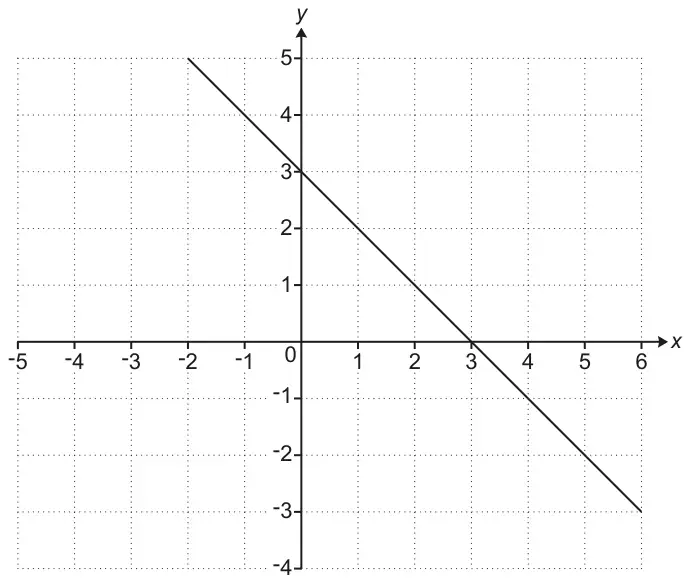
(a) By drawing a suitable line on the grid, solve these simultaneous equations.
\(x + y = 3\) and \(y = 2x - 3\) [4]
(b) Umi says,
The simultaneous equations \(y = 2x + 3\) and \(2y - 4x = 7\) will have no solutions.
Is Umi correct?
Explain how you decide. [2]
| Answer | Marks | Part marks and guidance | |
|---|---|---|---|
| Draws ruled line \(y = 2x - 3\) | 4 | M2 for drawing ruled line \(y = 2x - 3\) or M1 for correct line but freehand or for ruled line with gradient 2 or for ruled line with positive gradient passing through (0, –3) | Accuracy - use overlay as a guide and line must touch circles For M2 must reach at least (0, –3) and intersection with \(x + y = 3\) |
| AND | |||
| \(x = 2\) and \(y = 1\) | B2FT for \(x = 2\) and \(y = 1\) or B1FT for one correct value | FT their intersection of their ruled or freehand line with given line Allow correct or FT for B2 and B1 If intersection is not on integer values allow reasonable estimated readings | |
| Answer | Marks | Part marks and guidance | |
|---|---|---|---|
| Showing \(2y - 4x = 7\) can be written as \(y = 2x + 3.5\) oe Or Rearranges equations to the same form for comparison e.g. \(2y = 4x + 6\) and \(2y = 4x + 7\), or \(2y - 4x = 6\) and \(2y - 4x = 7\) or states that both have gradient of 2 with no error in rearrangement seen | 1 | Accept other working that supports a conclusion of parallel or no solutions | eg \(2(2x + 3) - 4x = 7\) and \(4x + 6 - 4x = 7\) or better \(2y = 4x + 6\) and \(2y - 4x = 7\) then eliminates \(x\) or \(y\) leading e.g. 6 – 7 oe or ‘no solutions’ |
| correct oe and the lines are parallel/have same gradient/ have no solutions oe | 1dep | Dep on first mark and with no errors seen | |