
Higher June 2017 Paper 1 Q14
14. The diagram shows the points P\((1, -4)\) and Q\((7, q)\), joined by a straight line.
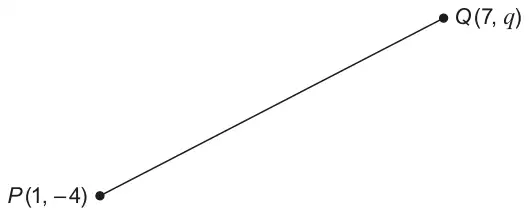
Diagram not drawn to scale
The gradient of PQ is \(\dfrac{5}{3}\).
(a) Find the value of \(q\). [3]
(b) The line \(L_1\) is parallel to the line PQ and passes through the point \((3, 0)\).
Where does the line \(L_1\) cross the \(y\)-axis? [2]
Where does the line \(L_1\) cross the \(y\)-axis? [2]
(c) The line \(L_2\) is perpendicular to the line PQ and passes through the point \((-5, 1)\).
Find the equation of \(L_2\). [3]
Find the equation of \(L_2\). [3]
| Scheme | Marks | Comments |
|---|---|---|
| (gradient of PQ = ) \(\dfrac{q - -4}{7 - 1}\) seen or implied | B1 | |
| \(\dfrac{q + 4}{6} = \dfrac{5}{3}\) seen or implied | M1 | ‘their \(\dfrac{q+4}{6}\)’ \(= \dfrac{5}{3}\) FT their derived gradient; \(\dfrac{q+4}{2} = 5\) implies B1 M1 |
| \(q = 6\) | A1 | CAO |
Alternative method
| Scheme | Marks | Comments |
|---|---|---|
| From similar triangles, finds or uses the scale factor ½ or 2 or states \(\dfrac{5}{3}\ (=)\ \dfrac{10}{6}\) | B1 | |
| Forms a valid relationship to find \(q\) seen or implied eg \(q + 4 = 2 \times 5\) or \((q =)\ 10 - 4\) | M1 | |
| \(q = 6\) | A1 |
| Scheme | Marks | Comments |
|---|---|---|
| \(0 = \dfrac{5}{3} \times 3 + c\) | M1 | Allow eg \(0 = \dfrac{5}{3} \times 3 - c\) |
| \((c =)\ {-5}\) ISW or \((0, -5)\) | A1 | Accept \(y = -5\) |
| Scheme | Marks | Comments |
|---|---|---|
| \(m_{L_2} = -\dfrac{3}{5}\) or equivalent, seen | B1 | Allow eg \(\dfrac{3}{-5}\) as equivalent |
| \(1 = -5\left(-\dfrac{3}{5}\right) + c\) | M1 | FT ‘their \(-\dfrac{3}{5}\)’ provided \(\neq \dfrac{5}{3}\) Accept other full methods e.g. \(\dfrac{y - 1}{x - -5} =\) ‘their \(-\dfrac{3}{5}\)’ |
| \(y = -\dfrac{3}{5}x - 2\) or equivalent | A1 | CAO Accept \(\dfrac{y - 1}{x + 5} = -\dfrac{3}{5}\) |
| (8) |