
1MA0 Higher November 2012 Paper 1 Q23
23
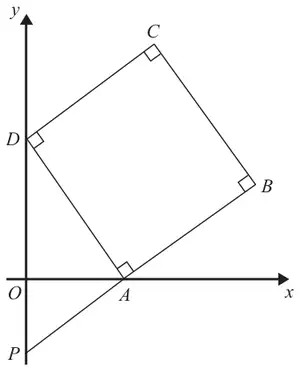
Diagram NOT accurately drawn
\(ABCD\) is a square.
\(P\) and \(D\) are points on the \(y\)-axis.
\(A\) is a point on the \(x\)-axis.
\(PAB\) is a straight line.
The equation of the line that passes through the points \(A\) and \(D\) is \(y = -2x + 6\)
Find the length of \(PD\). (4)
| Answer | Mark | Notes |
|---|---|---|
| 7.5 | 4 | B1 for identifying \(A\) at 3 or \(D\) at 6 or \(A(3, 0)\) or \(D(0, 6)\) oe eg may be seen as labels on the diagram M1 for \(0 = \frac{-1}{-2} \times 3 + c\) M1 (dep on previous M1) for 6 + ‘1.5’ A1 cao OR B1 for identifying \(A\) at 3 or \(D\) at 6 or \(A(3, 0)\) or \(D(0, 6)\) oe eg may be seen as labels on the diagram M1 for \(3/6 = OP/3\) or 1.5 oe seen (from similar triangles) M1 for 6 + ‘1.5’ A1 cao OR B1 for identifying \(A\) at 3 or \(D\) at 6 or \(A(3, 0)\) or \(D(0, 6)\) oe eg may be seen as labels on the diagram M1 for \((6 + OP)^2 = (6^2 + 3^2) + (3^2 + OP^2)\) oe (from Pythagoras) M1 for 6 + ‘1.5’ A1 cao |