
Higher November 2017 Paper 1 Q18
18.
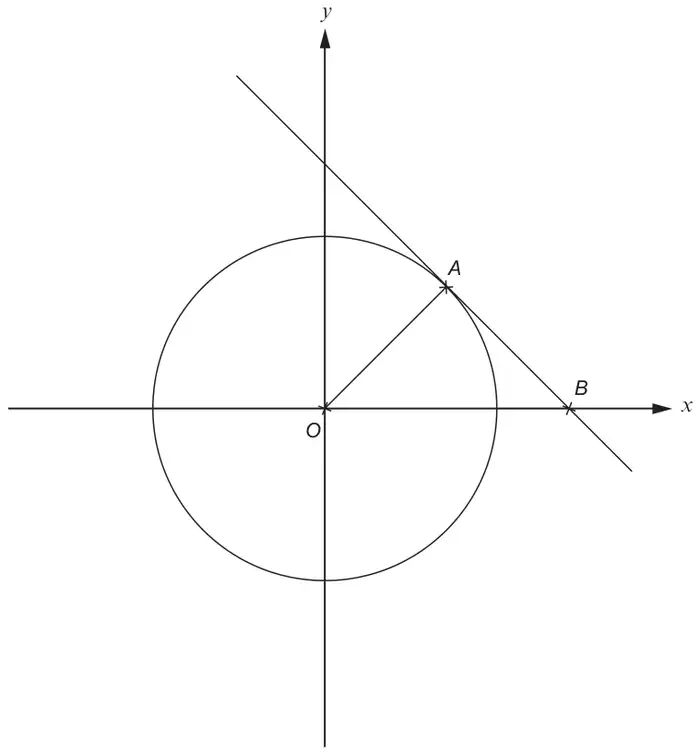
Diagram not drawn to scale
The diagram shows a circle with centre O.
The gradient of the radius OA is \(\dfrac{4}{3}\).
OA = 10 units.
The tangent to the circle at A meets the \(x\)-axis at B.
(a) Explain why the coordinates of A are (6, 8). [2]
(b) Find the coordinates of B. [5]
| Scheme | Marks | Comments |
|---|---|---|
| Correct explanation. e.g. \(\dfrac{8}{6} = \dfrac{4}{3}\) and \(6^2 + 8^2 = 10^2\) or equivalent or draws a 3,4,5 triangle and a 6,8,10 triangle and states they are similar | B2 | Must use both the gradient and the length of OA. B1 for a correct partial explanation e.g. \(\dfrac{8}{6} = \dfrac{4}{3}\) or \(6^2 + 8^2 = 10^2\) or equivalent or draws a 3,4,5 triangle and a 6,8,10 triangle |
| Scheme | Marks | Comments |
|---|---|---|
| (Gradient of tangent =) \(\dfrac{-1}{4/3}\) | M1 | |
| \(8 = -\dfrac{3}{4} \times 6 + c\) | m1 | FT ‘their – ¾’ |
| \(y = -\dfrac{3}{4}x + \dfrac{25}{2}\) or equivalent | A1 | CAO |
| \(0 = -\dfrac{3}{4}x + \dfrac{25}{2}\) | M1 | FT their equation of AB providing the gradient is negative. |
| \(\left(\dfrac{50}{3}, 0\right)\) or equivalent | A1 | Allow a final answer of \(x = \dfrac{50}{3}\) |
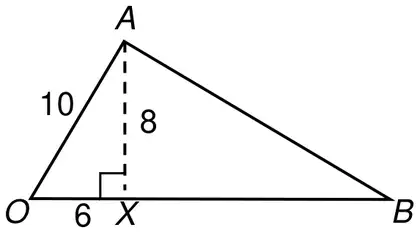
Alternative method 1
| Scheme | Marks |
|---|---|
| Identifies similar triangles OAX and OBA, seen or implied | M1 |
| \(\dfrac{10}{6} = \dfrac{OB}{10}\), seen or implied | M1 |
| \(OB = 10 \times \dfrac{10}{6}\) | M1 |
| \(OB = \dfrac{100}{6}\) or equivalent CAO | A1 |
| \(B\left(\dfrac{50}{3}, 0\right)\) or equivalent | A1 |
Alternative method 2
| Scheme | Marks |
|---|---|
| Identifies similar triangles OXA and AXB, seen or implied | M1 |
| \(\dfrac{BX}{8} = \dfrac{8}{6}\), seen or implied | M1 |
| \(OB = 8 \times \dfrac{8}{6} + 6\) | M1 |
| \(OB = \dfrac{100}{6}\) or equivalent CAO | A1 |
| \(B\left(\dfrac{50}{3}, 0\right)\) or equivalent | A1 |
Alternative method 3
| Scheme | Marks |
|---|---|
| \(\tan AOB = \dfrac{4}{3}\) | M1 |
| \(\cos AOB = \dfrac{3}{5}\) | M1 |
| \(\left(\cos AOB = \dfrac{OA}{OB} =\right)\ \dfrac{10}{OB} = \dfrac{3}{5}\) | M1 |
| \(OB = \dfrac{50}{3}\) or equivalent CAO | A1 |
| \(B\left(\dfrac{50}{3}, 0\right)\) or equivalent | A1 |
Alternative method 4
| Scheme | Marks |
|---|---|
| Identifies similar triangles OAX and OBA, seen or implied | M1 |
| \(AB = 10 \times \dfrac{8}{6}\), seen or implied | M1 |
| \(OB = \sqrt{10^2 + \left(\dfrac{40}{3}\right)^2}\) | M1 |
| \(OB = \dfrac{50}{3}\) or equivalent CAO | A1 |
| \(B\left(\dfrac{50}{3}, 0\right)\) or equivalent | A1 |
Alternative method 5
| Scheme | Marks |
|---|---|
| (Gradient AB =) \(\dfrac{-1}{4/3}\), seen or implied | M1 |
| \(-\dfrac{3}{4} = -\dfrac{8}{BX}\), seen or implied | M1 |
| \(OB = 8 \times \dfrac{4}{3} + 6\) | M1 |
| \(OB = \dfrac{100}{6}\) or equivalent CAO | A1 |
| \(B\left(\dfrac{50}{3}, 0\right)\) or equivalent | A1 |
| (7) |