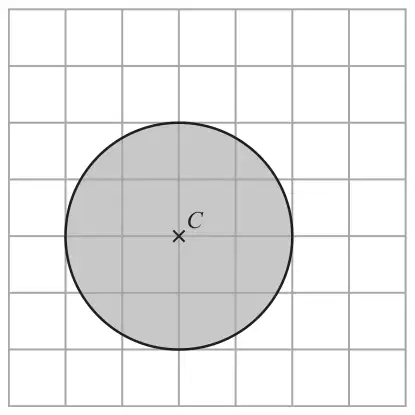
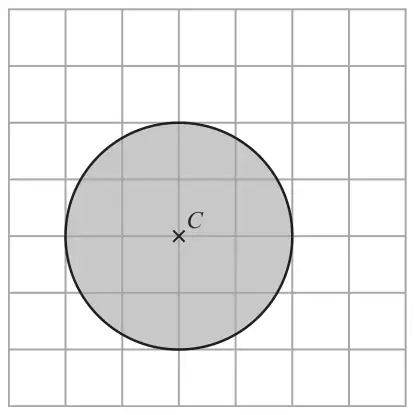
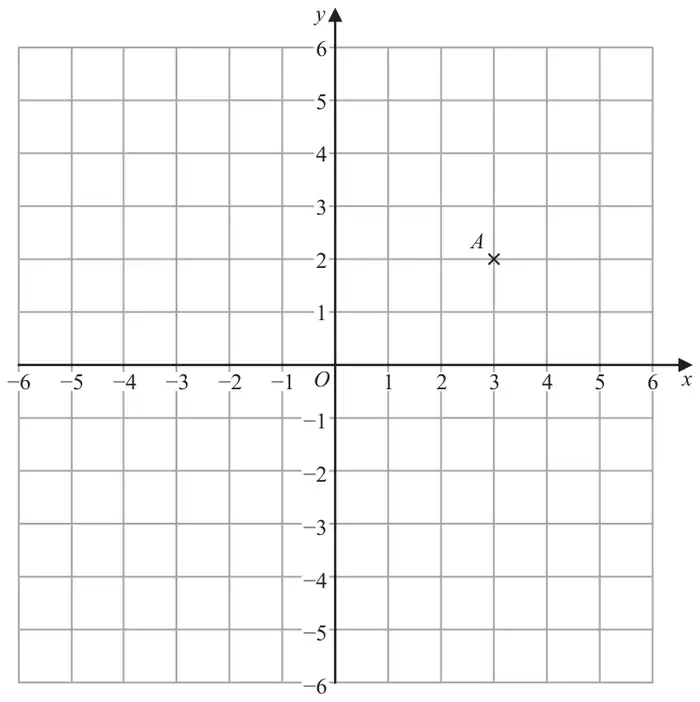
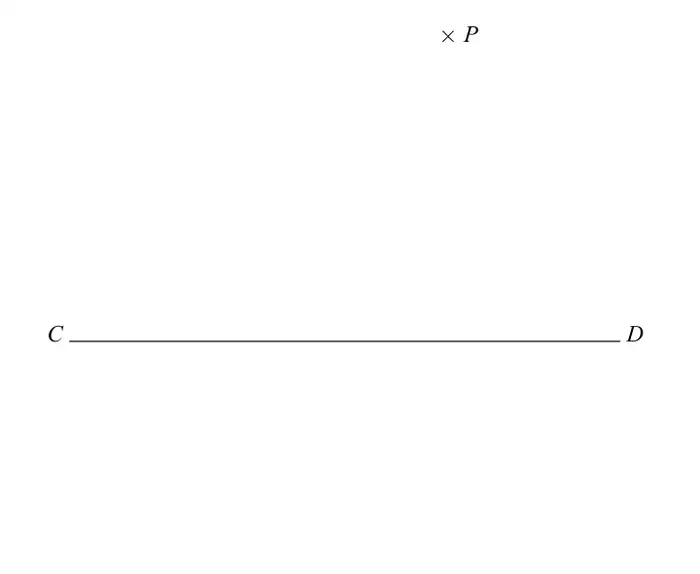
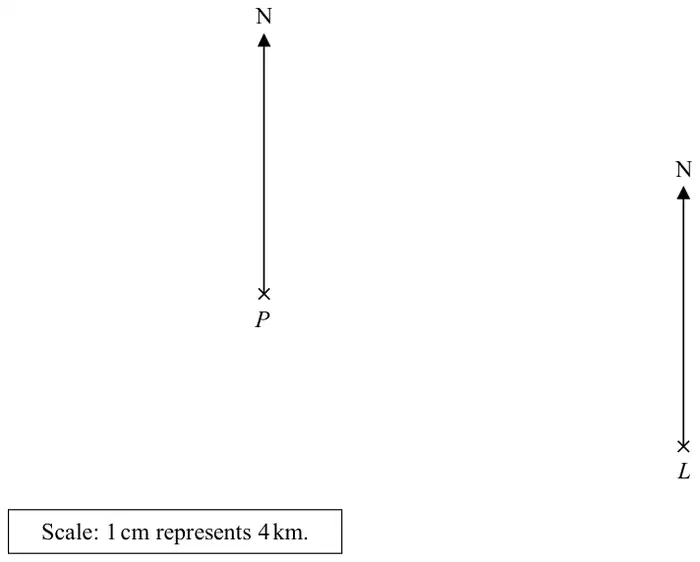
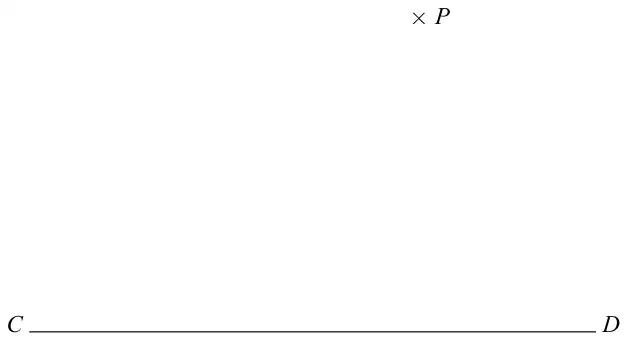
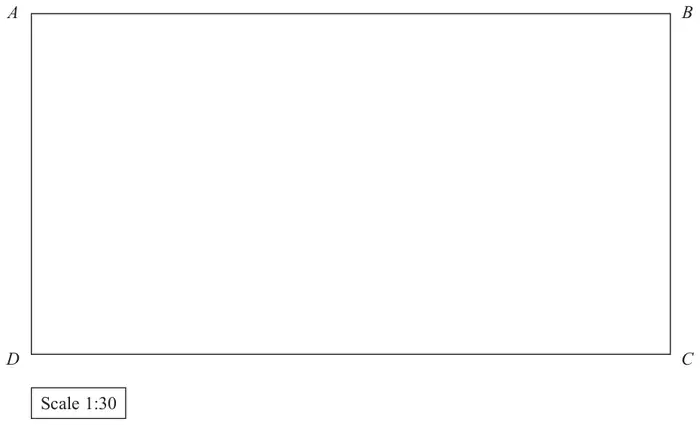
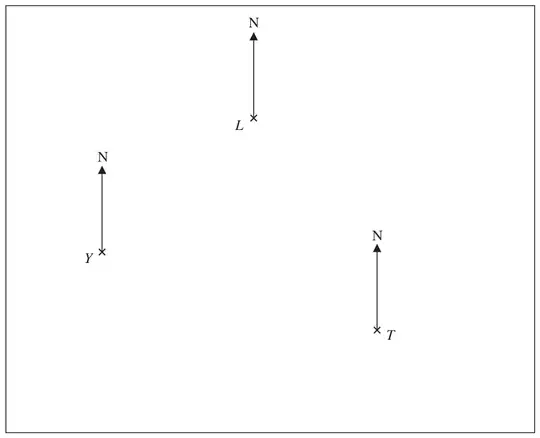
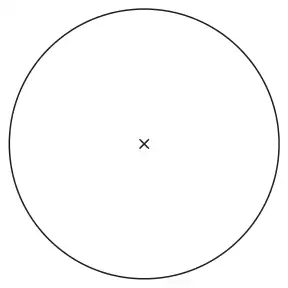
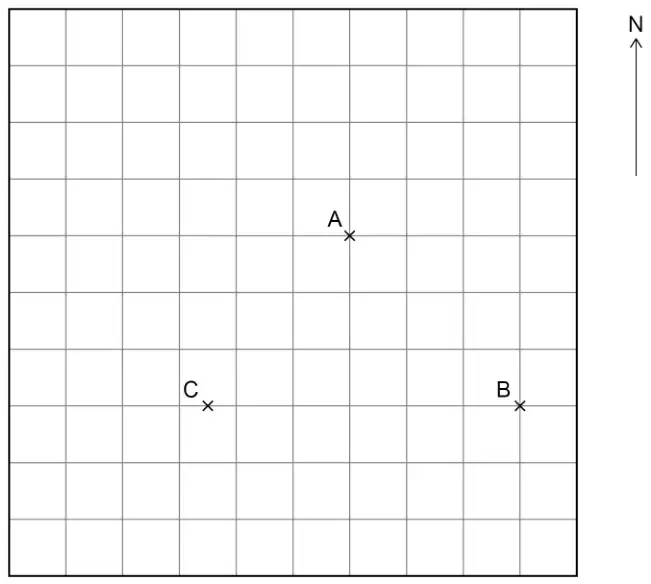
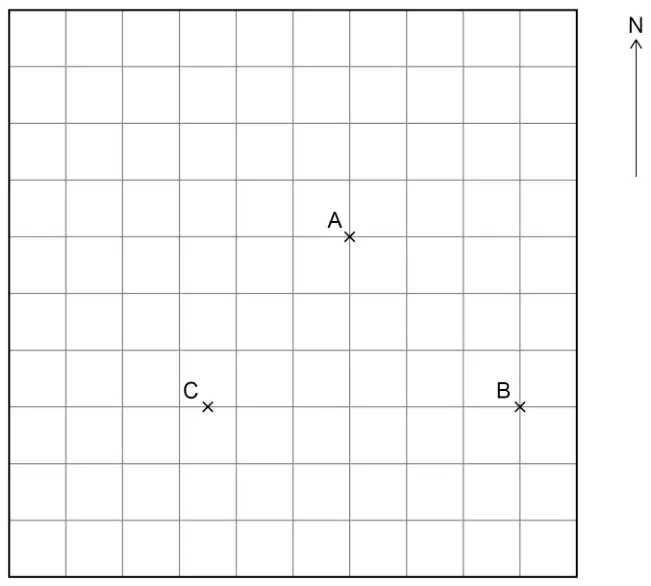
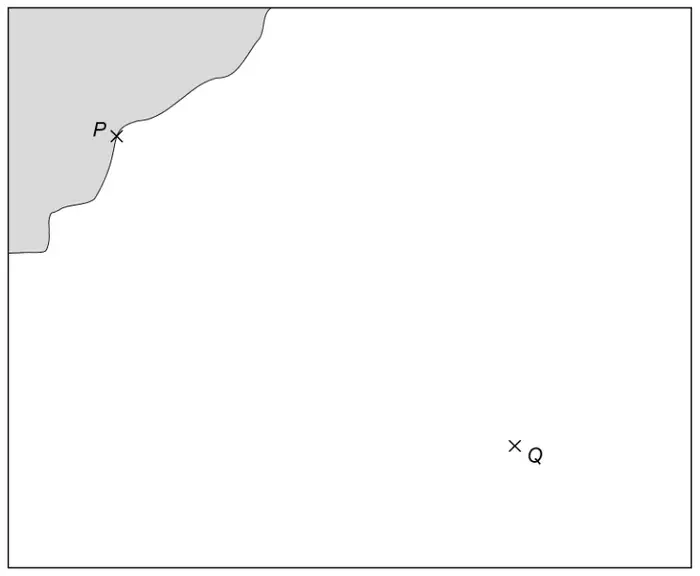
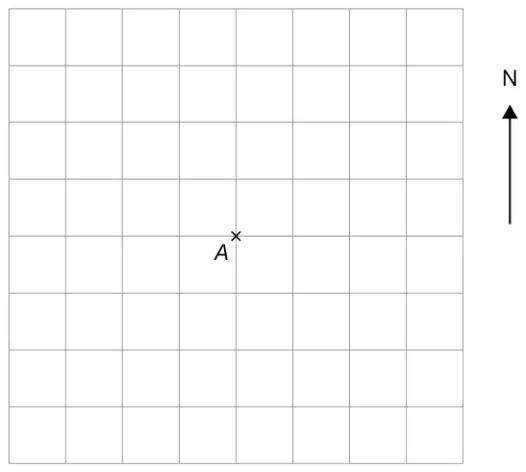
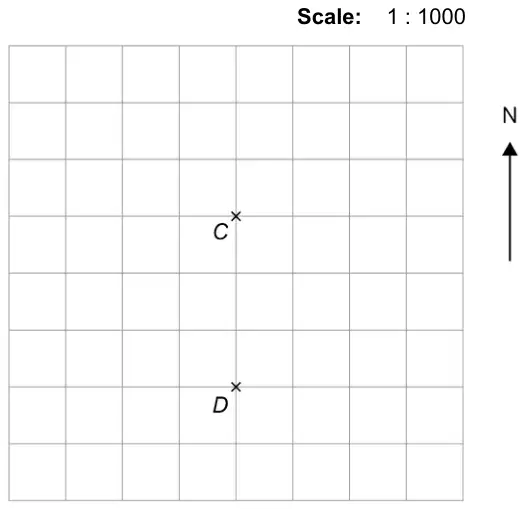
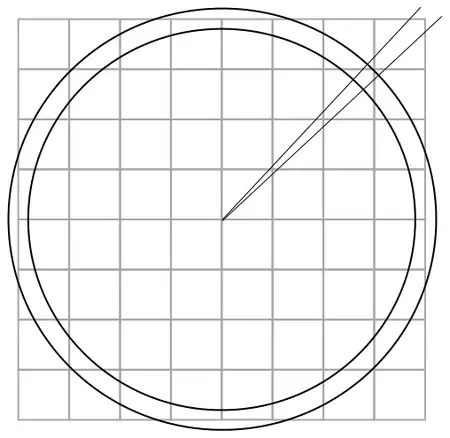
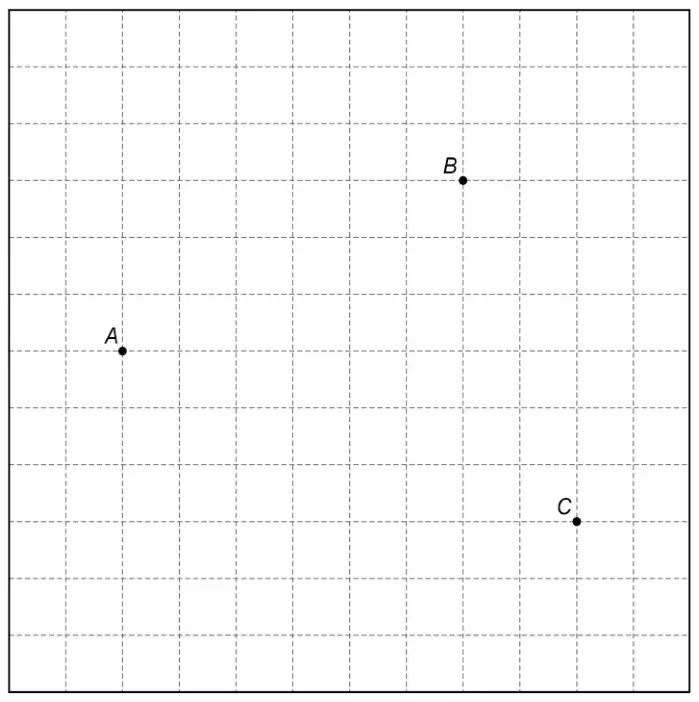
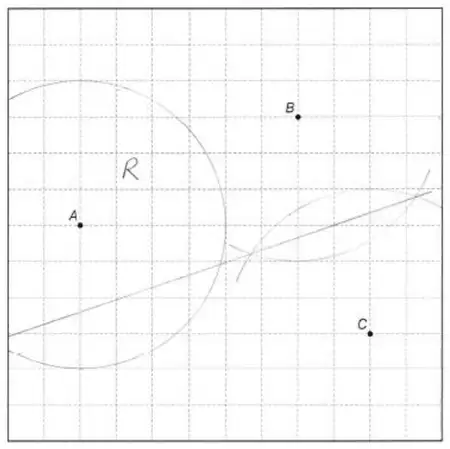
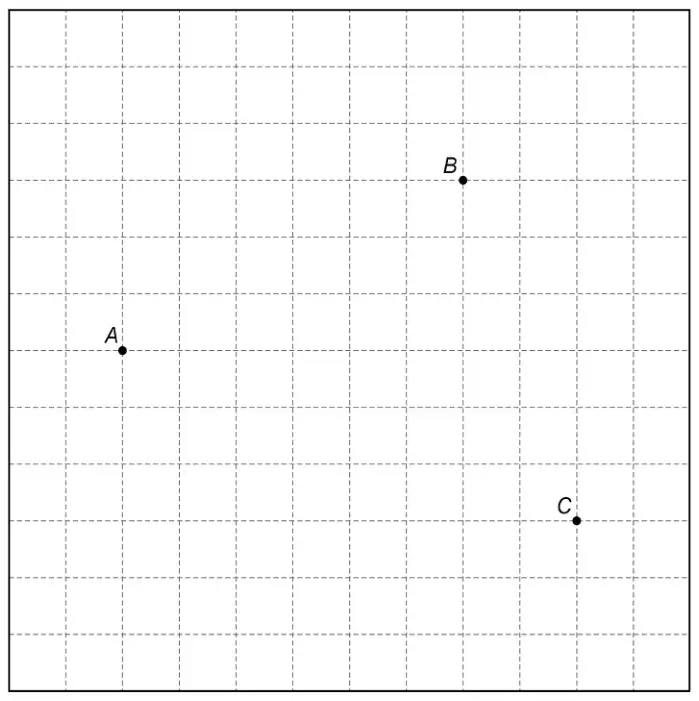
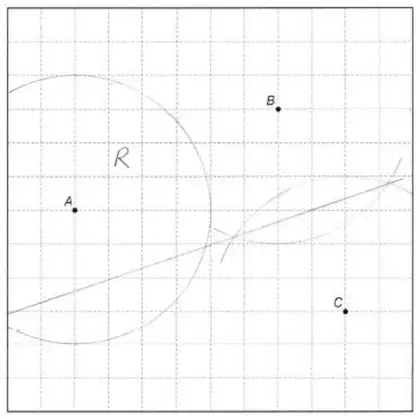
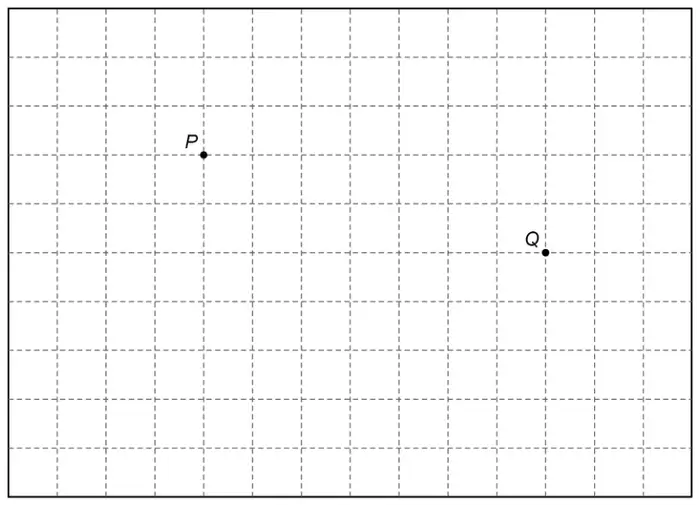
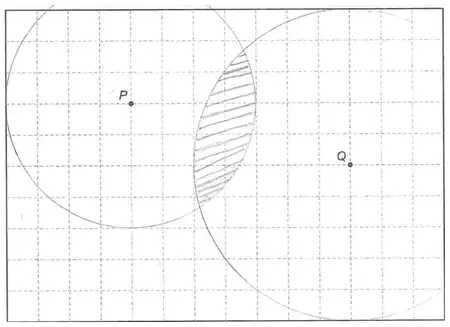
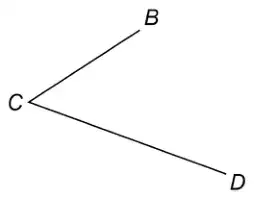
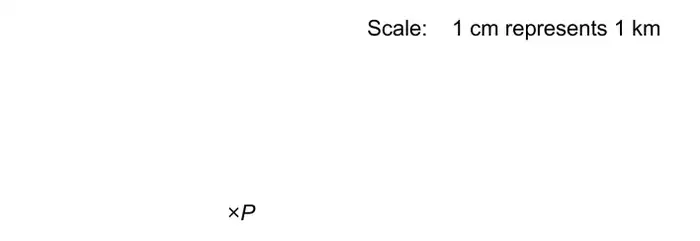
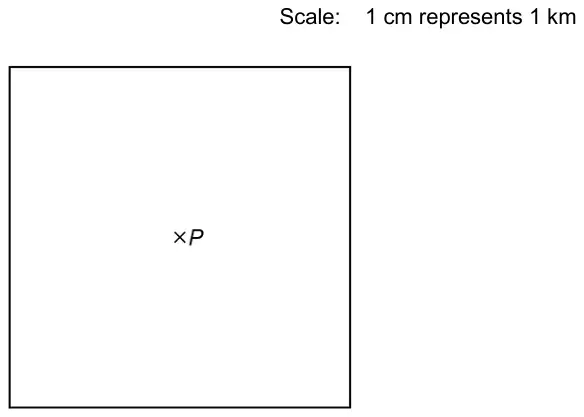
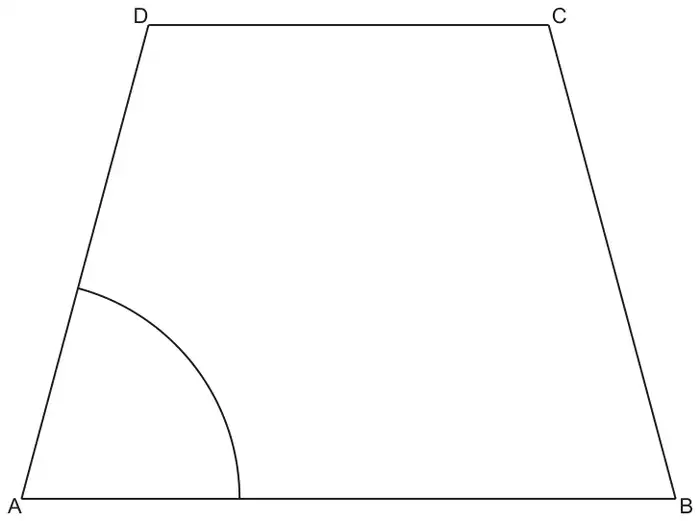
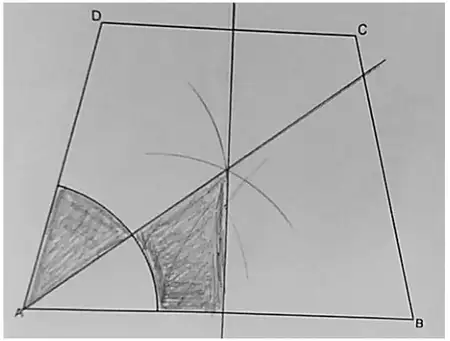
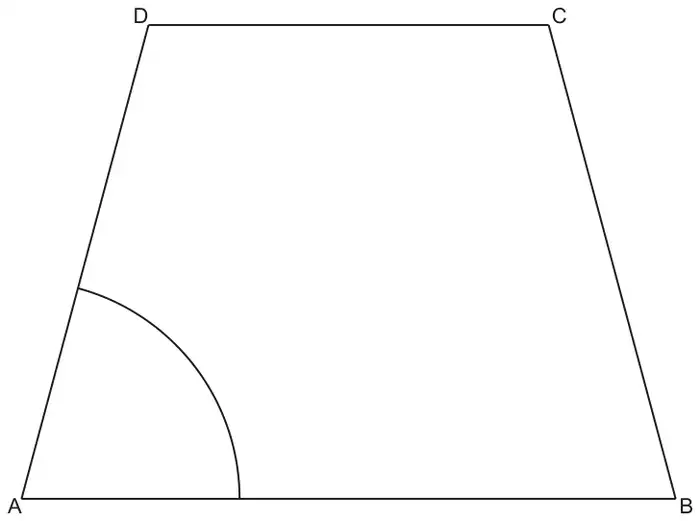
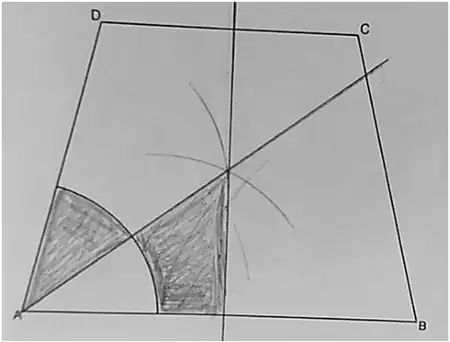
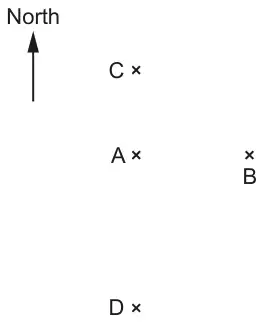
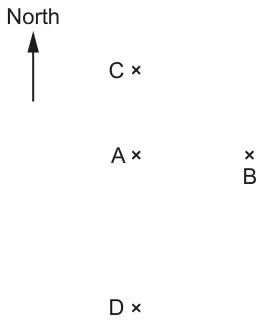
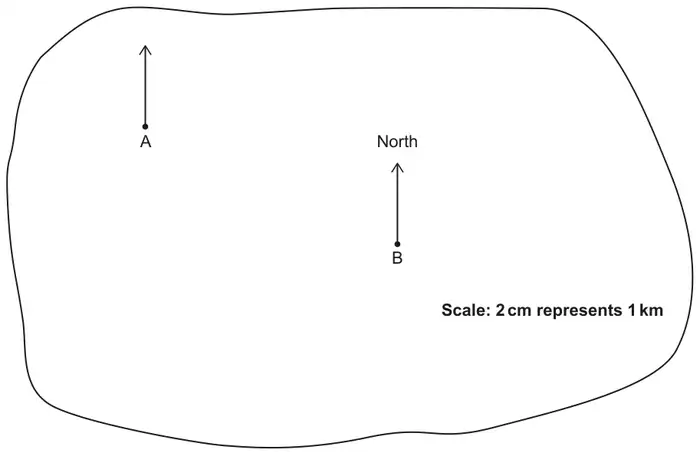
A point \(P\) is at least 2 cm from the point \(C\). Nadia is asked to shade the region where point \(P\) could be.
Her answer is shown on the grid.
Explain the mistake Nadia has made. (1)
Mark scheme
Answer
Mark
Mark scheme
Explanation
C1
for valid explanation identifying mistake,
Acceptable examples It’s on the wrong side of circle She shaded inside the circle (but should be outside) Shaded where \(P\) can’t be She shaded/drew less than 2cm She shaded at most 2 cm \(P\) should be outside (or on) the circle \(P\) should be anywhere outside the 2cm radius She shaded around point \(C\) not (at least) 2cm from point \(C\) Nadia should have shaded away from the circle
Not acceptable examples Shading is wrong or she shaded it incorrectly Region is in the wrong place Doesn’t fit inside the circle She shaded all the points between \(C\) and where all the points \(P\) could be The question says at least 2cm and not only 2cm away She shaded in too close She shaded a circle not a square or should’ve drawn/shaded a square
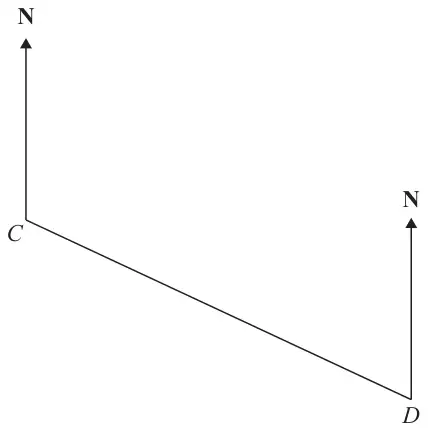
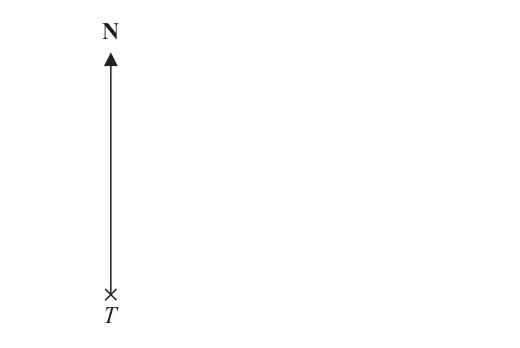
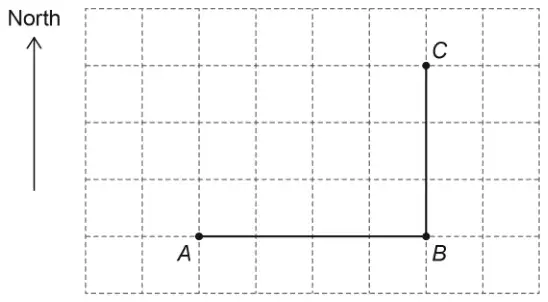
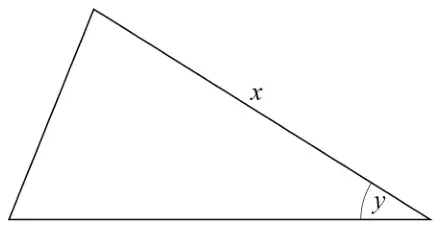
for \(147 + 180\) or for \(360 - (180 - 147)\), or for drawing a suitable diagram with 147 in the correct position and with the bearing of A from B indicated
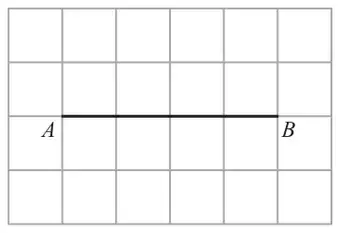
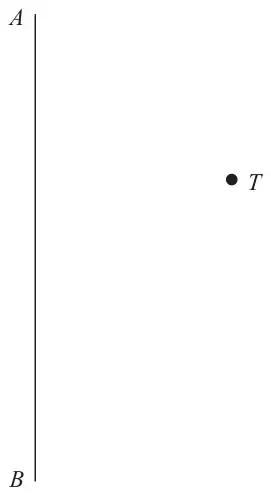
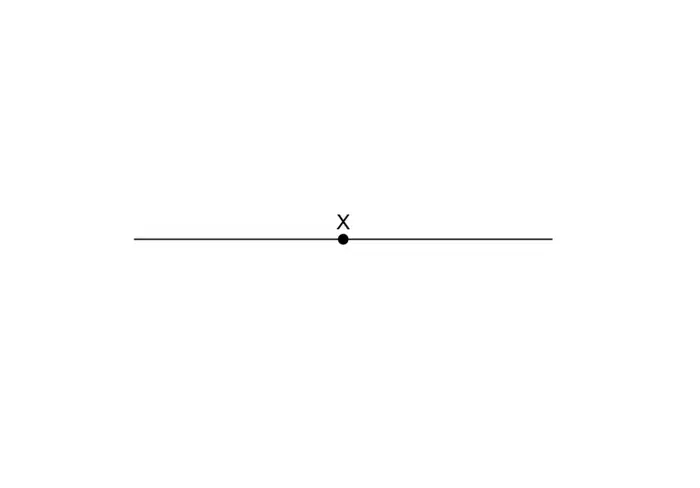
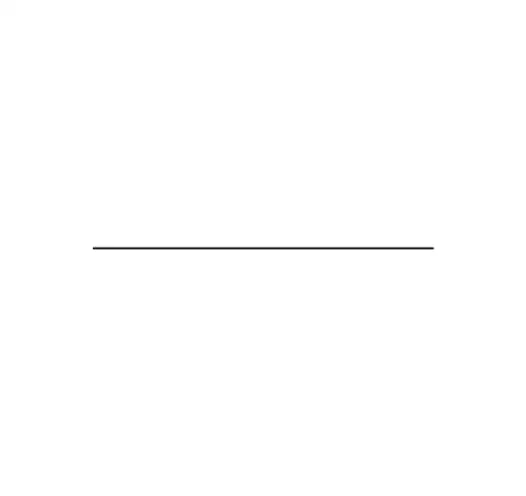
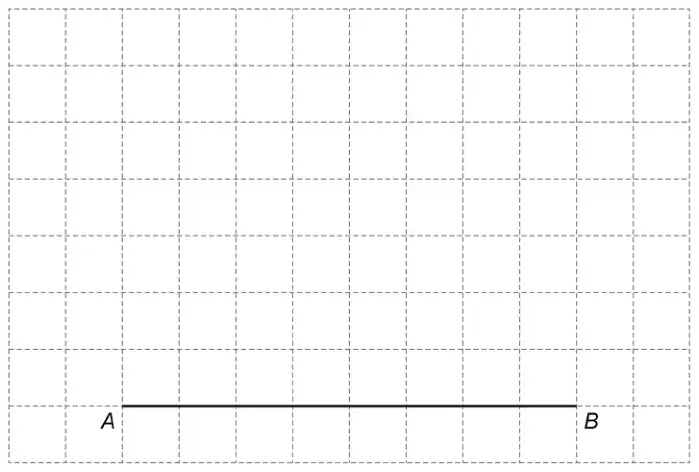
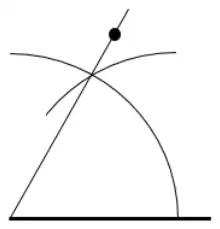
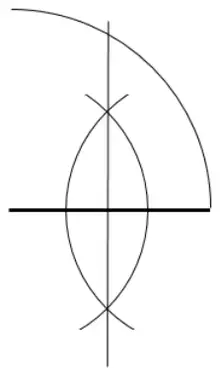
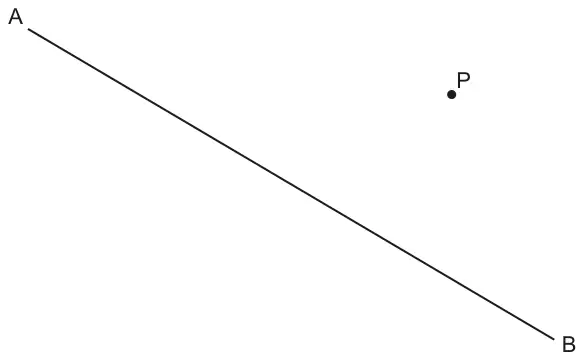
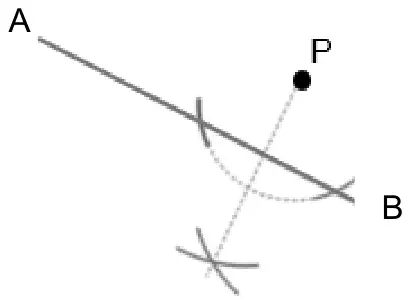
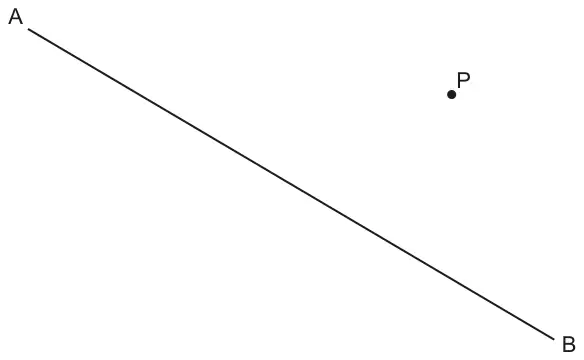
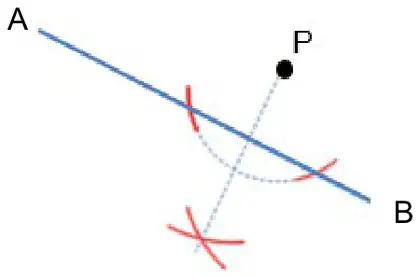
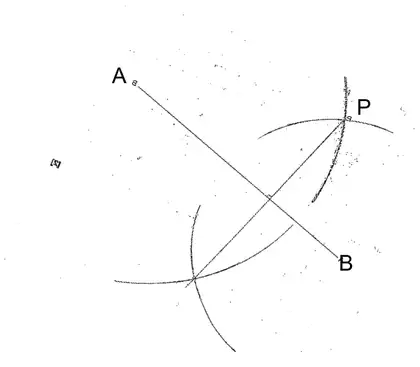
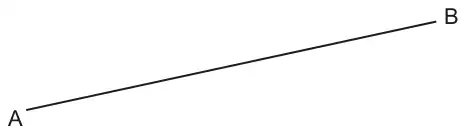
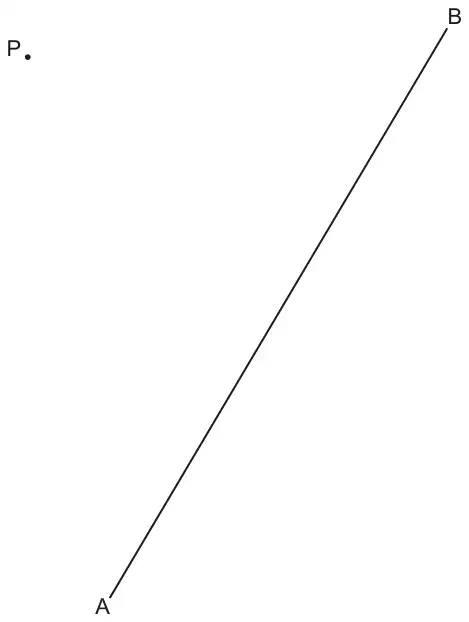
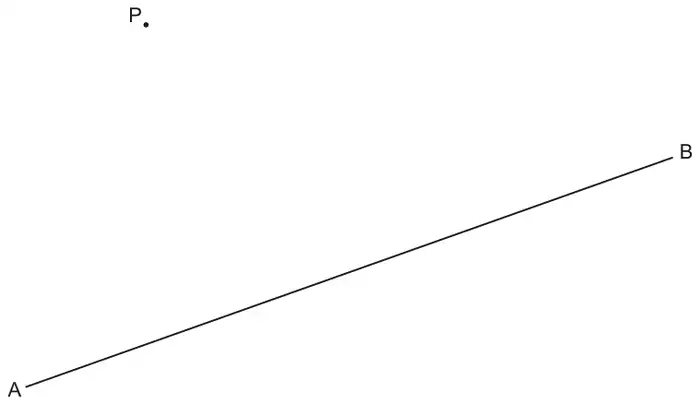
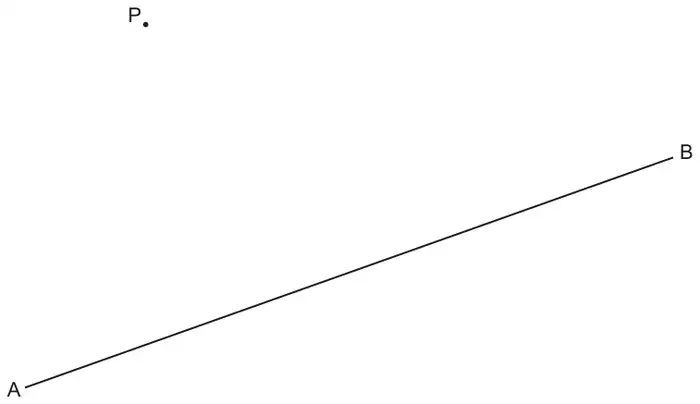
22 The point \(P\) lies on the line \(AB\). Use ruler and compasses to construct an angle of 90° at \(P\). You must show all your construction lines.(2)
Mark scheme
Answer
Mark
Mark scheme
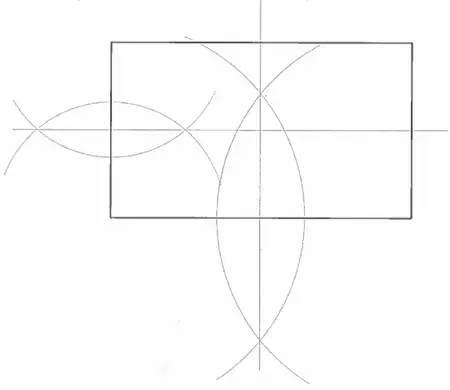
Angle constructed
C2
for fully correct construction with all arcs drawn
(C1
for line drawn within guidelines with no (or incorrect) construction arcs or correct arcs drawn and no line seen)
Additional guidance
Full marks cannot be awarded if no construction lines are seen
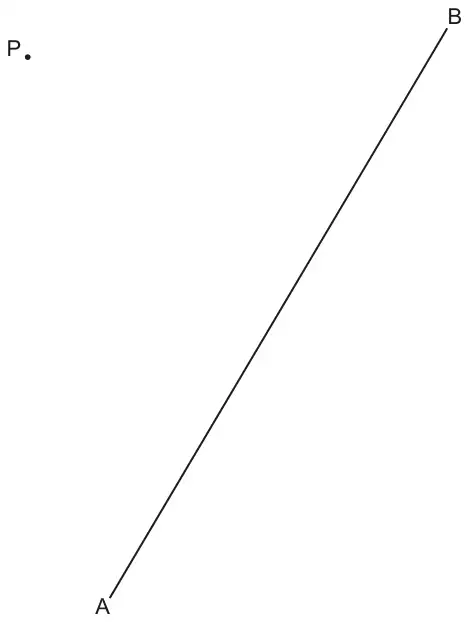
5 The point \(P\) lies on the line \(AB\). Use ruler and compasses to construct an angle of 90° at \(P\). You must show all your construction lines. (2)
Mark scheme
Answer
Mark
Mark scheme
Angle constructed
C2
for fully correct construction with all arcs drawn
(C1
for line drawn within guidelines with no (or incorrect) construction arcs or correct arcs drawn and no line seen)
Additional guidance
Full marks cannot be awarded if no construction lines are seen
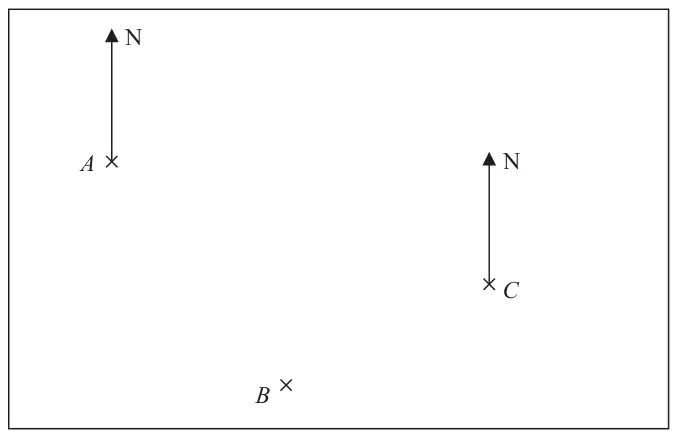
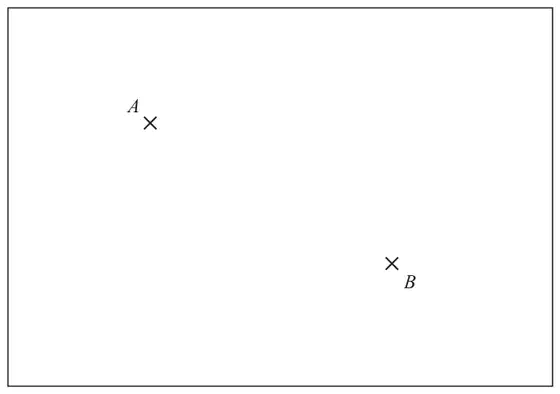
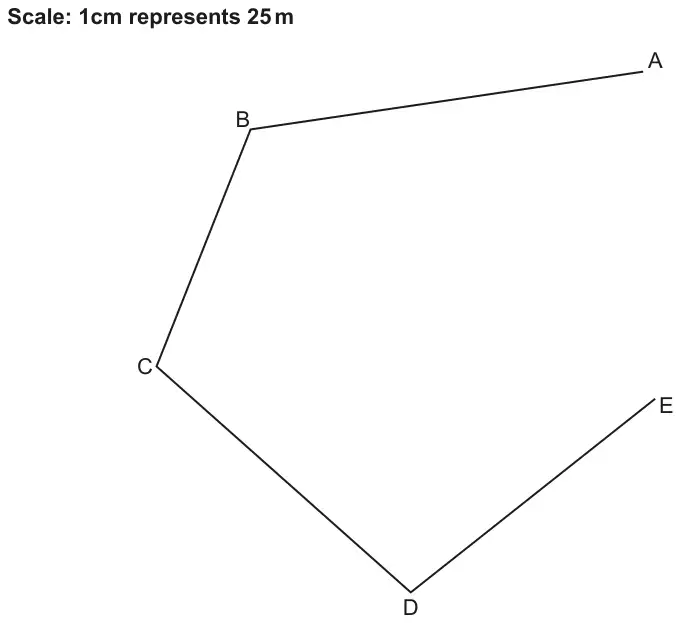
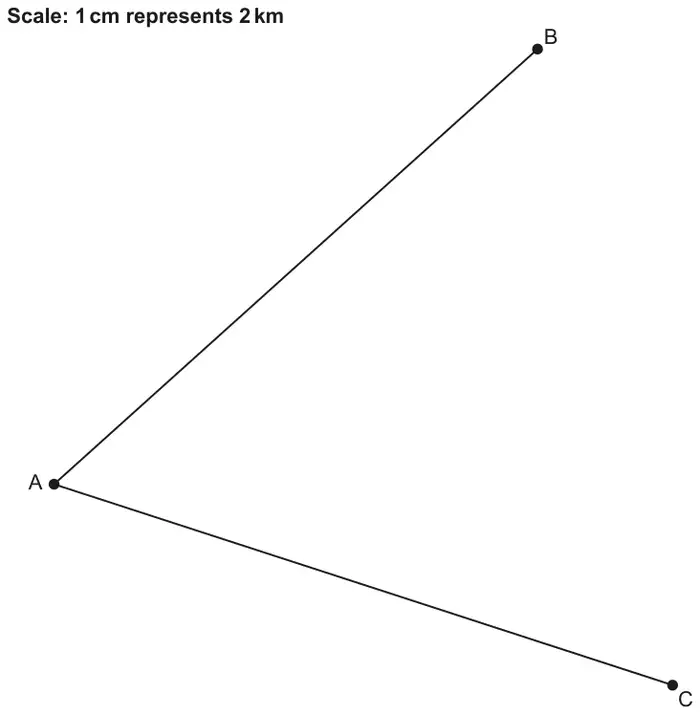
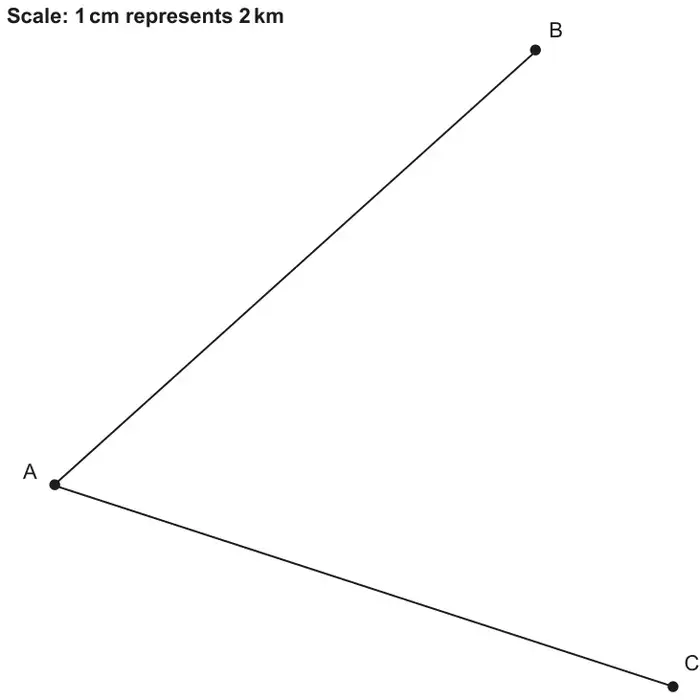
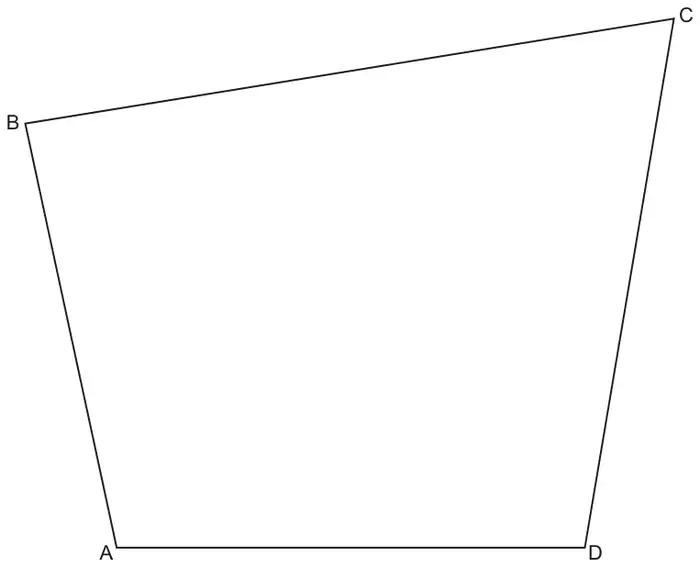
13 The accurately drawn map shows the positions of three points, \(A\), \(B\) and \(C\), in a field.
Scale: 1 cm represents 150 metres
Parveen walks in a straight line from \(A\) to \(B\). She then walks in a straight line from \(B\) to \(C\).
Susan walks in a straight line from \(A\) to \(C\).
Parveen walks more metres than Susan.
(a) How many more? (3)
(b) Find by measurement the bearing of \(A\) from \(C\). (1)
Mark scheme (a)
Answer
Mark
Mark scheme
300
M1
for a correct method to measure and convert one line to a distance in metres, eg (\(AB =\)) \(5 \times 150\) (= 750 or in the range 720 to 780) or (\(BC =\)) \(4 \times 150\) (= 600 or in the range 570 to 630) or (\(AC =\)) \(7 \times 150\) (= 1050 or in the range 1020 to 1080) or for \(5 + 4 - 7\) (= 2 or in the range 1.4 to 2.6)
M1
for a complete method, eg \(\text{``}750\text{''} + \text{``}600\text{''} - \text{``}1050\text{''}\) or \(\text{``}2\text{''} \times 150\)
A1
for answer in the range 210 to 390
Additional guidance
Accept measurements given in mm instead of cm for the first mark. Accept measurements given to a tolerance of ±2 mm
Where “750”, “600”, “1050” and “2” have come from their measurements
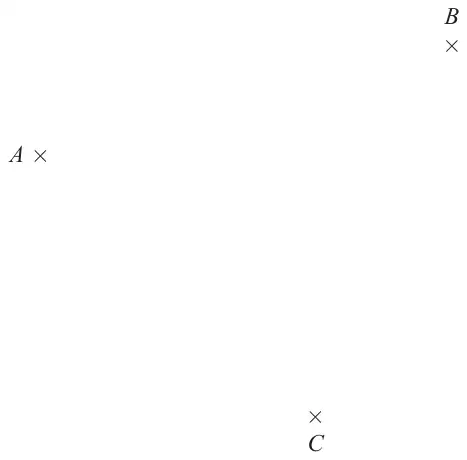
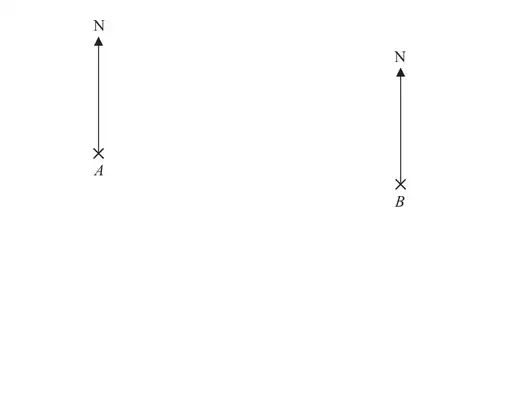
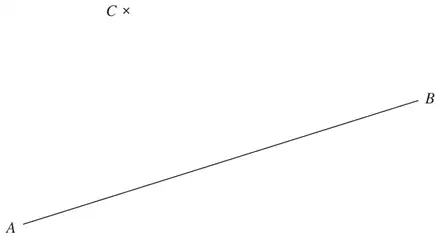
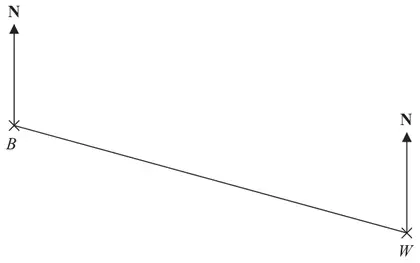
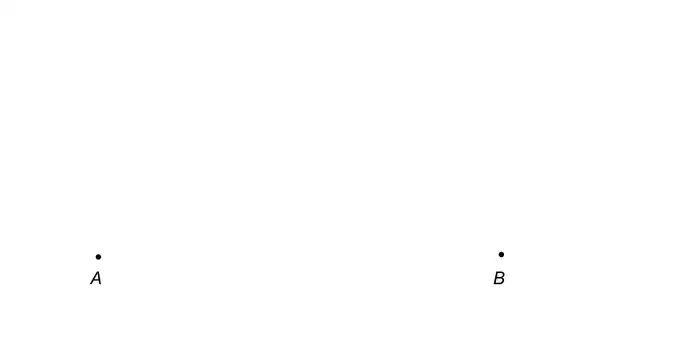
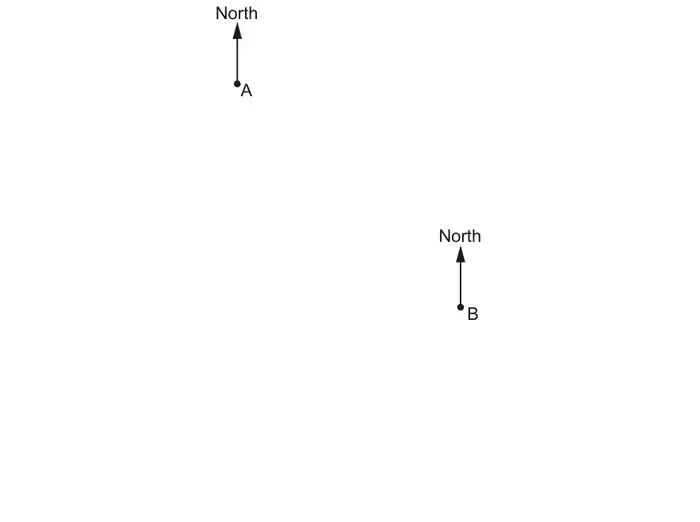
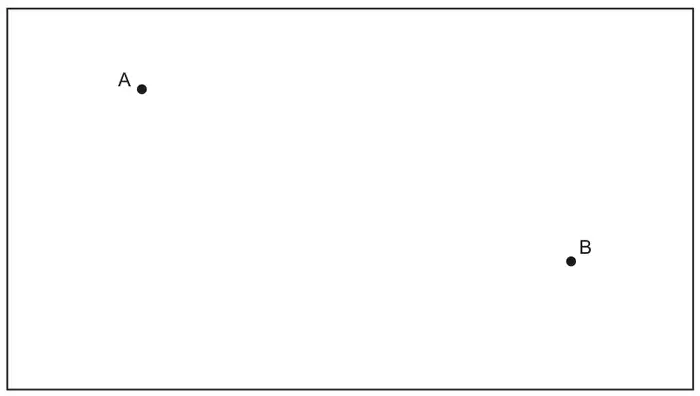
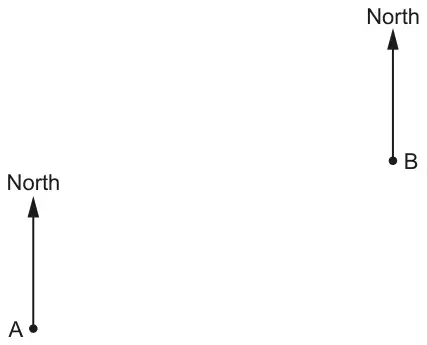
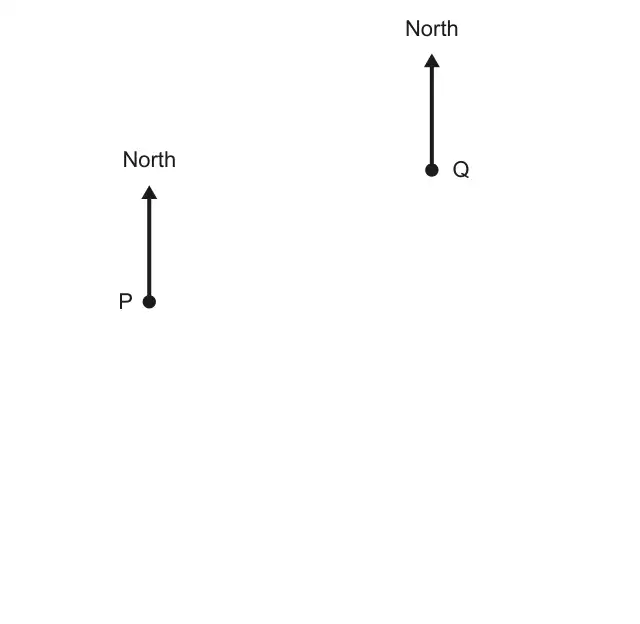
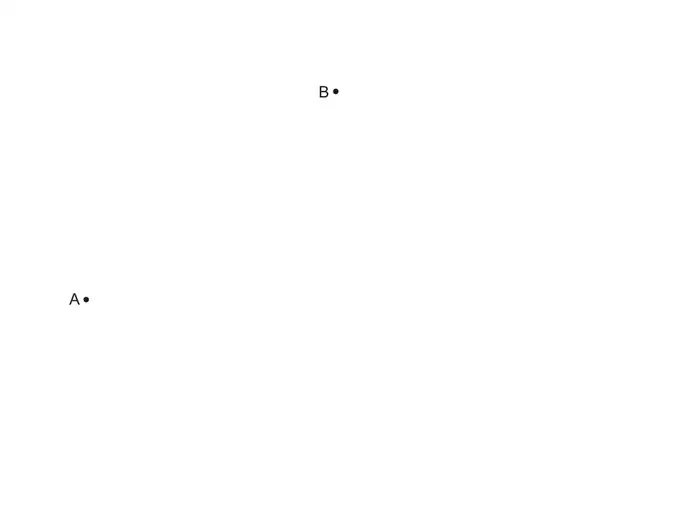
9 The diagram shows the position of two churches, \(A\) and \(B\).
Church \(C\) is on a bearing of \(130^\circ\) from church \(A\). Church \(C\) is on a bearing of \(245^\circ\) from church \(B\).
In the space above, draw an accurate diagram to show the position of church \(C\).
Mark the position of church \(C\) with a cross (\(\times\)). Label it \(C\). (3)
Mark scheme
Answer
Mark
Notes
Correct position of \(C\)
3
M1 for line drawn or point marked on a bearing of \(130^\circ\) from \(A\) M1 for line drawn or point marked on a bearing of \(245^\circ\) from \(B\) A1 for correct position of \(C\)
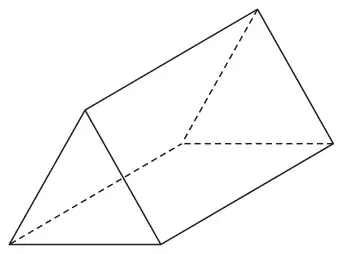
(a) Write down the number of vertices of the prism. (1)
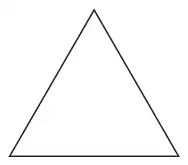
The cross section of the prism is an equilateral triangle.
(b) In the space below, draw a sketch of a net for this prism. (2)
(c) In the space below, draw accurately an equilateral triangle of side 6.5 cm. (2)
Mark scheme (a)
Answer
Mark
Notes
6
1
B1 cao
Mark scheme (b)
Answer
Mark
Notes
sketch of net
2
B2 for a correct sketch of a possible net. (B1 for between 3 and 5 faces (of which at least one must be a rectangle and no more than two triangles) with adjoining edges)
Mark scheme (c)
Answer
Mark
Notes
triangle drawn
2
M1 for line length 6.5 cm drawn (\(\pm\) 2mm) A1 for accurately drawn triangle (within overlay)
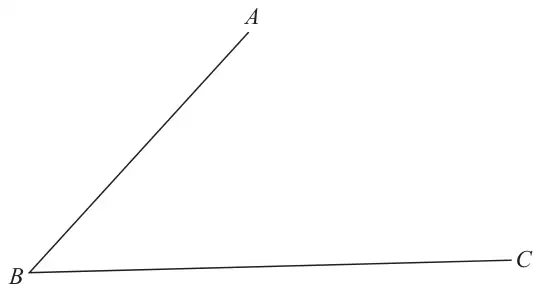
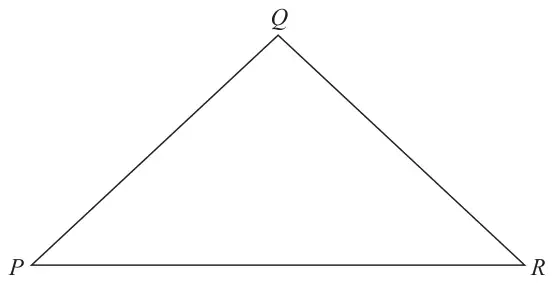
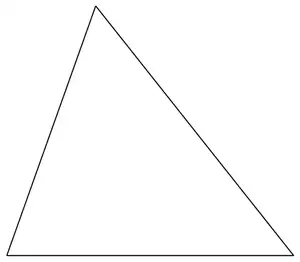
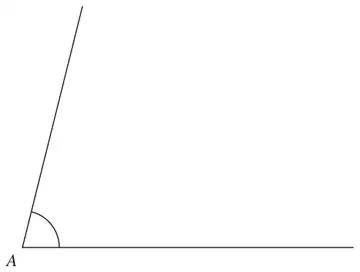
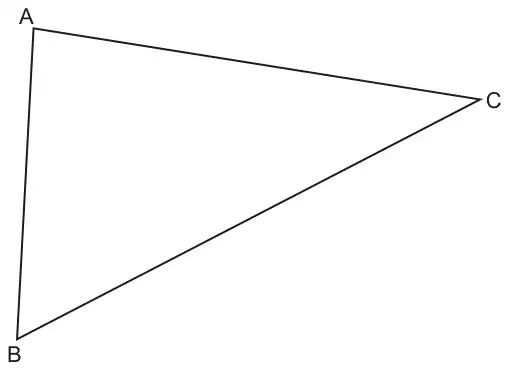
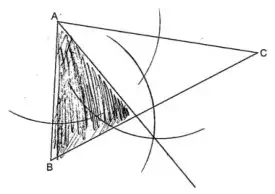
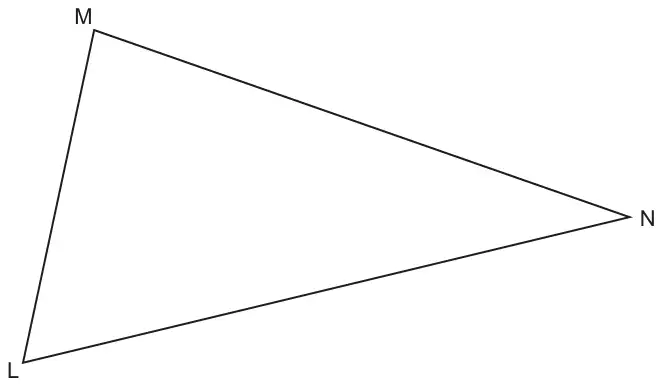
(a) Use ruler and compasses to bisect the angle at \(A\). You must show all your construction lines.(2)
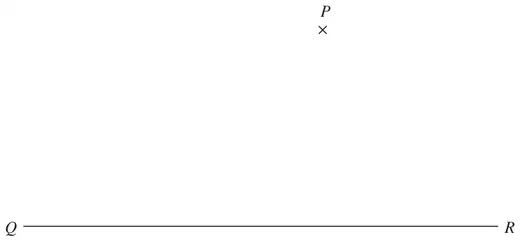
(b) Use ruler and compasses to construct the perpendicular from the point \(P\) to the line \(QR\). You must show all your construction lines.(2)
Mark scheme (a)
Answer
Mark
Notes
Correct construction
2
M1 for correct construction arcs or bisector within guidelines but no (or incorrect) construction arcs A1 for bisector within guidelines with correct arcs shown
Mark scheme (b)
Answer
Mark
Notes
Correct construction
2
M1 for correct construction arcs or perpendicular within guidelines but no (or incorrect) construction arcs A1 for perpendicular within guidelines with correct arcs shown
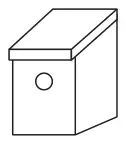
Tina has marked the six parts she needs on a piece of wood, as shown in the diagram below.
Diagram NOT accurately drawn
(a) Work out the total length of the six parts. (2)
Tina is going to cut a circular hole in the front of the nest box. She makes this accurate full size drawing to represent the hole.
(b) Measure the diameter of the hole. (1)
Here is a sketch of one side of the nest box.
Diagram NOT accurately drawn
(c) In the space below, make an accurate scale drawing of this side of the nest box. Use a scale of 1 cm to 20 mm. The line AB has been drawn for you.(3)
Mark scheme (a)
Answer
Mark
Notes
1270 or 1320
2
M1 for adding the six lengths or an answer of digits 127(0) or digits 132(0) A1 for 1270 or 1320
Mark scheme (b)
Answer
Mark
Notes
32 mm or 3.2 cm
1
B1 for answer in range 30 mm to 34 mm or in range 3 cm to 3.4 cm
Mark scheme (c)
Answer
Mark
Notes
Drawing
3
M1 for at least one right angle M1 for 10cm line or 12.5cm line A1 for fully correct drawing
24 Here is a scale drawing of an office. The scale is 1 cm to 2 metres.
A photocopier is going to be put in the office. The photocopier has to be closer to \(B\) than it is to \(A\). The photocopier also has to be less than 8 metres from \(C\).
Show, by shading, the region where the photocopier can be put. (3)
Mark scheme
Answer
Mark
Notes
Loci drawn
3
B1 line parallel to \(BC\) and 3 cm from \(BC\) B1 arc drawn centre \(C\) with radius 4 cm B1 ft for shading a region below their horizontal line and inside their arc
(a) On the triangle, draw all the lines of symmetry. (2)
(b) In the space below, use ruler and compasses to construct an equilateral triangle with sides of length 6 centimetres. You must show all your construction lines. (2)
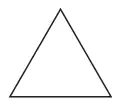
Here is an equilateral triangle.
Diagram NOT accurately drawn
The perimeter of this equilateral triangle is 24 cm.
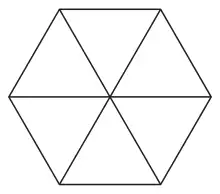
The hexagon below is made from 6 of these triangles.
(c) Work out the perimeter of this hexagon. (2)
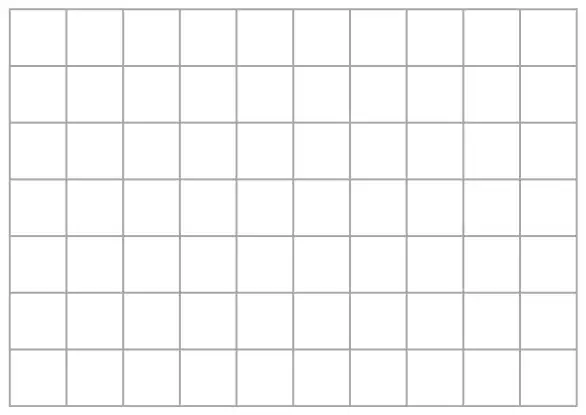
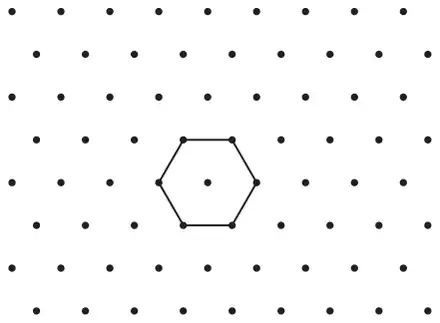
(d) On the grid below, show how the hexagon tessellates. You should draw at least 6 hexagons. (2)
Mark scheme (a)
Answer
Mark
Notes
2
M1 for any 1 correct line of symmetry, allow extras A1 for all 3 lines and no extras
Mark scheme (b)
Answer
Mark
Notes
Triangle drawn
2
M1 for intersecting arcs of radii 6cm or an accurate triangle with no arcs A1 for a fully correct triangle with arcs
Mark scheme (c)
Answer
Mark
Notes
48
2
M1 for \(24 \div 3\) (= 8) A1 cao
Mark scheme (d)
Answer
Mark
Notes
Tessellation
2
B2 for correct tessellation (at least 5 more shapes) (B1 for at least 4 shapes, including initial shape, correctly tessellating)
10 Here is a scale drawing of an office. The scale is 1 cm to 2 metres.
A photocopier is going to be put in the office. The photocopier has to be closer to \(B\) than it is to \(A\). The photocopier also has to be less than 8 metres from \(C\).
Show, by shading, the region where the photocopier can be put. (3)
Mark scheme
Answer
Mark
Notes
Loci drawn
3
B1 for line parallel to BC and 3 cm from BC B1 for arc drawn, centre C, with radius 4 cm B1 ft for shading a region below their horizontal line and inside their arc
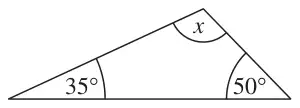
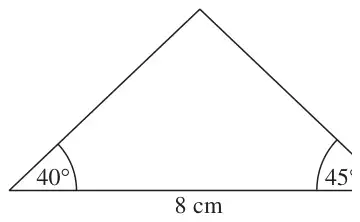
(b) In the space below, make an accurate drawing of this triangle. (3)
Mark scheme (a)
Answer
Mark
Notes
(i) 95
2
B1 cao
(ii) Reason
B1 angles in a triangle add to \(180^\circ\)
Mark scheme (b)
Answer
Mark
Notes
Drawing
3
B3 for a fully correct triangle (B2 for a triangle with 2 of the 3 aspects: line of 8cm; angle of \(40^\circ\); angle of \(45^\circ\)) (B1 for 1 of the 3 aspects)
10 Use ruler and compasses to construct the perpendicular from point \(C\) to the line \(AB\).
You must show all your construction lines.
(2)
Mark scheme
Answer
Mark
Notes
construction
2
M1 for a pair of arcs or a single arc, centre C, that cut line AB and at least one pair of arcs not at C within guidelines A1 for perpendicular within guidelines with appropriate construction arcs
OR M1 for an arc, centre A radius AC and an arc centre B radius BC. The two arcs must intersect below AB A1 for perpendicular within guidelines with appropriate construction arcs (SC If M0 scored, B1 for correct perpendicular line within guidelines)
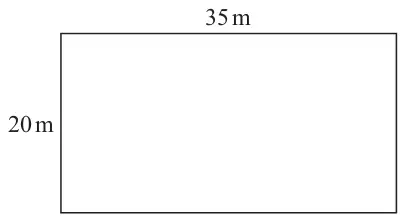
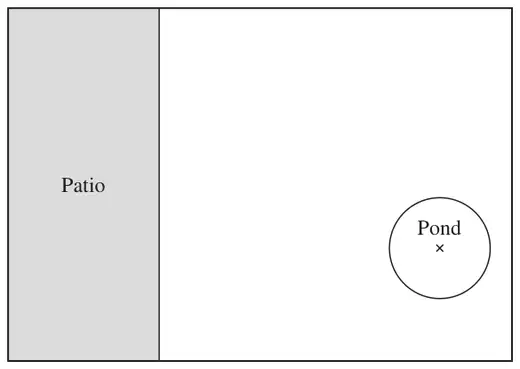
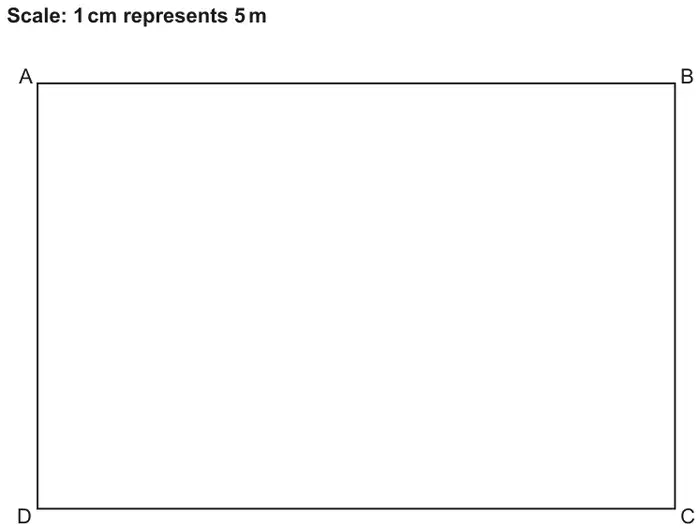
8 The diagram shows a garden in the shape of a rectangle. The scale of the diagram is 1 cm represents 2 m.
Scale: 1 cm represents 2 m
Irfan is going to plant a tree in the garden. The tree must be
more than 3 metres from the patio and more than 6 metres from the centre of the pond.
On the diagram, shade the region where Irfan can plant the tree. (3)
Mark scheme
Answer
Mark
Notes
Correct region
3
B1 for full line drawn 1.5 cm from edge of patio and parallel to it B1 for full arc of circle radius 3 cm centre the centre of the pond B1 ft for shading region to the right of their vertical line and outside the arc of their circle with correct centre
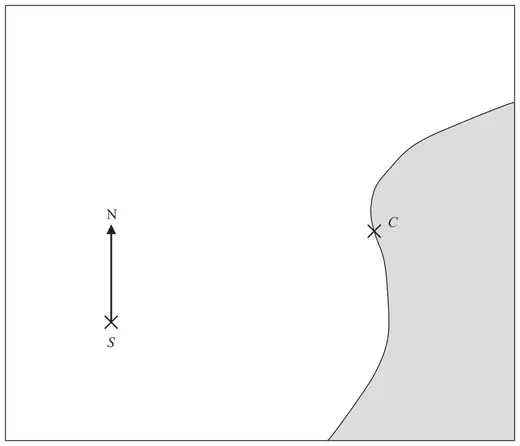
*13 Here is a map. The position of a ship, \(S\), is marked on the map.
Scale 1 cm represents 100 m
Point \(C\) is on the coast. Ships must not sail closer than 500 m to point \(C\).
The ship sails on a bearing of 037°
Will the ship sail closer than 500 m to point \(C\)? You must explain your answer. (3)
Mark scheme
Answer
Mark
Notes
Yes with explanation
3
M1 for bearing \(\pm 2^\circ\) within overlay M1 for use of scale to show arc within overlay or line drawn from \(C\) to ship’s course with measurement C1(dep M1) for comparison leading to a suitable conclusion from a correct method
20 The diagram shows the positions of two villages, Beckhampton (\(B\)) and West Kennett (\(W\)).
Scale: 4 cm represents 1 km.
(a) Work out the real distance, in km, of Beckhampton from West Kennett. (2)
The village, Avebury (\(A\)), is on a bearing of 038° from Beckhampton.
On the diagram, \(A\) is 6 cm from \(B\).
(b) On the diagram, mark \(A\) with a cross (\(\times\)). Label the cross \(A\). (2)
Mark scheme (a)
Answer
Mark
Notes
2.5
2
M1 for 10 (cm) or “10” \(\div\) 4 A1 for 2.45 – 2.55
Mark scheme (b)
Answer
Mark
Notes
A marked on diagram
2
M1 for a point marked (or line drawn) on a bearing of \(038^\circ\) from either point \(B\) or point \(W\), OR for a point marked (or arc drawn) 6 cm from \(B\) A1 for the position of Avebury marked (accept without label if not ambiguous)
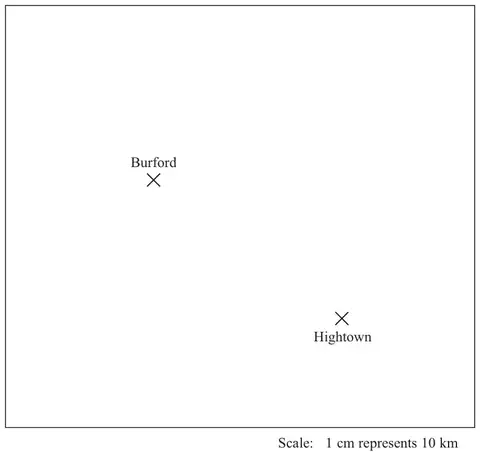
28 Here is a map. The map shows two towns, Burford and Hightown.
A company is going to build a warehouse. The warehouse will be less than 30 km from Burford and less than 50 km from Hightown.
Shade the region on the map where the company can build the warehouse. (3)
Mark scheme
Answer
Mark
Notes
Region shaded
3
B1 for circle arc of radius 3cm (± 2mm) centre Burford B1 for circle arc of radius 5 cm (± 2mm) centre Hightown B1 for overlapping regions of circle arcs shaded
14 The bearing of a ship from a lighthouse is \(050^\circ\)
Work out the bearing of the lighthouse from the ship. (2)
Mark scheme
Answer
Mark
Notes
230
2
M1 for 180 + 50 A1 cao OR M1 for 360 – (180 – 50) or 360 – 130 A1 cao OR M1 for 50 + (90 – 50) + 90 + 50 or 50 + 40 + 90 + 50 A1 cao OR M1 for a suitable diagram (sketch) with bearing of lighthouse from ship indicated and 50° marked at lighthouse; diagram only intended to indicate position of 50°; ignore other labels and markings unless they create ambiguity. A1 cao
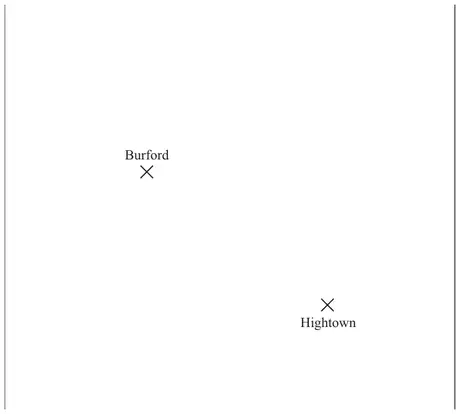
The warehouse will be less than 30 km from Burford and less than 50 km from Hightown.
Shade the region on the map where the company can build the warehouse. (3)
Mark scheme
Answer
Mark
Notes
Region shaded
3
B1 for circle arc of radius 3cm (± 2mm) centre Burford B1 for circle arc of radius 5 cm (± 2mm) centre Hightown B1 for overlapping regions of circle arcs shaded
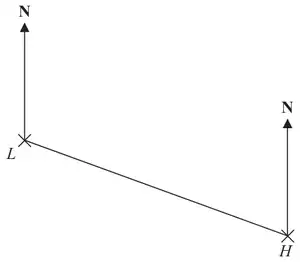
14 The diagram shows the position of a lighthouse \(L\) and a harbour \(H\).
The scale of the diagram is 1 cm represents 5 km.
(a) Work out the real distance between \(L\) and \(H\). (1)
(b) Measure the bearing of \(H\) from \(L\). (1)
A boat \(B\) is 20 km from \(H\) on a bearing of \(040^\circ\)
(c) On the diagram, mark the position of boat \(B\) with a cross (×). Label it \(B\). (2)
Mark scheme (a)
Answer
Mark
Notes
35
1
B1 for 34 – 36
Mark scheme (b)
Answer
Mark
Notes
110
1
B1 for 108 – 112
Mark scheme (c)
Answer
Mark
Notes
Position of B marked
2
B1 for a point marked on a bearing of 40° (±2°) from H or for a line on a bearing of 40° (±2°) (use straight line guidelines on overlay) B1 for a point 4 cm (± 0.2cm) from H or for a line of length 4 cm (± 0.2cm) from H (use circular guidelines on overlay) NB. No label needed for point
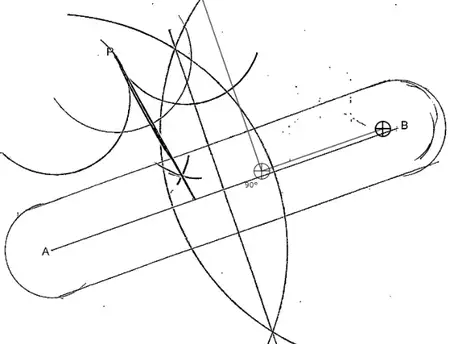
11 Construct the region that lies within 4 cm of the line. [3 marks]
Mark scheme
Answer
Mark
Comments
Circles or at least semicircular arcs, radius 4 cm, at both ends connected by horizontal lines at top and bottom
B3
B2 semicircles or at least semicircular arcs, radius 4 cm, at both ends B1 semicircle or at least semicircular arc, radius 4 cm, at one end or correct shape for region with incorrect measurements
Additional guidance
Condone parts of circles within the region not erased
Condone dotted lines used for (part of) the perimeter
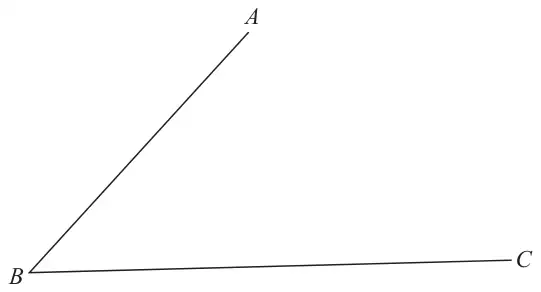
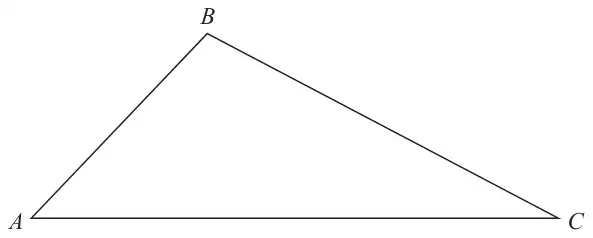
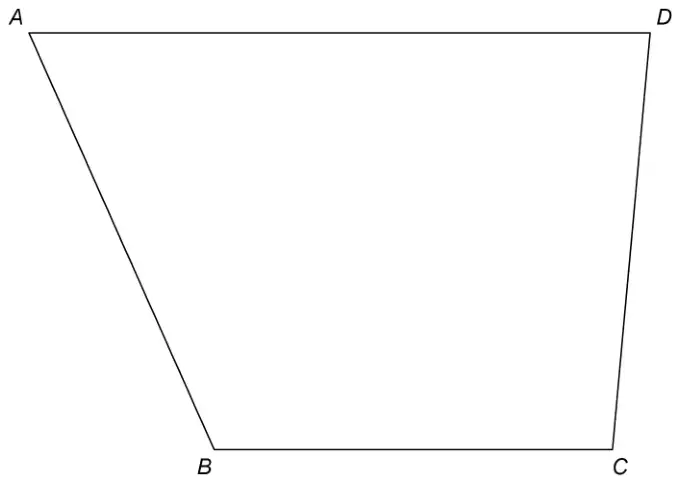
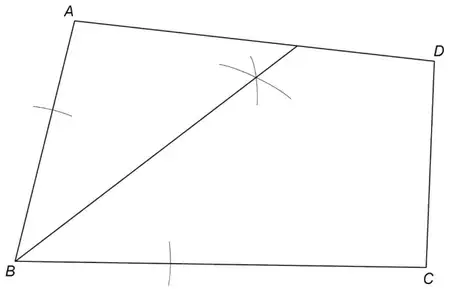
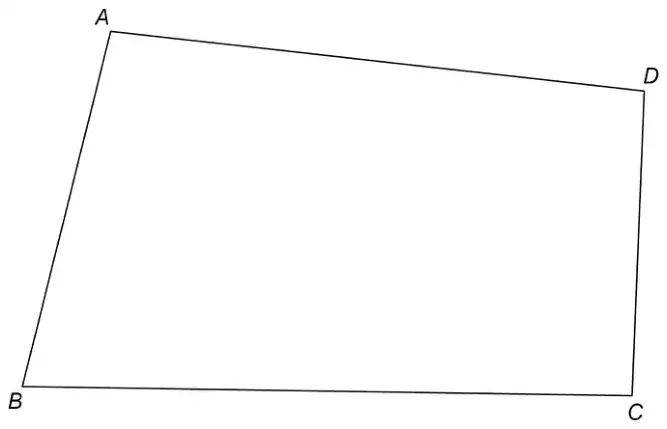
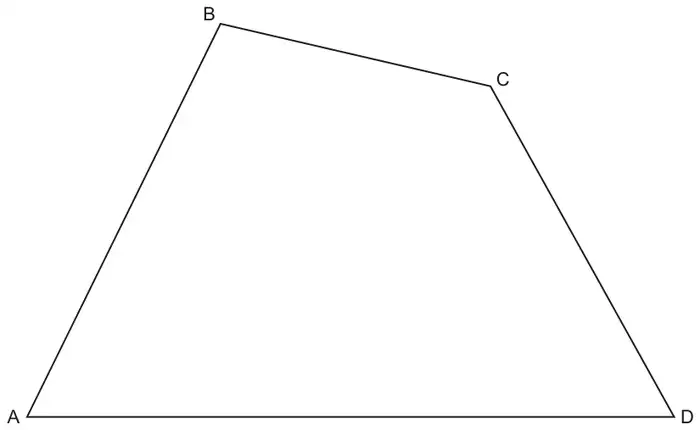
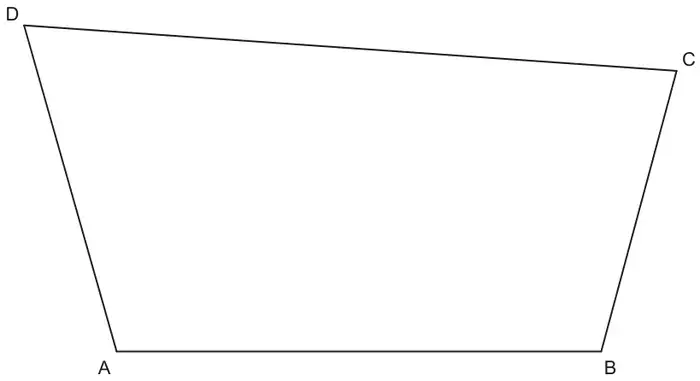
The tree will be in the region that is closer to \(AB\) than to \(BC\).
Label the region, R, where the tree could be planted.
Show all your construction lines. [3 marks]
Mark scheme
Answer
Mark
Comments
Alternative method 1
Pair of arcs, equal radii (\(\pm\) 2 mm), centre \(B\), intersecting \(AB\) and \(BC\)
M1
oe eg single arc, centre \(B\), intersecting \(AB\) and \(BC\) or single arc, centre \(B\), radius \(BC\) (\(\pm\) 2 mm), intersecting \(AB\)
Pair of intersecting arcs, equal radii (\(\pm\) 2 mm), centres the intersections on \(AB\) and \(BC\) and angle bisector drawn from \(B\) at least to the intersection of their arcs
A1
dashed line or condone solid line
Correct region R shown as the area between \(AB\) and a straight line from \(B\) to within 2mm of \(AD\)
B1
R may be labelled or shaded arcs not required for this mark only SC1 angle bisector for a different angle correctly constructed with arcs
Alternative method 2
Concentric arcs from \(B\), each intersecting \(AB\) and \(BC\)
M1
intersections with \(AB\) and \(BC\) must be seen, but full arcs are not necessary
Two lines from the \(AB\) intersection of one arc to the \(BC\) intersection of the other arc and angle bisector drawn from \(B\) at least to the intersection of their lines
A1
dashed line or condone solid line
Correct region R shown as the area between \(AB\) and a straight line from \(B\) to within 2mm of \(AD\)
B1
R may be labelled or shaded arcs not required for this mark only SC1 angle bisector for a different angle correctly constructed with arcs
Additional guidance
Mark any correct construction, ignoring incorrect attempts
Unless shaded incorrectly, ignore construction arcs or other lines in the region labelled
Bisector drawn with no construction arcs, but region correctly identified
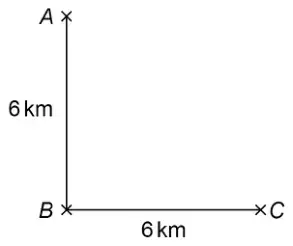
6 km due South of \(A\) and 6 km due West of \(C\).
Not drawn accurately
Work out the bearing of \(A\) from \(C\). [2 marks]
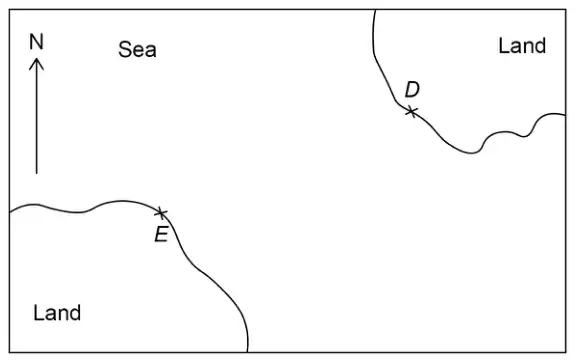
(b) Here is a scale drawing.
A ship is going to sail from \(D\) to \(E\).
Mia works out that the ship needs to sail on a bearing of 068°
Why must Mia be wrong? [1 mark]
Mark scheme (a)
Answer
Mark
Comments
\(\dfrac{180 - 90}{2}\) or \(\tan^{-1} \dfrac{6}{6}\) or 45
M1
oe may be seen on diagram eg \(\sin^{-1}\left(\dfrac{6}{\sqrt{72}}\right)\)
315
A1
SC1 answer of 135 (bearing of \(C\) from \(A\))
Additional guidance
\(\tan \dfrac{6}{6}\) unless recovered
M0
Mark scheme (b)
Answer
Mark
Comments
Correct explanation that the ship would be on land or 068° is the bearing of \(D\) from \(E\) or the bearing must be over 180° or the actual bearing is [246, 250]°
B1
eg that would take the ship over land 068° is from \(E\) 068° is the bearing from \(E\) to \(D\) the bearing is 248°
Additional guidance
Ignore irrelevant statements and compass points eg bearings go clockwise, bearings are measured from north, NE, south west
Do not accept incorrect statement or bearing alongside a correct statement
Bearings measured or stated outside of [246, 250]° range
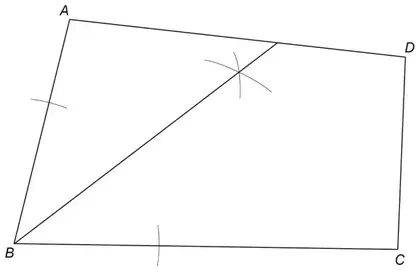
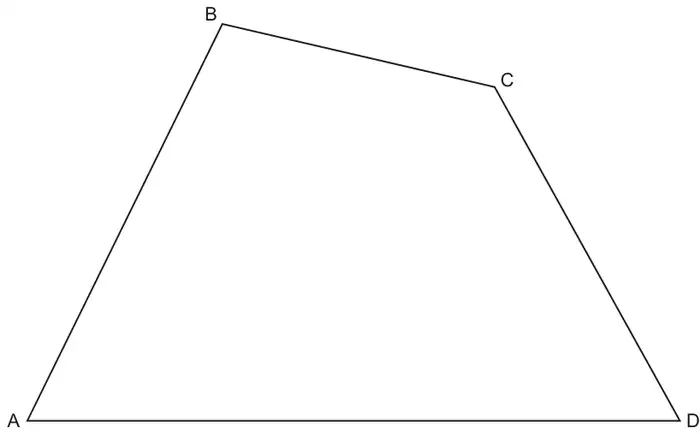
The tree will be in the region that is closer to \(AB\) than to \(BC\).
Label the region, R, where the tree could be planted.
Show all your construction lines. [3 marks]
Mark scheme
Answer
Mark
Comments
Alternative method 1
Pair of arcs, equal radii (\(\pm\) 2 mm), centre \(B\), intersecting \(AB\) and \(BC\)
M1
oe eg single arc, centre \(B\), intersecting \(AB\) and \(BC\) or single arc, centre \(B\), radius \(BC\) (\(\pm\) 2 mm), intersecting \(AB\)
Pair of intersecting arcs, equal radii (\(\pm\) 2 mm), centres the intersections on \(AB\) and \(BC\) and angle bisector drawn from \(B\) at least to the intersection of their arcs
A1
dashed line or condone solid line
Correct region R shown as the area between \(AB\) and a straight line from \(B\) to within 2 mm of \(AD\)
B1
R may be labelled or shaded arcs not required for this mark only SC1 angle bisector for a different angle correctly constructed with arcs
Alternative method 2
Concentric arcs from \(B\), each intersecting \(AB\) and \(BC\)
M1
intersections with \(AB\) and \(BC\) must be seen, but full arcs are not necessary
Two lines from the \(AB\) intersection of one arc to the \(BC\) intersection of the other arc and angle bisector drawn from \(B\) at least to the intersection of their lines
A1
dashed line or condone solid line
Correct region R shown as the area between \(AB\) and a straight line from \(B\) to within 2 mm of \(AD\)
B1
R may be labelled or shaded arcs not required for this mark only SC1 angle bisector for a different angle correctly constructed with arcs
Additional guidance
Mark any correct construction, ignoring incorrect attempts
Unless shaded incorrectly, ignore construction arcs or other lines in the region labelled
Bisector drawn with no construction arcs, but region correctly identified
24 An equilateral triangle has side length 16 metres.
Using ruler and compasses only, construct a scale drawing of the triangle.
Use the scale 1 centimetre represents 2 metres. [3 marks]
Scale: 1 cm represents 2 m
Mark scheme
Answer
Mark
Comments
Side of length [7.8, 8.2] cm drawn
B1
Correct construction with intersecting arcs, same radius as their base ± 2 mm to identify the third vertex or correct construction with intersecting arcs, equal radii ± 2 mm, line drawn at 60° and third vertex correctly positioned or correct construction with intersecting arcs, equal radii ± 2 mm and construction arc drawn to correctly identify the third vertex
M1
Triangle with equal sides [7.8, 8.2], with correct construction seen
A1ft
ft B0M1 triangle with equal sides ± 2 mm, with correct construction seen
Additional guidance
No construction arcs drawn can score a maximum of B1
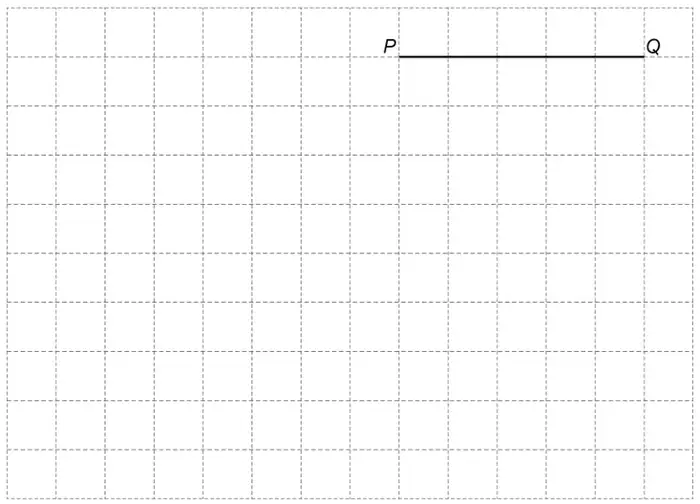
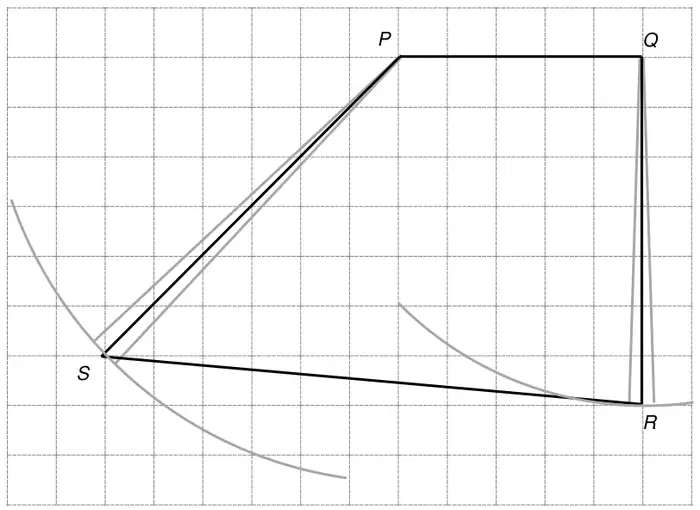
\(PQ = 5\) cm \(QR\) perpendicular to \(PQ\) \(QR = 7\) cm angle \(QPS = 135^\circ\) \(PS = 8.5\) cm
On the grid, draw the quadrilateral \(PQRS\).
\(PQ\) has been drawn for you. [4 marks]
Mark scheme
Answer
Mark
Comments
Angle \(PQR = [88^\circ, 92^\circ]\) and line from \(Q = [6.8, 7.2]\) cm and angle \(QPS = [133^\circ, 137^\circ]\) and line from \(P = [8.3, 8.7]\) cm and complete quadrilateral
B4
B3 at least three of the four measuring criteria met B2 any two of the measuring criteria met B1 any one of the measuring criteria met Length of \(QR\) must be within 2 mm of the right-hand arc shown below Length of \(PS\) must be within 2 mm of the left-hand arc shown below
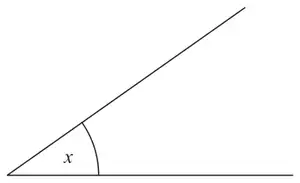
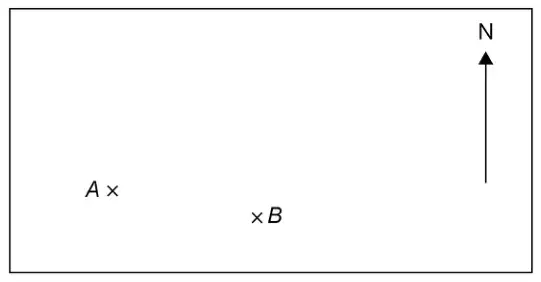
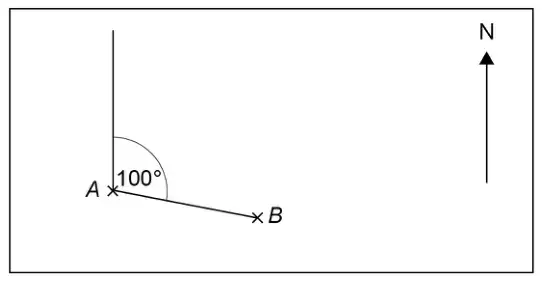
He draws two lines and measures the angle between them.
Kemal says that the bearing of \(A\) from \(B\) is \(100^\circ\)
Is his method correct?
Give a reason for your answer. [1 mark]
(b) On a different map, the bearing of \(D\) from \(C\) is \(045^\circ\)
Nina says,
“\(D\) is North West of \(C\).”
Is Nina correct?
Give a reason for your answer. [1 mark]
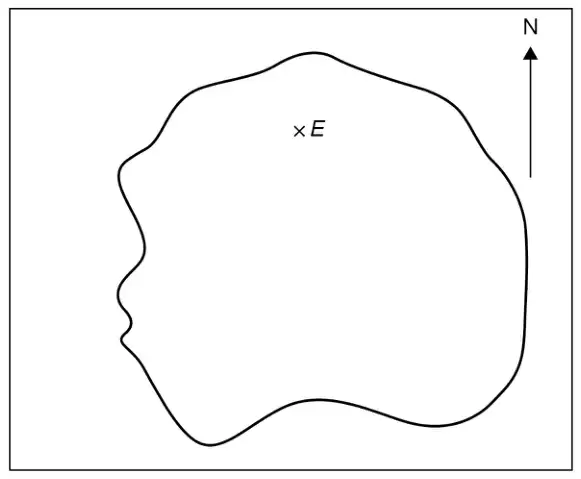
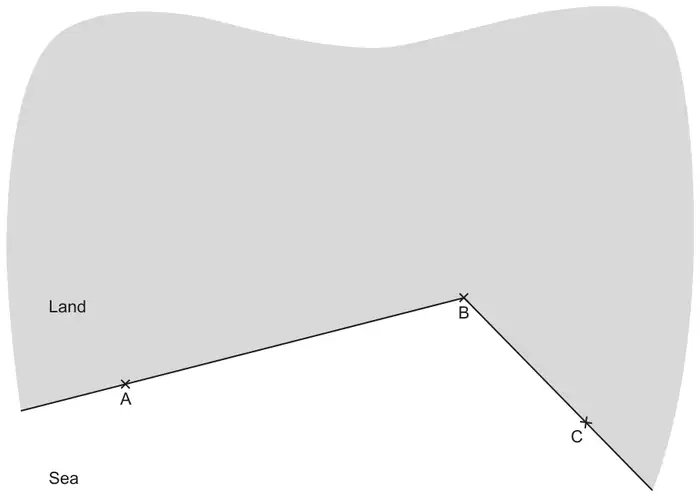
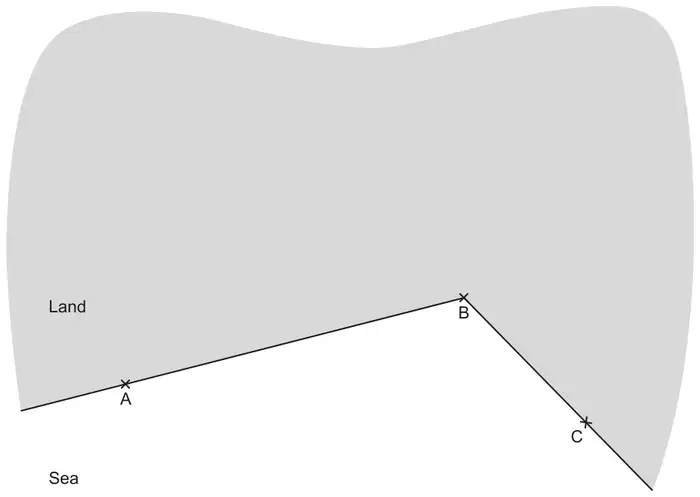
(c) This map shows an airport, \(E\), on an island.
Scale: 1 cm represents 100 km
A plane flies due South from the airport.
How far does it fly until it reaches the sea? [3 marks]
Mark scheme (a)
Answer
Mark
Comments
No and correct reason or No and correct description of correct method or No and 280(°)
B1
eg No, he has done B from A No, the North line should go from B
Additional guidance
Ignore non-contradictory, irrelevant responses alongside a correct response
Answer must either include ‘No’ or ‘Kemal is wrong’ oe
Ignore diagram if B1 scored from answer lines
No, it is 280
B1
No, should start / measure from B
B1
No, it’s from the wrong point
B1
Kemal is wrong, he started from A (and went to B)
B1
No and a correct method/drawing shown in either box
B1
No, the bearing should be reflex
B1
No, he did A to B (not A from B)
B1
No, should be anticlockwise
B0
No, measured the wrong way around
B0
No, bearing would be 260
B0
(It should be) 280 (not sufficient to imply ‘no’)
B0
No, he measured from A which is 100 but you’re meant to measure from B which is 170
B0
Bearing should start from B (should is not sufficient to imply ‘no’)
B0
Not measured from B
B0
Started from A (and went to B)
B0
No, it’s from the wrong place
B0
Mark scheme (b)
Answer
Mark
Comments
No and correct reason
B1
eg No, it’s North East No, NW is 315(°)
Additional guidance
Reasoning may be seen on diagram. The angles do not need to be accurate if intention is clear.
No, you’ve gone anticlockwise
B1
No, NW lies between 270 and 360 (but 045 is between 0 and 90)
B1
No, D is NE of C
B1
Do not accept incorrect statements eg No, North West is 225°
B0
No, C is SW of D (true but not referencing what Nina says)
B0
045 is NE
B0
D is NE of C
B0
No, it will be larger
B0
Mark scheme (c)
Answer
Mark
Comments
Line drawn due South from \(E\) (any length) or [4.3, 5.1]
M1
mark intention on ‘south’ mark intention on ‘line’ accept a cross on coast roughly south of E
their value \(\times\) 100
M1
[430, 510] implies M2 eg \(1.3 \times 100\)
[450, 490] and correct for their value
A1
SC1 600 [450, 490] scores M1M1A1 unless error seen
Additional guidance
Line drawn or no line drawn and \(4.6 \times 100 = 465\) (within range but not correct for their value)
M1M1A0
No line drawn and \(4.2 \times 100 = 420\)
M0M1A0
600 may score up to M2, only award SC1 if M0 scored
If line goes North as well as South of E, working must choose the South direction length (in range) for at least 1st M1 (but 2nd M1 could still be scored)
If line does not reach coast or goes beyond coast, full marks can still be awarded for a correct method with correct answer within range
Ignore units throughout eg \(4.8 \times 100 = 480\) cm
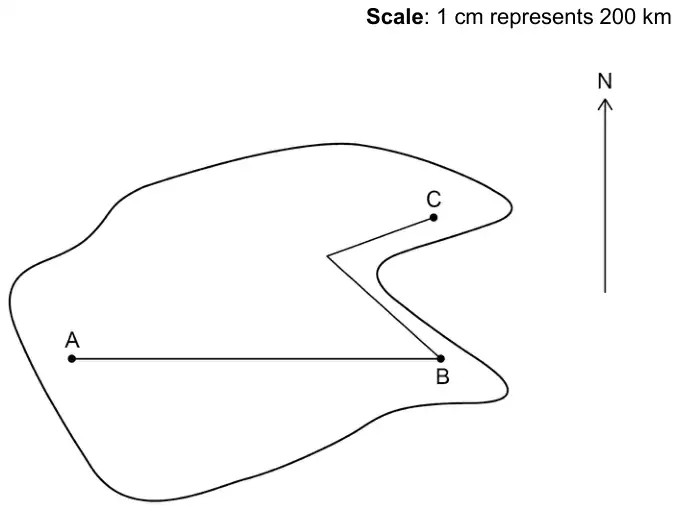
17 Here is a map of an island with cities A, B and C.
The straight lines represent roads.
(a) A is due West of B.
Write down the bearing of A from B. [1 mark]
(b) Umar drives from A to B on the route shown.
Kaz drives from B to C on the route shown.
Use the map to work out how much further Umar drives than Kaz.
You must show your working. [5 marks]
Mark scheme (a)
Answer
Mark
Comments
270
B1
Mark scheme (b)
Answer
Mark
Comments
Alternative method 1 (working in cm)
[6.3, 6.7]
B1
implied by 1300
[2.5, 2.9] and [1.8, 2.2] or [4.5, 4.9]
B1
implied by 540 and 400
implied by 940
their \(6.5 \times 200\) or 1300 and their \(2.7 \times 200\) or 540 and their \(2 \times 200\) or 400 or their \(6.5 \times 200\) or 1300 and (their 2.7 + their 2) \(\times 200\) or 940 or their \(6.5 \times 200\) or 1300 and their \(4.7 \times 200\) or 940
M1
oe 1300 and 540 and 400 implies B2M1 1300 and 940 implies B2M1 distances must be exact if measurements not shown
if only one value used for BC from the start, their 4.7 must be \(> 4\) and \(< 6\)
their \(1300 -\) their \(540 -\) their 400 or their \(1300 -\) their 940
M1dep
oe may be implied by correct answer for their distances their 940 must be \(> 800\) and \(< 1200\)
Correct answer for their 6.5 and their 2.7 and their 2 with all measurements seen or Correct answer for their 6.5 and their 4.7 with all measurements seen
A1ft
ft their measurements
their 4.7 must be \(> 4\) and \(< 6\)
Alternative method 2 (working in cm)
[6.3, 6.7]
B1
[2.5, 2.9] and [1.8, 2.2] or [4.5, 4.9]
B1
their \(6.5 -\) their \(2.7 -\) their 2 or their \(6.5 -\) their 4.7 or 1.8
M1
oe if only one value used for BC from the start, their 4.7 must be \(> 4\) and \(< 6\)
their \(1.8 \times 200\)
M1dep
oe may be implied by correct answer
Correct answer for their 6.5 and their 2.7 and their 2 with all measurements seen or Correct answer for their 6.5 and their 4.7 with all measurements seen
A1ft
ft their measurements
their 4.7 must be \(> 4\) and \(< 6\)
Additional guidance
Allow work in mm but note that they must multiply by 20 for the M1
Working may be on diagram
Must show measurements to score the A mark and answer must be correct for their original measurements
\(1300 - 940\) and answer 360 (no measurements)
B1B1M1M1A0
\(1300 - 920\) and answer 380 (no measurements)
B1B0M0M0A0
6.5, 4.6, \(1300 - 920\) and answer 380
B1B1M1M1A1ft
6.5, 4.2, \(1300 - 840\) and answer 460
B1B0M1M1A1ft
6.5, 2.6, 2 on diagram, \(1300 - 5 \times 200\) (5 wrong for their values and addition not shown)
Water from a sprinkler at \(P\) reaches up to 20 metres from \(P\). Water from a sprinkler at \(Q\) reaches up to 25 metres from \(Q\).
Scale: 1 cm represents 5 m
Using a pair of compasses,
show the region that water from both sprinklers reaches. [2 marks]
Mark scheme
Answer
Mark
Comments
Arc radius [3.8, 4.2] cm centre \(P\) or arc radius [4.8, 5.2] cm centre \(Q\)
M1
only need arcs within tolerance for the correct region ignore other lines M1 arc radius [3.8, 4.2] cm centre \(Q\) and arc radius [4.8, 5.2] cm centre \(P\) and correct ft region identified
Arc radius [3.8, 4.2] cm centre \(P\) and arc radius [4.8, 5.2] cm centre \(Q\) and region identified
A1
only need arcs within tolerance for the correct region ignore other lines
Additional guidance
Arcs may go outside the rectangle
Allow any unambiguous indication of the region eg labelled R or appropriate shading
Do not accept highlighting the perimeter of the region for identification of the region
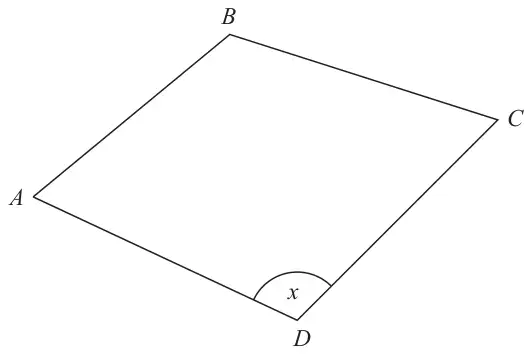
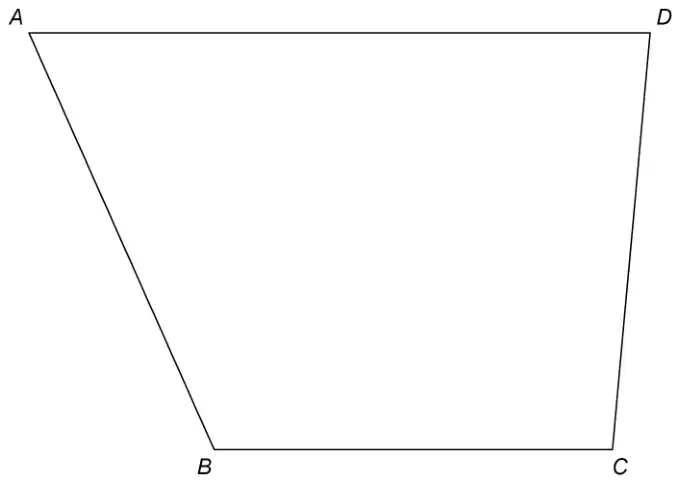
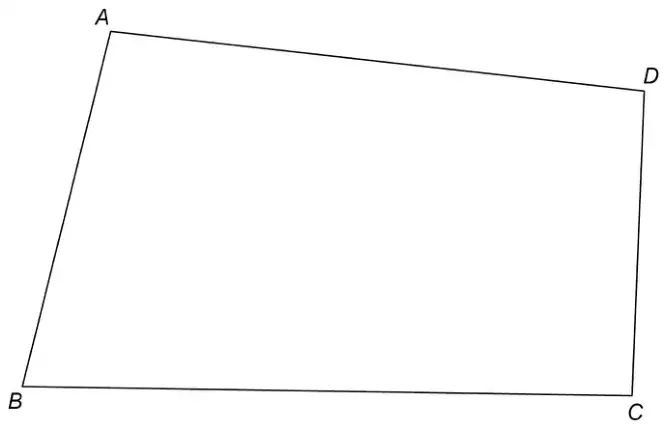
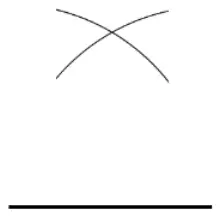
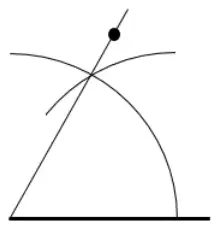
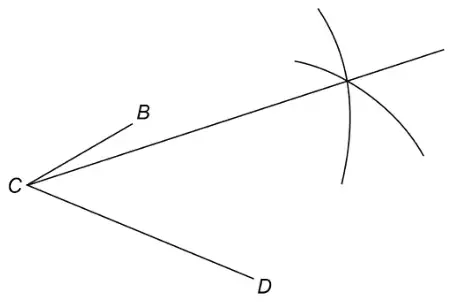
Use a pair of compasses to draw arcs of the same radius from B and D. Draw a straight line from C through the intersection of the arcs.
Write down the error in his method. [1 mark]
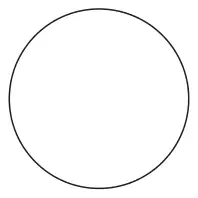
(b) Kay wants to show all the points 3 km from point P.
Here is her answer.
What is wrong with her answer? [1 mark]
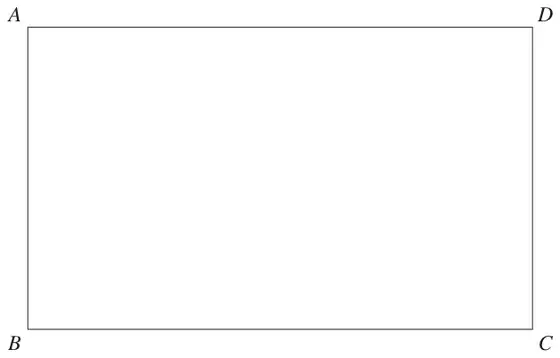
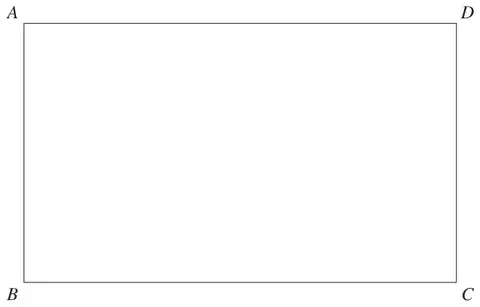
(c) Here is a rectangle.
Using a pair of compasses and a straight edge, construct one line of symmetry.
Show clearly your construction arcs. [2 marks]
Mark scheme (a)
Answer
Mark
Comments
The arcs should be drawn from C or from points the same distance from C or The lines are different lengths, so you can’t go from the ends
B1
oe
Additional guidance
CB ≠ CD
B1
Not drawn an arc from C
B1
He put compass in wrong place. He should have started at C but he started at B and D
B1
Should be an arc on each line CB and CD
B0
Arcs in wrong place
B0
Arcs aren’t equal
B0
His line isn’t in the centre of B and D
B0
D has a longer line than B
B0
Arcs aren’t the same radius
B0
Should be an arc from B to D
B0
Should be an arc from B to the line CD
B0
Should be an intersection on CB and CD
B0
Mark scheme (b)
Answer
Mark
Comments
It should be a circle, (not a square) or The corners are too far away
B1
oe eg accept circle constructed inside square, touching at midpoints of square to within 2mm
Additional guidance
A correct diagram takes precedence over statements, otherwise ignore diagram
Any distances if quoted, eg to corners, should be accurate to within 2mm
Ignore any reference to the top point P
The corners are more than 3 (km or cm) away from the point
B1
Some points are more than 3 (km or cm) away
B1
It isn’t 3 (km or cm) to the corners
B1
Each corner is [4.1, 4.5] (km or cm) from P (values represent tolerance)
B1
Each corner is more than 4 away
B1
It should be a circle
B1
Each point is 4.2 km from P (not true)
B0
The corners of the square are 4 km (out of tolerance)
B0
The corners of the square are 4 km while the rest are 3 km
B0
Each corner will be more than 1 km away
B0
She’s measured 3 cm from P without checking the corners
B0
It is not supposed to be this shape (but what should it be?)
B0
She has measured 4.3 km not 3 (not stated corners)
B0
She hasn’t shown all the points that represent 3 km
B0
She hasn’t plotted where all the 3 km points are
B0
It shouldn’t be a square
B0
Mark scheme (c)
Answer
Mark
Comments
One pair of equal, intersecting arcs from the vertices of one side of the rectangle
M1
tolerance \(\pm\) 1 mm
Fully correct construction of line of symmetry with either two pairs of equal, intersecting arcs from the vertices of the same side of the rectangle or one pair of equal, intersecting arcs from the vertices of one side of the rectangle and the diagonals drawn
A1
tolerance \(\pm\) 1 mm
line of symmetry may be solid or dashed but must touch opposite sides of rectangle
Additional guidance
Correct line with no appropriately constructed arcs
Answer [1.12, 1.2] km with or without [1120, 1200] seen
B1M1A0
Mark scheme (d)
Answer
Mark
Comments
Valid reason
B1
Indication that the shortest distance between two points is a straight line, but you can’t generally walk in a straight line between two places in a town
Additional guidance
You would have to walk along the streets
B1
There wouldn’t be a straight road between them
B1
You would have to walk along and then down
B1
There might be buildings in the way
B1
You can’t go as the crow flies
B1
There may be obstacles in the way
B1
It isn’t a straight path in real life
B1
Can’t go directly
B1
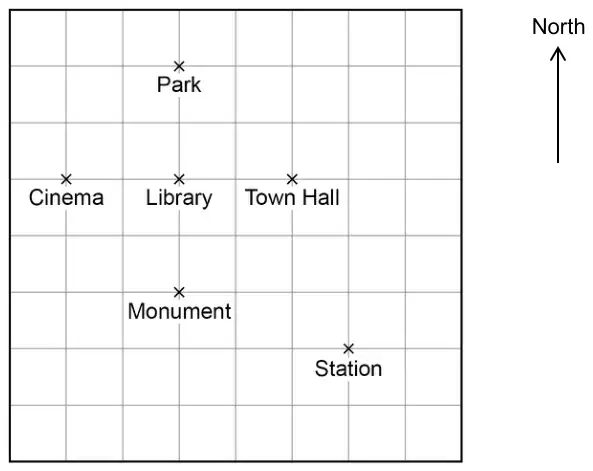
There might be buildings in the way such as the library
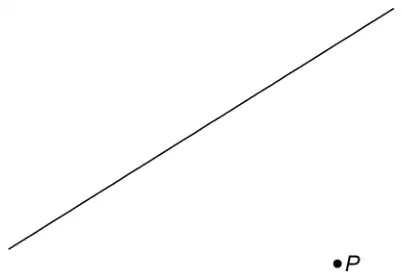
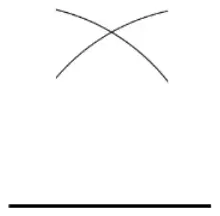
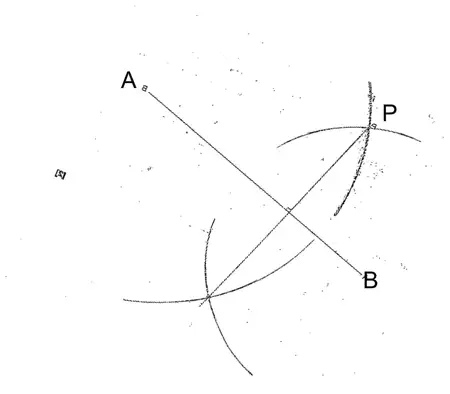
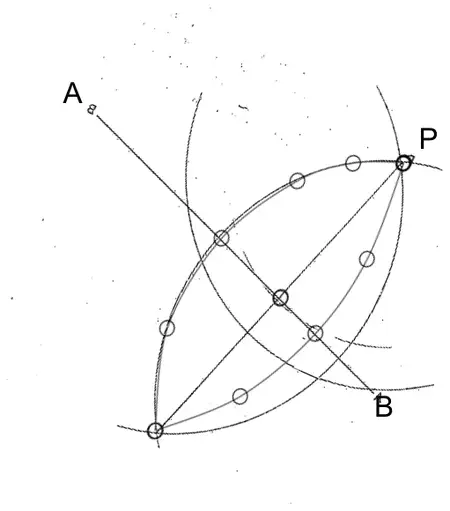
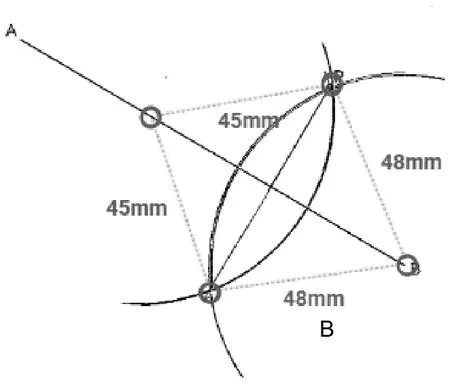
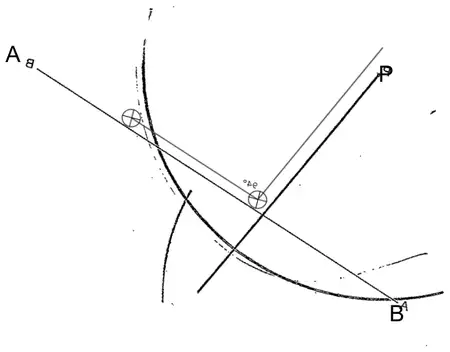
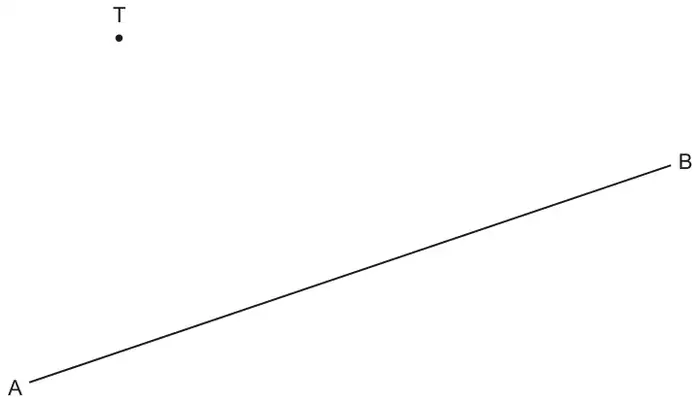
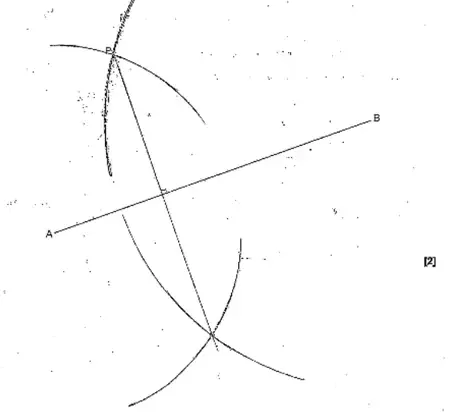
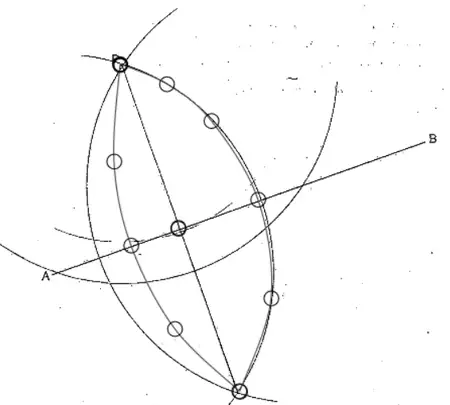
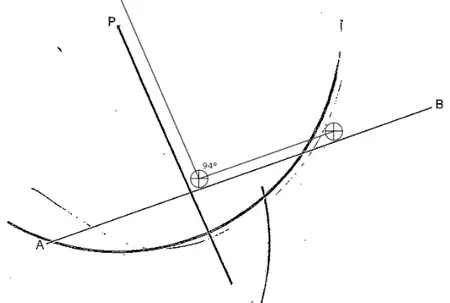
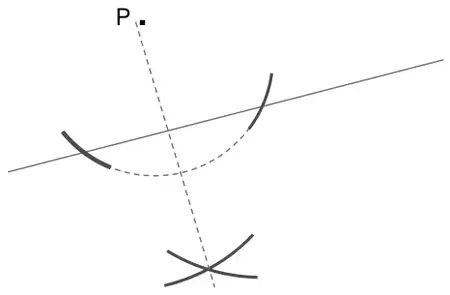
25 Construct the perpendicular from the point P to the line AB. Show all of your construction lines.
[2]
Mark scheme
Answer
Marks
Part marks and guidance
Ruled line through P and perpendicular to AB constructed with correct arcs (one pair intersecting AB)
2
B1 for correct arcs (one pair intersecting AB) only but no line or for correct ruled line but no, or incomplete, construction arcs
Condone dotted lines Set protractor to \(90^\circ\) and check \(88^\circ\) to \(92^\circ\) at AB Correct construction arcs as shown (may be two pairs of arcs used to draw line through P) Ignore other arcs if correct arcs clearly used to construct line Condone perpendicular extending beyond AB but must pass through P and reach AB (no daylight) Alternative (eg constructing a kite) Arc centred on A length AP and arc centred on B length BP meeting below AB (may also pass through P). Candidates may use points on AB other than A and B for this construction. In such cases check radii of arcs using on-line ruler to judge.
See appendix for exemplars
Appendix
Question 25
Response
Mark
A
Scores 2 This is a correct alternative method for arcs centred on A and B Use overlay to see arcs lie within circles (We can also check using on-line ruler) Candidates may use points on AB other than A and B for this construction. In such cases check radii of arcs using on-line ruler to judge.
B
Scores 2 This is the main method not the alternative. Arc from P intersects AB at B and another point. Red arc from B intersects the arc from that other point.
C
Scores 2 There is an arc from B through P. Another arc passes through P but its centre on AB is not identified - perhaps a small compass hole on the hard copy? This arc should have symmetry in line AB. This may need to be confirmed using the ruler tool.
D
0 marks Only one correct (pair of) arcs (One arc centred on P and cutting AB twice) and inaccurate line.
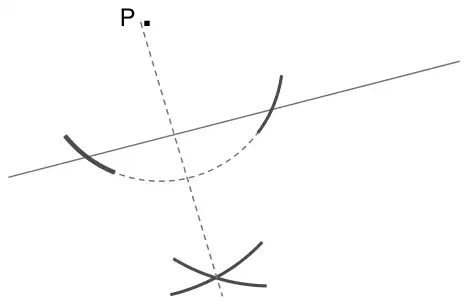
8 Construct the perpendicular from the point P to the line AB. Show all of your construction lines. [2]
Mark scheme
Answer
Marks
Part marks and guidance
Ruled line through P and perpendicular to AB constructed with correct arcs (one pair intersecting AB)
2
B1 for correct arcs (one pair intersecting AB) only or for correct ruled line but no, or incomplete, construction arcs
Condone dotted lines Set protractor to 90° and check 88° to 92° at AB Correct construction arcs as shown (may be two pairs of arcs used to draw line through P) Ignore other arcs if correct arcs clearly used to construct line Condone perpendicular extending beyond AB but must pass through P and reach AB (no daylight) Alternative (eg constructing a kite) Arc centred on A length AP and arc centred on B length BP meeting below AB (may also pass through P). Candidates may use points on AB other than A and B for this construction. In such cases check radii of arcs using on-line ruler to judge
See appendix for exemplars
Appendix: Question 8
Response
Mark
A
Scores 2 This is a correct alternative method for arcs centred on A and B Use overlay to see arcs lie within circles (We can also check using on-line ruler) Candidates may use points on AB other than A and B for this construction. In such cases check radii of arcs using on-line ruler to judge.
B
Scores 2 This is the main method not the alternative. Arc from P intersects AB at B and another point. Red arc from B intersects the arc from that other point.
C
Scores 2 There is an arc from B through P. Another arc passes through P but its centre on AB is not identified - perhaps a small compass hole on the hard copy? This arc should have symmetry in line AB. This may need to be confirmed using the ruler tool.
D
0 marks Only one correct (pair of) arcs (One arc centred on P and cutting AB twice) and inaccurate line.
Using a ruler and compasses only, construct and shade the region which is closer to AB than AC. [3]
Mark scheme
Answer
Marks
Part marks and guidance
acceptable bisector of angle A with two pairs of supporting arcs
M2
M1 for acceptable bisector of angle A with no or incorrect arcs
Tolerance ± 2° Use overlay Accept dashed or solid line for bisector If additional incorrect bisectors are drawn then this is choice and M0 unless the shading indicates they have chosen the correct bisector
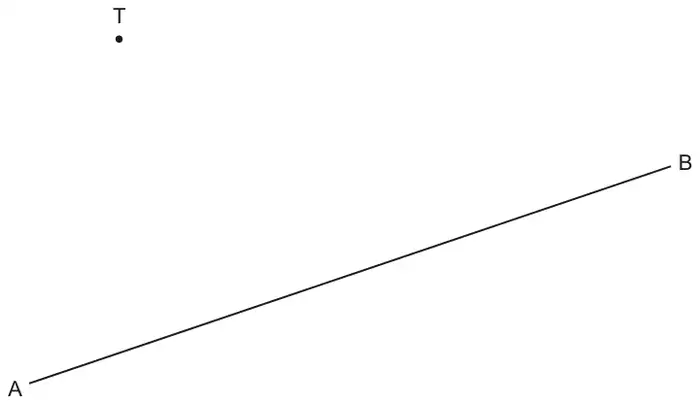
23 The diagram shows a town T and a straight road AB.
Scale: 2 cm represents 1 km
A new straight road is built from town T to the road AB. The road is the shortest possible distance from town T to the road AB.
(a)Using ruler and compasses only, construct the road from town T to the road AB. [2]
(b) The new road costs £200 000 per kilometre to build. The road constructor says
The new road will cost over £600 000 to build.
Show that the road constructor is incorrect. [3]
Mark scheme (a)
Answer
Marks
Part marks and guidance
Accurate ruled perpendicular from T to AB with correct construction arcs
2
B1 for accurate ruled perpendicular from T to AB with no/incorrect construction arcs \(\pm 2^\circ\)
For 2 marks or B1 must reach/cross AB
Correct arcs could be e.g. Kite method Condone dashed/dotted lines Multiple lines treat as choice
Mark scheme (b)
Answer
Marks
Part marks and guidance
520 000 to 560 000 with correct working oe OR that would be 6 cm on the map but it only measures 5.2 to 5.6 cm oe OR This money would build 3 km but it only measures 2.6 to 2.8 km oe
3
B1FT for [road =] 5.2 to 5.6 [cm] or 2.6 to 2.8 [km] or for their (a) measured ± 2mm M1FT for (their 5.2 to 5.6) \(\div 2 \times 200\,000\) oe or for \(600\,000 \div 200\,000 \times 2\)
For 3 marks accept e.g. it will be 40 000 to 80 000 less than this
B1 may be seen on the diagram Accept FT given in km as their (a) \(\div 2\)
M1 implied by 6 cm or 3 km Method can be implied by correct figures
For 3 marks accept e.g. \(3 \times 200000\) is greater than \(2.7 \times 200000\)
Using a ruler and compasses only, construct the position of the boat. Label the position of the boat clearly. [5]
Mark scheme
Answer
Marks
Part marks and guidance
Accurate ruled perpendicular bisector of AB with two correct pairs of supporting arcs
2
B1 for accurate ruled perpendicular bisector of AB with no or incorrect arcs
Use overlay as a guide Put ruler on screen to check 2 cm if needed Tolerance \(\pm\)2 mm and \(\pm 2^\circ\). Line length at least 2 cm Bisector crosses between circles of overlay but does not cut them and perpendicular by eye
Accurate ruled bisector of angle ABC with two correct pairs of supporting arcs
2
B1 for accurate ruled bisector of angle ABC with no or incorrect arcs
Tolerance \(\pm 2^\circ\). Line length at least 2 cm Bisector between or on red lines of overlay arcs.
Correct position of boat clearly identified at point of intersection of two straight lines
Using a ruler and compasses only, construct the position of the boat. Label the position of the boat clearly. [5]
Mark scheme
Answer
Marks
Part marks and guidance
Accurate ruled perpendicular bisector of AB with two correct pairs of supporting arcs
2
B1 for accurate ruled bisector perpendicular bisector of AB with no or incorrect arcs
Use overlay as a guide Put ruler on screen to check 2 cm if needed Tolerance ±2 mm and ±2°. Line length at least 2 cm Bisector crosses between circles of overlay but does not cut them and perpendicular by eye
Accurate ruled bisector of angle ABC with two correct pairs of supporting arcs
2
B1 for accurate ruled bisector of angle ABC with no or incorrect arcs
Tolerance ±2°. Line length at least 2 cm Bisector between or on red lines of overlay arcs
Correct position of boat clearly identified at point of intersection of two straight lines
(a) Construct the perpendicular from the point P to the line AB.
[2]
(b) The diagram shows a field LMN.
A tree is to be planted in the field so that it is
the same distance from the fences MN and ML
and
the same distance from corner M as from corner N.
Show, by construction, whether this can be done or cannot be done.
This .................... be done. [5]
Mark scheme (a)
Answer
Marks
Part marks and guidance
Ruled line through P and perpendicular to AB constructed with correct arcs (one pair intersecting AB)
2
B1 for correct arcs (one pair intersecting AB) only but no line or correct ruled line but no, or incomplete, construction arcs
Condone dotted lines Set protractor to 90° and check 88° to 92° at AB
Correct construction arcs as shown (may be two pairs of arcs used to draw line through P) Ignore other arcs if correct arcs clearly used to construct line
Condone perpendicular extending beyond AB but must pass through P and reach AB (no daylight)
Alternative arcs (eg a kite construction) One centred on A length AP and one centred on B length BP meeting below AB (may also pass through P). Candidates may use points on AB other than A and B for this construction. In such cases check radii of arcs using on-line ruler to judge
See appendix for exemplars (marked diagrams in the published mark scheme)
Mark scheme (b)
Answer
Marks
Part marks and guidance
accurate and correct ruled angle bisector of angle M with supporting arcs and accurate and correct ruled perpendicular bisector of MN with supporting arcs and ‘cannot’ with full evidence
5
B2 for accurate and correct ruled angle bisector of angle M with supporting arcs or B1 for accurate and correct ruled angle bisector of angle M
B2 for accurate and correct ruled perpendicular bisector of MN with supporting arcs or B1 for accurate and correct ruled perpendicular bisector of MN
B1 dep for correct decision (No) with full evidence dep on at least B1 B1
tolerance on angles \(\pm\) 2° and on radius of arcs \(\pm\) 2mm
For 5 marks the diagram must be fully correct with no extra constructions and lines touching the opposite sides of the triangle.
Bisectors to be at least 2cm long
full evidence means two correct ruled lines within tolerance
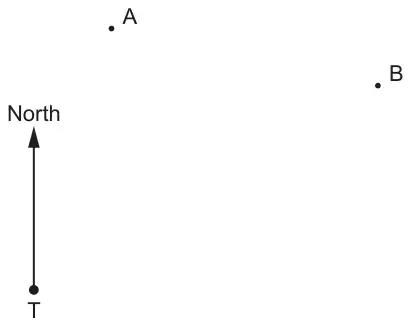
C is south-east of A and on a bearing of 225° from B.
Complete the diagram to show the positions of A, B and C. Show clearly the values of all three angles in triangle ABC.
Scale: 1 cm represents 2 km
[4]
Mark scheme
Answer
Marks
Part marks and guidance
Accurate and correct isosceles triangle with A, B and C points labelled and angles 45°, 45° and 90° correctly labelled
4
B1 for B 6 cm (\(\pm\) 2 mm) due east of A (\(\pm\) 2˚) B1 for C from A B1 for C from their B
For those who put B due west of A, award the second B1 if their C is marked at 225 \(\pm\) 2˚ from A and the third B1 if their C is marked at 135 \(\pm\) 2˚ from B
Condone dotted lines and accept symbol for 90º
line accurately drawn or point B marked 6 cm (\(\pm\)2 mm) and east (90 \(\pm\) 2˚) from A
line accurately drawn or C marked at 135 \(\pm\) 2˚ from A
line accurately drawn or C marked at 225 \(\pm\) 2˚ from B
(a) Construct the perpendicular from the point P to the line AB.[2]
(b) The diagram shows a field LMN.
A tree is to be planted in the field so that it is
the same distance from the fences MN and ML
and
the same distance from corner M as from corner N.
Show, by construction, whether this can be done or cannot be done.
This …………… be done. [5]
Mark scheme (a)
Answer
Marks
Part marks and guidance
Ruled line through P and perpendicular to AB constructed with correct arcs (one pair intersecting AB)
2
B1 for correct arcs (one pair intersecting AB) only but no line or correct ruled line but no, or incomplete, construction arcs
Condone dotted lines Set protractor to 90° and check 88° to 92° at AB Correct construction arcs as shown (may be two pairs of arcs used to draw line through P) Ignore other arcs if correct arcs clearly used to construct line Condone perpendicular extending beyond AB but must pass through P and reach AB (no daylight) Alternative arcs (eg a kite construction) One centred on A length AP and one centred on B length BP meeting below AB (may also pass through P). Candidates may use points on AB other than A and B for this construction. In such cases check radii of arcs using on-line ruler to judge
See appendix for exemplars
Appendix: Question 7(a)
The overlay only shows one solution.
Response
Comment
Mark
A
This is the a correct alternative method for arcs centred on A and B
Use overlay to see arcs lie within circles
(We can also check using on-line ruler)
Candidates may use points on AB other than A and B for this construction. In such cases check radii of arcs using on-line ruler to judge.
Scores 2
B
This is the main method not the alternative. Arc from P intersects AB at A and another point. Red arc from A intersects the arc from that other point.
Scores 2
C
Looks similar to Exemplar B but shows why the overlay must be used with caution.
Overlay shows red arc is centred at A.
The other arc is centred elsewhere on the line AB, but there is no evidence of where it is centred. This is checked by eye.
This is a valid alternative method.
Scores 2
D
Only one correct (pair of) arcs (One arc centred on P and cutting AB twice) and inaccurate line.
0 marks
E
No valid sets of arcs nor a correct line
0 marks
Mark scheme (b)
Answer
Marks
Part marks and guidance
accurate and correct ruled angle bisector of angle M with supporting arcs and accurate and correct ruled perpendicular bisector of MN with supporting arcs and ‘cannot’ with full evidence
5
B2 for accurate and correct ruled angle bisector of angle M with supporting arcs or B1 for accurate and correct ruled angle bisector of angle M
B2 for accurate and correct ruled perpendicular bisector of MN with supporting arcs or B1 for accurate and correct ruled perpendicular bisector of MN
B1 dep for correct decision (No) with full evidence dep on at least B1 B1
tolerance on angles ± 2° and on radius of arcs ± 2mm
For 5 marks the diagram must be fully correct with no extra constructions and lines touching the opposite sides of the triangle.
Bisectors to be at least 2 cm long
full evidence means two correct ruled lines within tolerance
5 B is 12 km due east of A. C is south-east of A and on a bearing of 225° from B.
Complete the diagram to show the positions of A, B and C. Show clearly the values of all three angles in triangle ABC.
Scale: 1 cm represents 2 km
[4]
Mark scheme
Answer
Marks
Part marks and guidance
Accurate and correct isosceles triangle with A, B and C points labelled and angles 45°, 45° and 90° correctly labelled
4
B1 for B 6 cm (± 2 mm) due east of A (± 2°)
B1 for C from A
B1 for C from their B
For those who put B due west of A, award the second B1 if their C is marked at 225 ± 2° from A and the third B1 if their C is marked at 135 ± 2° from B
condone dotted lines and accept symbol for 90°
line accurately drawn or point B marked 6 cm (±2 mm) and east (90 ± 2°) from A
line accurately drawn or C marked at 135 ± 2° from A
line accurately drawn or C marked at 225 ± 2° from B
22 The diagram shows the scale drawing of a sandpit, ABCD. It also shows the arc of all points in the sandpit that are 80 cm from corner A.
Scale: 1 cm represents 20 cm
A game is played by throwing a ball into the sandpit. Points may be scored when the ball lands in the sandpit.
1 point if the ball lands within 80 cm of corner A, and
1 point if the ball is closer to side AB than side AD, and
1 point if the ball is closer to corner A than corner B.
By completing the construction, find and shade the regions where 2 points can be scored. Show all your construction lines. [6]
Mark scheme
Answer
Marks
Part marks and guidance
Accurate ruled angle bisector with two pairs of supporting arcs isw
B2
B1 for accurate angle bisector at least 2 cm long with no/incorrect arcs isw
Use overlay as a guide, bisectors should lie within or on the lines For B2 allow use of the arc around A as one pair – at least 2 cm long for B2 Tolerance \(\pm 2^\circ\)
Accurate ruled perpendicular bisector with two correct pairs of intersecting arcs isw
B2
B1 for accurate perpendicular bisector at least 2 cm long with no/incorrect arcs isw
Tolerance \(\pm 2^\circ\) and \(\pm 2\) mm At least 2 cm long for B2 but must remain in tolerance if extended within shape for B1 and B2
2 correct regions shaded/clearly indicated with no extras
B2 dep
Dep on at least B1B1 B1dep for 1 correct region with no extras or 2 correct regions and one extra
B1dep on B1 for angle bisector for region bounded by angle bisector or dep on B1B1 for region bounded by both bisectors and arc
9 The diagram shows the scale drawing of a sandpit, ABCD. It also shows the arc of all points in the sandpit that are 80 cm from corner A.
Scale: 1 cm represents 20 cm
A game is played by throwing a ball into the sandpit. Points may be scored when the ball lands in the sandpit.
1 point if the ball lands within 80 cm of corner A, and
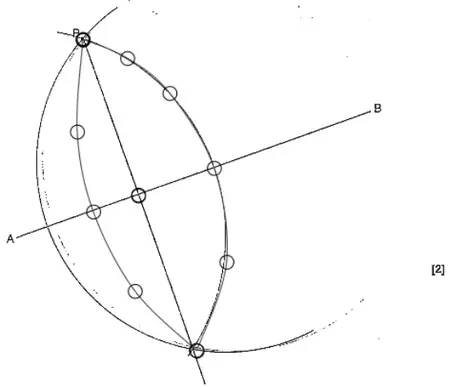
1 point if the ball is closer to side AB than side AD, and
1 point if the ball is closer to corner A than corner B.
By completing the construction, find and shade the regions where 2 points can be scored. Show all your construction lines. [6]
Mark scheme
Answer
Marks
Part marks and guidance
Accurate ruled angle bisector with two pairs of supporting arcs isw
B2
B1 for accurate angle bisector at least 2 cm long with no/incorrect arcs isw
Use overlay as a guide, bisectors should lie within or on the lines For B2 allow use of the arc around A as one pair – at least 2 cm long for B2 Tolerance ±2°
Accurate ruled perpendicular bisector with two correct pairs of intersecting arcs isw
B2
B1 for accurate perpendicular bisector at least 2 cm long with no/incorrect arcs isw
Tolerance ±2° and ±2 mm At least 2 cm long for B2 but must remain in tolerance if extended within shape for B1 and B2
2 correct regions shaded/clearly indicated with no extras
B2 dep
Dep on at least B1B1 B1dep for 1 correct region with no extras or 2 correct regions and one extra
B1dep on B1 for angle bisector for region bounded by angle bisector or dep on B1B1 for region bounded by both bisectors and arc
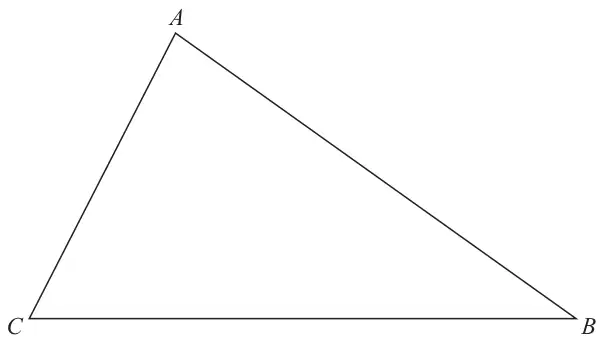
(a) Construct the bisector of angle ABC. Show all your construction lines. [2]
(b) Construct the perpendicular bisector of BC. Show all your construction lines. [2]
(c) Shade the region which is
nearer to BC than to AB
and
nearer to B than to C.
[1]
Mark scheme (a)
Answer
Marks
Part marks and guidance
Accurate ruled angle B bisector with two pairs of correct arcs
2
B1 for accurate ruled angle B bisector
Tolerance \(\pm 2^\circ\) e.g. one angle \(49^\circ\) to \(53^\circ\) and the line can be any length, must touch B and condone dotted line
Mark scheme (b)
Answer
Marks
Part marks and guidance
Accurate ruled perpendicular bisector of BC with two pairs of correct arcs
2
B1 for accurate ruled perpendicular bisector of BC
Tolerance \(\pm 2^\circ\) e.g. angle \(88^\circ\) to \(92^\circ\) and \(\pm\) 2mm e.g. 27mm to 31 mm and line can be any length, must touch BC and condone dotted line
Mark scheme (c)
Answer
Marks
Part marks and guidance
Correct region shaded
1 dep
dep on at least B1 and B1 and both bisectors intersecting
17 The diagram shows the scale drawing of a garden ABCD.
Scale: 1 cm represents 5 m
A tree is to be planted in the garden so that it is
at least 10 m from AB
and
closer to CD than CB
and
at least 15 m from D.
Using a ruler and compasses only, construct and shade the region in which the tree can be planted. [6]
Mark scheme
Answer
Marks
Part marks and guidance
Line drawn parallel to AB, 1.8 to 2.2 cm away that meets AD and their bisector of angle BCD
M1
Condone dotted lines throughout Use overlay as a guide If no angle bisector their horizontal line must at least touch the left hand boundary of angle bisector overlay
(a) The scale 1 cm represents 25 m can be written in the form \(1 : k\).
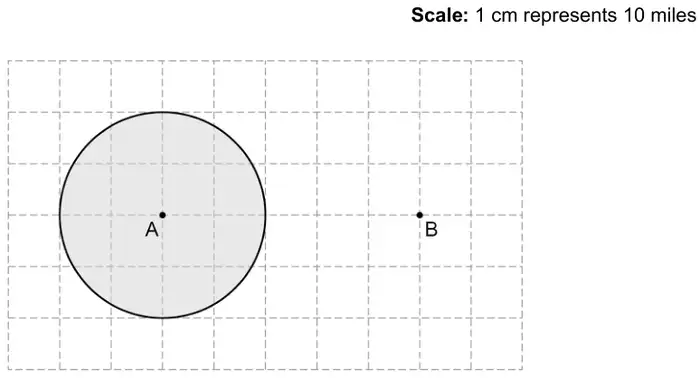
Find the value of \(k\). [1]
(b) The scale drawing represents a harbour.
A boat leaves the harbour from point C and sails on a path that is equidistant from BC and CD. The harbour rules do not allow boats to sail within 75 m of point E.
Find by construction whether the path of the boat will follow the harbour rules. Show all your construction lines. [5]
Mark scheme (a)
Answer
Marks
Part marks and guidance
2500
1
Ignore units
Mark scheme (b)
Answer
Marks
Part marks and guidance
Bisector of angle BCD accurate with pairs of correct arcs
M2
B1 for accurate bisector of angle BCD with no/incorrect arcs
Tol ± 2º use overlay Condone solid/broken lines bisector
Arc centre E radius 3 cm with length fit for purpose
M2
B1 for arc centre E
Tol ± 2 mm For B1 accept 5 correctly marked points in tolerance
No oe with correct constructions
B1
Dep on at least B1M2
Accept the boat will travel within 75 m
Notes
The drawing on this page is not printed at its original size, so measurements taken from it on screen will not match the 1 cm to 25 m scale.
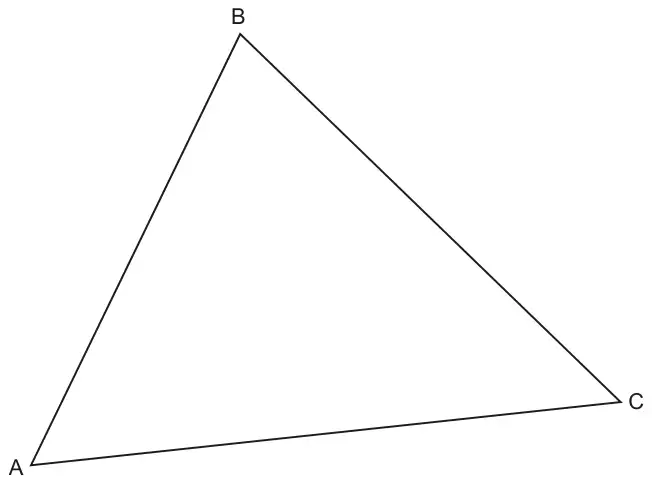
22 Construct the perpendicular from the point P to the line AB.
Show all of your construction lines.
[2]
Mark scheme
Answer
Marks
Part marks and guidance
Ruled perpendicular constructed with correct arcs (one pair intersecting AB)
2
Condone dashed line B1 for correct arcs (one pair intersecting AB) only but no line or correct ruled line but no, or incomplete construction arcs
Set protractor to \(90^\circ\) and check \(88^\circ\) to \(92^\circ\) at AB
Correct construction arcs as shown (may be two pairs of arcs used to draw line through P) Ignore other arcs if correct arcs clearly used to construct line
Condone perpendicular extending beyond AB but must pass through P and reach AB (no daylight)
Alternative arcs. One centred on A length AP and one centred on B length BP meeting below AB (may also pass through P). Use overlay as check
Candidates may use points on AB other than A and B for this construction. In such cases check radii of arcs using on-line ruler to judge.
aircraft B is 4960 km from T on a bearing of 057°.
Not to scale
(a) Aircraft A flies directly towards radar tower T at a speed of 890 km/h.
At what time will the aircraft pass over radar tower T? Give your answer to the nearest minute. [4]
(b) Calculate the distance that was between aircraft A and aircraft B at 3pm. [4]
Mark scheme (a)
Answer
Marks
Part marks and guidance
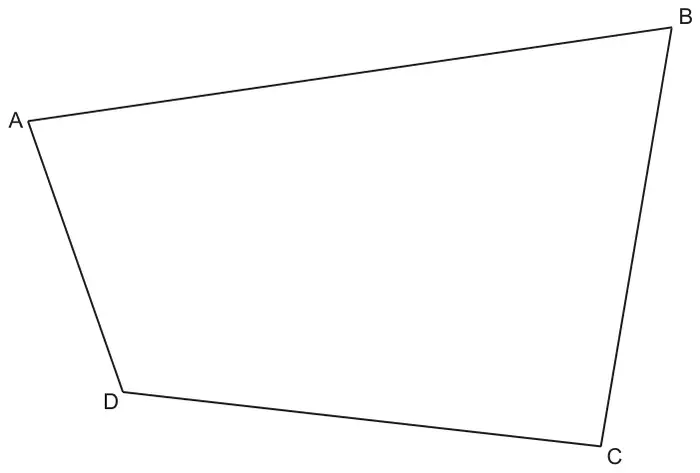
6.39 [pm] or 1839
4
B3 for 39 or answer rounding to 39.1 or 3°39 to 3°39′6.07″ or 6°39 to 6°39′6.07″ or 219 or answer rounding to 219.1 OR M1 for [\(t =\)] \(\dfrac{3250}{890}\) oe soi by 3.65(…) and M1FT for 60 × (their time) soi or evidence from their answer by using calculator key
Alternative method (converting speed to km/min) M1 for 890 ÷ 60 soi by \(\dfrac{89}{6}\) or \(14\frac{5}{6}\) oe or 14.8[3…] and M1FT for [\(t =\)] 3250 ÷ their 14.8[3…]
Condone 1839pm for full marks
e.g. \(3\frac{58}{89}\)
their time could be fraction or decimal and could be just the non-integer part (check using calculator)
Mark scheme (b)
Answer
Marks
Part marks and guidance
3345 to 3350 nfww
4
B1 for 42 seen AND M2 for [\(x^2 =\)] \(3250^2 + 4960^2 - 2 \times 3250 \times 4960 \cos\theta\) oe soi by [\(x^2 =\)] 11205110 to 11205111 or M1 for correct cosine rule with \(x^2\) not as subject
Alternative method (using horizontal/vertical components and Pythagoras) M3 for \(\sqrt{(4960\sin 57 - 3250\sin 15)^2 + (3250\cos 15 - 4960\cos 57)^2}\) or M2 for 4960sin57 – 3250sin15 or 3250cos15 – 4960cos57 or M1 for two of 4960sin57, 3250sin15, 3250cos15 or 4960cos57
May be seen on sketch diagram
For M2 or M1, \(\theta\) is a number in the range \(15 \leqslant \theta \leqslant 57\)
7 Construct the perpendicular from the point P to the line AB. Show all of your construction lines.
[2]
Mark scheme
Answer
Marks
Part marks and guidance
Ruled perpendicular constructed with correct arcs (one pair intersecting AB)
2
Condone dashed line B1 for correct arcs (one pair intersecting AB) only but no line or correct ruled line but no, or incomplete construction arcs
Set protractor to 90° and check 88° to 92° at AB
Correct construction arcs as shown (may be two pairs of arcs used to draw line through P) Ignore other arcs if correct arcs clearly used to construct line
Condone perpendicular extending beyond AB but must pass through P and reach AB (no daylight)
Alternative arcs. One centred on A length AP and one centred on B length BP meeting below AB (may also pass through P). Use overlay as check
Candidates may use points on AB other than A and B for this construction. In such cases check radii of arcs using on-line ruler to judge.
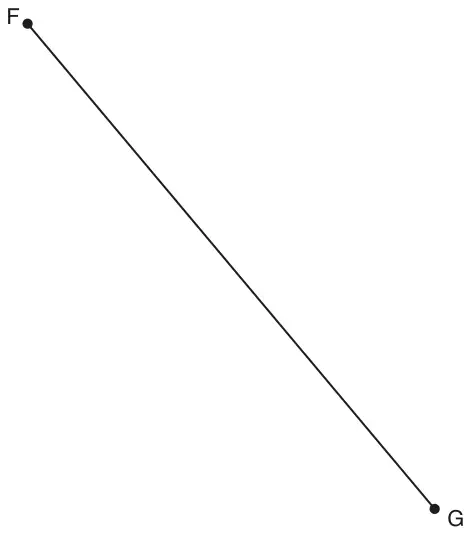
Using ruler and compasses only, construct the perpendicular bisector of FG.
[2]
Mark scheme
Answer
Marks
Part marks and guidance
Correct ruled line with two pairs of correct arcs
2
B1 for correct ruled line but no or wrong arcs or correct intersecting arcs no line
Arcs may be two continuous arcs centred at F and G with two intersections Anchor overlay on G. Line to be within overlay throughout. May be all on one side of FG only
20 The scale diagram below shows towns, A, B and C. Line AB represents the road from A to B and line AC represents the road from A to C.
A shopping centre is to be built so that it is
nearer to the road from A to B than the road from A to C,
less than 14 km from town C.
(a) Using construction, shade the region where the shopping centre could be built. Show all your construction lines.
[5]
(b) Explain why the region found in part (a) may not be an appropriate site for the shopping centre. [1]
Mark scheme (a)
Answer
Marks
Part marks and guidance
Accurate angle bisector with 2 pairs of correct arcs
2
B1 for correct bisector with no arcs or incorrect arcs
The bisector does not have to go through A but if extended it must go through A and it must lie within green lines in overlay. For 2 marks condone intersecting arcs of equal radius, one centre B and the other centre C for the construction with bisector drawn.
Arc centre C radius 7cm
2
B1 for arc centre C with incorrect radius
For arc, measure radius using ruler.
tolerance \(\pm\) 2 mm and \(\pm\) 2° for both constructions
Correct region indicated
1Dep
Dependent on at least B1 for bisector and B2 for arc
Mark scheme (b)
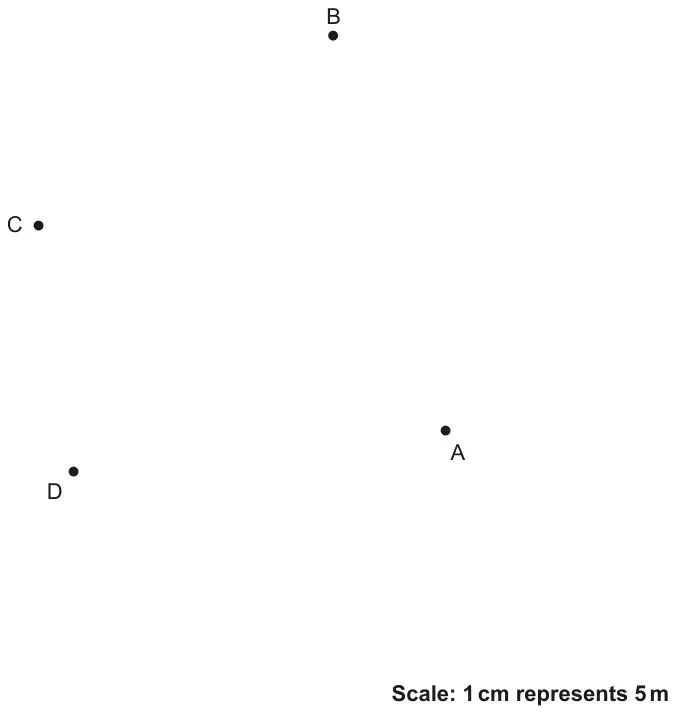
Answer
Marks
Part marks and guidance
accept any correct assumption e.g. Road[s] is not/are not straight, road AB is busier than road AC, land is not suitable for construction
1
If more than one choose the best one see list of exemplars
7 The scale diagram below shows towns, A, B and C. Line AB represents the road from A to B and line AC represents the road from A to C.
A shopping centre is to be built so that it is
nearer to the road from A to B than the road from A to C,
less than 14 km from town C.
(a) Using construction, shade the region where the shopping centre could be built. Show all your construction lines.[5]
(b) Explain why the region found in part (a) may not be an appropriate site for the shopping centre. [1]
Mark scheme (a)
Answer
Marks
Part marks and guidance
Accurate angle bisector with 2 pairs of correct arcs
2
B1 for correct bisector with no arcs or incorrect arcs
The bisector does not have to go through A but if extended it must go through A and it must lie within green lines in overlay. For 2 marks condone intersecting arcs of equal radius, one centre B and the other centre C for the construction with bisector drawn.
Arc centre C radius 7cm
2
B1 for arc centre C with incorrect radius
For arc, measure radius using ruler.
Correct region indicated
1Dep
Dependent on at least B1 for bisector and B2 for arc
tolerance ± 2 mm and ± 2° for both constructions
Mark scheme (b)
Answer
Marks
Part marks and guidance
accept any correct assumption e.g. Road[s] is not/are not straight, road AB is busier than road AC, land is not suitable for construction
1
If more than one choose the best one see list of exemplars
Appendix: exemplar responses for Q7(b)
Response
Mark
Road[s] are/are not straight
1
Land is not suitable for construction [ e.g. it may be a lake]
1
The land may flood
1
Site is too small for centre
1
Site is too steep for construction
1
Land lies in a AONB/National Park
1
Too far from the towns (A/B/C)
1
The roads may not be able to cope with the increased traffic
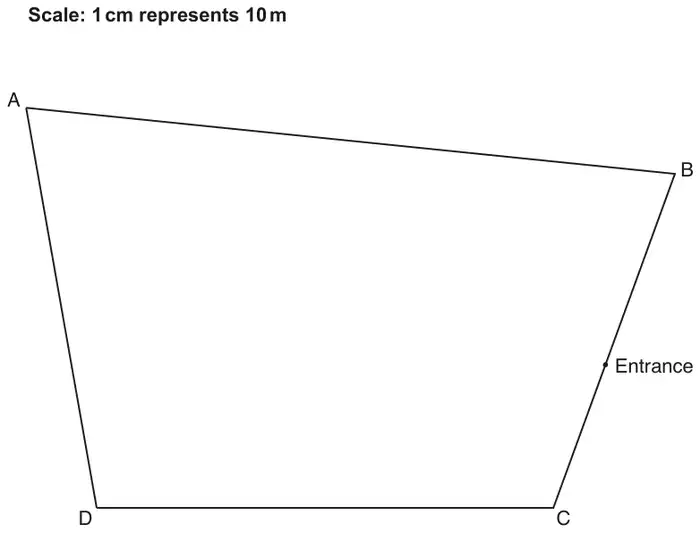
20 Four points A, B, C and D are shown on the scale diagram below.
(a) On the diagram, construct and mark the two points that are
the same distance from A and B
and
15 m from C.
Show all your construction lines. [5]
(b) The points A, B, C and D represent the four corners of Monty’s garden. His garden is bounded by four straight fences A to B, B to C, C to D and D to A.
Monty wants to plant a tree in his garden at a place that satisfies the two conditions in part (a).
Explain why there is only one position where Monty can plant his tree. [1]
Mark scheme (a)
Answer
Marks
Part marks and guidance
Accurate perpendicular bisector from at least AB passing within 3 cm of C with two pairs of correct arcs
2
B1 for accurate perpendicular bisector
Tolerance \(\pm\) 2 mm
Arc centre C, at least from BC to CD with radius 3 cm
2
B1 for any arc centre C
Two correct points marked intersecting the line and the arc
1
Dep on B1 (bisector) and B2 (arc) scored above
Mark scheme (b)
Answer
Marks
Part marks and guidance
One of the points is not in his garden or only one is in his garden
1
Accept any correct reason e.g. one point is behind the CD fence
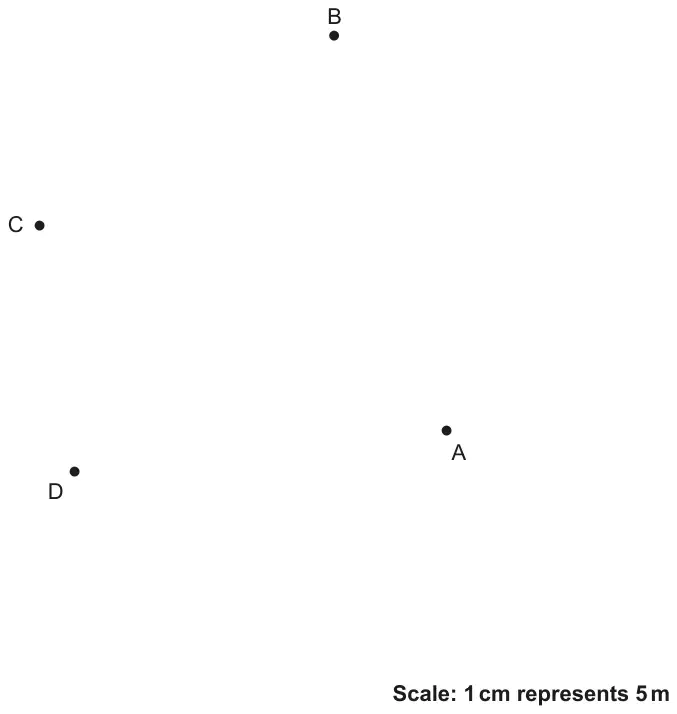
3 Four points A, B, C and D are shown on the scale diagram below.
(a) On the diagram, construct and mark the two points that are
the same distance from A and B and
15 m from C.
Show all your construction lines. [5]
(b) The points A, B, C and D represent the four corners of Monty’s garden. His garden is bounded by four straight fences A to B, B to C, C to D and D to A.
Monty wants to plant a tree in his garden at a place that satisfies the two conditions in part (a).
Explain why there is only one position where Monty can plant his tree. [1]
Mark scheme (a)
Answer
Marks
Part marks and guidance
accurate perpendicular bisector at least from AB passing within 3 cm of C with two pairs of correct arcs
2
B1 for accurate perpendicular bisector
tolerance ± 2 mm
arc centre C, at least from BC to CD, with radius 3 cm
2
B1 for any arc centre C
two points marked intersecting the arc and line
1
Dep on B1(bisector) and B2(arc) scored above
Mark scheme (b)
Answer
Marks
Part marks and guidance
One of the points is not in his garden or only one is in his garden
1
accept any correct reason e.g. one point is behind the CD fence
Notes
(corrected from the printed mark scheme: the appendix heading for these exemplars is printed as “Q6(b)”)
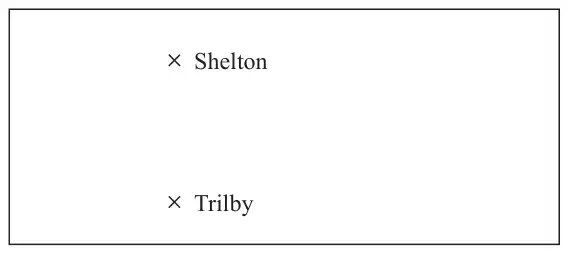
B is 25 kilometres due East of A. C is 25 kilometres due North of A. D is 45 kilometres due South of A.
Not to scale
(a) Work out the bearing of B from C. [2]
(b) Calculate the bearing of D from B. [4]
Mark scheme (a)
Answer
Marks
Part marks and guidance
135
2
B1 for angle 45
e.g 45 marked at ACB or ABC or 180 – 45 or 90 + 45
Mark scheme (b)
Answer
Marks
Part marks and guidance
209 to 209.1
4
M2 for \(\tan^{-1}(45 \div 25)\) or \(\tan^{-1}(25 \div 45)\) soi by 61, 60.94 to 60.95 or 29[.1], 29.05...
or
M1 for \(\tan\) [=] \(45 \div 25\) or \(\tan\) [=] \(25 \div 45\)
AND
M1 for 270 – their angleABD or 180 + their angleADB
Accept longer methods but they must get to the equivalent point to gain credit e.g. if they find the hypotenuse, they score M0 until they start to use sin or cos.
16 The scale diagram shows the positions of town A and town B.
Scale: 1 cm represents 10 miles
Lucy’s house is nearer to town A than to town B. Her house is exactly 50 miles from town B.
On the scale diagram show all the possible positions of Lucy’s house. You must show all your construction lines. [5]
Mark scheme
Answer
Marks
Part marks and guidance
Complete correct arc centred at B identified with full construction shown including either perpendicular bisector of AB (including arcs and intersecting the arc centred at B) or arc(s) of 5cm radius centred at A and intersecting the arc from B at 2 points
5
B4 5cm arc centred at B with full construction shown including either perpendicular bisector of AB (including arcs and intersecting the arc centred at B) or arc(s) of 5cm (\(\pm 0.2\) cm) radius centred at A and intersecting the arc from B at 2 points
OR
B2 for complete arc 5cm (\(\pm 0.2\) cm) centred at B or B1 for arcs 5cm (\(\pm 0.2\) cm) radius centred at B or continuous arc 5cm (\(\pm 0.2\) cm) radius centred at B, but not covering the whole of the required region, minimum span \(30^\circ\)
AND
B1 for arc[s] centred at A radius 5cm (\(\pm 0.2\) cm) or a perpendicular bisector of AB
OR
B1 for minimum of 3 points in the correct position without arc from B
B4 is fully correct without the correct locus identified
B is 25 kilometres due East of A. C is 25 kilometres due North of A. D is 45 kilometres due South of A.
Not to scale
(a) Work out the bearing of B from C. [2]
(b) Calculate the bearing of D from B. [4]
Mark scheme (a)
Answer
Marks
Part marks and guidance
135
2
B1 for angle 45
e.g. 45 marked at ACB or ABC, 180 – 45, 90 + 45
Mark scheme (b)
Answer
Marks
Part marks and guidance
209 to 209.1
4
M2 for \(\tan^{-1}(45 \div 25)\) or \(\tan^{-1}(25 \div 45)\) soi by 61, 60.94 to 60.95 or 29[.1], 29.05...
or
M1 for tan [=] 45÷25 or tan [=] 25÷45
Accept longer methods but they must get to the equivalent point to gain credit e.g. if they find the hypotenuse, they score M0 until they start to use sin or cos.
Can be implied by their answer
AND
M1 for 270 – their angleABD or 180 + their angleADB
(i) The distance from A to B is .............................. km. [2]
(ii) The bearing of B from A is .............................. \(^\circ\). [1]
(b) C is another farm. C is 2.5 km from B on a bearing of \(230^\circ\).
Mark and label the position of C on the map with a cross. [2]
Mark scheme (a)
Answer
Marks
Part marks and guidance
(i) 3.2
2
Accept 3.1 to 3.3 M1 for 6.2 to 6.6 [cm] seen or 62 to 66 [mm] seen
May be seen on diagram or on the answer line
(ii) 115
1
Accept 113 to 117
Mark scheme (b)
Answer
Marks
Part marks and guidance
C marked 5 cm from B C marked on bearing of \(230^\circ\) from B
2
Accept 4.8 to 5.2 cm Accept \(226^\circ\) to \(234^\circ\) B1 for one correct
Condone C not labelled if clear indication is given eg marked with a cross If C not indicated, an arc radius 5cm, centre B scores B1 with no other arcs Use overlay as a guide for 2 marks or use on screen ruler and protractor to confirm B1. Protractor reading \(126^\circ\) to \(134^\circ\)