29 The first three terms of a Fibonacci sequence are
\(a\) \(3a\) \(4a\)
The 5th term of this sequence is 286
Work out the value of \(a\). (3)
Mark scheme
Answer
Mark
Mark scheme
26
M1
for continuing the sequence to find the 5th term, eg \(3a + 4a + 4a\ (= 11a)\)
M1
(dep M1) for equating the fifth term with 286, eg \(3a + 4a + 4a = 286\) oe or \(286 \div \text{``}11\text{''}\)
A1
cao
Additional guidance
May be seen next to sequence Award M2 for a correct numerical statement relating 26, 11 and 286
An answer of 26 coming from an incorrect method, eg \(a + 3a + 4a + 7a + 11a = 26a\) scores M1 only unless numerical statement relating 26, 11 and 286 with no \(a\) is seen
Here are the first four terms of a different sequence.
9 15 21 27
(b) Is 63 a number in this sequence? You must give a reason for your answer. (2)
Mark scheme (a)
Answer
Mark
Mark scheme
11
B1
cao
Mark scheme (b)
Answer
Mark
Mark scheme
Yes (supported)
M1
for method to show that 63 is in the sequence, eg starts to list terms of the sequence, with at least 3 correct or \(6n + 3 = 63\) or \((63 - 3) \div 6\ (= 10)\) or \(6 \times 10 + 3\) or \((63 - 27) \div 6\) or \(27 + 6 + 6 + 6 + 6 + 6 + 6\)
A1
eg Yes and 33, 39, 45, 51, 57, 63 Yes and \(n = 10\) Yes and \((63 - 3) \div 6\) is a whole number Yes and \(6 \times 10 + 3 = 63\) Yes and \(63 - 27\) is divisible by 6, and the sequence goes up in 6’s Yes and \(27 + 6 + 6 + 6 + 6 + 6 + 6 = 63\) OR Like all the other terms in the sequence, it is in the 3 times table but not the 6 times table It’s the 10th term / 63 is the 10th term
Additional guidance
33, 39, 45, 51, 57, 63
‘Yes’ can be implied by an equivalent statement eg ‘63 is in the sequence’
Ignore additional incorrect statements but if the statement contradicts award A0 eg ‘33, 39, 45, 51, 57, 63, and yes and it’s the 11th term’ would be M1A0
20 \(x - 4\), \(x + 2\) and \(3x + 1\) are three consecutive terms of an arithmetic sequence.
(a) Find the value of \(x\). (2)
\(y - 4\), \(y + 2\) and \(3y + 1\) are three consecutive terms of a geometric sequence.
(b) Find the possible values of \(y\). (5)
Mark scheme (a)
Answer
Mark
Mark scheme
3.5
P1
for process to find the common difference between the first and second and the common difference between the third and second term eg \((3x + 1) - (x + 2)\ (= 2x - 1)\) and \((x + 2) - (x - 4)\ (= 6)\)
or for process to write a correct equation in \(x\), eg \((3x + 1) - (x + 2) = (x + 2) - (x - 4)\) or \(2x - 1 = 6\) oe
A1
for 3.5 oe eg \(\dfrac{7}{2}\)
Mark scheme (b)
Answer
Mark
Mark scheme
\(-0.5\), 8
P1
for process to write a correct equation in terms of the common ratio and \(y\) eg \(r(y - 4) = y + 2\) or \(r(y + 2) = 3y + 1\)
P1
for process to write a correct equation in \(y\) eg \(\dfrac{3y + 1}{y + 2} = \dfrac{y + 2}{y - 4}\) oe
P1
for process to write a correct equation without fractions eg \((3y + 1)(y - 4) = (y + 2)(y + 2)\) oe
P1
for process of writing a correct simplified equation eg \(2y^2 - 15y - 8\ (= 0)\)
A1
cao
Additional guidance
\(r\) can be any letter apart from \(y\)
The quadratic does not have to equal 0, ie accept \(2y^2 - 15y = 8\)
17 A ball is thrown upwards and reaches a maximum height. The ball then falls and bounces repeatedly.
After the \(n\)th bounce, the ball reaches a height of \(h_n\) After the next bounce, the ball reaches a height given by \(h_{n + 1} = 0.55h_n\)
After the 1st bounce, the ball reaches a height of 8 metres.
What height does the ball reach after the 4th bounce? (3)
Mark scheme
Answer
Mark
Mark scheme
1.331
M1
for method to find height after 2nd bounce, eg \(0.55 \times 8\ (= 4.4)\)
M1
for method to find height after 3rd bounce, eg \(0.55 \times \text{``}4.4\text{''}\ (= 2.4(2))\) or for method to find height after 4th bounce, eg \(0.55^3 \times 8\) or for method to find height after 5th bounce, eg \(0.55^4 \times 8\ (= 0.73(205))\)
A1
for 1.331, accept 1.33, 1.3 oe mixed number
Additional guidance
Award this mark for \(0.55^n \times 8\) where \(n \gt 1\)
If a correct answer is shown and then incorrectly rounded award full marks
16 At the start of year \(n\) the population of a species is \(P_n\)
At the start of the following year the population of the species is given by
\[P_{n + 1} = kP_n \quad \text{where } k \text{ is a positive constant.}\]
The population of the species at the start of year 1 is 8 million. The population of the species at the start of year 2 is 6 million.
(a) Work out the population of the species at the start of year 3 (3)
At the start of year 5 the value of \(k\) is increased by 0.3 to a new constant value.
Louise thinks that from the start of year 5 the population of the species would increase year on year.
(b) Is Louise correct? You must give a reason for your answer. (1)
Mark scheme (a)
Answer
Mark
Mark scheme
4.5
P1
for initial use of formula, eg \(6 = 8k\)
P1
for a full process to find \(P_3\) eg \(\text{``}\dfrac{6}{8}\text{''} \times 6\)
A1
oe
Mark scheme (b)
Answer
Mark
Mark scheme
Explanation
C1
for explanation Acceptable examples Yes, the population will increase as \(k\) is over 1 She is correct because \(1.05 \gt 1\) Yes, each year the population will increase by 5% Yes, because \(0.75 + 0.3 = 1.05\) Yes, a 0.3 increase is greater than the current 0.25 decrease
Not acceptable examples Yes, the population will increase each year Yes, because there is an increase in \(k\) No because 0.3 is less than 0.75
Additional guidance
If figures are given as part of the answer they must be correct, but can allow ft
8 Here are the first four terms of a number sequence.
97 91 85 79
(a) Explain how to work out the next number of the sequence. (1)
(b) Work out the difference between the 5th term and the 7th term of the sequence. (2)
(c) Explain why 52 is not a number in this sequence. (1)
Mark scheme (a)
Answer
Mark
Mark scheme
Explanation
C1
for explanation, eg subtract 6, decrease by 6, going down by 6
Mark scheme (b)
Answer
Mark
Mark scheme
12
M1
for \(73 - 61\) or \(6 \times 2\)
A1
cao
Additional guidance
At least one term must be correct and intention to subtract shown
Accept \(-12\)
Mark scheme (c)
Answer
Mark
Mark scheme
Explanation
C1
for explanation relating to odd and/or even numbers Acceptable 52 is even the sequence is odd numbers it goes to 55 (and you cannot reach 52) it goes to 49 (which has gone past 52) \(n\)th term is \(103 - 6n = 52\) which has no integer solutions 52 is between the 8th and 9th terms
Not acceptable subtracting 6 each time will not lead to 52 it goes past 52
The 4th term of a different geometric sequence is \(\dfrac{5\sqrt{2}}{4}\)
The 6th term of this sequence is \(\dfrac{5\sqrt{2}}{8}\)
Given that the terms of this sequence are all positive,
(b) work out the first term of this sequence. You must show all your working. (3)
Mark scheme (a)
Answer
Mark
Mark scheme
4000
P1
for process to identify the common ratio, eg \(400\sqrt{5} \div 200\ (= 2\sqrt{5})\) or \(200 \div 400\sqrt{5}\ \left(= \dfrac{1}{2\sqrt{5}}\right)\) or for a process to find the next term of the sequence, eg \(200 \times (200 \div 10)\)
A1
cao
Additional guidance
May use any 2 consecutive terms
Mark scheme (b)
Answer
Mark
Mark scheme
5
P1
for process to find the ratio of the 4th and 6th terms, eg \(\dfrac{5\sqrt{2}}{8} \div \dfrac{5\sqrt{2}}{4}\ \left(= \dfrac{1}{2}\right)\) or \(\dfrac{5\sqrt{2}}{4} \div \dfrac{5\sqrt{2}}{8}\ (= 2)\) or for finding that the 2nd term is \(\dfrac{5\sqrt{2}}{2}\)
P1
for complete process to find 1st term, eg \(\dfrac{5\sqrt{2}}{4} \div \left(\dfrac{1}{\sqrt{2}}\right)^3\)
A1
cao
Additional guidance
Award 0 marks for a correct answer with no supportive working
(i) Write down two numbers that could be the 4th and 5th terms of this sequence. (1)
(ii) Write down the rule you used to get your numbers. (1)
Mark scheme
Answer
Mark
Mark scheme
(i) terms given
B1
states two terms eg 11, 10 or 9, 6
(ii) explanation
C1
explanation
Acceptable examples Take away 2 then 1; take away 4 then 3 The difference goes down by 1 each time \(-4, -3;\ -2, -1\) The differences are 4 and 3; the differences are 2 and 1
Not acceptable examples It goes down by 1 each time An algebraic rule
Additional guidance
(i) May be written on the sequence with no contradiction elsewhere
8 Here are the first five terms of a number sequence.
3 8 13 18 23
(a) Write down the next two terms of this sequence. (1)
Jim says that 50 is a term in this sequence. Jim is wrong.
(b) Explain why. (1)
Mark scheme (a)
Answer
Mark
Mark scheme
28 33
B1
cao
Mark scheme (b)
Answer
Mark
Mark scheme
Explanation
C1
for explanation Acceptable examples all terms end in 3 or 8 there are no terms that end in 0 50 does not end in 3 or 8 48 and 53 are both in the sequence (could be shown) 48 is in the sequence and 50 is 2 more \(5n - 2 = 50\) so \(n\) is not a whole number. if it started at 0 then it would but it starts at 3 so it never will or shows sequence continuing up to and beyond 50 Not acceptable examples adding 5 each time will not lead to 50 (insufficient) it goes past 50 the closest number to 50 is 48
Additional guidance
One correct, one incorrect statement gets C1 as long as they are not contradictory.
19 At the start of year \(n\), the number of animals in a population is \(P_n\) At the start of the following year, the number of animals in the population is \(P_{n + 1}\) where
\(P_{n + 1} = kP_n\)
At the start of 2017 the number of animals in the population was 4000 At the start of 2019 the number of animals in the population was 3610
Find the value of the constant \(k\). (3)
Mark scheme
Answer
Mark
Mark scheme
0.95
P1
for initial use of the formula eg \(3610 = kP_n\) or \(P_{n+1} = 4000k\) or for \(P_{n+2} = k^2 P_n\) or for \(3610 = k^2 \times 4000\)
P1
for a complete method to find \(k\) eg \(\sqrt{\dfrac{3610}{4000}}\) or \(\pm 0.95\)
Here are the first four terms of the sequence of triangle numbers.
1 3 6 10
(b) Find the 8th term of this sequence. (2)
Mark scheme (a)
Answer
Mark
Mark scheme
Explanation
C1
for explanation Acceptable examples the sequence is going +1, +2 so the next term is +3 \(1 + 1 = 2,\ 2 + 2 = 4,\ 4 + 3 = 7\) add the current term position to the term to get the next term add the two previous terms and add 1 Not acceptable examples you add 1 each time the number goes up by 3 7 is wrong it should be 8 because you double each time
Additional guidance
The pattern may be just seen on the sequence given
Mark scheme (b)
Answer
Mark
Mark scheme
36
M1
for finding the next term of \(10 + 5\ (= 15)\) or for \(\frac{1}{2} \times 8 \times (8 + 1)\) oe
5 The first four terms of a Fibonacci sequence are
\(a \qquad 2a \qquad 3a \qquad 5a\)
The sum of the first five terms of this sequence is 228
Work out the value of \(a\). (3)
Mark scheme
Answer
Mark
Mark scheme
12
P1
for a process to find the fifth term, eg \(3a + 5a\ (= 8a)\)
P1
for setting up the equation eg \(a + 2a + 3a + 5a + [8a] = 228\)
A1
cao
Additional guidance
[\(8a\)] allow use of what is clearly indicated as the missing term \(\dfrac{228}{19}\) or \(\dfrac{228}{1+2+3+5+8}\) scores P1 P1 \(\dfrac{228}{1+2+3+5+[8]}\) scores P0P1
22 The number of rabbits on a farm at the end of month \(n\) is \(P_n\) The number of rabbits at the end of the next month is given by \(P_{n+1} = 1.2P_n - 50\)
At the end of March there are 200 rabbits on the farm.
(a) Work out how many rabbits there will be on the farm at the end of June. (3)
(b) Considering your results in part (a), suggest what will happen to the number of rabbits on the farm after a long time. (1)
Find an expression, in terms of \(n\), for the \(n\)th term of this sequence. (2)
Mark scheme
Answer
Mark
Mark scheme
\(n^2 - 2n\)
M1
for correct deduction from differences, eg 2nd difference of 2 implies \(1n^2\) or gives a quadratic expression which includes the term \(1n^2\) or states 1, 4, 9, 16, 25 and deduces 2, 4, 6, 8, 10
13 The first term of a sequence of numbers is 24 The term-to-term rule of this sequence is ‘add 8’
Josie says,
“No number in this sequence is in the 5 times table.”
(a) Give an example to show that Josie is wrong. (1)
(b) Is 85 a number in this sequence? Give a reason for your answer. (1)
Mark scheme (a)
Answer
Mark
Mark scheme
example
C1
example given eg 40, 80, etc.
Mark scheme (b)
Answer
Mark
Mark scheme
No with reason
C1
for No with reason Acceptable examples 80 and 88 are both in the sequence 80 is in the sequence and 85 is 5 more 24, 32, ..... 80, 88, .... 85 is not in the 8 times table 85 is an odd number \(8n+16=85\) so \(n\) is not a whole number. Not acceptable examples adding 8 each time will not lead to 85 (insufficient) it goes past 85 Yes .....
(a) The \(n\)th term of a sequence is \(3n + 4\) Explain why 21 is not a term of this sequence. (2)
(b) Here are the first three terms of a different sequence.
1 2 4
Write down two numbers that could be the 4th term and the 5th term of this sequence. Give the rule you have used to get your numbers. (2)
Mark scheme (a)
Answer
Mark
Mark scheme
Explanation
C2
full explanation eg explains that both 19 and 22 are terms in the sequence or solves \(3n + 4 = 21\) to find \(n = 17/3\) oe
Acceptable examples 19 is in the sequence and 19 + 3 is more than 21 The 5th term is 19 and the 6th term is 22 7, 10, 13, 16, 19, 22 17 is not in the 3 times table Because 21 is in the 3 times table and the sequence is plus 4
(C1
for substituting to find a term in the sequence or forming an equation eg \(3n + 4 = 21\) or for a partial explanation or an explanation with some ambiguity)
Acceptable examples The closest number is 22 \(3 \times 6 = 18\), 18 + 4 is higher than 21 19 is in the sequence so 21 can’t be in the sequence. Starting at 7 and adding 3 each time won’t lead to 21 It’s the 3 times table plus 4 21 is in the 3 times table
Not acceptable examples Adding 4 each time won’t lead to 21 It doesn’t end up at 21, it goes past it
Additional guidance
7, 10, 13, 16, 19, 22, ...
Mark scheme (b)
Answer
Mark
Mark scheme
terms given
B1
states two terms eg 7,11 or 8,16 or 5, 7
explanation
C1
explanation eg add one more each time, doubling
Acceptable examples Add 3 and add 4 The difference goes up by one each time It doubles +1, +2, +1, +2 or indicates +1, +2 repeats itself
Not acceptable examples It goes up by 1 each time It doubles so \(2n\) +1, +2, +3, +4 so \(2n + 1\)
Additional guidance
May be indicated on the sequence with no contradictory statement made
16 The \(n\)th term of a sequence is given by \(an^2 + bn\) where \(a\) and \(b\) are integers.
The 2nd term of the sequence is \(-2\) The 4th term of the sequence is 12
(a) Find the 6th term of the sequence. (4)
Here are the first five terms of a different quadratic sequence.
0 2 6 12 20
(b) Find an expression, in terms of \(n\), for the \(n\)th term of this sequence. (2)
Mark scheme (a)
Answer
Mark
Mark scheme
42
P1
for process to find an equation in \(a\) and \(b\), eg \(a \times 2^2 + b \times 2 = -2\) (\(4a + 2b = -2\)) or \(a \times 4^2 + b \times 4 = 12\) (\(16a + 4b = 12\))
P1
for process to find a pair of simultaneous equations and eliminate one unknown, eg \(16a + 8b = -8\) and \(16a + 4b = 12\) and subtraction or \(16a + 4b = 12\) and \(8a + 4b = -4\) and subtraction
A1
for \(a = 2\) and \(b = -5\)
A1
cao
Additional guidance
Allow one arithmetic error in elimination, eg \(16a + 8b = -8\) and \(16a + 4b = 12\) leading to \(4b = 20\) but no subtraction sign seen
(a) Given that \((\sqrt{x} - 1)\), 1 and \((\sqrt{x} + 1)\) are the first three terms of S, find the value of \(x\). You must show all your working. (3)
(b) Show that the 5th term of S is \(7 + 5\sqrt{2}\) (2)
Mark scheme (a)
Answer
Mark
Notes
2
M1
for start to express the common ratio algebraically, eg \(1/(\sqrt{x} - 1)\) or \((\sqrt{x} + 1)/1\) or \(\sqrt{x} + 1 = k \times 1\) or \(1 = k \times (\sqrt{x} - 1)\)
M1
for setting up an appropriate equation in \(x\), eg \(1/(\sqrt{x} - 1) = (\sqrt{x} + 1)/1\)
C1
for convincing argument to show \(x = 2\)
Mark scheme (b)
Answer
Mark
Notes
Shown
M1
for expressing the relationship between the common ratio, one of the first three terms of the sequence and the fifth term, eg 5th term = 3rd term × (common ratio)²
C1
for a complete explanation to include eg, \((\sqrt{2} + 1)(\sqrt{2} + 1)^2 = 7 + 5\sqrt{2}\)
18 Here is a sequence of patterns made with counters.
(a) Find an expression, in terms of \(n\), for the number of counters in pattern number \(n\). (2)
Bayo has 90 counters.
(b) Can Bayo make a pattern in this sequence using all 90 of his counters? You must show how you get your answer. (2)
Mark scheme (a)
Answer
Mark
Notes
\(3n + 1\)
M1
for a method to deduce the \(n\)th term, eg. \(3n + k\), where \(k\) is an integer or \(k\) is omitted or for \(n = 3n + 1\)
A1
for \(3n + 1\) oe (accept \(n\) replaced by another letter)
Mark scheme (b)
Answer
Mark
Notes
No (supported)
C1
for using (their expression in (a)) = 90 or shows that 88 or 91 is in the sequence
C1
for an answer of “No” and a convincing argument eg. pattern number 30 has 91 counters or \((90 - 1) \div 3\ (= 29.66\ldots)\) or shows that the next term after 88 is 91 Note: no ft from (a)
11 A sequence of patterns is made from circular tiles ● and square tiles □
Here are the first three patterns in the sequence.
(a) How many square tiles are needed to make pattern number 6? (2)
(b) How many circular tiles are needed to make pattern number 20? (2)
Derek says,
“When the pattern number is odd, an odd number of square tiles is needed to make the pattern.”
(c) Is Derek right? You must give reasons for your answer. (2)
Mark scheme (a)
Answer
Mark
Notes
36
M1
demonstrates the start of a method that could lead to the answer, eg recognition of square numbers, or use of differences, or diagrams
A1
cao
Mark scheme (b)
Answer
Mark
Notes
80
M1
demonstrates the start of a method that could lead to the answer, eg repeated addition of 4, or \(20 \times 4\)
A1
cao
Mark scheme (c)
Answer
Mark
Notes
C2
conclusion with supportive evidence, eg odd \(\times\) odd = odd, or all odd numbers squared will be odd.
(C1)
(e.g. starts to work with (generate) square numbers for odd patterns or \((2n + 1)^2\) eg \(1 \times 1 = 1\), or generates sequence for squares using differences)
18 Here are the first four terms of an arithmetic sequence.
11 17 23 29
(a) Find, in terms of \(n\), an expression for the \(n\)th term of this arithmetic sequence. (2)
(b) Is 121 a term of this arithmetic sequence? You must explain your answer. (2)
Mark scheme (a)
Answer
Mark
Notes
\(6n + 5\)
2
B2 for \(6n + 5\) (B1 for \(6n + k\), where \(k\) is an integer or absent)
Mark scheme (b)
Answer
Mark
Notes
no with explanation
2
M1 for \(\text{``}6n + 5\text{''} = 121\) or any other valid method, eg counting on 6s to get to 119 (or more) A1 for no with complete explanation, eg \(6n = 116\) will not give a whole number
3 Here are the first four terms of an arithmetic sequence.
11 17 23 29
(a) Find, in terms of \(n\), an expression for the \(n\)th term of this arithmetic sequence. (2)
(b) Is 121 a term of this arithmetic sequence? You must explain your answer. (2)
Mark scheme (a)
Answer
Mark
Notes
\(6n + 5\)
2
B2 for \(6n + 5\) (B1 for \(6n + k\) where \(k\) is an integer or absent)
Mark scheme (b)
Answer
Mark
Notes
No with explanation
2
M1 for "\(6n + 5\)" = 121 or any other valid method, e.g. counting on 6s (to get to 119 or more) A1 for No with complete explanation, e.g. \(6n = 116\) will not give a whole number
*16 Here are the first four terms in a number sequence.
5 8 11 14
Kasey thinks that the number 34 is in this sequence.
Is Kasey correct? You must show how you get your answer. (3)
Mark scheme
Answer
Mark
Notes
No with reason
3
M1 for 17, 20 or \(+3\) or \(3n + 2\) M1 for method to show that 34 is not in the sequence eg continue sequence to at least 32 eg attempt to solve \(3n + 2 = 34\) C1 (dep on M2) for statement with conclusion eg No with 32, 35 shown eg \(n = 32 \div 3\) which is not a whole number
14 Here is a sequence of patterns made with counters.
(a) In the space below, draw pattern number 4 (1)
(b) Complete the table. (1)
Pattern number
1
2
3
4
5
Number of counters
5
9
13
(c) Find an expression, in terms of \(n\), for the number of counters in pattern number \(n\). (2)
Habeeb has 50 counters. He wants to use as many of his counters as possible to make a pattern in the sequence.
(d) What is the number of the pattern he can make using the greatest number of his counters? (2)
Mark scheme (a)
Answer
Mark
Notes
1
B1 cao
Mark scheme (b)
Answer
Mark
Notes
17, 21
1
B1 for 17, 21 cao
Mark scheme (c)
Answer
Mark
Notes
\(4n + 1\)
2
B2 for \(4n + 1\) oe (B1 for \(4n + k\), \(k \neq 1\), or \(k\) is absent or \(n = 4n + 1\))
Mark scheme (d)
Answer
Mark
Notes
12
2
M1 for \((50 - 1) \div 4\) or evidence of using their formula from part (c) if in the form \(an + b\) or repeated addition of 4 (at least 3) ft table in part (b) or 49 seen A1 cao
7 Here are the first five terms of an arithmetic sequence.
2 6 10 14 18
(a) Write down an expression, in terms of \(n\), for the \(n\)th term of this sequence. (2)
*(b) Is 86 a term in the sequence? You must give a reason for your answer. (1)
Mark scheme (a)
Answer
Mark
Notes
\(4n - 2\)
2
B2 for \(4n - 2\) oe (B1 for \(4n + k\), \(k \neq -2\) or \(k\) is absent, or \(n = 4n - 2\))
Mark scheme (b)
Answer
Mark
Notes
Yes + reason
1
C1 ft from (a) for decision and explanation, e.g. equating 86 with nth term and “Yes, its the 22nd term” or continuing the sequence up to 86 and “Yes, 86 is in the sequence” oe
8 A square of side 3 cm is made from nine squares of side 1 cm.
(a) How many more squares of side 1 cm are needed to make a square of side 6 cm? (2)
Here is a tile.
Here is a sequence of patterns made from these tiles.
(b) How many of these tiles are needed to make Pattern number 7? (2)
Mark scheme (a)
Answer
Mark
Notes
27
2
M1 for a complete method to find the number of extra squares, e.g. by drawing a square of side 6 cm and attempt to find the number of extra squares or for 6² − 3² or 3 × 9 or 4 × 9 – 9 A1 cao
Mark scheme (b)
Answer
Mark
Notes
49
2
M1 for pattern 7 drawn or (1 + 3 + 5) + 7 + 9 + 11 + 13 or 40 or 7² or a list of square numbers up to 36 A1 cao
8 Here are the first four terms of an arithmetic sequence.
3 10 17 24
(a) Find, in terms of \(n\), an expression for the \(n\)th term of this arithmetic sequence. (2)
(b) Is 150 a term of this sequence? You must explain how you get your answer. (2)
Mark scheme (a)
Answer
Mark
Notes
\(7n - 4\)
2
B2 for \(7n - 4\) (B1 for \(7n + d\) where \(d\) is an integer)
Mark scheme (b)
Answer
Mark
Notes
explanation
2
M1 for ‘\(7n - 4\)’ = 150 or any other valid method, eg. counting on 7s (to get 150) A1 for a complete explanation eg. the 22nd term is 150 or \(n = 22\) from solution of equation or a clear demonstration based on 22 or complete sequence
5 Here are the first 5 terms of an arithmetic sequence.
3 9 15 21 27
(a) Find an expression, in terms of \(n\), for the \(n\)th term of this sequence. (2)
Ben says that 150 is in the sequence.
(b) Is Ben right? You must explain your answer. (1)
Mark scheme (a)
Answer
Mark
Notes
\(6n - 3\)
2
M1 for attempt to establish linear expression in \(n\) with coefficient of 6 e.g. \(6n + k\) where \(k\) is an integer (accept \(n = 6n - 3\) for one mark) A1 cao
Mark scheme (b)
Answer
Mark
Notes
No + Reason
1
C1 ft from their answer to part (a) for decision and explanation eg “stating no and because all the terms in the sequence are odd and 150 is even” or “no and ‘\(6n - 3\)’ = 150, \(n = 153/6\) ... so \(n\) is not an integer” or Continuing the sequence to show terms 147 and 153 and state “no as 150 is not in the sequence” oe
(b) How many grey tiles are needed for Pattern number 10? (2)
Jenny says,
‘I will need exactly 46 grey tiles for Pattern number 18’.
(c) Is Jenny right? You must give a reason for your answer. (2)
Mark scheme (a)
Answer
Mark
Notes
1
B1 for correct pattern
Mark scheme (b)
Answer
Mark
Notes
31
2
M1 for correct diagram of pattern number 10 with or without shading A1 cao OR M1 for any 4 consecutive terms in the sequence 4, 7, 10, .... A1 cao OR M1 for use of \(3n + 1\) with \(n = 10\) A1 cao
Mark scheme (c)
Answer
Mark
Notes
No with appropriate reason
2
M1 for attempt to divide 45 by 3 A1 for ‘No’ and comment that this is the number needed for pattern number 15 OR M1 for starts at 4 and builds up correctly to 46 or 55 A1 for ‘No’ and comments that 55 are needed for pattern 18 or 46 are needed for pattern 15 oe OR M1 for use of \(3n + 1\) with \(n = 18\) A1 for ‘No’ and comments that 55 are needed for pattern 18 oe OR M1 for \(3n + 1 = 46\) A1 for ‘No’ and comments 46 are needed for pattern 15 oe
(b) A sequence has \(n\)th term \(\quad 3n^2 + 5n + 2\)
Are any of the terms in the sequence a prime number?
Tick a box.
Yes
No
Give a reason for your answer. [1 mark]
Mark scheme (a)
Answer
Mark
Comments
\((3n + 2)(n + 1)\)
B2
oe product of brackets any consistent letter condone = 0 ignore any attempt to solve B1 \((3n + 2)\) or \((n + 1)\) seen in a product of 2 linear brackets or \(3n(n + 1) + 2(n + 1)\) or \(n(3n + 2) + (3n + 2)\)
Additional guidance
\((3n + 2)(n + 1) + k\)
B1
Mark scheme (b)
Answer
Mark
Comments
No and valid reason
B1
valid reasons include the sequence is always even and greater than 2 \(n + 1\) and \(3n + 2\) cannot be equal to 1 each term can be made by multiplying (whole) numbers together not equal to 1 \(n + 1\) and \(3n + 2\) are factors not equal to 1
Additional guidance
Yes ticked
B0
No reason given
B0
No ticked, and every term in the sequence is even and the first term is 10
B1
No ticked, and odd + odd + 2 is even, even + even + 2 is even and first term is 10
Work out an expression for the \(n\)th term. [3 marks]
Mark scheme
Answer
Mark
Comments
\(2n^2 + 3n + 1\) or \(a = 2\) and \(b = 3\) and \(c = 1\)
B3
B2 \(2n^2 + 3n\ (+\,c)\) or \(a = 2\) and \(b = 3\) or \(2n^2\ (+\,bn) + 1\) or \(a = 2\) and \(c = 1\) B1 \(2n^2\ (+\,bn + c)\) or \(a = 2\) or \(an^2\ (+\,bn) + 1\) with \(a \ne 0\) or \(c = 1\) or second difference = 4
Additional guidance
Terms may be in any order
Second difference = 4 scores B1 even if used incorrectly eg answer \(8n\)
4 must be the second difference to score B1 eg answer \(5n + 4\) with no working or statement that 4 is the second difference
may be embedded in or implied by an inequality or equation eg \((n - 15)^2 - 15^2 + 236 = 10\) \((n - 15)^2 - 15^2 + 236 \gt 10\) \((n - 15)^2 \gt -1\)
Valid explanation with M1 seen
A1
eg M1 seen and all the terms must be 11 or more or \((n - 15)^2 \geqslant 0\) and 11 is added
Additional guidance
Condone a different letter used eg \(x\)
M2 and all the terms must be greater than 11
M2A0
M2 and the 15th term is the smallest
M2A0
Least term is 11 with no working for completing the square
M0
M2 and squaring a bracket always has two digits then adding 11 means it has at least two digits
M2A0
\((n - 15)(n - 15)\) is equivalent to \((n - 15)^2\)
\((n - 15n)^2\)
M0
Ignore incorrect work after M2 eg \((n - 15)^2 + 11 = 0\)
M2
Condone \((n - 15)^2\) is positive and 11 is added
oe \(39 - 10 - 10\) implies M1M1 (3rd term \(=\)) 48 implies M1M1 may be implied by the difference, after their 2nd term, consistently being the correct 19 \(19n\) may be seen as part of \(19n + b\)
their \(29 + 3 \times\) their 19 or \(10 + 4 \times\) their 19 or substitutes \(n = 5\) into expression of the form their \(19n + b\)
M1dep
oe (4th term \(=\)) 67 implies M1M1M1 \(b\) must be an integer
86
A1
SC1 107 or 137 using Fibonacci SC1 126 using difference of 29
Additional guidance
3rd mark must be a correct method for working out the 5th term
Going past the 5th term eg 10, 29, 48, 67, 86, 105, without answer 86
M1M1M1A0
\(10 + 19 = 39\) 10, 39, 58, 77, 96 (not the correct 19 being added)
25 The \(n\)th term of a geometric progression is \(\quad r^n \quad\) where \(\quad r \gt 0\)
The second term is \(\dfrac{8}{9}\)
Work out the third term.
Give your answer in the form \(\quad \dfrac{c\sqrt{2}}{d} \quad\) where \(c\) and \(d\) are integers. [2 marks]
Mark scheme
Answer
Mark
Comments
\(r^2 = \dfrac{8}{9}\) or \(\sqrt{\dfrac{8}{9}}\) or \(\dfrac{2\sqrt{2}}{\sqrt{9}}\) or \(\dfrac{\sqrt{8}}{3}\) or \(\dfrac{2\sqrt{2}}{3}\) or \(\left(\sqrt{\dfrac{8}{9}}\right)^3\) or \(\dfrac{8\sqrt{8}}{27}\)
19 Here are the first four terms of a quadratic sequence.
\[3 \qquad 20 \qquad 47 \qquad 84\]
Work out an expression for the \(n\)th term of the sequence. [4 marks]
Mark scheme
Answer
Mark
Comments
Alternative method 1 \(n\)th term \(= an^2 + bn + c\)
(second differences =) 10 or \(a = 5\) or \(5n^2\)
M1
second difference seen at least once and not contradicted by a different value unless recovered may be seen by the sequence
\(3 - 5 \times 1^2\) and \(20 - 5 \times 2^2\) or \(-2\) and 0 or \(b = 2\) or \(2n\)
M1dep
oe subtraction of \(5n^2\) from any two consecutive terms eg \(47 - 5 \times 3^2\) and \(84 - 5 \times 4^2\) or 2 and 4 implied by \(5n^2 + 2n \ldots\)
\(5 \times 1^2 + 2 \times 1 + c = 3\) or \(5 + 2 + c = 3\) or (\(2n + c\) and) \(2 \times 1 + c = -2\)
M1dep
oe substitution of \(a = 5\) and \(b = 2\) eg \(5 \times 2^2 + 2 \times 2 + c = 20\) or oe use of \(2n + c\) and another term eg (\(2n + c\) and) \(2 \times 2 + c = 0\)
\(5n^2 + 2n - 4\)
A1
terms in any order SC2 \(a = 5\) and \(c = -4\) SC1 \(c = -4\)
Alternative method 2 \(n\)th term \(= an^2 + bn + c\)
(second differences =) 10 or \(a = 5\) or \(5n^2\)
M1
second difference seen at least once and not contradicted by a different value unless recovered may be seen by the sequence
\(3 \times 5 + b = 17\) or \(b = 2\) or \(2n\)
M1dep
oe substitution of \(a = 5\) eg \(5 \times 5 + b = 27\) implied by \(5n^2 + 2n \ldots\)
\(5 \times 1^2 + 2 \times 1 + c = 3\) or \(5 + 2 + c = 3\)
M1dep
oe substitution of \(a = 5\) and \(b = 2\) eg \(5 \times 2^2 + 2 \times 2 + c = 20\)
\(5n^2 + 2n - 4\)
A1
terms in any order SC2 \(a = 5\) and \(c = -4\) SC1 \(c = -4\)
Alternative method 3 \(n\)th term \(= an^2 + bn + c\)
Any 3 of \(a + b + c = 3\) \(4a + 2b + c = 20\) \(9a + 3b + c = 47\) \(16a + 4b + c = 84\)
M1
oe 3 equations
\(3a + b = 17\) and \(5a + b = 27\) or \(a = 5\) and \(b = 2\)
M1dep
oe pair of equations in \(a\) and \(b\) eg \(8a + 2b = 44\) and \(15a + 3b = 81\) implied by \(5n^2 + 2n \ldots\)
\(5 \times 1^2 + 2 \times 1 + c = 3\) or \(5 + 2 + c = 3\)
M1dep
oe substitution of \(a = 5\) and \(b = 2\) eg \(5 \times 2^2 + 2 \times 2 + c = 20\)
\(5n^2 + 2n - 4\)
A1
terms in any order SC2 \(a = 5\) and \(c = -4\) SC1 \(c = -4\)
Additional guidance
Up to M3 may be awarded for correct work with no answer or incorrect answer, even if this is seen amongst multiple attempts
Second differences = 10 scores M1 even if used incorrectly eg \(10n \ldots\)
The \(x\)-values in the table make a linear sequence.
The \(y\)-values in the table make a different linear sequence.
(a) Complete the table. [2 marks]
(b) Draw a straight line passing through the points (0, 3), (2, 7) and (4, 11) [2 marks]
(c) Use the graph to work out the value of \(y\) when \(\;x = 3\) [1 mark]
Mark scheme (a)
Answer
Mark
Comments
\((x =)\) 10 and \((y =)\) 15
B2
B1 \((x =)\) 10 or \((y =)\) 15
Additional guidance
\(x\)
0
2
4
6
8
10
\(y\)
3
7
11
15
19
23
B2
Mark scheme (b)
Answer
Mark
Comments
Straight line from (0, 3) to (4, 11)
B2
B1 at least two of (0, 3), (2, 7) and (4, 11) plotted or straight line from (0, 3) to (2, 7) or straight line from (2, 7) to (4, 11) \(\pm\dfrac{1}{2}\) square
Additional guidance
B2 or B1 may be awarded for a straight line without points plotted
Mark intention
Ignore line drawn after (4, 11)
Two points plotted with the same \(x\)-coordinate is choice unless the line is drawn through one of the points
Mark scheme (c)
Answer
Mark
Comments
9
B1ft
correct or ft their line in (b) \(\pm\dfrac{1}{2}\) square
(b) The term-to-term rule for a different sequence is
subtract \(k\)
The 1st term is 34 The 4th term is 10
Work out the value of \(k\). [3 marks]
Mark scheme (a)
Answer
Mark
Comments
\(46 \div 2\) or 23 or \(4x = 46\)
M1
oe
their \(23 \div 2\) or \(46 \div 2 \div 2\) or \(46 \div 4\)
M1dep
oe may be seen as a fraction eg \(\dfrac{23}{2}\) or \(11\dfrac{1}{2}\) or \(\dfrac{46}{4}\) or \(11\dfrac{2}{4}\)
11.5
A1
SC2 5.75 or 11 remainder 1
Additional guidance
\(46 \div 2 = 25\), (\(25 \div 2 =\)) 12.5
M1M1A0
\(46 \div 2 = 24\), followed by 11
M1M0A0
11.5 in working, different answer on answer line (do not ignore further work)
M1M1A0
Mark scheme (b)
Answer
Mark
Comments
Alternative method 1
\(34 - k\) or \(34 - 10\) or 24
M1
oe implied by \(34 - 2k\) or \(34 - 3k\)
\(3k = 34 - 10\) or \(3k =\) their 24 or \(\dfrac{34 - 10}{3}\) or \(\dfrac{\text{their } 24}{3}\)
M1dep
oe
8
A1
SC2 \(-8\) or all terms seen 34, 26, 18, 10 SC1 6
Alternative method 2
\(10 + k\) or \(34 - 10\) or 24
M1
oe implied by \(10 + 2k\) or \(10 + 3k\)
\(10 + 3k = 34\) or \(3k =\) their 24 or \(\dfrac{34 - 10}{3}\) or \(\dfrac{\text{their } 24}{3}\)
M1dep
oe
8
A1
SC2 \(-8\) or all terms seen 34, 26, 18, 10 SC1 6
Alternative method 3
One correct trial
M1
a correct trial is either a subtraction of the same value, exactly three times, from 34 and evaluated correctly or addition of the same value, exactly three times, from 10 and evaluated correctly
22 A sequence of patterns is made using horizontal sticks and vertical sticks.
The table shows the number of horizontal sticks and vertical sticks in each pattern.
Pattern
Number of horizontal sticks
Number of vertical sticks
1
2
2
2
4
3
3
6
4
What fraction of the total number of sticks in Pattern \(n\) are horizontal?
Give your answer in terms of \(n\). [3 marks]
Mark scheme
Answer
Mark
Comments
\(\dfrac{2n}{3n + 1}\)
B3
oe eg \(\dfrac{2n}{2n + (n + 1)}\) B2 any two correct \(n\)th terms from \(2n\) or \(n + 1\) or \(3n + 1\) B1 any one correct \(n\)th term from \(2n\) or \(n + 1\) or \(3n + 1\)
Additional guidance
May be seen in a fraction or added eg \(2n + (n + 1)\)
B2
Do not accept \(2n\) embedded in an incorrect expression eg \(2n - 2\)
21 The first two terms of a quadratic sequence are 10 and 17
Here is some information about the sequence.
Work out an expression for the \(n\)th term of the sequence. [4 marks]
Mark scheme
Answer
Mark
Comments
Alternative method 1: using the left hand values
(\(a\) =) \(6 \div 2\) or (\(a\) =) 3
M1
implied by \(3n^2 \ldots\)
\(3 \times\) their \(3 + b = 7\) or \(b = -2\)
M1dep
oe \(3n^2 - 2n \ldots\) implies M1M1
\(3 +\) their \(-2 + c = 10\) or \(c = 9\)
M1dep
oe
\(3n^2 - 2n + 9\)
A1
SC1 30 and 49 as the next two terms
Alternative method 2: subtracting \(3n^2\) to get a linear sequence
(\(a\) =) \(6 \div 2\) or (\(a\) =) 3
M1
implied by \(3n^2 \ldots\)
\(10 -\) their \(3 \times 1^2\) or 7 and \(17 -\) their \(3 \times 2^2\) or 5 or \(b = -2\)
M1dep
oe using any two terms \(3n^2 - 2n \ldots\) implies M1M1
(their 5 − their 7) (\(\times\) 1) \(+ c = 7\) or \(-2\) (\(\times\) 1) \(+ c = 7\) or \(c = 9\)
M1dep
oe equation using any term
\(3n^2 - 2n + 9\)
A1
SC1 30 and 49 as the next two terms
Alternative method 3: simultaneous equations
Simultaneous equations leading to a fully correct method to work out \(a\) or \(b\) or \(a = 3\) or \(b = -2\)
M1
eg \(a + b + c = 10\) and \(4a + 2b + c = 17\) and \(9a + 3b + c = 30\) and \(3a + b = 7\) and \(5a + b = 13\) and \(2a = 6\) and (\(a\) =) 3 implied by \(3n^2 \ldots\) or \(\ldots -2n \ldots\)
Substitutes for \(a\) or \(b\) in one or two of the simultaneous equations with fully correct method to work out the other value
M1dep
eg \(3 \times\) their \(3 + b = 7\) or \(b = -2\) \(3n^2 - 2n \ldots\) implies M1M1
Substitutes for \(a\) & \(b\) to work out \(c\) or \(c = 9\)
M1dep
any term eg \(3 - 2 + c = 10\)
\(3n^2 - 2n + 9\)
A1
SC1 30 and 49 as the next two terms
Alternative method 4: Using the ‘0th’ term to get \(c\)
(\(a\) =) \(6 \div 2\) or (\(a\) =) 3
M1
implied by \(3n^2 \ldots\)
\(0n^2 + 0n + c = 9\) or \(c = 9\)
M1
their \(3 + b +\) their \(9 = 10\) or \(b = -2\)
M1dep
oe dep on M2
\(3n^2 - 2n + 9\)
A1
SC1 30 and 49 as the next two terms
Additional guidance
In all cases \(a\), \(b\) and \(c\) refer to the general expression for the \(n\)th term of a quadratic sequence \(an^2 + bn + c\)
Condone \(n = 3n^2 - 2n + 9\) and accept any letter for \(n\)
Note that \(b = -2\) does not imply a specific number of marks
(a) All the terms of a geometric progression are positive.
The second and fourth terms are shown.
………. 4 ………. 16
Work out the first and third terms. [2 marks]
(b) The first two terms of an arithmetic progression are shown.
\(p\) \(5p\) …..
The sum of the first three terms is 90
Work out the value of \(p\). [3 marks]
Mark scheme (a)
Answer
Mark
Comments
First term 2 and Third term 8
B2
B1 one correct or First term \(2^1\) or Third term \(2^3\) or First term \(-2\) and Third term \(-8\) or \(4x^2 = 16\) (any letter) oe equation or \(ar = 4\) and \(ar^3 = 16\)
Additional guidance
If answer lines are blank, mark progression first and then working lines
Correct answer for 1st term or 3rd term in the progression, but incorrect numerical term on answer line
B0 for that term
Correct answer for 1st term or 3rd term in the progression, with non-contradictory algebraic term on answer line
B1 for that term
Correct answers for 1st term and 3rd term in the progression, with non-contradictory algebraic terms on answer lines
B2
First term 2 Third term \(2^3\)
B1
First term \(-2\) Third term 10
B0
\(4x = \dfrac{16}{x}\) (any letter)
B1
Mark scheme (b)
Answer
Mark
Comments
Alternative method 1
3rd term \(= 9p\)
M1
oe implied by a total of \(15p\)
\(p + 5p +\) their 3rd term \(= 90\) or \(15p = 90\)
M1
oe their 3rd term must be a linear expression in terms of \(p\) \(90 \div 15\) implies M1M1
6
A1ft
ft their 3rd term, which must be a linear expression in \(p\), or their equation in the form sum of 3 linear terms in \(p = 90\) allow ft answers rounded to 1dp or better
Alternative method 2
\(90 \div 3\) or 30
M1
oe
\(5p =\) their 30
M1dep
oe
6
A1
Additional guidance
For A1ft, if not an integer, the answer must be given as a decimal, fully simplified fraction or fully simplified mixed number Once awarded, ignore further incorrect conversions eg \(p + 5p + 25p = 90\), \(31p = 90\), \(p = \dfrac{90}{31}\), \(p = 3\) (ignore conversion)
M0M1A1ft
Their 3rd term may first appear in their addition, eg \(p + 5p + 10p = 90\) implies that \(10p\) is their 3rd term
Sum \(15p\) and/or answer 6 may come from incorrect 3rd term, eg eg1 (3rd term \(10p\)), \(p + 5p + 10p = 15p\), \((15p = 90)\), \(p = 6\) receives 2nd mark only; they have an incorrect 3rd term and an incorrect total for their 3 terms, but their answer is correct for their total, so equating to 90 is implied even if not seen eg2 (3rd term \(10p\)), \(p\), \(5p\), \(10p\), \(15p = 90\), \(p = 6\)
M0M1A0ft M0M0A0ft
If their 3rd term has an algebraic coefficient the 2nd mark can be awarded for a correct equation, but A1 cannot be awarded eg (3rd term \(np\)), \(p + 5p + np = 90\)
(b) The first two terms of an arithmetic progression are shown.\[p \qquad 5p \qquad \ldots\]
The sum of the first three terms is 90
Work out the value of \(p\). [3 marks]
Mark scheme (a)
Answer
Mark
Comments
First term 2 and Third term 8
B2
B1 one correct or First term \(2^1\) or Third term \(2^3\) or First term \(-2\) and Third term \(-8\) or \(4x^2 = 16\) (any letter) oe equation or \(ar = 4\) and \(ar^3 = 16\)
Additional guidance
If answer lines are blank, mark progression first and then working lines
Correct answer for 1st term or 3rd term in the progression, but incorrect numerical term on answer line
B0 for that term
Correct answer for 1st term or 3rd term in the progression, with non-contradictory algebraic term on answer line
B1 for that term
Correct answers for 1st term and 3rd term in the progression, with non-contradictory algebraic terms on answer lines
B2
First term 2 Third term \(2^3\)
B1
First term \(-2\) Third term 10
B0
\(4x = \dfrac{16}{x}\) (any letter)
B1
Mark scheme (b)
Answer
Mark
Comments
Alternative method 1
3rd term \(= 9p\)
M1
oe implied by a total of \(15p\)
\(p + 5p +\) their 3rd term \(= 90\) or \(15p = 90\)
M1
oe their 3rd term must be a linear expression in terms of \(p\) \(90 \div 15\) implies M1M1
6
A1ft
ft their 3rd term, which must be a linear expression in \(p\), or their equation in the form sum of 3 linear terms in \(p = 90\) allow ft answers rounded to 1dp or better
Alternative method 2
\(90 \div 3\) or 30
M1
oe
\(5p =\) their 30
M1dep
oe
6
A1
Additional guidance
For A1ft, if not an integer, the answer must be given as a decimal, fully simplified fraction or fully simplified mixed number Once awarded, ignore further incorrect conversions eg \(p + 5p + 25p = 90\), \(31p = 90\), \(p = \dfrac{90}{31}\), \(p = 3\) (ignore conversion)
M0M1A1ft
Their 3rd term may first appear in their addition, eg \(p + 5p + 10p = 90\) implies that \(10p\) is their 3rd term
Sum \(15p\) and/or answer 6 may come from incorrect 3rd term, eg eg1 (3rd term \(10p\)), \(p + 5p + 10p = 15p\), \((15p = 90)\), \(p = 6\) receives 2nd mark only; they have an incorrect 3rd term and an incorrect total for their 3 terms, but their answer is correct for their total, so equating to 90 is implied even if not seen eg2 (3rd term \(10p\)), \(p\), \(5p\), \(10p\), \(15p = 90\), \(p = 6\)
M0M1A0ft
M0M0A0ft
If their 3rd term has an algebraic coefficient the 2nd mark can be awarded for a correct equation, but A1 cannot be awarded eg (3rd term \(np\)), \(p + 5p + np = 90\)
Work out the 100th term of the sequence. [3 marks]
Mark scheme
Answer
Mark
Comments
Alternative method 1
\(21 - 17\) or \(17 - 21\) or \(17 + 4\) or \(21 - 4\) or (difference is) 4 or (7th term =) \(21 + 4\) or 25 or (4th term =) \(17 - 4\) or 13
M1
may be seen as 17 21 with 4 between allow (difference is) \(-4\)
\(17 + (100 - 5) \times 4\) or \(17 + 95 \times 4\) or 17 + 380 or \(21 + (100 - 6) \times 4\) or \(21 + 94 \times 4\) or 21 + 376 or \(17 - 4 \times 4 + 99 \times 4\) or \(1 + 99 \times 4\) or 1 + 396 or \(17 - 5 \times 4 + 100 \times 4\) or \(-3 + 100 \times 4\) or \(-3 + 400\)
M1dep
must be using 4 oe calculation that would evaluate to 397 5th term \(+ 95 \times 4\) 6th term \(+ 94 \times 4\) 1st term \(+ 99 \times 4\) 0th term \(+ 100 \times 4\)
397
A1
Alternative method 2
\(4n\)
M1
oe eg \(n \times 4\)
\(4n - 3\)
A1
oe
397
A1
Additional guidance
Term to term rule described eg Add on 4 each time
M1
\(a + 5d = 21\), \(a + 4d = 17\) only
M0
Difference shown as 4 then eg \(n + 4\)
M1
Only eg \(n + 4\) or \(3n + 4\)
M0
\(4n - 3\) seen even if not subsequently used
M1A1
\(4n\) seen eg \(4n + 13\) even if not subsequently used
M1
Correct list going up in 4s stopping at 397
M1M1A1
List going up in 4s with an error or not reaching 397
M1M0A0
No subtraction seen and incorrect difference eg 17 21 with +3 between
13 The \(n\)th term of a sequence is \(\quad \dfrac{n(n - 4)}{\sqrt{n + 3}}\)
Work out the sum of the 1st and 6th terms. [3 marks]
Mark scheme
Answer
Mark
Comments
\(\dfrac{1(1 - 4)}{\sqrt{1 + 3}}\) or \(\dfrac{-3}{\sqrt{4}}\) or \(\dfrac{6(6 - 4)}{\sqrt{6 + 3}}\) or \(\dfrac{6 \times 2}{\sqrt{9}}\) or \(\dfrac{12}{3}\) or \(\dfrac{4}{1}\)
Work out the 100th term of the sequence. [3 marks]
Mark scheme
Answer
Mark
Comments
Alternative method 1
\(21 - 17\) or \(17 - 21\) or \(17 + 4\) or \(21 - 4\) or (difference is) 4 or (7th term =) \(21 + 4\) or 25 or (4th term =) \(17 - 4\) or 13
M1
may be seen as 17 21 with 4 between them allow (difference is) \(-4\)
\(17 + (100 - 5) \times 4\) or \(17 + 95 \times 4\) or \(17 + 380\) or \(21 + (100 - 6) \times 4\) or \(21 + 94 \times 4\) or \(21 + 376\) or \(17 - 4 \times 4 + 99 \times 4\) or \(1 + 99 \times 4\) or \(1 + 396\) or \(17 - 5 \times 4 + 100 \times 4\) or \(-3 + 100 \times 4\) or \(-3 + 400\)
M1dep
must be using 4 oe calculation that would evaluate to 397 5th term \(+ 95 \times 4\) 6th term \(+ 94 \times 4\) 1st term \(+ 99 \times 4\) 0th term \(+ 100 \times 4\)
397
A1
Alternative method 2
\(4n\)
M1
oe eg \(n \times 4\)
\(4n - 3\)
A1
oe
397
A1
Additional guidance
Term to term rule described eg Add on 4 each time
M1
\(a + 5d = 21\), \(a + 4d = 17\) only
M0
Difference shown as 4 then eg \(n + 4\)
M1
Only eg \(n + 4\) or \(3n + 4\)
M0
\(4n - 3\) seen even if not subsequently used
M1A1
\(4n\) seen eg \(4n + 13\) even if not subsequently used
M1
Correct list going up in 4s stopping at 397
M1M1A1
List going up in 4s with an error or not reaching 397
M1M0A0
No subtraction seen and incorrect difference eg 17 21 with +3 between them
29 The \(n\)th term of a sequence is \(\qquad 12n - 5\)
Work out the numbers in the sequence that
have two digits and are not prime. [3 marks]
Mark scheme
Answer
Mark
Comments
55 and 91
B3
B2 for (7), 19, 31, 43, 55, 67, 79, 91 or 55 identified with 0 or 1 incorrect answer or 91 identified with 0 or 1 incorrect answer or 55 and 91 identified with 1 incorrect answer
B1 at least 2 correct two-digit numbers from the sequence seen
Additional guidance
The correct sequence is (7), 19, 31, 43, 55, 67, 79, 91 Ignore continuation of sequence beyond 91
Ignore further working unless contradictory
55 and 91 identified and 5th and 8th terms stated (ignore fw)
B3
55 and 91 identified and answer 2 (or there are 2) (ignore fw)
B3
55 identified and 5th stated (ignore fw)
B2
Condone 5 or 5th as final answer provided there is a clear link to 55 eg \(12 \times 5 = 60 - 5 = 55\) \(55 \div 11 = 5\) 5 on answer line
B2
Condone 8 or 8th as final answer provided there is a clear link to 91 eg \(12 \times 8 = 96 - 5 = 91\) 8 on answer line
10 The \(n\)th term of a sequence is \(\quad 12n - 5\)
Work out the numbers in the sequence that
have two digits and are not prime. [3 marks]
Mark scheme
Answer
Mark
Comments
55 and 91
B3
B2 for (7), 19, 31, 43, 55, 67, 79, 91 or 55 identified with 0 or 1 incorrect answer or 91 identified with 0 or 1 incorrect answer or 55 and 91 identified with 1 incorrect answer
B1 at least 2 correct two-digit numbers from the sequence seen
Additional guidance
The correct sequence is (7), 19, 31, 43, 55, 67, 79, 91 Ignore continuation of sequence beyond 91
Ignore further working unless contradictory
55 and 91 identified and 5th and 8th terms stated (ignore fw)
B3
55 and 91 identified and answer 2 (or there are 2) (ignore fw)
B3
55 identified and 5th stated (ignore fw)
B2
Condone 5 or 5th as final answer provided there is a clear link to 55 eg \(12 \times 5 = 60 - 5 = 55\) \(55 \div 11 = 5\) 5 on answer line
B2
Condone 8 or 8th as final answer provided there is a clear link to 91 eg \(12 \times 8 = 96 - 5 = 91\) 8 on answer line
\(10 \qquad 15 \qquad 20 \qquad\) is an arithmetic progression.
Use three of the numbers to make a different arithmetic progression.
Describe the rule. [2 marks]
Mark scheme
Answer
Mark
Comments
13 20 27 and Add 7 or 15 27 39 and Add 12 or 20 15 10 and Subtract 5 or 27 20 13 and Subtract 7 or 39 27 15 and Subtract 12
B2
oe rule B1 one correct arithmetic progression (using numbers from the list) with no or incorrect rule ie 13 20 27 or 15 27 39 or 20 15 10 or 27 20 13 or 39 27 15
Additional guidance
Accept the expression for the \(n\)th term as the rule 13 20 27 and \(7n + 6\) or eg \(\times 7 + 6\) or 15 27 39 and \(12n + 3\) or 20 15 10 and \(25 - 5n\) or 27 20 13 and \(34 - 7n\) or 39 27 15 and \(51 - 12n\)
B2
Ignore incorrect expression for the \(n\)th term alongside a correct rule eg 13 20 27 and Add 7 so \(n + 7\)
B2
13 20 27 and +7 or 7 more or going up in 7s
B2
20 15 10 and five times table (scores for the arithmetic progression)
B1
13 20 27 and \(n + 7\) (scores for the arithmetic progression)
The first term in both sequences is 10. The term-to-term rule for Sara’s sequence is add 14. The term-to-term rule for Tom’s sequence is add 35.
Each sequence stops when a term reaches or goes above 500.
(a) Find the number of terms that are the same in both Sara’s and Tom’s sequence.
You must show your working. [4]
(b) Find an expression for the \(n\)th term of Sara’s sequence. [2]
Mark scheme (a)
Answer
Marks
Part marks and guidance
8 with correct working
4
B3 for answer 7 with correct working
Correct working requires evidence of at least M2 If answer 8 and M2 earned award 4 marks If answer 7 and M2 earned award B3
OR
Listing: M3 for [10], 80, 150, 220, 290, 360, 430, 500 or for 70, 140, 210, 280, 350, 420, 490 or M2 for two correct lists up to at least the first common term 80 or 70 or M1 for a list with at least [10,] 24, 38, 52, 66, 80 or [10,] 45, 80 or a list with at least 14, 28, 42, 56, 70 or 35, 70
If candidate uses both listing and calculation methods, mark the better of these methods e.g. [10,] 24, 38, 52, 66, 80 and [10,] 45, 80 or 14, 28, 42, 56, 70 … and 35, 70. isw errors beyond 80 or 70 for M2 but not M3
isw any errors beyond these values
OR
Calculation: M3 for \((500 - 10) \div 70\ [+\ 1]\) oe or M2 for \(2 \times 5 \times 7\) implied by LCM = 70 or M1 for showing prime factors of 14 and 35 [14 = ] 2, 7 and [35 = ] 5, 7
For M3 accept e.g. \(10 + 70(n\ [-1]) = 500\)
Condone e.g. HCF = 70 but 70 must come from use of prime factors
Allow e.g. 2, 7 and 5, 7 on factor trees or in Venn diagram
If 0 or 1 scored, instead award SC2 for answer 8 with no or insufficient working
If 0 scored, instead award SC1 for answer 7 with no or insufficient working
Do not award SC2 if clearly from wrong working
Do not award SC1 if clearly from wrong working
Mark scheme (b)
Answer
Marks
Part marks and guidance
\(14n - 4\) oe final answer
2
B1 for answer \(14n + k\) oe or \(-4 + pn\) oe \((p \ne 0)\) or for correct answer seen then spoilt
Accept unsimplified for 2 marks or B1
Condone \(n = 14n - 4\), Condone use of other variable e.g. \(14x - 4\) for 2 marks or B1
(b) Another sequence is defined by \(u_{n+1} = 6u_n - 7\).
(i) Find the value of \(u_1\) in the case when \(u_2 = 2 \times u_1\). [2]
(ii) Explain what happens to the sequence \(u_{n+1} = 6u_n - 7\) when \(u_1 = 1.4\). [1]
Mark scheme (a)
Answer
Marks
Part marks and guidance
4.5 or \(4\frac{1}{2}\) or \(\frac{9}{2}\) oe nfww
3
M2 for \(\frac{29.5 + 2}{7}\) or M1 for \(29.5 = k \times 7 - 2\) oe Trials : M1 for each correct trial with value of \(k\) in \(k \times 7 - 2\) with the result to a maximum of 2 marks
Mark scheme (b)
Answer
Marks
Part marks and guidance
(i) 1.75 or \(1\frac{3}{4}\) or \(\frac{7}{4}\) oe
2
M1 for \(2u_1 = 6u_1 - 7\) oe or better Trials : M1 for one correct trial with input and output for \(u_1\)
(i) Write down the 4th term of this sequence of numbers.\[1 \qquad 4 \qquad 9 \qquad \ldots\ldots \qquad 25 \qquad 36 \qquad 49\]
[1]
(ii) Write down the name for the sequence of numbers. [1]
(b)
(i) Amit draws these four diagrams. Amit writes the number of dots on the perimeter underneath each diagram.
Amit says
My diagrams show the first four triangular numbers.
Complete this statement.
Amit is incorrect because ...................................................... [1]
(ii) Use the grid below to draw the correct diagram for the 5th triangular number.
[1]
Mark scheme (a)
Answer
Marks
Part marks and guidance
(i) 16
1
(ii) Square [numbers]
1
Accept e.g. squared Do not accept \(n^2\) oe
Mark scheme (b)
Answer
Marks
Part marks and guidance
(i) All the dots in the triangle should be filled in/counted oe or There should be 10 [dots] oe or 9 is not a triangular number oe
1
(ii) Correct diagram of 15 dots
1
Ignore any numbers and mark diagram Diagram correct by eye with 15 dots drawn in correct arrangement. Ignore connecting lines, wobbles, different size dots but not extra dots unless clearly discarded/erased
The first term in both sequences is 10. The term-to-term rule for Sara’s sequence is add 14. The term-to-term rule for Tom’s sequence is add 35.
Each sequence stops when a term reaches or goes above 500.
(a) Find the number of terms that are the same in both Sara’s and Tom’s sequence.
You must show your working. [4]
(b) Find an expression for the \(n\)th term of Sara’s sequence. [2]
Mark scheme (a)
Answer
Marks
Part marks and guidance
8 with correct working
4
B3 for answer 7 with correct working
Correct working requires evidence of at least M2 If answer 8 and M2 earned award 4 marks If answer 7 and M2 earned award B3
OR
Listing: M3 for [10], 80, 150, 220, 290, 360, 430, 500 or for 70, 140, 210, 280, 350, 420, 490 or M2 for two correct lists up to at least the first common term 80 or 70
If candidate uses both listing and calculation methods, mark the better of these methods e.g. [10,] 24, 38, 52, 66, 80 and [10,] 45, 80 or 14, 28, 42, 56, 70 … and 35, 70. isw errors beyond 80 or 70 for M2 but not M3
Or
M1 for a list with at least [10,] 24, 38, 52, 66, 80 or [10,] 45, 80 or a list with at least 14, 28, 42, 56, 70 or 35, 70
isw any errors beyond these values
OR
Calculation: M3 for (500 – 10) ÷ 70 [ + 1] oe or M2 for 2 × 5 × 7 implied by LCM = 70
For M3 accept e.g. 10 + 70(\(n\) [ –1]) = 500
Condone e.g. HCF = 70 but 70 must come from use of prime factors
or M1 for showing prime factors of 14 and 35 [14 = ] 2, 7 and [35 = ] 5, 7
Allow e.g. 2, 7 and 5, 7 on factor trees or in Venn diagram
If 0 or 1 scored, instead award SC2 for answer 8 with no or insufficient working If 0 scored, instead award SC1 for answer 7 with no or insufficient working
Do not award SC2 if clearly from wrong working
Do not award SC1 if clearly from wrong working
Mark scheme (b)
Answer
Marks
Part marks and guidance
\(14n - 4\) oe final answer
2
B1 for answer \(14n + k\) oe or \(-4 + pn\) oe \((p \ne 0)\) or for correct answer seen then spoilt
Accept unsimplified for 2 marks or B1 Condone \(n = 14n - 4\) Condone use of other variable e.g. \(14x - 4\) for 2 marks or B1
9 The next term in a Fibonacci sequence is found by adding together the previous two terms.
In a particular Fibonacci sequence:
the first term is 3
the second term is \(x\).
(a) Show that the fifth term in the sequence is \(6 + 3x\). [2]
(b) The sixth term in the sequence is 74. Find the value of \(x\). [4]
Mark scheme (a)
Answer
Marks
Part marks and guidance
\(3 + x\)
1
\(3 + x + 3 + 2x\) [\(= 6 + 3x\)]
1
Intent to add correct successive algebraic terms must be clearly conveyed egA list of the terms 3, \(x\), \(3 + x\), \(3 + 2x\), \(6 + 3x\) is insufficient for the second mark but scores the first mark for \(3 + x\)
Mark scheme (b)
Answer
Marks
Part marks and guidance
13 nfww
4
M2 for \(9 + 5x = 74\) or M1 for \(3 + 2x + 6 + 3x\) or better
M1 FT for [\(x =\)] \(\frac{74 - \textit{their } 9}{\textit{their } 5}\)
M2 may be subsequently implied by arithmetic working
FT must be from \(ax + b = c\) May be seen in stages as two arithmetic steps or as formal algebra
Condone consistent use of different variable for all marks e.g. B2 for denominator \(4x + 1\) For B marks isw attempts to cancel after seen in fraction
B2 for denominator \(4n + 1\) oe
or for \(2n\) and \(4n + 1\) seen
B2 for denominator e.g. \(5 + 4(n - 1)\) oe
May not be in a fraction
or B1 for \(2n\) oe
or for \(4n + c\) oe
For B1 expressions do not need to be in a fraction where \(c\) is any number including zero, or ‘\(c\)’ B1 for e.g. \(4n\), \(4n + c\), \(4n - 1\), \(3 + 4(n - 1)\) Do not allow as part of an incorrect expression e.g. \(2n^2 + 4n\)
(a) Work out the next term in this sequence.\[1 \qquad 3 \qquad 6 \qquad 10 \qquad \ldots\ldots\] [1]
(b) In the Fibonacci sequence below, the next term is found by adding the two previous terms. The second term is 7, the third term is 10 and the fourth term is 17.
Work out the first and fifth terms of the sequence.
17 The \(k\)th term of a sequence is \(r^k\), where \(r \ne 0\).
The sixth term is equal to three times the second term.
Find the value of \(r\), giving your answer correct to 3 decimal places. [4]
Mark scheme
Answer
Marks
Part marks and guidance
1.316
4
B3 for answer 1.3160 to 1.3161
OR
M3 for [\(r\) =] \(\sqrt[4]{3}\) oe or M2 for \(r^4 = 3\) or M1 for \(r^6 = 3r^2\)
Trials or insufficient method: B4 for answer 1.316 or B3 for answer 1.3160 to 1.3161 or M2 for at least three correct trials of \(r^4\) oe or of \(r^6\) and \(3r^2\) oe or M1 for at least two correct trials of \(r^4\) oe or of \(r^6\) and \(3r^2\) oe
eg M3 for \(\sqrt{3}\) = 1.73[2…] and \(\sqrt{1.73[2\ldots]}\)
13 Ryan is making a sequence of patterns using counters. Here are the first four patterns in the sequence.
(a) Ryan started with 80 counters.
Ryan says
I still have enough counters to make Pattern 5 and Pattern 6.
Is Ryan correct? Show how you decide. [4]
(b)
(i) Complete the table below for the addition of counters in consecutive patterns.
Patterns to add
Counters to add
Total counters
Pattern 1 + Pattern 2
\(3 + 6\)
9
Pattern 2 + Pattern 3
\(6 + 10\)
16
Pattern 3 + Pattern 4
[1]
(ii) The number of counters in Pattern \(k\) + Pattern \((k + 1)\) is 144.
Find the value of \(k\). [2]
Mark scheme (a)
Answer
Marks
Part marks and guidance
No and 83 oe or No and 49 and 46 or No and 25 and 28
4
M3 for 3 + 6 + 10 + 15 + their 21 + their 28 or for their 21 + their 28 and 80 – their 34 or for 80 – (their 21+15+10+6+3) and their 28 or B2 for 21 and 28 or B1 for 21 or 28
OR
M2 for 80–(their 21+15+10+6+3) or 80–their 34 or M1 for [80–] 3 + 6 + 10 + 15
implied by 83 implied by 49 and 46 implied by 25 and 28
their 21 > 15 and their 28 > their 21 B2 implied by 49
M2 implied by 25 or 46 M1 implied by 34
Mark scheme (b)
Answer
Marks
Part marks and guidance
(i) \(10 + 15\) and 25
1
(ii) 10
2
M1 for recognition of square number pattern
If 0 scored SC1 for answer 11
e.g. \(\sqrt{144}\), \(11 \times 11\), 36, 49, [64, ….]
(a) The next term in a Fibonacci sequence is found by adding together the two previous terms.
(i) The first and second terms of a particular Fibonacci sequence are \(x\) and \(y\). Show that the fourth term of the sequence can be written as \(x + 2y\). [2]
(ii) The fourth term of the same Fibonacci sequence is 7. The seventh term of the sequence is 31. Work out the value of \(x\) and the value of \(y\). You must show your working. [6]
(b) Here are the first four terms of a sequence.\[1 \qquad \sqrt{3} \qquad 3 \qquad 3\sqrt{3}\]
Write an expression for the \(n\)th term. [2]
(c) Here are the first four terms of a quadratic sequence.\[-1 \qquad 5 \qquad 13 \qquad 23\]
The \(n\)th term is \(n^2 + bn + c\).
Find the value of \(b\) and the value of \(c\). [3]
Mark scheme (a)
Answer
Marks
Part marks and guidance
(a)(i)
[\(u_3\) = ] \(x + y\)
1
[\(u_4\) = ] \(y + x + y\) [= \(x + 2y\)]
1
(a)(ii)
3 2 with correct working
6
M2 for [\(u_7\) = ] \(7 + x + y + 7 + x + y + 7\) oe or better
or M1 for [\(u_5\) = ] \(x + y + 7\) oe or better and B1 for \(x + 2y = 7\) oe B1FT for their \((2x + 2y + 21) = 31\) oe M1 for solving their equations e.g. subtracting equations to give \(x = 3\)
If 0 or 1 scored, instead award SC2 for answers [\(x\) =] 3 and [\(y\) =] 2 with no or insufficient working If 0 scored, instead award SC1 for [\(x\) =] 3 or [\(y\) =] 2 or both correct answers switched, with no or insufficient working
“Correct working” requires evidence of at least B1 B1 or M2 or M1 M1 e.g. \(2x + 2y + 21\) or \(2x + 3y + x + 2y + 2x + 3y\) or \(5x + 8y\) e.g. \(x + y + x + 2y\) or \(2x + 3y\)
e.g. \(5x + 8y = 31\) FTtheir \(u_7\) e.g. multiplying one equation and correctly adding or subtracting to eliminate one variable
correct answers with trials will score 6 marks M1 for each correct trial (value of \(x\) and a value of \(y\)) up to a maximum of M3 e.g. \(x = 1\) \(y = 4\) gives 1 4 5 9 [14 23 37]
Mark scheme (b)
Answer
Marks
Part marks and guidance
\((\sqrt{3})^{n-1}\) or \(3^{\frac{1}{2}(n-1)}\) oe
2
M1 for common ratio of \(\sqrt{3}\) implied by answer of \((\sqrt{3})^k\)
Mark scheme (c)
Answer
Marks
Part marks and guidance
3 −5
3
B2 for \(b\) = 3 OR M1 for [−1 5 13 23] − [1 4 9 16] implied by −2 1 4 7 B1 for \(c\) = −5
condone 3\(n\) for 2 marks If equations used M1 for e.g. 1 + b + c = −1 oe 4 + 2b + c = 5 oe Allow any correct method
3 Here are the first four dot patterns in a sequence.
(a) Draw Pattern 5 in the sequence. [1]
(b) Without drawing, work out how many dots are in Pattern 8 of the sequence. Explain how you worked out your answer. [2]
Mark scheme (a)
Answer
Marks
Part marks and guidance
Correct pattern of 9 dots:
1
May be at the end of the sequence
Mark scheme (b)
Answer
Marks
Part marks and guidance
15
Add 2 [each time] or goes up in 2s oe or \(2n - 1\) oe or correct calculation leading to 15 using 7, 8, or values from given terms e.g. \(7 + 8\) or \(2 \times 7 + 1\) or 8 [dots] and 7 [dots] or [1, 3, 5, 7, 9] 11, 13, 15
1
1
Ignore a drawing
Do not accept “odd numbers” but accept “the eighth odd number” oe Mark the best part if no contradiction \(8 + 7\) may be 8 on left, one less on right 2 times previous pattern number + 1 oe
15 Here are the first four terms of a quadratic sequence.
−1 3 13 29
The \(n\)th term is \(an^2 + bn + c\).
Find the values of \(a\), \(b\) and \(c\). [4]
Mark scheme
Answer
Marks
Part marks and guidance
[a=] 3 [b=] −5 [c=] 1
4
B2 for a = 3 or M1 for second differences = 6
M1 for revised terms of −4 −9 −14 −19 or B1 for either b = −5 or c = 1
Condone e.g. \(3n^2\) at least two terms
See appendix for alternative methods
Appendix: Question 15
Using simultaneous equations : e.g. \(a + b + c = -1\) \(4a + 2b + c = 3\) \(9a + 3b + c = 13\) ………M1 subtracting \(3a + b = 4\) \(5a + b = 10\) …….. M1
9 Here are the first three patterns in a sequence.
(a) Draw Pattern 4 in the sequence.
Pattern 4
[1]
(b) Without drawing it, work out how many dots there are in Pattern 8. Explain how you decide. [2]
(c) Pattern \(n\) has 196 dots.
Find the value of \(n\). [1]
Mark scheme (a)
Answer
Marks
Part marks and guidance
1
Four rows of four dots roughly in a square pattern
Mark scheme (b)
Answer
Marks
Part marks and guidance
64 and 8 rows of 8 oe
2
B1 for 64 M1 for \(8 \times 8\) oe seen or The differences increase by 2 oe with at least 49 + 15 shown
Ignore any drawings oe = \(8^2\) or 8 + 8 + ....8 (eight times) or 1, 4, 9, 16, 25, 36, 49, 64 seen or the pattern number squared Do not accept Square numbers alone as a justification but accept It is the 8th square number for M1
M2 for expression of correct form with two correct elements e.g. \(5 \times \left(\sqrt{3}\right)^n\) or M1 for expression of correct form with one correct element e.g. \(3 \times \left(\sqrt{3}\right)^n\)
(c) Explain why 511 is not a term in the sequence. [1]
(d) Find the term in the sequence that is nearest to 511. [3]
Mark scheme (a)
Answer
Marks
Part marks and guidance
22
1
Condone extra correct terms beyond 22
Mark scheme (b)
Answer
Marks
Part marks and guidance
\(4n + 2\) oe
2
B1 for \(4n\)
oe may be a form of \(6 + 4(n - 1)\)
Mark scheme (c)
Answer
Marks
Part marks and guidance
The numbers are even oe or 511 is odd oe or \(n\) is [a] decimal
1
Even must clearly refer to the terms Odd must refer to 511 (or “it”)
See Appendix
Only after their \(4n + 2 = 511\) solved to a decimal (may be 127.25)
Appendix
Exemplars: 14c
Comment
Mark
It isn’t an even number
1
It’s not a multiple of 2 Same as “It is odd”
1
It’s an odd number In this context, “it” clearly refers to 511
1
Because 127 \(\times\) 4 + 2 = 510 and 128 \(\times\) 4 + 2 = 514 and there is nothing between.
1
The sequence goes up in 4s and 11 isn’t a multiple of 4 True but ignores the constant in \(4n + 2\)
0
4 doesn’t go into 511
0
It goes up in the 4 times table and numbers in the 4 times table are even Recognises “even” but for the four times table and not the sequence.
0
Mark scheme (d)
Answer
Marks
Part marks and guidance
510
3
B2 for (127 or 514) as answer OR M1 for their \(4n + 2 = 511\) or better soi 127.25 M1 for their 127.25 (rot) correctly substituted in their \(4n + 2\) OR M2 for trials using their \(4n + 2\) leading to 509 < integer terms < 513
or
M1 for two correct trials using their \(4n + 2\) If 0 scored SC1 for 128 as answer
FT for method only if their (b) is of form \(an + b\) where \(a \ne 0\) and \(b \ne 0\) Look back to 14b
Rounded or truncated
A trial is substituting a value for \(n\) in their \(4n + 2\) (allow adding their 4 after first calculation) May be 22, 26, 30... 506, 510, 514
(a) Here are the first four terms of a sequence.\[\frac{1}{2} \qquad \frac{4}{3} \qquad \frac{9}{4} \qquad \frac{16}{5}\]
Find the \(n\)th term of this sequence. [2]
(b) Here are the first four terms of a quadratic sequence, the \(n\)th term of this quadratic sequence is \(an^2 + bn + c\).\[2 \qquad 12 \qquad 28 \qquad 50\]
Find the values of \(a\), \(b\) and \(c\). [4]
Mark scheme (a)
Answer
Marks
Part marks and guidance
\(\dfrac{n^2}{n + 1}\)
2
B1 for \(n^2\) or \(n + 1\)
Mark scheme (b)
Answer
Marks
Part marks and guidance
[\(a =\)] 3 [\(b =\)] 1 [\(c =\)] −2
4
B2 for [\(a =\)] 3 or M1 for second differences = 6 and M1 for revised differences of −1 0 1 2 or B1 for \(b\) or \(c\) correct
(a) Write down the second and third terms of the following two sequences.
(i) Rule : To get the next term subtract 4 from the previous term. First term = 19.\[19 \qquad \ldots\ldots\ldots \qquad \ldots\ldots\ldots\]
[1]
(ii) Rule : To get the next term multiply the previous term by 5 and then add 3. First term = 7.\[7 \qquad \ldots\ldots\ldots \qquad \ldots\ldots\ldots\]
[1]
(b) Here are the first four terms of another sequence.\[5 \qquad 9 \qquad 13 \qquad 17\]
Write an expression for the \(n\)th term of this sequence. [2]
Mark scheme (a)
Answer
Marks
Part marks and guidance
(i) 15 11
1
(ii) 38 193
1
Mark scheme (b)
Answer
Marks
Part marks and guidance
\(4n + 1\) oe
2
B1 for \(4n + k\) \(k\) may be 0
Accept \(n4\) (if clear this is not \(n^4\)) and \(n \times 4\) and \(4 \times n\) oe \(5 + (n - 1) \times 4\) scores 2 marks Condone \(x = \ldots\) and \(n^{\text{th}} = \ldots\) for 2 marks Condone \(n = 4n + 1\) for 1 mark
(c) Grey and white tiles are used to make the four patterns in the diagram below.Write an expression for the total number of tiles needed to make Pattern \(n\). [2]
Mark scheme (a)
Scheme
Marks
Comments
\(\sqrt{40{\cdot}5}\) is not a whole number oe OR \((2(6^2) + 9 =)\ 81\) AND \((2(7^2) + 9 =)\ 107\) OR 40·5 not a square number 40.5 is not an integer \(n^2 = 40.5\) is not possible
\(2n^2\) is even, 9 is odd. Even + odd = odd
B2
B1 for one of the following:
sight of \(\sqrt{40.5}\) oe and no comment
\(\sqrt{(90 - 9)\div2} = k\) (where \(k \ne 40{\cdot}5\)) and an appropriate comment
\(2(6^2) + 9 = c\) AND \(2(7^2) + 9 = d\) where \(c = 81\) and \(d \gt 90\), or \(c \lt 90\) and \(d = 107\)
\(2n^2 + 9\) is always odd
At least 4 trials showing correct calculations and stating all odd
Mark scheme (b)
Scheme
Marks
Comments
\(64a^7b^{96}\)
B2
If not B2 then award B1 for one of the following:
(Fifth term =) \(32a^9b^{48}\)
(Seventh term =) \(128a^5b^{192}\)
Two parts correct from 64, \(a^7\), \(b^{96}\) with term in the form \(pa^qb^r\), where \(p, q, r \ne 0\)
Mark scheme (c)
Scheme
Marks
Comments
\(n^2 + 4n\) or \(n(n+4)\) or \((n+2)^2 - 4\) or \(n(n+2) + 2n\) oe
B2
Mark final answer for B2 B1 for one of the following:
white = \(n^2\) AND grey = \(4n\)
an answer that simplifies to \(n^2 + kn\ (+m)\) oe where \(k\ne0\) e.g. \((n+1)^2 - 4\ (= n^2 + 2n - 3)\)
a correct answer then spoiled
\(n = n^2 + 4n\)
Award B1 for correct answer but with incorrect notation e.g. nx(n+2) + 2n or n2 + n x 4
If no marks, award SC1 for an answer of \(10y^2-21\)
Mark scheme (c)
Scheme
Marks
Comments
\(3(4w-3)\)
B1
Allow \(3 \times (4w-3)\) or \((4w-3)3\) or \((4w-3) \times 3\) Mark final answer.
Mark scheme (d)
Scheme
Marks
Comments
\(5x = 11\)
B1
\(x = 2.2\) or \(\frac{11}{5}\) or \(2\frac{1}{5}\) ISW
B1
FT equation in the form \(5x = a\) where \(a \neq 14\). Note: If on FT the answer is an integer it should be given as an integer. Allow embedded answer.
Note: An answer of 2.2 or \(\frac{11}{5}\) or \(2\frac{1}{5}\) is awarded B1 B1.
If no marks, award SC1 for (\(x\) = ) (14 - 3) ÷ 5 not 14 - 3 ÷ 5
Mark scheme (e)
Scheme
Marks
Comments
A correct explanation e.g.
‘It should be cubed (not multiplied by three).’ ‘(The middle line) should be (\(y\) = ) \(5^3\).’ ‘It should be 5 × 5 × 5 (not 5 × 3).’ ‘\(5^3\) means multiply 5 by itself three times (not multiply by 3).’
E1
Allow e.g.
‘The opposite of cube root is not to multiply by 3.’ ‘The power of three does not mean multiply by 3.’ ‘She multiplied by 3 but she should have cubed.’ ‘\(5^3 = 5 \times 5 \times 5\).’ ‘\(y\) is 125 (not 15).’ ‘\(\sqrt[3]{15} \neq 5\)’ ‘\(\sqrt[3]{15}\) = 2.46…or 2.47’ ‘\(\sqrt[3]{125} = 5\).’
Do not allow e.g. ‘She multiplied by 3.’ ‘She thinks it is a divide by 3.’
(i) Write down the next term in the following sequence. [1]
3, 12, 48, 192, …
(ii) Write down the rule for continuing the following sequence. [1]
\(-3\), \(-11\), \(-19\), \(-27\), …
(b)
Patterns are made using sticks. The first three patterns in a sequence are shown below.
Hugo says,
The number of sticks in pattern 7 is 35 because there are 5 sticks in pattern 1 and 5 × 7 = 35.
Is Hugo correct?
Yes ☐ No ☐
Give the reason for your answer. [1]
Mark scheme (a)
Scheme
Marks
Comments
(i) 768
B1
(ii) Subtract 8 (each time)
B1
Allow -8, ‘minus 8’, ‘take away 8’ and ‘going down by 8’ OR -8n + 5
Do not allow ‘a difference of 8’ or n = -8
Mark scheme (b)
Scheme
Marks
Comments
No, indicated or implied with an appropriate reason e.g.
‘Only 4 sticks are added to make the next pattern (not 5).’ ‘The sticks increase by 4 each time.’ ‘It should be 29 sticks.’ ‘The nth term is 4n + 1 (not 5n).’
Pattern 7 drawn correctly AND they have stated it is not 35 sticks, or it is 29 sticks.
E1
Allow e.g. ‘It’s not 5 per pattern.’ ‘They do not go up by 5 each time.’ ‘5 × 2 = 10 but the second pattern only has 9 sticks (so not going up in 5’s).’ ‘Pattern 3 has 13 sticks and 13 isn’t part of the 5 times table.’
Do not allow e.g. ‘The second pattern only has 9 sticks.’ ‘A stick is shared (without further explanation).’
(a) The \(n\)th term of a sequence is given by the expression \(n^2 + 3n + 2\). Prove that every term of the sequence is an even number. Show all your working. [2]
(b) The diagram shows four patterns made using rectangular tiles.
Find an expression for the number of rectangular tiles needed for the \(n\)th pattern. [2]
Mark scheme (a)
Scheme
Marks
Comments
\((n+1)(n+2)\)
B1
Allow \(n(n+3) + 2\) with (odd x even) or (even x odd) is even then + 2 is even
odd × even → even (since \(n+1\) and \(n + 2\) are consecutive numbers so one will be odd and one even)
B1
Suitable complete explanation.
Alternative method 1 - using expansion of odd and even expressions
Alternative method 2 – using combinations of odd and even terms
Scheme
Marks
Comments
Correct justification e.g. if \(n\) is odd then \(n^2 + 3n + 2\) is odd + odd + even → even AND if \(n\) is even then \(n^2 + 3n + 2\) is even + even + even → even
B2
B1 for justification with either odd OR even values for \(n\). OR B1 for at least 4 correctly evaluated terms from substituting two (or more) odd values AND two (or more) even values of \(n\).
\(n\)
1
2
3
4
5
\(n^2+3n+2\)
6
12
20
30
42
\(n\)
6
7
8
9
10
\(n^2+3n+2\)
56
72
90
110
132
Mark scheme (b)
Scheme
Marks
Comments
\(n^2 + 2\)
B2
B1 for \(n^2 + k\) where \(k \ne 0\) or 2 Allow B1 for \(n^2 + bn + c\) where \(b \ne 0\) or \(c \ne 0\)
The following sequence of patterns is made using squares and triangles.
(i) Draw Pattern 5 in the space below. [1]
(ii)
Is it possible for one of the patterns in the sequence to have 23 squares and 21 triangles? Give a reason for your answer. [1]
Yes ☐ No ☐
(iii) Write down the \(n\)th term for the number of squares in the pattern. [2]
(b) The \(n\)th term of a different sequence is \(4n - 5\). Write down the first 3 terms of the sequence. [2]
Mark scheme (a)
Scheme
Marks
Comments
(i) A correct diagram for pattern 5
B1
Allow a good freehand drawing. Must see internal lines.
(ii) No, indicated with a correct explanation e.g.
‘The number of squares and triangles are always even’ ‘These are odd numbers.’ ‘The number of squares must be even.’ ‘The number of triangles must be even.’ ‘23 and 21 are not in the 2 times table.’ ’23 is an odd number.’ ’21 is an odd number.’ ‘They are not multiples of 2.’
E1
Allow e.g.
‘There would be 1 square left over.’ ‘There would be 1 triangle left over.’ ‘There will not be an equal number of triangles on the top and bottom.’ ‘There will not be an equal number of squares on the top and bottom.’ ‘There needs to be one more of each.’
Do not allow ‘It is going up in 2’s.’ ‘The number of squares and triangles are equal.’ ‘There will always be two more squares than triangles.’
(iii) \(2n + 2\) or \(2(n + 1)\)
B2
Condone the use of other letters e.g. \(2x + 2\) B1 for n2 + 2 or \(2n \pm k\) where \(k \neq 0\)
Mark scheme (b)
Scheme
Marks
Comments
\(-1\), 3 and 7
B2
Allow in any order. B1 for one of the following:
Any two of \(-1\), 3, and 7 as the first 3 terms e.g. \(-5\), \(-1\), 3
(a) The first 5 terms of a sequence are shown below.
5 8 11 14 17
Complete the term-to-term rule for this sequence. [1]
\(t_1 = 5\)
\(t_{n+1} = t_n\) ……………… , \(n \geqslant 1\)
(b)
(i) Show that \(x^3 - 2x - 5 = 0\) can be rearranged as \(x = \sqrt{\dfrac{2x + 5}{x}}\). [1]
(ii) Use the iterative formula \(x_{n+1} = \sqrt{\dfrac{2x_n + 5}{x_n}}\) with \(x_1 = 2\) to find a solution of \(x^3 - 2x - 5 = 0\) correct to 1 decimal place. Write down all your values of \(x_{n+1}\). [3]
Mark scheme (a)
Scheme
Marks
Comments
+3
B1
Allow ‘Plus 3’ but not 3
Mark scheme (b)
Scheme
Marks
Comments
(b)(i) Correct rearrangement to \(x = \sqrt{\dfrac{2x+5}{x}}\)
B1
Allow working back from \(x = \sqrt{\dfrac{2x+5}{x}}\) to \(x^3 - 2x - 5 = 0\)
(b)(ii) \(x_2 = \sqrt{\dfrac{9}{2}}\) or 2.12(...)
15. A shop sells storage boxes. A stack of four of these boxes is shown below.
Diagram not drawn to scale
The height of a single box is 35·2 cm. The height of four of the same boxes when stacked is 52 cm.
A different stack of these boxes has a height of 85·6 cm. How many boxes are in this stack? [5]
Mark scheme
Scheme
Marks
Comments
(52 – 35.2) ÷ 3
M1
May be seen in stages
= 5.6 (cm)
A1
(85.6 – 35.2) ÷ 5.6 or
35.2 + 9 × 5.6 oe
m1
FT ‘their (52 – 35.2) ÷ 3’
Note: If a candidate is awarded M1 A0 and attempts repeated additions with their incorrect 5.6, there needs to be enough additions to get to a value just below or just above 85.6. They may use a mixture of + ‘their 5.6’ (1box) and + ‘their 16.8’ (3boxes) within their additions.
10 (boxes)
A2
Not from incorrect working A1 for 9 (boxes)
If no marks, from a method starting with (52 – 35.2) ÷ 4 = 4.2 award
SC2 for 12 boxes from (85.6 – 52) ÷ 4.2 + 4 or (85.6 – 35.2) ÷ 4.2
SC1 for 8 boxes from (85.6 – 52) ÷ 4.2
(5)
Alternative
Alternative method 1
Scheme
Marks
Comments
(52 – 35.2) ÷ 3
M1
= 5.6 (cm)
A1
(85.6 – 52) ÷ 5.6 or
52 + 5.6 + 5.6 + 5.6 + 5.6 + 5.6 + 5.6 oe or
m1
FT ‘their (52 – 35.2) ÷ 3’
Note: If a candidate is awarded M1 A0 and attempts repeated additions with their incorrect 5.6, there needs to be enough additions to get to a value just below or just above 85.6. They may use a mixture of + ‘their 5.6’ (1box) and + ‘their 16.8’ (3boxes) within their additions.
10 (boxes)
A2
Not from incorrect working A1 for 6 (boxes)
Alternative method 2
Scheme
Marks
Comments
52 – 35.2 = 16.8 with an attempt at repeated additions to get to 85.6. At least 1 addition must be attempted. e.g. 35.2 + 16.8 + ……. or 52 + 16.8 + …….
M2
35.2 + 16.8 + 16.8 + 16.8 ( = 85.6) or
(85.6 – 35.2) ÷ 16.8
OR
52 + 16.8 + 16.8 or
(85.6 – 52) ÷ 16.8
m1
Note: If the answer to 52 – 35.2 is incorrect and they have attempted repeated additions with their incorrect 16.8 onto either 35.2 or 52. Marks can only be awarded if there are enough additions to get to a value just below or just above 85.6. In this case award M1 m1.
Note: (85.6 – 35.2) ÷ 16.8 or (85.6 – 52) ÷ 16.8 implies M2. If the answer to 52 – 35.2 is incorrect but the correct divisions are shown with their incorrect 16.8 then award M1 m1.
10 (boxes)
A2
Not from incorrect working A1 for 1 + 3 + 3 + 3 or 4 + 3 + 3 or 9 boxes or 6 boxes (as appropriate for their method)
7. The following sequence of patterns is made using lines and circles.
(a) How many lines and circles will there be in pattern 5? [2]
(b)
Is it possible for a pattern in this sequence to have 36 lines and 24 circles?
Yes ☐ No ☐
Show how you decide. [1]
Mark scheme (a)
Scheme
Marks
Comments
Lines 26 AND Circles 17
B2
Award B1 for any one of:
Lines 26 OR Circles 17.
26 and 17 seen as answers without labels.
Lines 17 AND Circles 26 (answers reversed).
Lines 21 AND Circles 14 (pattern 4).
Mark scheme (b)
Scheme
Marks
Comments
Unambiguously stating or implying ‘No’ with a reason, e.g.
‘when the lines are odd the circles are even’ ‘when the circles are even the lines are odd’ ‘both numbers are even’ ‘one should be even and one should be odd’ ‘(pattern 7 has) 36 lines and 23 circles’ ‘the circles pattern goes up in 3’s but it doesn’t start on a multiple of 3’
E1
Allow e.g.
‘should be 23 circles’ ‘the difference is always an odd number’ ‘The circles sequence is 17, 20, 23, 26’ ’36 lines has 23 circles’ ‘there cannot be 24 circles’
Do not allow ‘add three to the circles’ ‘the circles pattern is going up in threes’
Find an expression for the \(n\)th term of this sequence. [2]
1 10 19 28 37
(b)
(i)
The \(n\)th term of a different sequence is \(3(n^2 + 1)\). Find the 10th term of this sequence. [1]
(ii)
Explain why 601 cannot be a term of this sequence. Do not find any more terms. [1]
Mark scheme (a)
Scheme
Marks
Comments
\(9n - 8\) oe
B2
Allow e.g. \(n\)9 – 8 or \(n \times 9 - 8\)
B1 for \(9n + k\) where \(k \neq -8\)
Mark scheme (b)
Scheme
Marks
Comments
(i) 303
B1
(ii) Valid explanation e.g. ‘601 is not in the 3 times table.’ or ‘601 is not a multiple of 3.’ or correctly (partially) solve the equation \(3(n^2 + 1) = 601\) to show \(n\) is not an integer
(b) The \(n\)th term of a sequence is \(\left(2\sqrt{3}\right)^n\).
Find and simplify the 3rd term of this sequence. [2]
(c) Find the \(n\)th term of this sequence.
1·5, 3, 5·5, 9, 13·5, ... [2]
Mark scheme (a)
Scheme
Marks
Comments
\(\dfrac{243}{32}\)
B2
B1 for a numerator of 243 or a denominator of 32 or for \(-\dfrac{81}{16}\times-\dfrac{3}{2}\) si; implied by e.g. \(-\dfrac{81^{\times-3}}{16_{\times2}}\)
Mark scheme (b)
Scheme
Marks
Comments
\(24\sqrt{3}\)
B2
B1 for \(2^3\times\left(\sqrt{3}\right)^3\) or better
Here are the first four patterns in a different sequence.
Write down the rule connecting the number of triangles with the number of squares in each pattern. [1]
Number of triangles = ………………
Mark scheme (a)
Scheme
Marks
Comments
(i)
B1
(ii) 7
B1
(iii) 98
B1
Mark scheme (b)
Scheme
Marks
Comments
(Number of triangles =) 2 × number of squares oe
B1
ISW
Allow e.g. ‘2 × squares’ ‘double the number of squares’ ‘squares doubled’ ‘ S x 2’
Do not allow e.g. ‘× 2’ ‘2 × pattern number’ ‘for each square there are two triangles’ ‘one square and two triangles’ ‘the triangles go up in two’s the square’s go up in one’s’
(a) Factorise and hence solve the following equation. [3]\[4x^2 + 16x + 15 = 0\]
(b) Find the \(n\)th term of the following sequence. [2]
7, 10, 15, 22, 31, 42, .......
(c) Ali walks slowly from home through a forest and back home again.
He walks a total distance of \((3x + 1)\) km in a time of \(\left(\dfrac{x}{2} + 6\right)\) hours. Ali’s average speed is 2 km/h. He left home at 9 a.m.
At what time did Ali return home? [4]
(d) The expression \(x^2 + 18x + 2\) has a minimum value. By completing the square, complete the statements below. You must show all your working.[3]
‘The minimum value of \(x^2 + 18x + 2\) occurs when \(x =\) ………………….’
‘The minimum value of \(x^2 + 18x + 2\) is …………....’
Mark scheme (a)
Scheme
Marks
Comments
\((2x + 3)(2x + 5)\ (=0)\)
B2
If not B2, award B1 for \((2x \pm 3)(2x \pm 5)\) or \((x + 5/2)(x + 3/2)\)
\(x = -3/2\) with \(x = -5/2\) ISW
B1
Strict FT from ‘their pair of brackets’ provided equivalent level of difficulty, with at least one answer a fraction
Mark scheme (b)
Scheme
Marks
Comments
\(n^2 + 6\)
B2
B1 for \(n^2 \pm a\), where \(a \ne 0\)
Mark scheme (c)
Scheme
Marks
Comments
\(x = 5.5\)
B2
B1 for sight of any one of the following:
\(\dfrac{3x + 1}{x/2 + 6} = 2\)
\(\dfrac{3x + 1}{2} = x/2 + 6\)
\(3x + 1 = 2(x/2 + 6)\)
\(2x = 11\)
at least 2 correct trials
Total number of hours 8.75 (hours)
B1
5(:)45 pm or 17(:)45
B1
FT ‘their number of hours’ provided at least B1 previously awarded
(a) Factorise and hence solve the following equation. [3]\[6x^2 - x - 2 = 0\]
(b) Find the \(n\)th term of the following sequence. [2]
4, 7, 12, 19, 28, 39, ......
(c) Calculate the 105th term of a sequence with an \(n\)th term of \(3n^2 - n\). [1]
(d) The expression \(x^2 + 14x + 25\) has a minimum value. By completing the square, complete the statements below. You must show all your working. [3]
‘The minimum value of \(x^2 + 14x + 25\) occurs when \(x =\) ………………….’
‘The minimum value of \(x^2 + 14x + 25\) is ………………….’
Mark scheme (a)
Scheme
Marks
Comments
\((2x + 1)(3x - 2)\ (=0)\)
B2
If not B2, award B1 for \((2x \pm 1)(3x \pm 2)\) or \((2x \pm 2)(3x \pm 1)\)
\(x = -1/2\) with \(x = 2/3\)
B1
Do not accept 0.6 for \(2/3\), unless sight of \(2/3\) Allow 0.66(...) or 0.67 for \(2/3\) Strict FT from ‘their pair of brackets’ provided equivalent level of difficulty, with at least one answer a fraction
14. Beth is making some designs using small square tiles. She labels the patterns, as shown below.
(a) Beth has a further 75 small square tiles. How many tiles will Beth have left after making Pattern 5? [2]
(b) Write an expression for the number of small square tiles in Pattern \(n\). [2]
(c) Show that Beth cannot make a complete design using exactly 796 tiles. [1]
Mark scheme (a)
Scheme
Marks
Comments
2 (tiles left over)
B2
B1 for (Pattern 5 uses) 73 (tiles) or \(75 - (2 \times 6^2 + 1)\)
Mark scheme (b)
Scheme
Marks
Comments
\(2(n + 1)^2 + 1\) or \(2n^2 + 4n + 3\) or equivalent
B2
ISW B1 for sight of \((n + 1)^2\) or equivalent or for sight of \(2n^2\)
Mark scheme (c)
Scheme
Marks
Comments
Demonstrates correctly, e.g. \(2 \times 20^2 + 1 = 801\) and \(2 \times 19^2 + 1 = 723\), OR (omitting the +1), considering \(2 \times 19^2 = 722\) and \(2 \times 20^2 = 800\), OR \((n + 1)^2 = 397.5\) with an indication that \(n\) cannot be a whole number, OR statement that complete designs all have an odd number of tiles, i.e. ‘796 is not odd and all designs use an odd number of tiles’, or ‘796 is even and all designs use an odd number of tiles’ OR \(2n^2 + 4n + 3 = 796\) so \(2n^2 + 4n - 793 = 0\) with substitution of \(n = 18\) to give \(-73\), \(n = 19\) to give 5
The diagram shows four patterns made using square grey tiles. There are 4 tiles in Pattern 1.
(a) How many tiles are there in Pattern 5? [1]
(b)
(i) Find an expression for the number of tiles in Pattern \(n\). [2]
(ii) Describe how the arrangement of the tiles can be used to explain your expression in (b)(i). [1]
Mark scheme (a)
Scheme
Marks
Comments
28 (small grey tiles)
B1
Mark scheme (b)
Scheme
Marks
Comments
(i) \(n^2 + 3\) or equivalent
B2
B1 for \(1n^2\ (\pm a)\)
(ii) A suitable description, e.g. ‘a square of \(n\) by \(n\), with one tile at the right side and 2 tiles added on the bottom’, ‘square in the top left, then add 3’
E1
Allow ‘a square with extra 3 tiles’ FT from equivalent of \(n^2 + 3\) only
17. Grey tiles are used to make patterns as follows.
(a) How many grey tiles would you need to make Pattern \(n\)? [2]
(b) What is the number of the pattern you would make when you use exactly 147 grey tiles? [2]
Mark scheme (a)
Scheme
Marks
Comments
\(n^2 + 3\) or equivalent
B2
Mark final answer. Accept \(n^2 + 2 + 1\). Award B1 for one of the following:
appropriate sight of \(n^2\)
evidence of working with \(n^2\) (e.g. 1, 4, 9, 16, … or 1 + 3, 4 + 3, 9 + 3.... or 1 × 1 + 3, 2 × 2 + 3, 3 × 3 + 3 …. but not 4, 7, 12, 19…. alone). Do not allow B1 for only 5 × 5 + 3 seen.
Mark scheme (b)
Scheme
Marks
Comments
\((n =)\ 12\)
B2
Award B2 for an embedded answer e.g. 122+3=147 BUT only B1 if contradicted by \(n \neq 12\).
FT ‘their \(n^2 + 3\)’ \(= 147\), provided of equivalent difficulty (\(an^2 + b = c\) or equivalent, where \(a,\ c \neq 0\) and \(n\) is a whole number of tiles).
Unsupported 12 is awarded B2.
Award B1 for any one of the following:
\(n^2 + 3 = 147\) or equivalent
\(\sqrt{144}\)
12 × 12
attempting to add successive odd numbers to correctly identify 147 as a term in the sequence (e.g. 4 + 3 + 5 + 7 + 9 ………………..23)
continuing the sequence to correctly identify 147 as a term in the sequence (e.g. 4, 7, 12, 19,…147).
6. Grey tiles are used to make patterns as follows.
(a) How many grey tiles would you need to make Pattern \(n\)? [2]
(b) What is the number of the pattern you would make when you use exactly 147 grey tiles? [2]
Mark scheme (a)
Scheme
Marks
Comments
\(n^2 + 3\) or equivalent
B2
Mark final answer. Accept \(n^2 + 2 + 1\). Award B1 for one of the following:
appropriate sight of \(n^2\)
evidence of working with \(n^2\) (e.g. 1, 4, 9, 16, … or 1 + 3, 4 + 3, 9 + 3.... or 1 × 1 + 3, 2 × 2 + 3, 3 × 3 + 3 …. but not 4, 7, 12, 19…. alone). Do not allow B1 for only 5 × 5 + 3 seen.
Mark scheme (b)
Scheme
Marks
Comments
\((n =)\ 12\)
B2
Award B2 for an embedded answer e.g.122 + 3 = 147 BUT only B1 if contradicted by \(n \neq 12\).
FT ‘their \(n^2 + 3\)’ \(= 147\), provided of equivalent difficulty (\(an^2 + b = c\) or equivalent, where \(a,\ c \neq 0\) and \(n\) is a whole number of tiles).
Unsupported 12 is awarded B2.
Award B1 for any one of the following:
\(n^2 + 3 = 147\) or equivalent
\(\sqrt{144}\)
12 × 12
attempting to add successive odd numbers to correctly identify 147 as a term in the sequence (e.g. 4 + 3 + 5 + 7 + 9 ………………..23)
continuing the sequence to correctly identify 147 as a term in the sequence (e.g. 4, 7, 12, 19,…147).
Find the \(n\)th term of the sequence. Hence, find the 250th term. [3]
\(n\)th term = ………… 250th term = …………
Mark scheme
Scheme
Marks
Comments
(nth term =) \(3n^2 - 1\) or equivalent
B2
B1 for sight of \(3n^2\) OR \(6n^2/2\). Sight of 2nd difference 6 is insufficient for B1.
(250th term =) 187499
B1
FT from their \(3n^2 \pm k\), where \(k \neq 0\) OR from their \(3n^2 \pm an\), where \(a \neq 0\) OR from their \(3n^2 \pm an \pm k\), where \(a \neq 0\), \(k \neq 0\).
(b) Write down an expression for the \(n\)th term of the following sequence. [2]
4, 11, 18, 25, ………
(c) List all of the integers that satisfy the following inequality. [2]\[13 \lt 2n \lt 19\]
Integers are ……………………
Mark scheme (a)
Scheme
Marks
Comments
(i) \(m^7\)
B1
(ii) \(m^{10}\)
B1
Mark scheme (b)
Scheme
Marks
Comments
\(7n - 3\)
B2
Mark final answer. B1 for sight of \(7n\). Allow notation of \(n7\) or \(7{\times}n\) or \(n{\times}7\) for \(7n\). Allow \(N\) for \(n\), but penalise –1 for use of a different letter.
Mark scheme (c)
Scheme
Marks
Comments
7, 8 and 9
B2
Answer line takes precedence. Award B2 for all three integers and no extras.
Award B1 for one of the following indicated as a final answer:
7, 8, 9 and only one other incorrect value
for two correct with no incorrect value
7 to 9
7, 7·5, 8, 8·5, 9
sight of 6.5 < \(n\) < 9.5 or equivalent
14,16,18
14,15,16,17,18.
Allow B2 for correct embedded answers of 7, 8 and 9 (e.g. sight of only 2 × 7 = 14, 2 × 8 = 16, 2 × 9 = 18 with no other calculations) BUT only B1 if contradicted on answer line (e.g. 14, 16, 18 for the example above).
12. Alan Frames is a company that employs 360 people. 6 of these people are to be selected to discuss changes to the company logo.
The manager has decided to use a systematic sampling method. He has a numbered list of all 360 people.
(a) When using systematic sampling, where in the list should the manager start his selection of the 6 people? Tick (✓) one of the boxes. [1]
The 60th name in the list
☐
At a randomly chosen name
☐
First person in the list
☐
Last person in the list
☐
A name by any multiple of 60 in the list
☐
(b) The manager actually starts by selecting the 4th name in his list. Complete the table below to give the position in the list of the 6 people who would be selected using systematic sampling. [2]
Person selected
1st
2nd
3rd
4th
5th
6th
Position in the list
4th
……
……
……
……
……
Mark scheme (a)
Scheme
Marks
Comments
At a randomly chosen name
B1
Mark scheme (b)
Scheme
Marks
Comments
(360 ÷ 6 =) 60 or 360 ÷ 60 = 6 or 6 × 60 = 360
B1
May be implied by any of the following:
consistent position patterns + 60 indicated for at least 3 consecutive positions e.g. (4,) 60, 120, 180, 240, 300
4. A restaurant uses square tables to seat customers. Four chairs fit around one table, as shown in the diagram below.
For groups of more than four customers, tables are arranged in a line. For example, six chairs fit around two tables, as shown in the diagram below.
The total cost of buying new tables and chairs can be calculated using the formula:
Total cost (£) = number of tables × 17.84 + number of chairs × 9.47
Four new tables are to be arranged in a line. Calculate the total cost of buying the four tables and the chairs needed for these tables. You must show all your working. [5]
Mark scheme
Scheme
Marks
Comments
Sight of 10 (chairs)
B1
May be implied in later working Award B1 for correct diagram drawn with 4 tables and 10 chairs shown
4 × 17.84 + 10 × 9.47
M2
FT for M2 for 4 tables AND ‘their 10 chairs’ where the number of chairs > 6 e.g. use of 4 tables and 8 chairs
Award M1 for:
4 × 17.84 (= (£)71.36))
10 × 9.47 (= (£)94.7(0))
‘their number of chairs > 6’ × 9.47
(£)166.06
A2
Only award A2 if 4 tables have been considered with their chairs > 6 Award A1 for
(£)71.36
(£)94.7(0)
‘their number of chairs > 6’ × 9.47 correctly evaluated
Note: A total cost needs to be checked as it may imply M1 A1 Note: common incorrect totals are: 4 × 17.84 + 12 × 9.47 = £185 4 × 17.84 + 16 × 9.47 = £222.88 4 × 17.84 + 24 × 9.47 = £298.64 These are awarded B0M2A2
The Venn diagram shows the number of customers who bought these items.
(i) How many baths did these customers buy? [1]
(ii) A bath costs £180. A set of taps cost £60.
Calculate the total cost of the baths and sets of taps bought by these 80 customers. [3]
(b) HydraDwr also sells pipes and couplings to join the pipes.
(i) 3 pipes are joined together using 2 couplings, as shown below.
Diagram not drawn to scale
How many couplings are needed to join 6 pipes? [1]
(ii) An equation is used to work out the number of couplings needed to join pipes.
\(P\) = the number of pipes \(C\) = the number of couplings
Which of the following equations can be used to calculate the number of couplings needed? Circle your answer. [1]
\(C = 2P\) \(C = P + 1\) \(C = P - 1\) \(C + P = 1\) \(C = P\)
Mark scheme (a)
Scheme
Marks
Comments
(i) 50 (baths)
B1
Do not accept 50/80
(ii) All appropriate products given, i.e.
(Bath, Taps) (10 + 40) × 180 AND (40 + 30) × 60 (=9000 AND 4200)
(Bath, Bath & tap, Tap) 10 × 180 AND 40 × (180 + 60) AND 30 × 60 (=1800 AND 9600 AND 1800)
(Bath, Split bath & tap, Tap) 10 × 180 AND 40×180 AND 40×60 AND 30×60 (= 1800 AND 7200 AND 2400 AND 1800)
M2
FT from either an error in evaluating ‘10 + 40’ or for 40 < ‘their 50’ < 60 in (a)(i) Allow intention if brackets are missing (for M2 or M1) Intention to ‘add’ is not required If additional working is seen, there needs to be clear indication of which are the appropriate products
M1 for any one of the following partial method, ignore any additional inappropriate products:
(b) Write down an expression for the \(n\)th term of the following sequence. [2]
4, 11, 18, 25, ………
(c) List all of the integers that satisfy the following inequality. [2]\[13 \lt 2n \lt 19\]
Integers are ……………………
Mark scheme (a)
Scheme
Marks
Comments
(i) \(m^7\)
B1
(ii) \(m^{10}\)
B1
Mark scheme (b)
Scheme
Marks
Comments
\(7n - 3\)
B2
Mark final answer. B1 for sight of \(7n\). Allow notation of \(n7\) or \(7{\times}n\) or \(n\times 7\) for \(7n\). Allow \(N\) for \(n\), but penalise –1 for use of a different letter.
Mark scheme (c)
Scheme
Marks
Comments
7, 8 and 9
B2
Answer line takes precedence. Award B2 for all three integers and no extras.
Award B1 for one of the following indicated as a final answer:
7, 8, 9 and only one other incorrect value
for two correct with no incorrect value
7 to 9
7, 7·5, 8, 8·5, 9
sight of 6.5 < \(n\) < 9.5 or equivalent
14,16,18
14,15,16,17,18.
Allow B2 for correct embedded answers of 7, 8 and 9 (e.g. sight of only 2 × 7 = 14, 2 × 8 = 16, 2 × 9 = 18 with no other calculations) BUT only B1 if contradicted on answer line (e.g. 14, 16, 18 for the example above).
10. A rubber ball is dropped from a height of 8 m onto horizontal ground. After each bounce, the ball reaches a maximum height that is 17% lower than the maximum height reached after its previous bounce.
The diagram below shows the path of the ball for the first few bounces.
Diagram not drawn to scale
Write a formula for the maximum height, \(H\), in metres, reached by the ball after \(n\) bounces. [3]
Mark scheme
Scheme
Marks
Comments
H = 8 × 0·83n or H = 8 × \(\left(\dfrac{83}{100}\right)^{n}\) or equivalent
B3
B2 for 8 × (1 – 0.17)n or equivalent or H = 8 × \(\dfrac{83^{n}}{100}\) OR B1 for sight of 0·83n or equivalent, or B1 for H = (8 × 0·83)n or equivalent
If no marks awarded: SC1 for H = 8 × 0.17n or equivalent
4. A jewellery designer makes brooches. Each brooch consists of a number of identical pieces of metal.
These brooches come in different designs. These designs follow a simple pattern.
The first three designs are shown below. Design 1 consists of 3 pieces of metal.
(a)
How many pieces of metal will be used to make the brooch in Design 5? [1]
(b)
Which design uses 11 pieces of metal? [1]
(c)
A customer says,
“To find how many pieces of metal are used in every design, you multiply the design number by 3, because Design 1 has three pieces of metal.”
Is the customer correct for every design?
Yes ☐ No ☐
Give a reason for your answer. [1]
(d)
One customer decides to order a special brooch with a horizontal bar at the top.
The designer knows two of the angles. These are shown in the diagram below.
Diagram not drawn to scale
Calculate the size of angle \(x\). [2]
\(x =\) …………………… °
(e)
The designer uses the following formula to calculate how much he will charge for a brooch.
Charge for a brooch (in £) = 2 × cost of materials + 14
A customer spends £30 on a brooch for a friend.
Calculate the cost of the materials for this brooch. [2]
Cost of materials is £ ……………………
Mark scheme (a)
Scheme
Marks
Comments
7
B1
Mark scheme (b)
Scheme
Marks
Comments
9
B1
Mark scheme (c)
Scheme
Marks
Comments
No and valid reason given e.g.
‘No because you add two onto each of the design numbers’ ‘No because it is the design + 2’ ‘No because that rule doesn’t work for Design 2’ ‘No because Design 2 uses 4 pieces (not 6)’ ‘No, because for design 2, 2 × 3 = 6, design 3, 3×3 = 9 and both totals are not correct’ ‘No, because design 3 has 5 pieces of metal which shows it is not multiplied by 3’ ‘No because design 3 would be 9 and not 5’ ‘No because the rule is n + 2 not n × 3’
E1
Ignore any further spurious comments.
Do not accept ‘No, because the designs add one more piece of metal each time’ ‘No because you add on 1 each time’
Do not accept values from incorrect number work e.g. ‘No because design 3 would be 6 and not 5’
Mark scheme (d)
Scheme
Marks
Comments
180 – (55 + 90) or 90 - 55
M1
35(°)
A1
Mark scheme (e)
Scheme
Marks
Comments
(30 – 14) ÷ 2
M1
May be seen in stages
Allow sight of embedded 8 for M1, e.g.
2 × 8 + 14 = 30
2 × 8 = 16 + 14 = 30
Award M1 for sight of two correctly evaluated improving trials e.g. 2 × 6 + 14 = 26 AND 2 × 7 + 14 = 28
(£)8
A1
Answer line takes precedence – do not award A1 if answer line states £30 If answer line is blank, accept embedded answers provided that it is not contradicted (e.g. if they say cost of materials is 30)
B1 for sight of \(2n^2\) OR for sight of consistent 2nd difference 4.
= 20 001
B1
FT from their \(2n^2 \pm k\), where \(k \ne 0\) OR from their \(2n^2 \pm an\), where \(a \ne 0\) OR from their \(2n^2 \pm an \pm k\), where \(a \ne 0, k \ne 0\). An unsupported answer of 20 001 gains all 3 marks. If no marks, award SC1 for an unsupported answer of 20 000.
(a) Write an expression for the \(n\)th term of the following sequence. [2]
2 7 12 17 ……………
\(n\)th term = ……………………
(b) The first four diagrams in a sequence are shown below.
Complete the following subtraction. [1]
Number of circles in Diagram 17
–
Number of circles in Diagram 16
=
(c) The first three diagrams in another sequence are shown below.
Give an expression, in terms of \(n\), for the number of dots ( ● ) in Diagram \(n\). You must simplify your expression. [2]
Mark scheme (a)
Scheme
Marks
Comments
5n − 3
B2
B1 for sight of 5n. Mark final answer.
Mark scheme (b)
Scheme
Marks
Comments
17
B1
Mark scheme (c)
Scheme
Marks
Comments
2n + 2 OR 2(n + 1)
B2
If 2n + 2 is not their final answer allow B1 for sight of 2n + 2 in earlier work. B1 for a correct answer not simplified or incorrectly simplified e.g. n + n + 2.
2. Brendon makes pendants for necklaces using circles. The pendants come in a variety of sizes. The first 3 sizes are shown below.
(a) How many circles are used to make a Size 5 pendant? [1]
(b) Which size of pendant has 17 circles? [1]
(c) Brendon has 26 circles left over. What is the largest size of pendant that he can make? [1]
(d)
Mary says,
To find the number of circles used in the next size up, you double the number of circles used in the size before it.
Is Mary correct?
Yes ☐ No ☐
Give a reason for your answer. [1]
Mark scheme (a)
Scheme
Marks
Comments
11
B1
Mark scheme (b)
Scheme
Marks
Comments
(size) 8
B1
Mark scheme (c)
Scheme
Marks
Comments
(size) 12
B1
Mark scheme (d)
Scheme
Marks
Comments
No and suitable reason given Eg ‘No because you increase by 2 each time’ ‘No because 5 isn’t double 3’ ‘No, the rule is +2 (not × 2)’ ‘No, because if you double the circles in size 2 you get 10 which isn’t 7 circles in size 3.’ ‘No because you just add on 2 to the number of circles before it.’ ‘No because you add the size number + size number + 1’ ‘No because to get size 3 you add 3 and 4’
E1
Allow ‘No because size 1 is 3, size 2 is 5 then size 3 is 7 so it isn’t doubling’ ‘No because it goes up by 2’
(a) Write an expression for the \(n\)th term of the following sequence. [2]
2 7 12 17 ……………
\(n\)th term = ……………………
(b) The first four diagrams in a sequence are shown below.
Complete the following subtraction. [1]
(c) The first three diagrams in another sequence are shown below.
Give an expression, in terms of \(n\), for the number of dots ( ● ) in Diagram \(n\). You must simplify your expression. [2]
Mark scheme (a)
Scheme
Marks
Comments
\(5n - 3\)
B2
B1 for sight of \(5n\). Mark final answer.
Mark scheme (b)
Scheme
Marks
Comments
17
B1
Mark scheme (c)
Scheme
Marks
Comments
\(2n + 2\) OR \(2(n + 1)\)
B2
If \(2n + 2\) is not their final answer allow B1 for sight of \(2n + 2\) in earlier work. B1 for a correct answer not simplified or incorrectly simplified e.g. \(n + n + 2\).
(a) Write down the \(n\)th term of the following sequence. [2]
8, 11, 14, 17, ……
(b) Make \(t\) the subject of the formula \(r = 3t - 8\). [2]
(c) A rectangle has a length of \((x + 5)\) cm and a width of \((2x - 3)\) cm. Its perimeter is 46 cm.
Calculate the value of \(x\). [4]
Mark scheme (a)
Scheme
Marks
Comments
3n + 5 or equivalent
B2
B1 for sight of 3n. B0 for −3n Mark final answer.
Mark scheme (b)
Scheme
Marks
Comments
\(3t = r + 8\) or \(r + 8 = 3t\) or \(-3t = -r - 8\)
B1
\(t = \dfrac{r + 8}{3}\) or \(\dfrac{r + 8}{3} = t\) or \(t = \dfrac{-r - 8}{-3}\)
B1
F.T. only from \(3t = \pm r \pm 8\), stated or implied. (\(3t = r + 8\) will have already gained the previous B1.) B1B0 for \(-\,t = \dfrac{-r - 8}{3}\) or equivalent. Mark final answer. Note Allow B1B0 for t = (r + 8) ÷ 3 with or without brackets. Allow B1B0 for \(\dfrac{r + 8}{3}\) (‘t’ missing)
FT collection of ‘their terms’ if of equivalent difficulty. (linear equation only.)
( x =) 7
B1
FT only from ax = b. Allow a fraction from a FT value unless x is a whole number. (x =) 7 gains all four marks. Each B mark implies all previous B marks. Mark final answer.
Alternative method
Scheme
Marks
Comments
A trial showing correct values and understanding of perimeter. (e.g. 2(4 + 5) + 2(2×4 – 3) = 28 )
B1
Consistent use of x AND correct evaluation.
An improved trial.
B1
Dependent on first B1. If 1st trial is using ‘7’ award B1B1 followed by B1 if left embedded but B2 if shown as x = 7.
(x = )7
B2
B1 for an implied / embedded ‘x = 7’ but not shown as x = 7. (x =) 7 gains all four marks. Mark final answer.
5. Here is a diagram of a snooker table. The dotted lines on the diagram show the path of a ball as it bounces off the side of the table.
Diagram not drawn to scale
(a) Find the size of angle \(b\). [2]
(b)
What is the special name given to angle \(b\)? [1]
right angle obtuse angle acute angle reflex angle straight angle
All the red balls at the beginning of a snooker game are placed on the table in the shape of an equilateral triangle. Here is part of the pattern of how the red balls are placed. There are 5 rows of red balls in the complete pattern.
(c)
Denise says,
“There are 15 red balls on the table at the beginning of a snooker game”.
Using the pattern of balls above, show that Denise is correct. [1]
(d)
There are 22 balls on the table at the beginning of a snooker game. 15 of the balls are red. Denise picks one ball, at random, from the table at the beginning of a game. Which of the words below describes the chance that she will pick a red ball? Circle your answer. [1]
certain likely even chance unlikely impossible
Mark scheme (a)
Scheme
Marks
Comments
180(°) – 40(°) – 40(°) 100(°)
M1 A1
Accept embedded answers
Mark scheme (b)
Scheme
Marks
Comments
obtuse angle
B1
If incorrect, F.T their answer for angle \(b\) in 5(a)
Mark scheme (c)
Scheme
Marks
Comments
Full explanation e.g. “(there should be 15 because) 1+2+3+4+5 = 15” “(there should be 15 because) (6)+4+5” “you have to add an extra 9” “it’s a triangular number”
E1
Allow “it’s 15 because every row goes up one” Accept complete diagram of 15 balls E0 for correctly completed diagram followed by an explanation which contradicts the diagram
(a) Write down the \(n\)th term of the following sequence. [2]
8, 11, 14, 17, ……
(b) Make \(t\) the subject of the formula \(r = 3t - 8\). [2]
(c) A rectangle has a length of \((x + 5)\) cm and a width of \((2x - 3)\) cm. Its perimeter is 46 cm.
Calculate the value of \(x\). [4]
Mark scheme (a)
Scheme
Marks
Comments
3n + 5 or equivalent
B2
B1 for sight of 3n. B0 for −3n Mark final answer.
Mark scheme (b)
Scheme
Marks
Comments
\(3t = r + 8\) or \(r + 8 = 3t\) or \(-3t = -r - 8\) \(t = \dfrac{r + 8}{3}\) or \(\dfrac{r + 8}{3} = t\) or \(t = \dfrac{-r - 8}{-3}\)
B1 B1
F.T. only from \(3t = \pm r \pm 8\), stated or implied. (\(3t = r + 8\) will have already gained the previous B1.) B1B0 for \(-\,t = \dfrac{-r - 8}{3}\) or equivalent. Mark final answer. Note Allow B1B0 for \(t = (r + 8) \div 3\) with or without brackets. Allow B1B0 for \(\dfrac{r + 8}{3}\) (‘\(t\)’ missing)
FT collection of ‘their terms’ if of equivalent difficulty. (linear equation only.)
( x =) 7
B1
FT only from ax = b. Allow a fraction from a FT value unless x is a whole number. (x =) 7 gains all four marks. Each B mark implies all previous B marks. Mark final answer.
1.(c) Alternative method
Scheme
Marks
Comments
A trial showing correct values and understanding of perimeter. (e.g. 2(4 + 5) + 2(2×4 – 3) = 28 )
B1
Consistent use of x AND correct evaluation.
An improved trial.
B1
Dependent on first B1. If 1st trial is using ‘7’ award B1B1 followed by B1 if left embedded but B2 if shown as x = 7.
(x = )7
B2
B1 for an implied / embedded ‘x = 7’ but not shown as x = 7. (x =) 7 gains all four marks. Mark final answer.
(a) One of the values below is the solution to \(k + 3 = 6{\cdot}9\) Circle the correct answer. [1]
2·3 20·7 3·9 9·9 207
(b) Simplify the expression \(12w + 15w - w\). [1]
(c) Write down the next term in the following sequence. [1]
14, 20, 26, 32, ……………
(d) Describe in words the rule for continuing the following sequence. [1]
4, 12, 36, 108, …
Rule: ………………………………………
(e) Look at the sequence:
8, 16, 24, 32, …
Will any of the first 100 terms of this sequence be a prime number? Explain how you know. [1]
Mark scheme (a)
Scheme
Marks
Comments
3.9
B1
Mark scheme (b)
Scheme
Marks
Comments
26w
B1
Mark final answer.
Mark scheme (c)
Scheme
Marks
Comments
38
B1
Mark scheme (d)
Scheme
Marks
Comments
Multiply (the previous term) by 3
B1
Allow ×3 or equivalent.
Mark scheme (e)
Scheme
Marks
Comments
Any suitable reason e.g. “8 is a factor of every number (in the sequence)” or “All numbers (in the sequence) are even (and 2 is the only even prime)” or “There are no primes in the 8 times table”.
(c) The nth term of a sequence is given by \(3n - 20\).
(i) What is the value of the 6th term? [1]
(ii) Consider the following statement. ‘There are no odd numbers greater than 50 in this sequence.’ Show that this statement is incorrect. [1]
Mark scheme (a)
Scheme
Marks
Comments
(m = ) 9·6
B1
Mark final answer. Allow embedded answer. B1 for 9·6/2 or 9·6/2 = 4·8 with no further work. B0 for 9·6/2 followed by ‘m ≠ 9·6’.
Mark scheme (b)
Scheme
Marks
Comments
(i) 3(2x – 5)
B1
Allow 3 × (2x – 5)
(ii) y(y + 4)
B1
Allow y × (y + 4)
Mark scheme (c)
Scheme
Marks
Comments
(i) −2
B1
B0 for −2n. Mark final answer.
(ii) Example given, e.g. 3 × 25 – 20 = 55
B1
Candidates must show a calculation or link a term with its correct value e.g. ‘25th term is 55’. If they list the terms, then the list must be accurate and start at −2 (6th term) or one of the previous terms.
4. A lighting company sells sets of lights in different sizes. Some of the sets are shown below.
The pattern can be continued to make larger sets of lights.
(a) How many light bulbs are needed to make Set 5? Circle your answer. [1]
9 10 11 12 13
(b) Which set has 27 light bulbs? [2]
Set ……………
(c) A customer thinks that to find the number of bulbs that are in a set, you multiply the set number by 3. Is the customer correct?
Yes ☐ No ☐
Give a reason for your answer. [1]
Mark scheme (a)
Scheme
Marks
Comments
11
B1
Mark scheme (b)
Scheme
Marks
Comments
Attempt to continue the sequence in 2s to 27 (3, 5, 7), 9, 11, 13, 15, 17, 19, 21, 23, 25, 27
M1
Award M1 for correct diagram with set 13 drawn. FT from part (a) if 9 or 13 given as answer to part (a)
13
A1
Answer in (a)
Answer in (b)
9
14
13
12
Alternative
Alternative method
Scheme
Marks
(27 – 1) ÷ 2
M1
13
A1
Accept embedded answers.
The alternative method is printed in italics in the original.
Mark scheme (c)
Scheme
Marks
Comments
No and explanation given E.g. ‘You add on 2 each time.’ ‘There are not 6 bulbs in set 2’ ‘3 times 2 is not 5’ ‘5 times 3 is 15 not 11’ ‘double and add 1’ ‘not multiples of 3’ ‘× 2 +1’ ‘if it was correct set 2 should be 6 bulbs but it has 5’ ‘7 is not a multiple of 3’ ‘2n + 1’
E1
Allow: ‘There is 1 bulb in common.’ ‘There is some overlap.’ ‘all numbers are odd’
(a) Rearrange the following formula to make \(x\) the subject. Give your answer in its simplest form. [3]\[2(x + y) = 7y - 3\]
(b) Write down the \(n\)th term of the following sequence. [2]
3, 6, 11, 18, 27, …
Mark scheme (a)
Scheme
Marks
Comments
14(a) \(2x + 2y = 7y - 3\) OR \(x + y = \dfrac{7y - 3}{2}\)
B1
F.T. until 2nd error provided of equivalent difficulty.
\(2x = 5y - 3\) OR \(x = \dfrac{7y - 3}{2} - y\)
B1
\(x = \dfrac{5y - 3}{2}\)
B1
Accept x= \(\dfrac{5y}{2} - \dfrac{3}{2}\) OR x = \(\dfrac{-5y + 3}{-2}\) OR x = 2½y − 1½ or equivalent. Must have ‘x = ‘. An answer of \(\dfrac{5y - 3}{2}\) gains B1B1B0 (missing ‘x =’) Mark final answer.
Mark scheme (b)
Scheme
Marks
Comments
\(n^2 + 2\)
B2
Mark final answer. B1 for n2 ± …., not for n2 alone B0 for an2 ± ….. where a ≠ 1.
(a) Ysgol Fron Isa and Ysgol Caewen are two very different high schools. One school is large, and in a rural area. The other is a small school in a town. The town in which the small school is situated has many traffic-free cycle routes.
All of the pupils in Years 7 to 10 were surveyed in both of these schools. They were asked the following questions.
Do you cycle to school? Yes ☐ No ☐
If you answered ‘no’, would you like to cycle to school? Yes ☐ No ☐
The results were displayed in graphs, as shown below.
(i) Which school and year group has an approximately equal split between the 3 categories:
pupils who cycle to school,
pupils who would like to cycle to school, and
other pupils? [1]
School: …………… Year Group: ……………
(ii) Circle either TRUE or FALSE for each of the following statements. [3]
There are definitely more pupils in Ysgol Fron Isa who cycle to school than in Ysgol Caewen.
TRUE
FALSE
Both schools have pupils in each year group with no interest in cycling to school.
TRUE
FALSE
The questions asked were biased.
TRUE
FALSE
Approximately 20% of the pupils surveyed in Ysgol Caewen cycle to school.
TRUE
FALSE
It is more likely that it is Ysgol Fron Isa that is the small school situated in a town.
TRUE
FALSE
(b) In January 2011, there were 1200 miles of National Cycle Network (NCN) routes in Wales. In January 2016, there were 1400 miles of NCN routes in Wales.
(i) If the number of miles of NCN routes in Wales were to continue to increase by the same number of miles per year, how many miles of cycle routes would there be in January 2018? [2]
(ii) Why is your answer in (i) unlikely to be an accurate estimate of the number of miles of NCN routes in Wales in January 2018? [1]
Mark scheme (a)
Scheme
Marks
Comments
(i) (Ysgol) Caewen and (Year Group) 10
B1
(ii) FALSE TRUE FALSE TRUE TRUE
B3
All 5 correct
B2 for any 4 correct B1 for any 3 correct
Mark scheme (b)
Scheme
Marks
Comments
(i) 1480 (miles)
B2
B1 for sight of any one of
200 ÷ 5
40 (miles) in 1 year
80 (miles in 2 years)
B0 for an answer for 2018 as 1600 (miles) Ignore statement of incorrect unit, such as km for miles
(ii) Reason suggesting rate of increase not necessarily linear, e.g. ‘unlikely to be a constant rate of increase’, ‘not a uniform pattern each year’, ‘they can vary’, ‘because there can be more one year than another year’, ‘it is a total over 5 years so the number each year can increase or decrease’, ‘not the same miles every time’, ‘there could be more routes in different years’, ‘don’t know what will happen’, ‘because this is just an estimate based on previous data’, ‘cycling becoming more popular, rate may increase because of it’, ‘could have run out of money’
E1
Do not allow if additional incorrect statements are made
Allow, e.g. ‘because it can change’, ‘perhaps they have not built any more since 2016’, ‘cycling becoming more popular’, ‘January 2018 hasn’t happened yet’
(a) Rearrange the following formula to make \(x\) the subject. Give your answer in its simplest form. [3]\[2(x + y) = 7y - 3\]
(b) Write down the \(n\)th term of the following sequence. [2]
3, 6, 11, 18, 27, …
Mark scheme (a)
Scheme
Marks
Comments
\(2x + 2y = 7y - 3\) OR \(x + y = \dfrac{7y - 3}{2}\)
B1
F.T. until 2nd error provided of equivalent difficulty.
\(2x = 5y - 3\) OR \(x = \dfrac{7y - 3}{2} - y\)
B1
\(x = \dfrac{5y - 3}{2}\)
B1
Accept x= \(\dfrac{5y}{2} - \dfrac{3}{2}\) OR x = \(\dfrac{-5y + 3}{-2}\) OR x = 2½y − 1½ or equivalent. Must have ‘x = ‘. An answer of \(\dfrac{5y - 3}{2}\) gains B1B1B0 (missing ‘x =’) Mark final answer.
Mark scheme (b)
Scheme
Marks
Comments
\(n^2 + 2\)
B2
Mark final answer. B1 for n2 ± …., not for n2 alone B0 for an2 ± ….. where a ≠ 1.
4. Sophia designs jewellery. She is working on the design of a bracelet. Each link of the bracelet uses lengths of silver, .
(a) How many lengths of silver are needed for 3 links of the bracelet? Circle your answer. [1]
14 16 12 18 10
(b) Sophia thinks that she needs 6 lengths of silver for each extra link. Explain why Sophia is not correct. [1]
(c) Sophia uses 50 lengths of silver to make a bracelet. How many links are there in this bracelet? [2]
Mark scheme (a)
Scheme
Marks
Comments
14
B1
Mark scheme (b)
Scheme
Marks
Comments
Correct explanation given E.g. ‘You add on 4 each time.’ ‘There are 2 lengths that are common.’ ‘There is some overlap.’ ‘Start with 6 but then add on 4 each time’ ‘Because after each link you need another 4 lengths of silver’ ‘Because she only needs 4’ ‘Because you don’t add on the middle links’ ‘If she uses 6 lengths of silver then she will have 2 spare for all but the first one’ ‘Needs 6 lengths of silver for only the 1st link’
E1
Mark scheme (c)
Scheme
Marks
Comments
Attempt to continue the sequence to 50 (6, 10, 14), 18, 22, 26, 30, 34, 38, 42, 46, 50
M1
Allow if clearly trying to create a linear sequence with difference of 4. (Allow no more than 2 errors) Award M1 for correct diagram with 12 links drawn
An answer of 12 earns both marks
12
A1
Alternative method 1 (50 – 2) ÷ 4 M1 12 A1
Alternative method 2 1 + (50 – 6) ÷ 4 M1 12 A1
Accept embedded answers.
Award SC1 for an evaluated answer from an incomplete method (50 - lengths of silver) ÷ 4 Eg (50-10) ÷ 4 = 10 or (50-6) ÷ 4 = 11
11. Ollie has a job in a workshop that makes decorations.
He makes decorations using small squares of stained glass.
Ollie has made the following decorations.
He labels the first decoration D1. He labels the next 3 decorations in order, D2, D3 and D4.
He continues to make decorations and labels following this pattern.
(a) After making decoration D5, Ollie notices he only has 10 small squares of stained glass left. How many more squares of stained glass will Ollie need to make decoration D6? [2]
(b) Ollie uses a rule to work out how many squares he needs for each decoration. He states that to make decoration D10 he would need 55 squares. Is Ollie correct? You must show your working. [1]
Mark scheme (a)
Scheme
Marks
Comments
(Needs a further) 11 (squares)
B2
B1 for sight of 6+5+4+3+2+1 or 21squares
Mark scheme (b)
Scheme
Marks
Comments
(States or implies ‘correct’ with sight of, e.g.
10+9+8+7+6+5+4+3+2+1, or
… 21, 28, 36, 45, 55, or
… +7, +8, +9, +10
5 × (10 + 1)
B1
CAO Do not accept any contradictions, e.g. an incorrect answer for the correct sum, i.e. 10+9+8+7+6+5+4+3+2+1 with an answer other than 55
Allow ‘correct’ with D10 diagram drawn in the answer space
9. Ollie and Josef both have jobs in a workshop that makes decorations.
They make decorations using small squares of stained glass.
(a) Ollie has made the following decorations.
He labels the first decoration D1. He labels the next 3 decorations in order, D2, D3 and D4.
He continues to make decorations and labels following this pattern.
(i) After making decoration D5, Ollie notices he only has 10 small squares of stained glass left. How many more squares of stained glass will Ollie need to make decoration D6? [2]
(ii) Ollie uses a rule to work out how many squares he needs for each decoration. He states that to make decoration D10 he would need 55 squares. Is Ollie correct? You must show your working. [1]
(b) Josef has made the following three decorations using small squares of stained glass.
Josef labels these patterns P1, P2 and P3 in order.
Josef continues to make decorations following the pattern he has started.
(i) How many more squares would he need to make pattern P22 than to make pattern P18? [1]
(ii) Josef has 22 squares.
Josef states,
‘I think I can make one complete decoration using all 22 squares, with none left over.’
Is Josef correct?
Yes ☐ No ☐
Give a reason for your answer. [1]
(iii) Each small square of stained glass measures 0·5 cm by 0·5 cm. The perimeter of one of Josef’s decorations is 10 cm. Complete the label that Josef would use for this decoration. [2]
P ……………
Mark scheme (a)
Scheme
Marks
Comments
(i) (Needs a further) 11 (squares)
B2
B1 for sight of 6+5+4+3+2+1 or 21squares
(ii) States or implies ‘correct’ with sight of, e.g.
10+9+8+7+6+5+4+3+2+1, or
… 21, 28, 36, 45, 55, or
… +7, +8, +9, +10
5 × (10 + 1)
B1
CAO Do not accept any contradictions, e.g. an incorrect answer for the correct sum, i.e. 10+9+8+7+6+5+4+3+2+1 with an answer other than 55
Allow ‘correct’ with D10 diagram drawn in the answer space
Mark scheme (b)
Scheme
Marks
Comments
(i) 8
B1
(ii) States or implies ‘No’ with a reason, e.g. ‘all Josef’s patterns have an odd number of squares’, ‘same number on each branch from the one top square makes it an odd number’, ‘one square left over’, ‘one square short’, ‘one more needed’, ‘the arms would be unequal (in length)’, ’22 is even’, ‘P10 is (made using) 21 (squares), P11 is (made using) 23 (squares)’, ‘he would only be able to make a pattern with 21 squares’
E1
Do not accept ‘No’ with, e.g. ‘too many squares’, ’22 is not part of the pattern’, ‘it is unequal’
(iii) P4
B2
Allow P = 4 B1 for sight of 10÷0.5 or 20 (small square edges) or shows 5 squares on each side (stated or diagram in the answer space for (b)(iii)) B0 for P20 unless sight of 10÷0.5 (which is awarded B1)
4. Josef has a job in a workshop that makes decorations.
He has made the following three decorations using small squares of stained glass.
Josef labels these patterns P1, P2 and P3 in order.
Josef continues to make decorations following the pattern he has started.
(a) How many more squares would he need to make pattern P22 than to make pattern P18? [1]
(b)
Josef has 22 squares.
Josef states,
‘I think I can make one complete decoration using all 22 squares, with none left over.’
Is Josef correct?
Yes ☐ No ☐
Give a reason for your answer. [1]
(c)
Each small square of stained glass measures 0·5 cm by 0·5 cm. The perimeter of one of Josef’s decorations is 10 cm. Complete the label that Josef would use for this decoration. [2]
P …………………
Mark scheme (a)
Scheme
Marks
Comments
8
B1
Mark scheme (b)
Scheme
Marks
Comments
States or implies ‘No’ with a reason, e.g. ‘all Josef’s patterns have an odd number of squares’, ‘same number on each branch from the one top square makes it an odd number’, ‘one square left over’, ‘one square short’, ‘one more needed’, ‘the arms would be unequal (in length)’, ’22 is even’, ‘P10 is (made using) 21 (squares), P11 is (made using) 23 (squares)’, ‘he would only be able to make a pattern with 21 squares’
E1
Do not accept ‘No’ with, e.g. ‘too many squares’, ’22 is not part of the pattern’, ‘it is unequal’
Mark scheme (c)
Scheme
Marks
Comments
P4
B2
Allow P = 4 B1 for sight of 10÷0.5 or 20 (small square edges) or shows 5 squares on each side (stated or diagram in the answer space for (c)) B0 for P20 unless sight of 10÷0.5 (which is awarded B1)
(a) Write down the next two numbers in the following sequence. [2]
33 26 19 12 ……… ………
(b) Solve the equation \(13y - 5 = 9y + 27\). [3]
Mark scheme (a)
Scheme
Marks
Comments
5 −2
B2
B1 for 5. B1 F.T. for ‘their 5’ – 7 if negative.
Mark scheme (b)
Scheme
Marks
Comments
\(13y - 9y = 27 + 5\)
B1
To gain the first two B1 marks there must be an equation. Accept embedded answer. F.T. until 2nd error.
\(4y = 32\)
B1
\(y = 8\)
B1
32/4 not accepted as final answer. If FT leads to a whole number answer, it must be shown as a whole number. Otherwise accept a fraction. Mark final answer.
(c) Using the formula \(2T = M + 3K\), find the value of \(K\) when \(T = 11\) and \(M = 4\). [2]
Mark scheme (a)
Scheme
Marks
Comments
5 −2
B2
B1 for 5. B1 F.T. for ‘their 5’ – 7 if negative.
Mark scheme (b)
Scheme
Marks
Comments
7g – 2f
B2
Must be an expression for B2. B1 for sight of (+)7g OR – 2f. B1 for 7g + – 2f. Mark final answer.
Mark scheme (c)
Scheme
Marks
Comments
For sight of 22 = 4 + 3K OR 18 = 3K OR \(\dfrac{22-4}{3}\) (=K)
B1
‘2 × 11’ must be shown to be 22 and used at some stage.
(K=) 6
B1
An answer of 6 gains both B1 marks. Allow an embedded answer e.g. 2×11 = 4 + 3 ×6 gains B2. BUT 22 = 4 + 18 alone is B0. B1B0 for 18/3 as a final answer.
We'd like to use Google Analytics cookies to count visits and see which pages help most. They're optional, and the site works exactly the same either way. Privacy policy

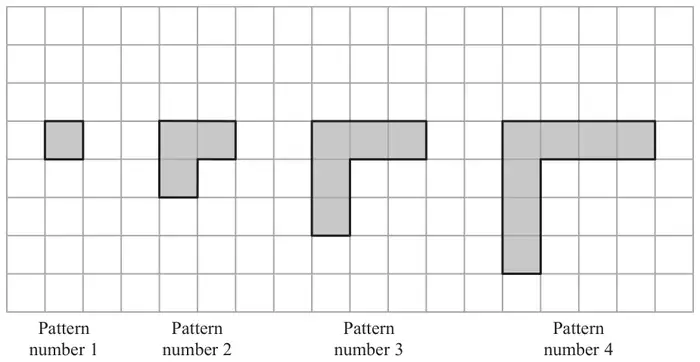

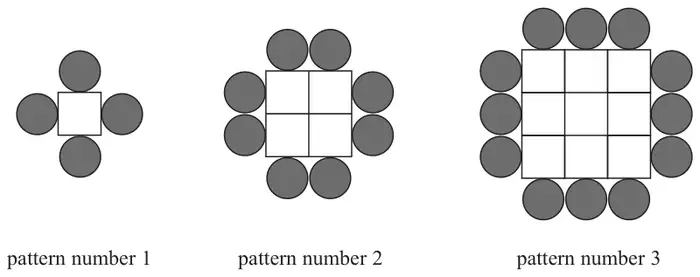
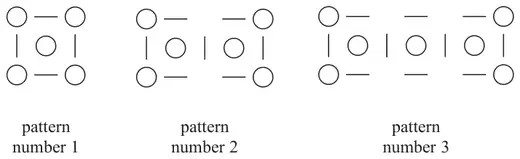
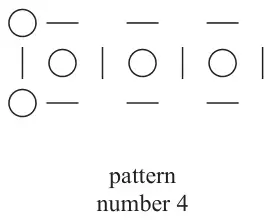
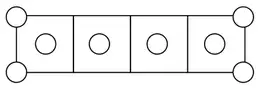
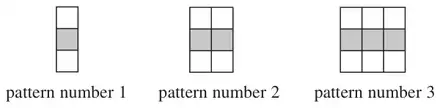

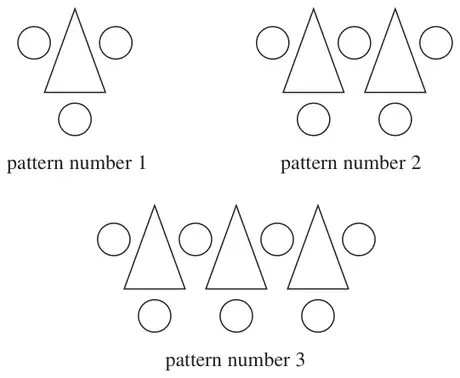
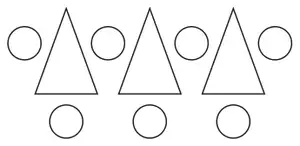

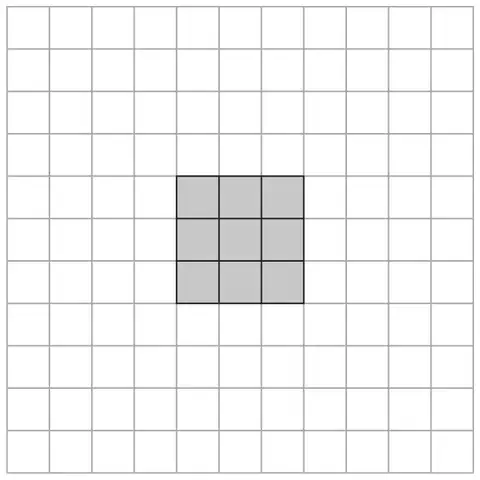

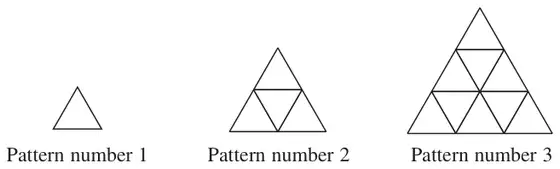
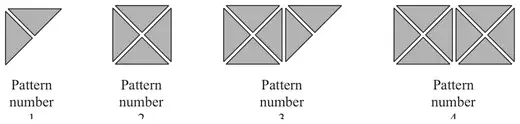

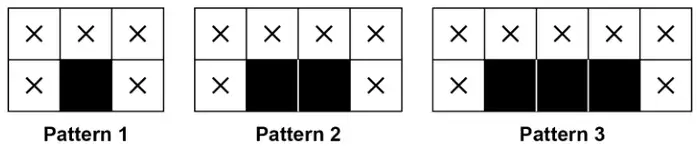
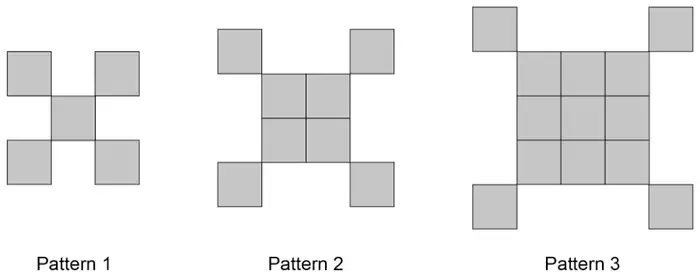
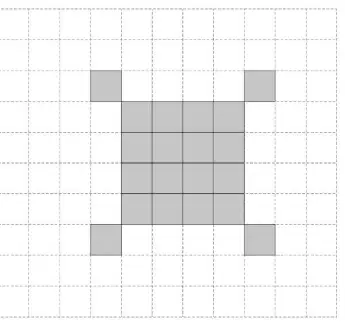
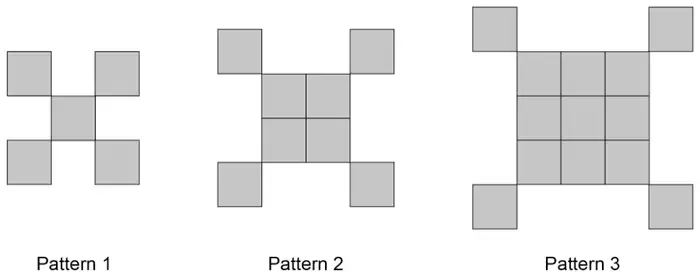
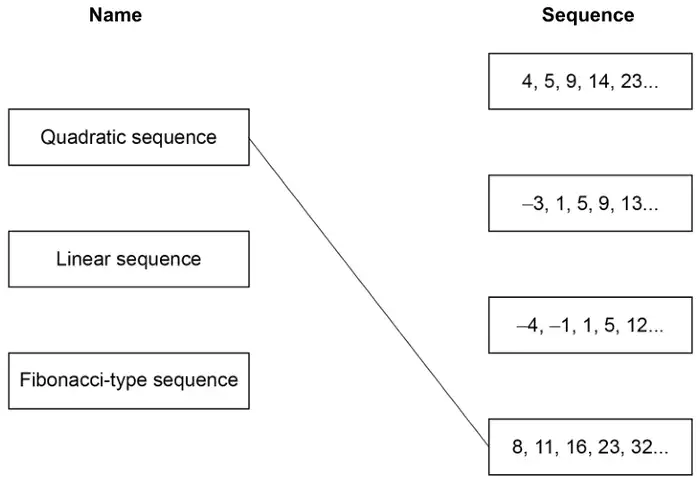
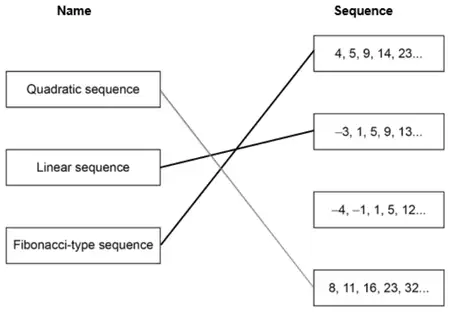
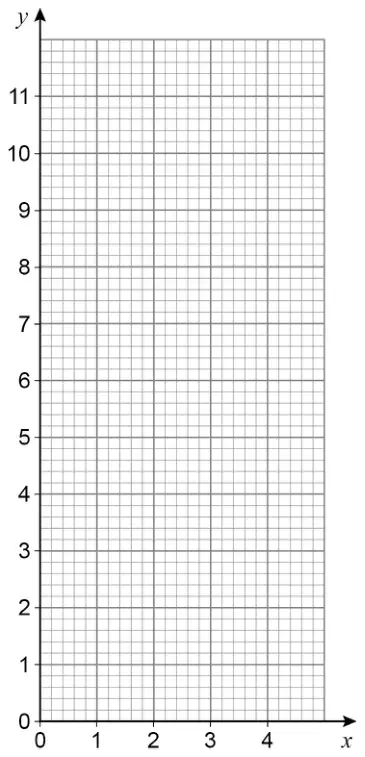
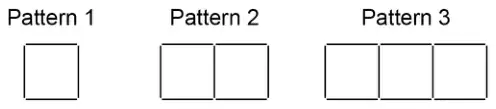
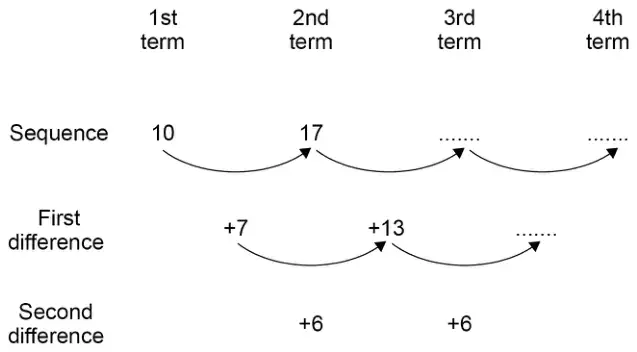
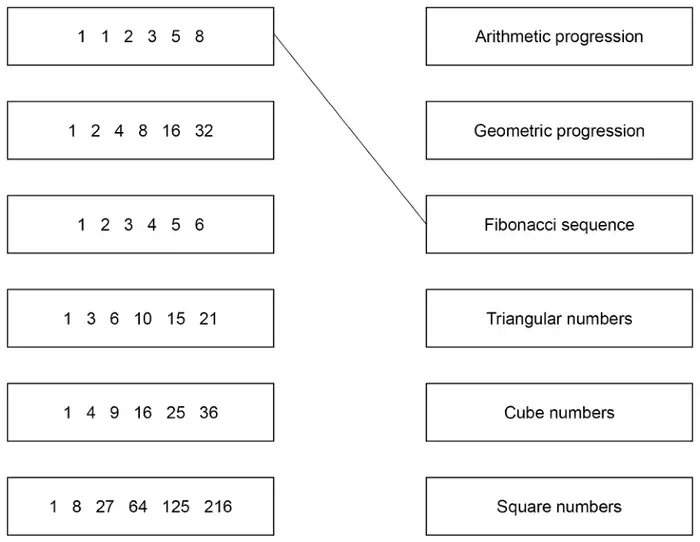
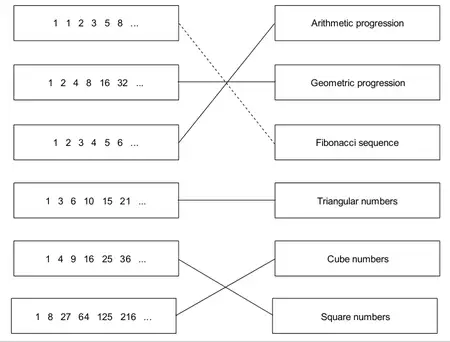
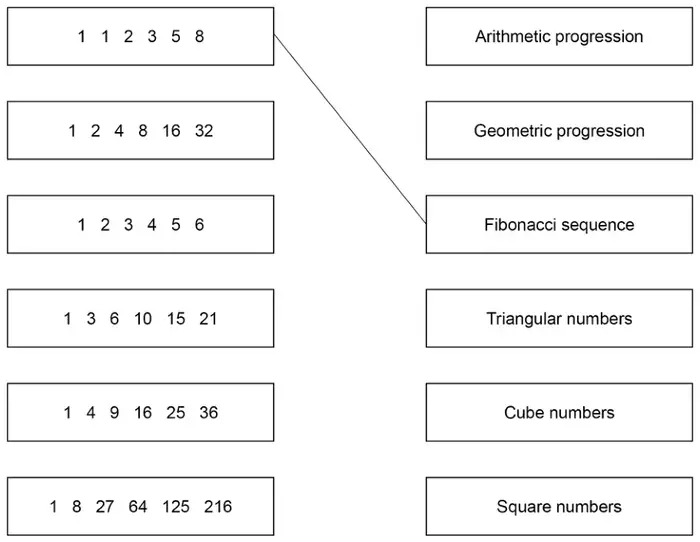
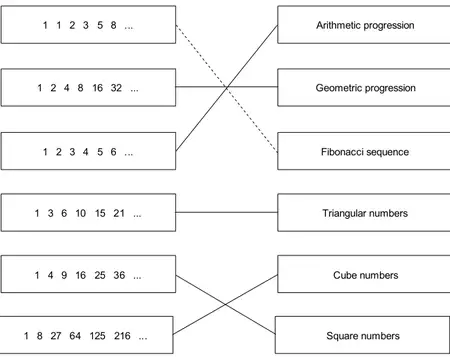
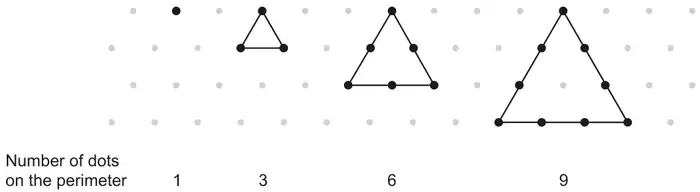
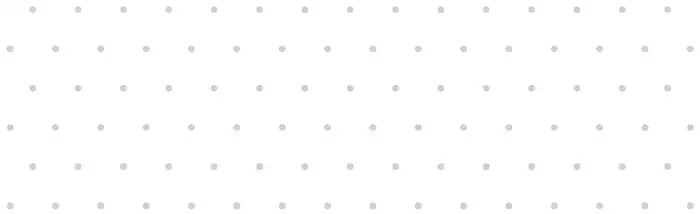
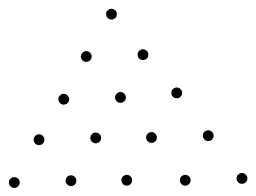
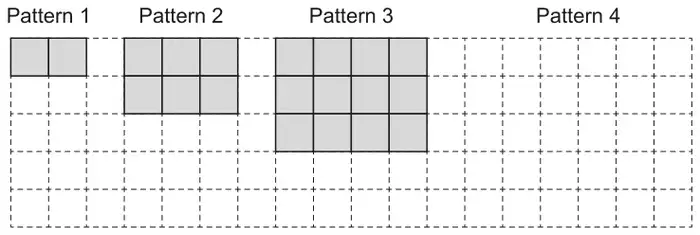
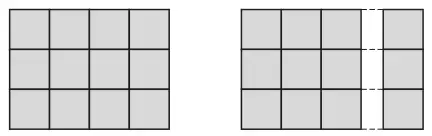
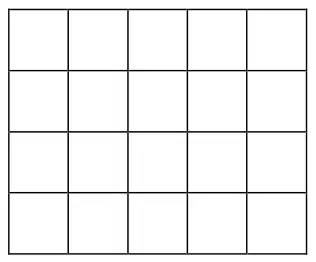
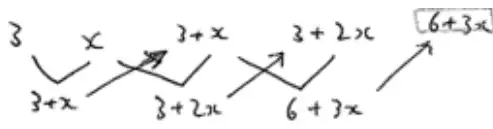
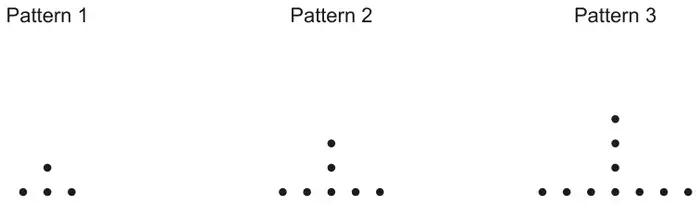
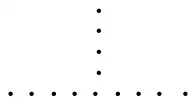
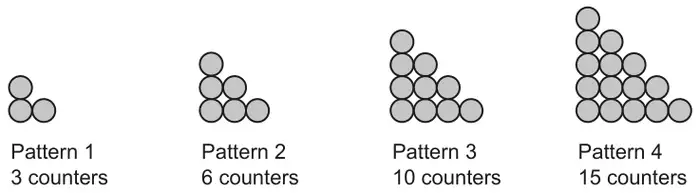
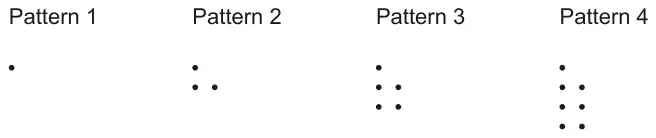
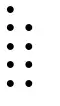
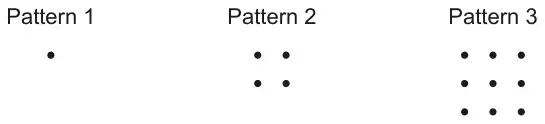
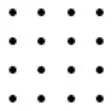
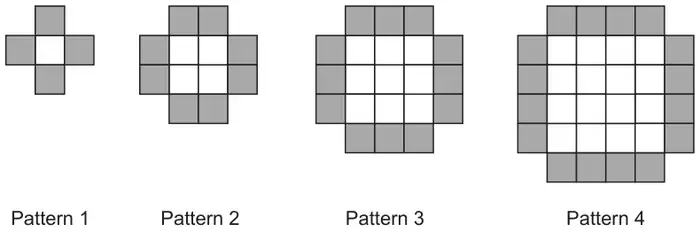
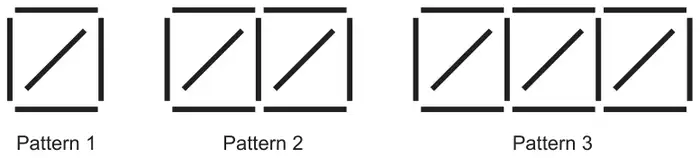
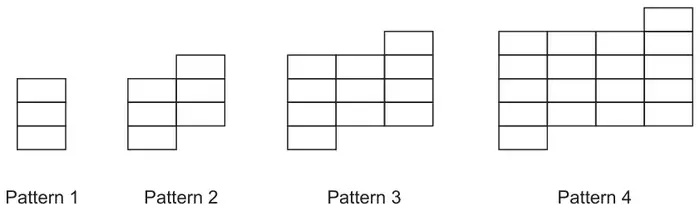
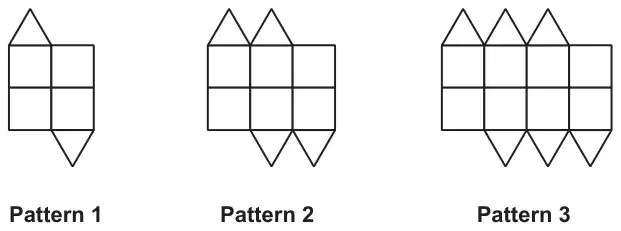
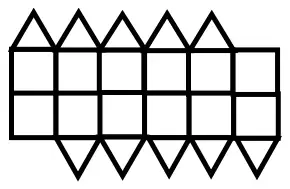
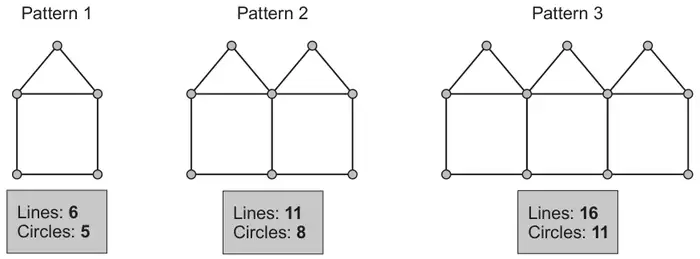
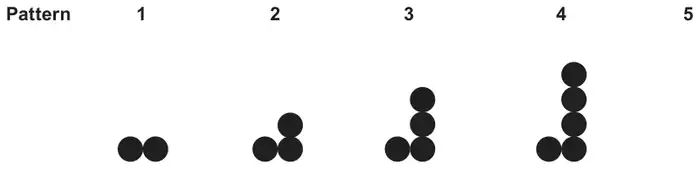
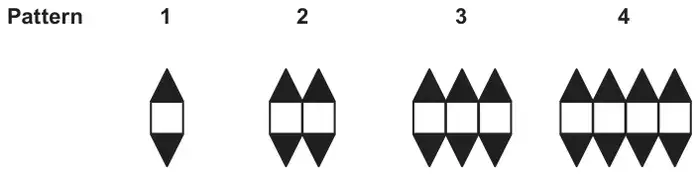

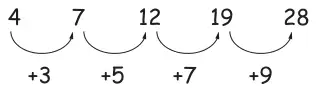
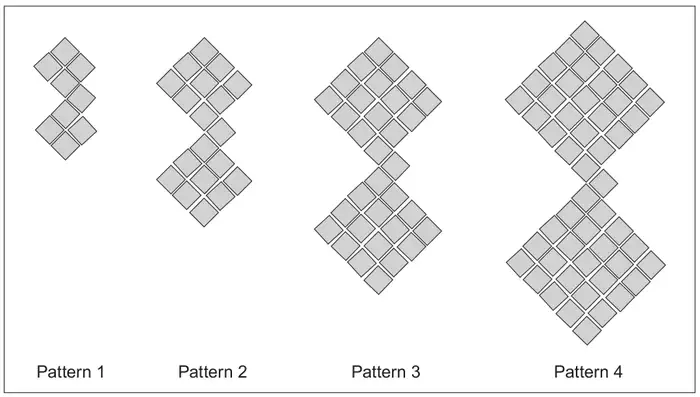

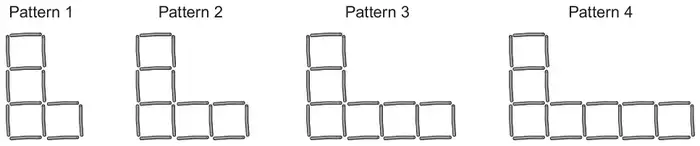
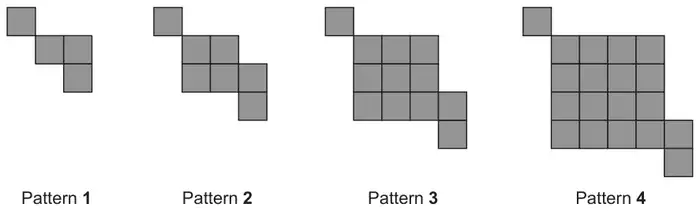
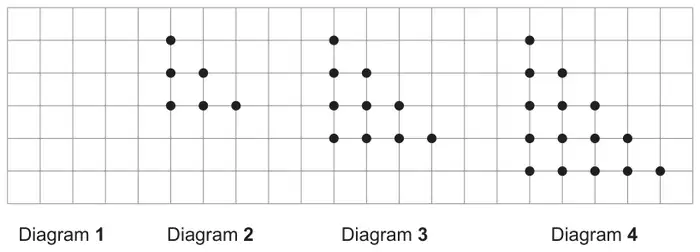
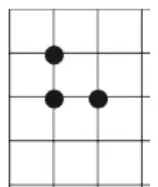
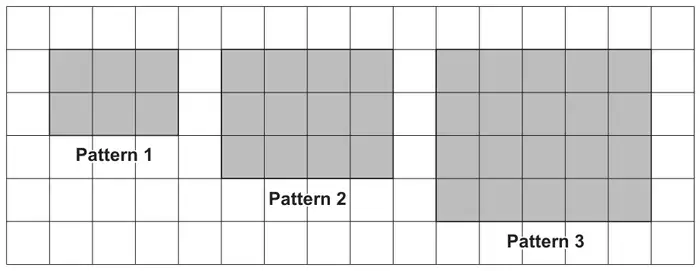
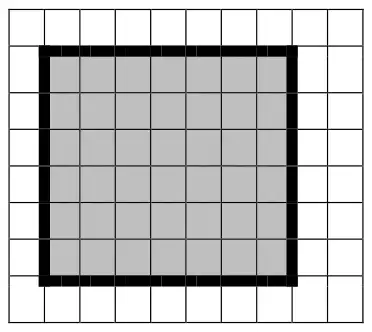
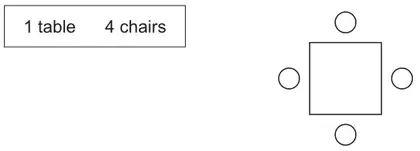
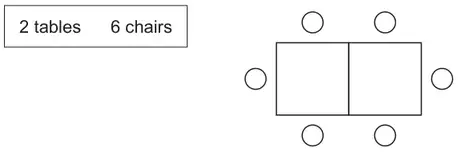
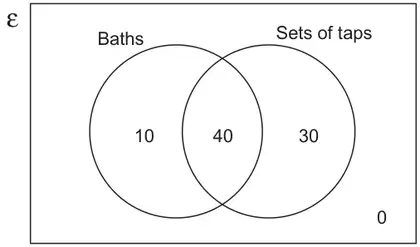

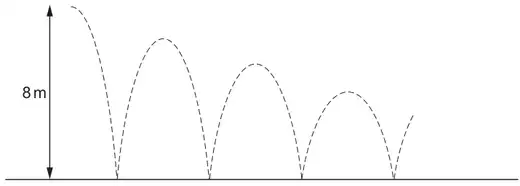
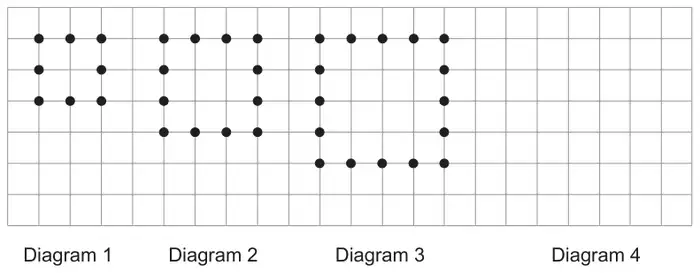
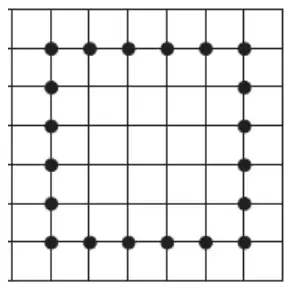
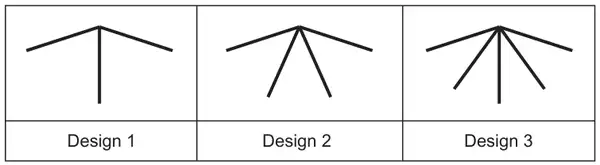
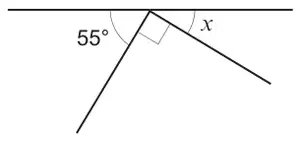
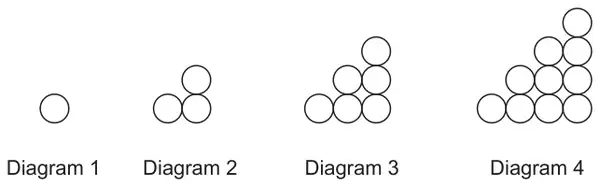
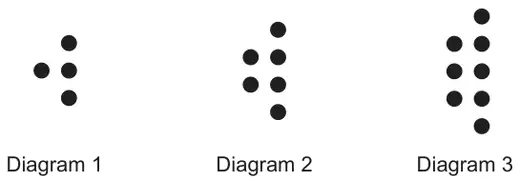
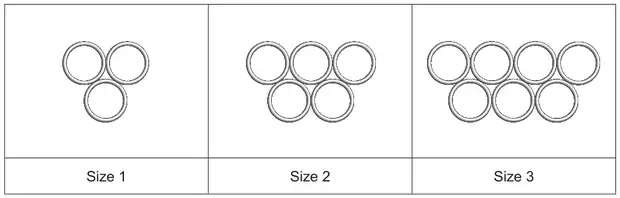
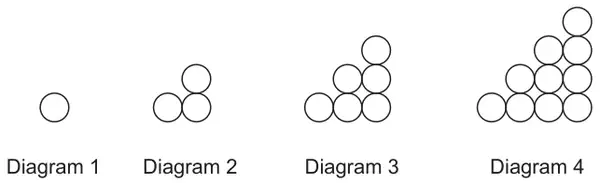

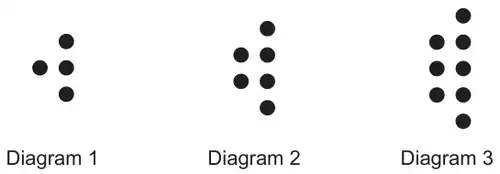
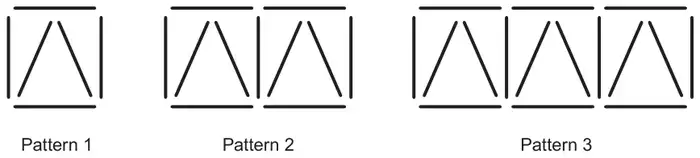
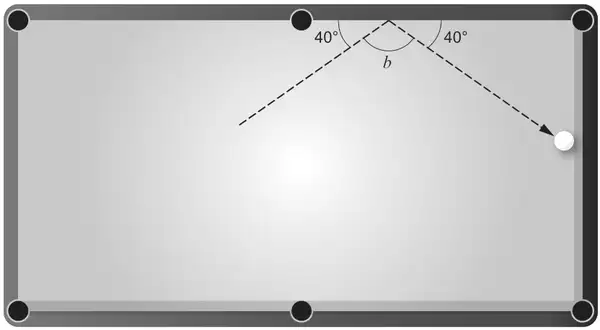
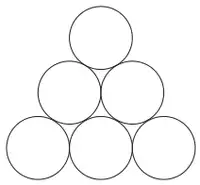
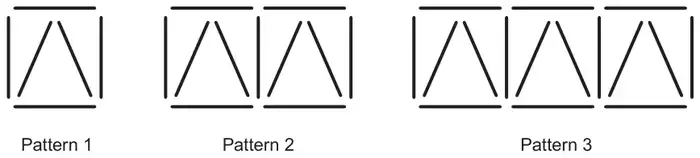
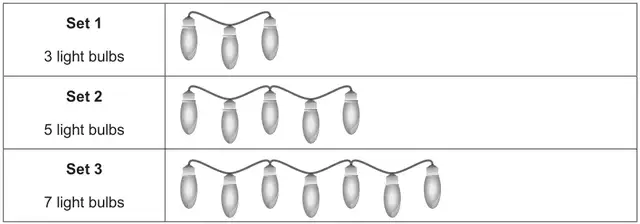
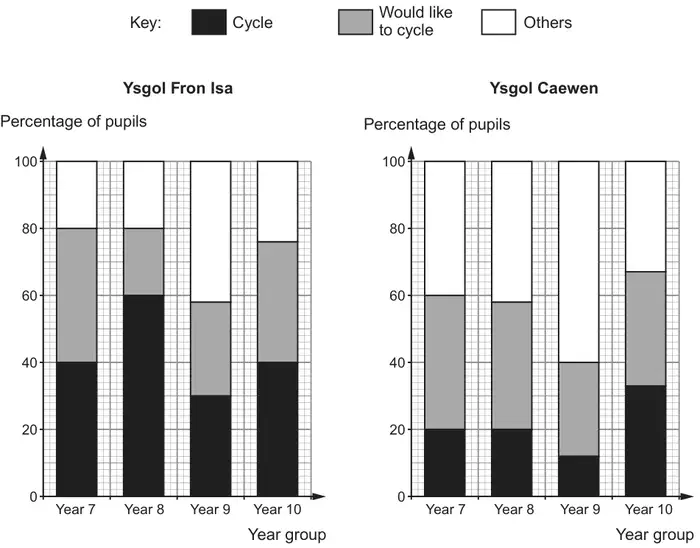
 .